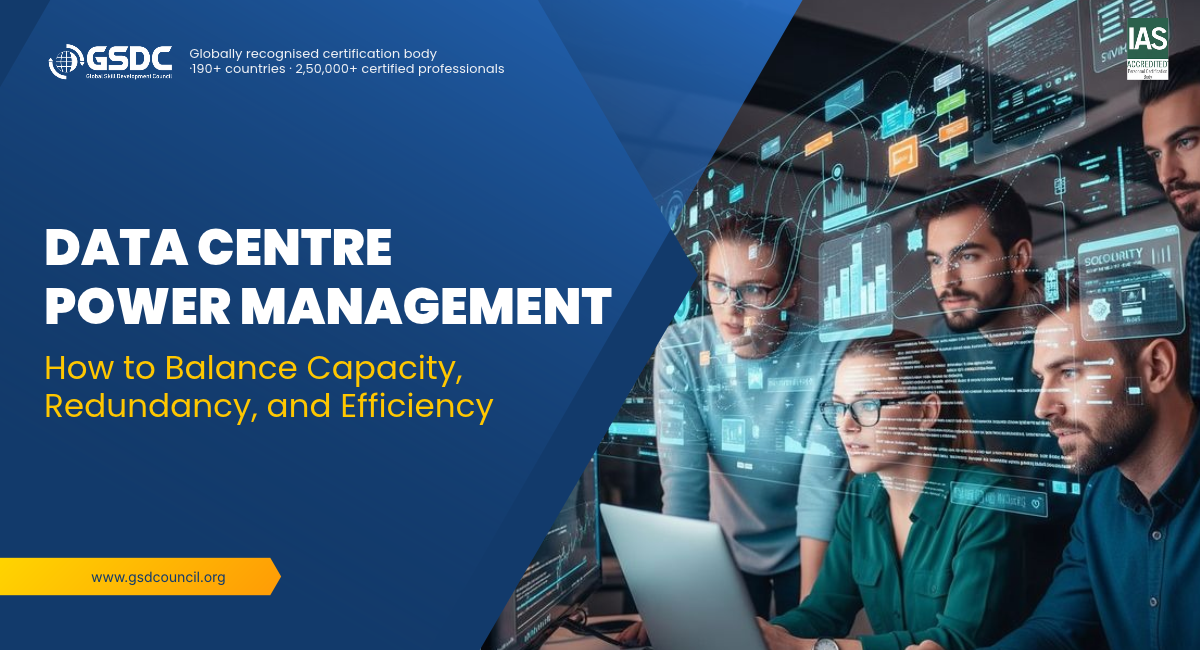
Data Centre Power Management: How to Balance Capacity, Redundancy, and Efficiency
Written by Emily Hilton
- Understanding the Three Priorities of Data Centre Power Management
- Why Balancing Capacity, Redundancy, and Efficiency Is Difficult
- How to Balance Capacity, Redundancy, and Efficiency
- Using Power Usage Effectiveness to Measure Efficiency
- How AI Workloads Affect the Balance
- Common Mistakes to Avoid When Planning Data Centre Power
- Best Practices for Long-Term Data Centre Power Management
- The Role of Data Centre Professionals in Power Management
- Build Your Data Centre Infrastructure Knowledge With GSDC
Running a data centre is not just about making sure there is enough electricity. It also means having enough power to run servers and other equipment, keeping backup systems ready for unexpected failures, and avoiding unnecessary energy consumption.
Getting the balance right can be challenging. Adding more servers increases power demand, while installing backup systems adds to infrastructure costs. At the same time, data centres need to reduce energy consumption without affecting daily operations or system reliability.
This is why capacity, redundancy, and efficiency need to be considered together when managing data centre power. A good power management plan helps data centres handle growing workloads, avoid interruptions, and use energy more effectively.
In this blog, we will look at how data centre professionals can balance these three areas through better planning, power system design, and regular monitoring.
Understanding the Three Priorities of Data Centre Power Management
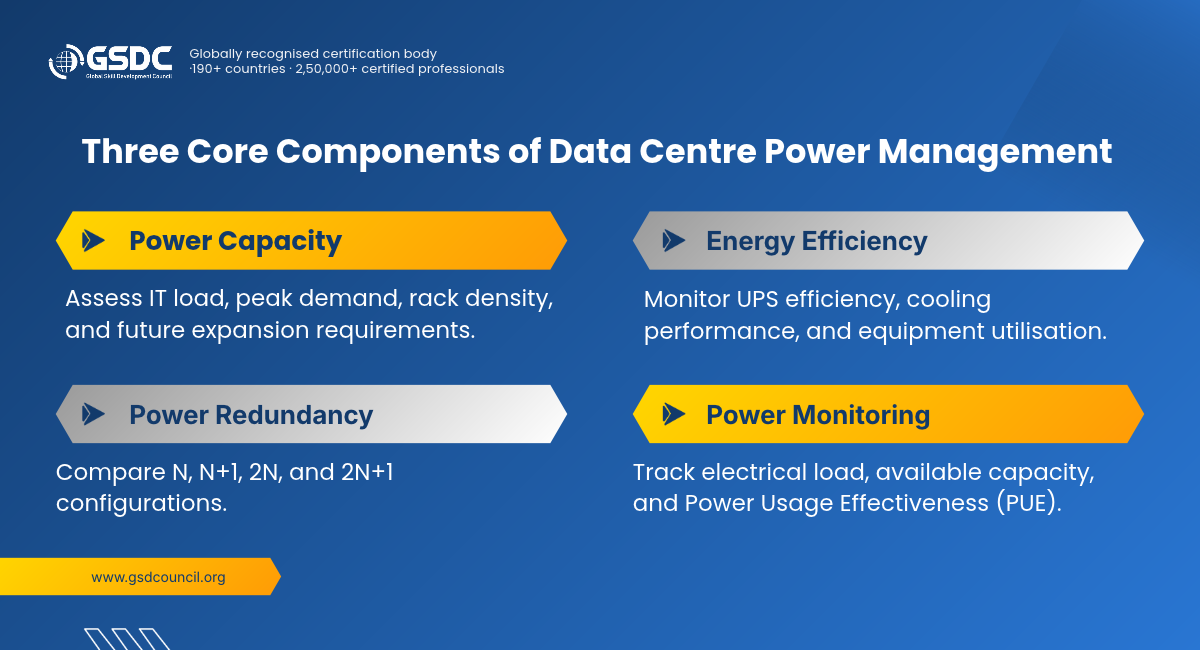
Before designing or upgrading a power infrastructure, data centre teams need to understand how capacity, redundancy, and efficiency influence one another.
1. Power Capacity: Having Enough Power for Current and Future Workloads
Power capacity refers to the amount of electrical power available to support a data centre's IT equipment and facility infrastructure. It determines how many servers, storage systems, networking devices, and other components a facility can operate safely.
Data centre power requirements change as organisations introduce new applications, expand cloud infrastructure, and adopt AI workloads. For example, high-performance AI servers may require significantly more power per rack than traditional server configurations.
Effective data centre capacity planning should consider:
- Current IT load: Measure the power consumed by servers, storage, and networking equipment.
- Peak power demand: Identify the highest expected electricity requirement during demanding workloads.
- Rack power density: Understand how much power individual racks require, particularly in high-density environments.
- Future expansion: Estimate additional capacity needed for new servers, applications, and AI infrastructure.
- Available electrical capacity: Evaluate transformers, switchgear, UPS systems, generators, and distribution equipment.
The objective is to provide sufficient capacity without installing significantly more infrastructure than the facility needs.
2. Power Redundancy: Maintaining Operations During Failures
Redundancy provides additional power components or independent supply paths that help maintain operations when equipment fails or requires maintenance. A data centre may have sufficient power capacity under normal conditions but still face downtime if a critical UPS module, generator, or distribution path becomes unavailable.
Redundant power design reduces this risk by providing backup components and alternative supply arrangements.
Common redundancy configurations include:
N Configuration
The system has only the capacity required to support the operational load. A failure in a critical component may affect the power supply if no additional protection is available.
N+1 Configuration
The system includes one additional component beyond the number required to support the load. If one component fails, the additional component can help maintain operations.
2N Configuration
Two independent power systems are provided, with each designed to support the full required load. If one power path fails, the other can support the IT equipment.
2N+1 Configuration
This combines two independent power paths with additional component redundancy to provide another layer of protection. The right configuration depends on business continuity requirements, acceptable downtime, workload criticality, and infrastructure costs.
The goal is not to add the highest possible level of redundancy. It is to select a configuration that provides the required availability without unnecessary investment and complexity.
3. Energy Efficiency: Reducing Power Consumption Without Affecting Reliability
Energy efficiency focuses on how effectively a data centre uses electricity to support its IT operations.
A facility may have sufficient capacity and strong redundancy but still consume more energy than necessary. Inefficient cooling systems, electrical losses, underutilised servers, and oversized equipment can increase operating costs.
Data centre energy efficiency can be improved through:
- Using efficient UPS systems and power distribution equipment.
- Improving cooling and airflow management.
- Identifying and consolidating underutilised servers.
- Monitoring electricity consumption across the facility.
- Optimising equipment utilisation and operating conditions.
- Reviewing Power Usage Effectiveness (PUE).
The challenge is to reduce unnecessary energy consumption while maintaining the power availability and performance required by critical workloads.
Why Balancing Capacity, Redundancy, and Efficiency Is Difficult
These three priorities cannot be planned independently. A decision that improves one area may create additional requirements in another.
For example, increasing server capacity may require additional electrical infrastructure and cooling. Adding redundant UPS modules may improve availability but increase capital costs and create more equipment to maintain.
Some common planning challenges include:
Planning decision | Potential challenge |
| Increasing power capacity | Higher infrastructure and operating costs |
| Adding redundant components | More equipment, maintenance, and capital investment |
| Operating equipment at low loads | Reduced efficiency in some power systems |
| Increasing rack density | Greater power distribution and cooling requirements |
| Reducing energy consumption | Must not compromise availability or equipment performance |
| Planning for AI workloads | Higher power demand and changing capacity requirements |
Data centre teams must evaluate these decisions together rather than focusing on a single performance measure.
How to Balance Capacity, Redundancy, and Efficiency
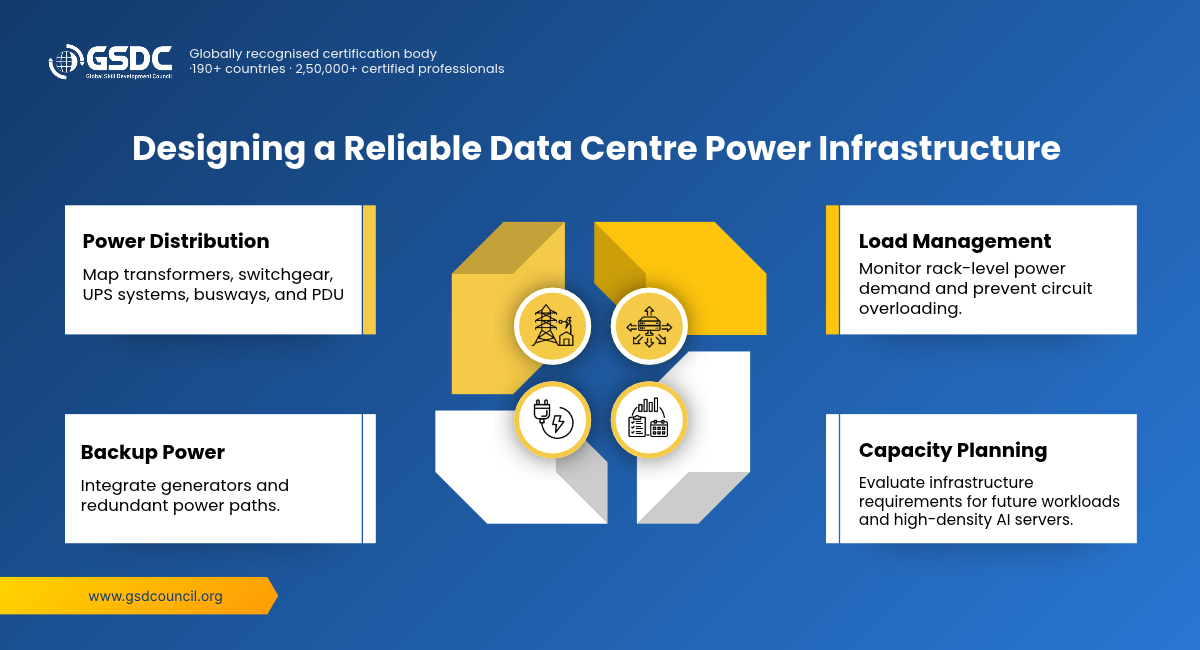
A practical data centre power management strategy starts with understanding workload requirements and then designing infrastructure around availability, expansion, and energy performance.
Step 1: Assess Current and Future Power Requirements
Start by measuring the facility's existing power consumption and identifying how much additional capacity may be needed. Review server loads, rack density, peak demand, and planned technology upgrades. Include AI and high-performance computing requirements where relevant.
For example, a facility planning to introduce AI servers should evaluate whether its existing transformers, UPS systems, power distribution units, and cooling infrastructure can support the additional demand.
This assessment helps prevent capacity shortages and unnecessary infrastructure expansion.
Step 2: Select Redundancy Based on Business Requirements
Not every workload requires the same level of power protection. A data centre supporting critical financial transactions may have different availability requirements from a facility running less time-sensitive internal applications.
Evaluate:
- The business impact of power interruptions.
- Required service availability.
- Acceptable recovery time.
- Maintenance requirements.
- Cost of implementing additional backup capacity.
Based on these factors, select an appropriate redundancy configuration such as N+1 or 2N. This helps ensure that investment in redundancy matches actual operational requirements.
Step 3: Design Power Distribution for the Required Load
Power distribution must safely deliver electricity from the incoming supply to individual server racks. Data centre power distribution includes transformers, switchgear, UPS systems, busways, PDUs, and electrical circuits.
A well-planned design should:
- Support current and expected IT loads.
- Avoid overloading individual circuits.
- Provide appropriate backup power paths.
- Support maintenance without unnecessary service disruption.
- Allow future expansion where required.
The design should also consider how additional equipment will affect the entire power chain, rather than only the available power at the incoming supply.
Step 4: Improve Efficiency Across the Power Infrastructure
Once capacity and redundancy requirements are established, evaluate where energy can be saved. Review the efficiency of UPS systems, transformers, cooling equipment, and power distribution components. Check whether installed equipment is operating at suitable load levels.
Also identify underutilised servers and unnecessary infrastructure that may be consuming electricity without delivering sufficient computing value. These improvements can reduce energy consumption without weakening the facility's power protection strategy.
Step 5: Monitor Capacity, Availability, and Energy Usage
Power management is an ongoing activity. Workloads change, equipment ages, and infrastructure requirements increase over time.
Monitoring systems help data centre teams track:
- Total facility power consumption.
- IT equipment power demand.
- Available electrical capacity.
- UPS and generator performance.
- Power distribution conditions.
- Energy efficiency indicators such as PUE.
Regular reviews help identify capacity constraints, equipment issues, and opportunities to improve energy performance before they affect operations
Using Power Usage Effectiveness to Measure Efficiency
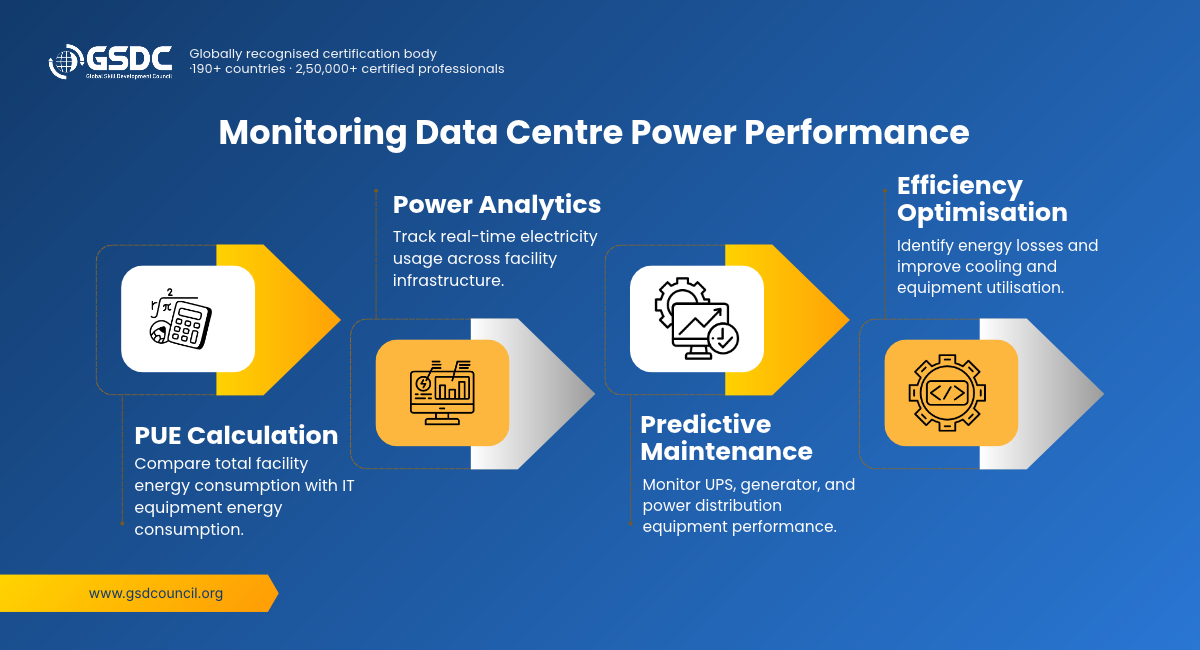
Power Usage Effectiveness (PUE) is one of the most widely used metrics for evaluating data centre energy efficiency. It compares the total energy consumed by a data centre with the energy used by its IT equipment.
PUE = Total Data Centre Energy / IT Equipment Energy
For example, consider a data centre that consumes 1,500 kW of total power, while its IT equipment uses 1,000 kW.
Its PUE would be:
1,500 / 1,000 = 1.5
A PUE closer to 1.0 generally indicates that less additional energy is being used by supporting infrastructure such as cooling and power systems.
However, PUE should not be used as the only measure of data centre efficiency. It does not directly measure the useful computing work delivered or the availability of the facility.
Data centre teams should evaluate PUE alongside capacity utilisation, power reliability, and operational performance.
How AI Workloads Affect the Balance
AI is creating new challenges for data centre power management. AI training and inference workloads often require high-performance processors and accelerators that consume significant electricity.
This affects all three priorities.
Capacity: AI infrastructure may require higher power availability per rack and additional electrical distribution capacity.
Redundancy: Critical AI workloads may require reliable backup power arrangements to prevent interruptions and protect ongoing operations.
Efficiency: Higher power consumption makes efficient cooling, equipment selection, and workload management increasingly important.
AI can also support power management through demand forecasting, predictive maintenance, and cooling optimisation. However, the additional computing resources required by AI applications must also be included in capacity planning.
Common Mistakes to Avoid When Planning Data Centre Power
Even with a well-defined strategy, certain planning mistakes can create operational and financial challenges.
- Planning only for current demand: Ignoring future workloads can lead to power shortages during expansion.
- Adding excessive redundancy: Installing more backup capacity than required can increase costs and infrastructure complexity.
- Ignoring equipment load levels: Power equipment may operate inefficiently when consistently underutilised.
- Focusing only on PUE: A good PUE does not automatically mean that the facility has sufficient capacity or reliable backup systems.
- Overlooking cooling requirements: Higher power density also increases the need for effective thermal management.
- Neglecting regular reviews: Changes in IT workloads can make earlier capacity and efficiency assumptions inaccurate.
Avoiding these mistakes helps maintain a practical balance between infrastructure investment, operational reliability, and energy consumption.
Best Practices for Long-Term Data Centre Power Management
A long-term strategy should treat capacity, redundancy, and efficiency as connected parts of infrastructure planning.
Data centre teams can follow these practices:
- Review capacity regularly: Measure current power demand and forecast future requirements.
- Match redundancy to business risk: Select backup configurations based on workload criticality and availability needs.
- Evaluate the complete power chain: Check incoming supply, UPS systems, generators, switchgear, and rack-level distribution.
- Track equipment utilisation: Identify underused infrastructure and opportunities for optimisation.
- Improve cooling performance: Manage airflow and thermal conditions to support higher-density workloads efficiently.
- Monitor energy performance: Track PUE and other operational indicators over time.
- Plan for AI infrastructure: Include higher rack power density and cooling requirements in future capacity assessments.
- Review the design after upgrades: Reassess capacity, redundancy, and efficiency whenever major infrastructure changes are introduced.
The Role of Data Centre Professionals in Power Management
Balancing capacity, redundancy, and efficiency requires professionals who understand electrical infrastructure, power distribution, backup systems, cooling, and facility operations.
Data centre professionals must evaluate power requirements, plan infrastructure upgrades, select appropriate redundancy configurations, and monitor energy performance. They also need to understand how changes in technology and workload demand affect the overall facility.
The Certified Data Centre Professional certification by GSDC is designed for individuals who want to develop their knowledge of data centre infrastructure and operations. It can help professionals strengthen their understanding of infrastructure components, operational requirements, and data centre management practices.
Build Your Data Centre Infrastructure Knowledge With GSDC
As data centre power requirements continue to increase, organisations need professionals who can make informed infrastructure decisions while balancing availability, capacity, and energy efficiency.
The GSDC Certified Data Centre Professional certification is relevant to data centre operators, IT infrastructure professionals, facility teams, and individuals looking to develop their knowledge of data centre operations.
Explore the Data Centre Professional certification and build your understanding of data centre infrastructure, power management, redundancy, and operational best practices.

Related Certifications
Stay up-to-date with the latest news, trends, and resources in GSDC
If you like this read then make sure to check out our previous blogs: Cracking Onboarding Challenges: Fresher Success Unveiled
Not sure which certification to pursue? Our advisors will help you decide!