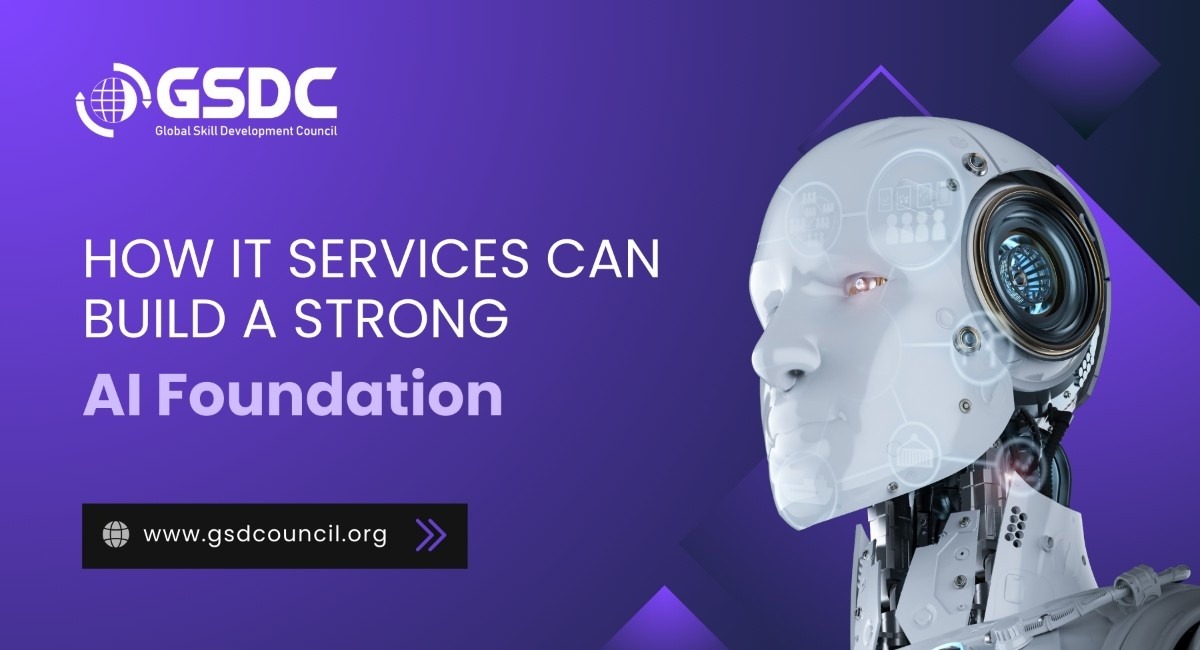
How IT Services Can Build a Strong AI Foundation
Written by Matthew Hale
Artificial intelligence is transforming the IT service industry in a very practical and significant manner. It is no longer about future possibilities but is centered on how things get done in the present day and age. Customers are no longer seeking IT support on a mere technical level but on faster solutions, smarter automation, or business value.
This paradigm change is also affecting the role that IT service providers play or will play in the future. Not only are they expected to carry out tasks, but also be innovative partners that can point out where they can apply AI, improve, or solve business problems.
AI makes this transformation possible by helping teams work more efficiently, handle complex workloads, and deliver consistent results at scale. For IT service companies, building an AI strategy is no longer optional-it is essential for staying relevant and competitive.
Why AI Matters Today
Client expectations are changing fast. Businesses no longer want IT partners who only follow instructions. They now expect IT service providers to:
- Lead AI adoption
- Suggest smart AI-driven solutions
- Improve speed and efficiency
- Deliver measurable business value
AI is shifting IT services from routine support to strategic transformation. Projects that use AI are also commanding higher pricing because they produce better results in less time.
Right now, organizations have a valuable opportunity to stand out. But this window is limited. Soon, AI will become a basic expectation for every IT provider. Companies that act early will gain a strong competitive advantage.
Where AI Helps Most in IT Services
Generally speaking, AI has its most value in tasks that are highly repetitive in nature.
-
AI adds the most value in high-volume work.
If this task is repeated hundreds and thousands of times, AI can perform it quicker and more accurately than human beings.
-
AI improves IT support operations.
It can sort and manage support tickets, helping teams respond more quickly and efficiently.
-
AI supports automated software testing.
Testing processes become faster and more reliable with AI-powered automation.
-
AI helps create technical documents.
AI can generate reports, guides, and documentation in a fraction of the usual time.
-
AI simplifies invoice and form processing.
It is capable of reading, extracting, and structuring data from documents.
-
AI predicts system problems early.
Data analysis from previous incidents can enable AI systems to alert teams before any failure occurs.
-
AI detects unusual activity.
It helps identify security risks and system issues before they cause damage.
These are practical, real-world areas where AI is already helping IT service organizations today.
What AI Can and Cannot Do
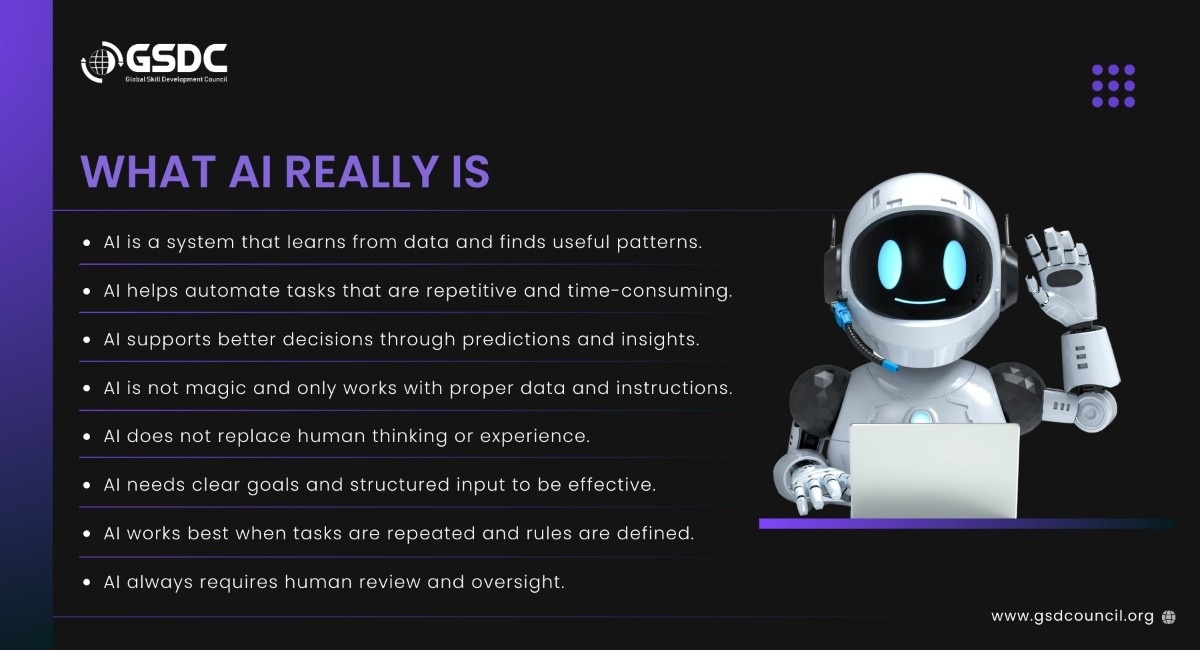
AI is a powerful tool, but it has clear strengths and limits. Understanding both is important before using AI in real projects.
AI works well for
- Document processing capabilities: An AI system can easily read, classify, and retrieve data from several documents. This will save time.
- Code generation: AI assists programmers in coding with greater speed and efficiency, corrects code errors, and creates standard code structures.
- Predictive Maintenance: Using the data available, the AI is able to forecast problems and malfunctions to prevent them from actually occurring.
- Automated testing: The use of AI in software testing allows it to be done automatically by machines
AI needs caution for:
- Complex business decisions: This is where AI can assist by providing information. However, such decisions are better left to human intelligence.
- Deep strategic thinking: AI can process information but not understand company objectives, market dynamics, or company strategies as humans can.
AI is not ready for:
- Replacing senior experts: Though AI can help experts, it is not able to replace the experience, creativity, and use of discretion acquired by experts over the years.
- Making big technical decisions on its own: Important architecture and technology choices require human leadership and responsibility.
An understanding of these boundaries is useful for applying AI correctly-applying it where it offers the most value and not disappointing expectations.
Three Types of AI You Should Know
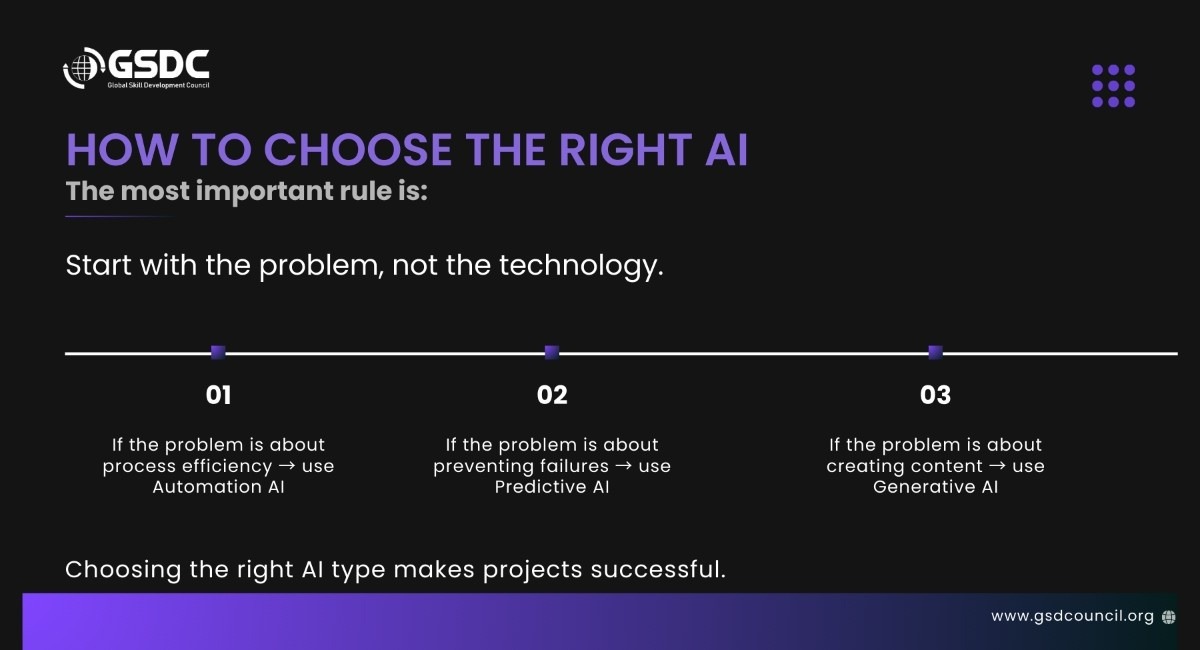
AI is not just one technology. In IT services, it is mainly used in three different ways.
- Automation AI handles repetitive tasks.
This type of AI is used to automate rule-based work such as ticket routing, data entry, and routine processes.
Examples: automatically assigning IT support tickets, processing invoices, or updating system records.
-
Predictive AI helps prevent problems.
It uses historical data to forecast failures, performance problems, or future trends before they happen.
Examples: predicting server downtime, identifying security risks, or forecasting system performance issues.
-
Generative AI creates new content.
This Generative AI can write code, produce a report, document, reply, or summarize.
Examples: generating technical documentation, writing emails, creating test scripts, or assisting developers with coding.
Each type of AI corresponds to a unique type of business challenge. This classification helps organizations determine when they should utilize a certain type of AI.
How Successful IT Companies Use AI
The major IT players are not only talking about AI; rather, they are applying it smartly.
-
They use AI inside their own teams.
AI tools are used for coding, documentation, testing, and project management to improve speed and productivity.
-
They create ready-to-use AI solutions.
Rather than creating new systems for each client, they build reusable AI models and frameworks that can serve multiple projects.
-
They focus on business results.
They do not just bill for mere hours worked but actually price their services for value and outcomes AI produces in service to clients.
The three approaches come in handy in helping IT companies to deliver improved services, clinch more clients, and edge out the competition.
Common Misunderstandings About AI
Many companies are reluctant to implement AI due to some common myths and misconceptions surrounding it. Awareness of the truth behind these myths makes it easier to implement AI.
|
Misunderstanding |
Reality |
|
AI will replace human teams |
AI does not eliminate jobs. It helps teams work faster, reduce repetitive work, and focus on more important tasks. |
|
AI projects take years to complete |
AI can start small with quick pilot projects that deliver visible results in 60–90 days. |
|
AI needs perfect data |
AI does not require flawless data. It can begin with existing data and improve gradually as more information becomes available. |
|
AI is only for large companies |
AI tools and platforms are now affordable and accessible for small and medium businesses as well. |
|
AI works automatically once installed |
AI systems need proper setup, regular monitoring, and human oversight to remain accurate and useful. |
|
AI can solve every problem |
AI works best for specific, well-defined tasks and is not a universal solution for all business challenges. |
|
AI results are always correct |
AI can make mistakes, so human review and validation are always important. |
Knowledge about these realities will enable a realistic approach to the adoption of AI by organizations.
How You Can Start with AI
- Identify tasks that are repeated frequently in your daily operations.
- Focus on areas that consume the most time and manual effort.
- Choose one clear and simple use case to begin with.
- Select the right AI type based on the problem you want to solve.
- Start with a small, low-risk pilot project.
- Rely on data that already exists rather than waiting for data to be perfect.
- Human review of AI-generated content should be done every time.
- Results on the measurements of time saved and accuracy increased.
- Continuously upgrade the AI solution with feedback.
- Expand AI step by step to other business processes.
Small, practical actions like these help organizations build a strong AI foundation and achieve real, measurable success.
Empowering IT Professionals for the AI Era
Artificial Intelligence skills are emerging as the basics required in the modern Information Technology service professional. GSDC assists in adopting Artificial Intelligence in anIRisk-free manner through internationally recognized certifications.
The Certified Generative AI in ITSM credential is designed for IT professionals who want to apply AI technology in real-world service management scenarios. This certification empowers IT experts to leverage AI for automating IT functions, accelerating ticket resolution, improving documentation, and delivering smarter, more efficient IT services.
Through GSDC certifications, organizations are able to develop AI-ready teams and keep pace with the changing world of AI-driven IT services.

Conclusion
The adoption of AI in IT services is no longer optional. It is gradually getting incorporated into the operations of businesses and the way IT services are offered. Customers will soon realize the use of AI solutions, either through the present providers or through others.
The question all IT service suppliers have to ask is: Will your clients choose to work with AI, or will they go to someone ready for this all along?
Those organizations that start working on AI capabilities will remain relevant, competitive, and successful. The AI era is already present, and it is already the right time to take action.

Related Certifications
Stay up-to-date with the latest news, trends, and resources in GSDC
If you like this read then make sure to check out our previous blogs: Cracking Onboarding Challenges: Fresher Success Unveiled
Not sure which certification to pursue? Our advisors will help you decide!