Essential Skills for Becoming an Effective Workplace Trainer

Written by Emily Hilton
- What is “Train the Trainer”?
- Core Skills to Become an Effective Trainer
- Qualities of a Good Trainer at Work
- How to Train the Trainer: Implementing Effective Programs
- Benefits of Train the Trainer
- GSDC Train the Trainer Certification
- Putting It All Together: Developing Your Trainer Practice
- Moving Forward
Think about the best trainer you’ve ever had at work, someone who didn’t just teach, but made learning feel easy, engaging, and meaningful. Organizations, especially in today’s rapidly changing work environment, do not require just expert coordinators regarding a subject but also need good facilitators who have the power to create and implement learning that has a lasting effect creatively.
If you’re stepping into a training role or aiming to level up your facilitation game, you’ve probably wondered, “What is train the trainer, and how can it help me become more effective?” The answer lies in mastering the right train the trainer skills, a blend of communication, design thinking, empathy, and adaptability that turns good trainers into great ones.
In this blog, you will get the essential skills needed to teach a train the trainer course, explore the qualities of a good trainer at work, understand how to train the trainer effectively, and see how earning a train the trainer certification can amplify your credibility, confidence, and the overall train the trainer benefits for both you and your organisation.
What is “Train the Trainer”?
Before diving into skills, we need clarity on the term. The phrase “train the trainer” refers to a model or programme where individuals are equipped to become trainers themselves rather than simply being trainees of a content module. In other words, rather than “teach learners”, you are being prepared to teach the trainer. The model emphasizes how to design, deliver and manage training so that knowledge cascades effectively.
The question of what is train the trainer, therefore, encompasses:
- The shift from subject-expert to facilitator-trainer
- Understanding learning, group dynamics, and training design
- Being able to duplicate learning by having others train after you
When you ask how to train the trainer, you are really asking: how do we build those capabilities so someone can go on to train others? And one of the most valuable ways is through gaining formal credentials a train the trainer certification.
Core Skills to Become an Effective Trainer
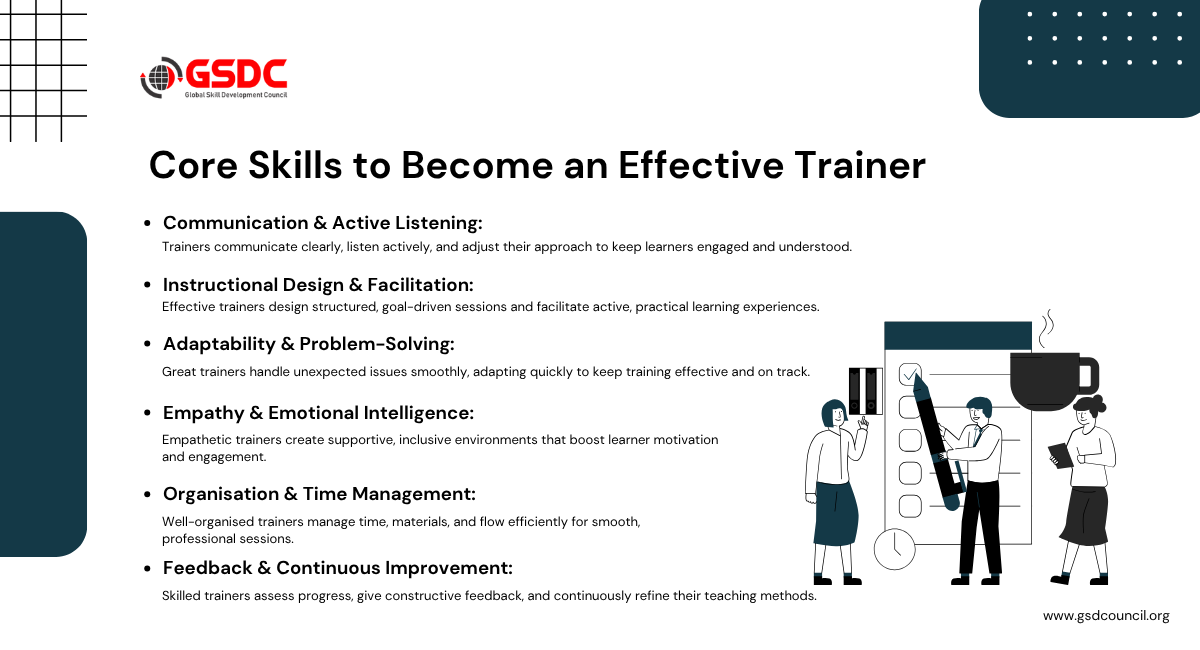
What makes someone able to excel when delivering training? These are the indispensable train the trainer skills that support high-impact training.
- Communication & Active Listening: Strong communication is the foundation of effective training. Trainers must explain ideas clearly, notice how learners respond, and adjust their approach accordingly. Active listening ensures participants feel heard and engaged, making learning more meaningful.
- Instructional Design & Facilitation: Knowing your subject isn’t enough you need to know how to teach it. Trainers assess learner needs, set clear goals, and design sessions that balance theory with practice. Facilitation involves managing discussions, answering questions, and keeping learners actively involved throughout.
- Adaptability & Problem-Solving: Training rarely goes exactly as planned. Technical issues, distracted learners, or last-minute changes can occur. Effective trainers adapt quickly, solve problems on the spot, and keep sessions on track, ensuring the learning experience remains smooth and relevant.
- Empathy & Emotional Intelligence: The qualities of a good trainer at work include understanding and caring about learners. Empathy helps create a safe, inclusive environment where participants feel valued and motivated, which increases engagement and knowledge retention.
- Organisation & Time Management: Well-structured sessions run smoothly. Trainers must prepare materials, manage schedules, and stay on track during sessions. A good organisation keeps learners focused and demonstrates professionalism.
- Feedback & Continuous Improvement: Training is a cycle, not a one-time event. Trainers evaluate learner progress, provide constructive feedback, and refine their own approach. Continuous improvement ensures sessions remain effective and impactful.
- Digital & Technological Skills: Modern training often blends in-person and online learning. Trainers need to be comfortable with virtual platforms, interactive tools, and hybrid teaching methods to engage learners effectively across formats.
Mastering these train the trainer skills equips anyone to deliver sessions that truly make a difference, enabling knowledge transfer, engagement, and better outcomes for learners.
Qualities of a Good Trainer at Work
While the skills above are what you do, the qualities describe who you are. Some of the essential qualities of a good trainer at work include:
- Credibility and subject matter competence are the characteristics of a trainer who commands respect among students if the instructor is very knowledgeable in the subject matter.
- Confidence and presence denote the capability to take over a session and control the audience or the virtual space.
- Enthusiasm and energy are necessary since passion spreads easily.
- Openness to feedback is a quality of good trainers who are always looking for ways to improve by getting the input of the students, doing some self-reflection, and then making the necessary adjustments.
- Self-awareness and adaptability imply that you have an understanding of your strong and weak points, and you adjust your behavior accordingly.
- Commitment to learner success signifies that the trainer who is genuinely committed to the success of the students knows that only those who care about the outcome of their students will not just do the work for the sake of it.
These qualities complement the skills needed to teach a train the trainer course and help ensure you deliver lasting impact in workplace training.
How to Train the Trainer: Implementing Effective Programs
If you’re tasked with designing a train the trainer programme, or want to upskill internal trainers, here are key steps:
- Select the right participants: Choose individuals with subject knowledge, credibility and willingness to teach. As the train-the-trainer model highlights, candidates should be self-reflective and open to feedback.
- Define clear learning outcomes: What will your trainers be able to do afterwards?
- Design engaging content: Mix theory with practice.
- Deliver practice and feedback loops: Give participants opportunities to teach mini-sessions, observe peers and receive feedback.
- Measure and evaluate: Track training delivery outcomes, learner satisfaction, performance improvement.
- Sustain and scale: After initial training, support ongoing learning and development, mentoring, and allow trainers to cascade their skills. The train-the-trainer model emphasises sustainability rather than one-off workshops.
By understanding how to train the trainer, organisations build internal capability, reduce reliance on external trainers, and promote consistent learning experiences.
Benefits of Train the Trainer
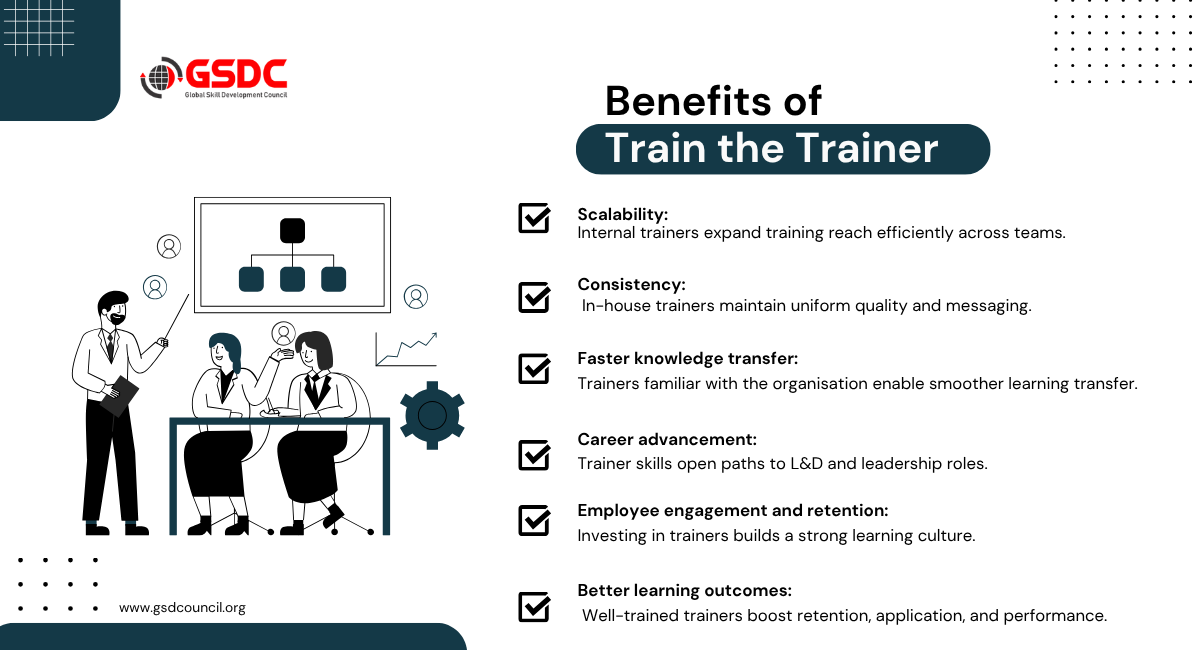
Structured training initiatives yield tangible gains, and the extent of corporate learning is massive. The Global Corporate Training Market was worth USD 383.1 billion in 2023 and is projected to reach USD 728.95 billion by 2032, with a CAGR of 7.76% from 2025 to 2032.
Companies can acquire full advantage of this expanding financial commitment in learning and development by providing Employee with skilled trainer and certified trainers expertise.
- Scalability: You develop internal trainers who can cascade training across departments, making the programme more sustainable and cost-effective.
- Consistency: Having internal trainers ensures consistent quality, messaging, and learning outcomes.
- Faster knowledge transfer: Internal trainers understand the organization's culture, processes, and context better, so transfer happens more smoothly.
- Career advancement: For individuals, gaining trainer capability opens roles such as Training Manager, L&D Specialist, or Instructional Designer and following a structured instructional designer career path is one of the most direct routes from training delivery into design.
- Employee engagement and retention: When people see that you invest in building training capability, it signals a learning-oriented culture.
- Better learning outcomes: Well-designed train-the-trainer programmes lead to improved retention, application, and performance.
When you combine strong train the trainer skills with the right platform and certification, you unlock these benefits in your organisation and for your personal career.
GSDC Train the Trainer Certification
Overview
The Global Skill Development Council offers a formal train the trainer certification designed for professionals who want to master training delivery and facilitation. The “Train The Trainer Certification” programme covers training design, delivery techniques, use of training frameworks, evaluation and monitoring.
Certification Highlights
- Coverage of learning theory, designing lesson plans, training delivery and evaluation.
- Access to templates, case studies and hands-on resources.
- Self-paced learning with exam, and certification upon passing.
- Recognised globally and applicable across industries.
- Significant benefit for those aiming to build internal training capability or enhance their trainer credentials.
Why it matters
Acquiring a formal train the trainer certification such as GSDC’s gives you credibility and a structured toolkit. It signals to your employer or clients that you possess the skills needed to teach a train the trainer course and the qualities of a good trainer at work. It not only strengthens your personal brand, but enables the train the trainer benefits of scaling training, consistency and organisational impact.

Putting It All Together: Developing Your Trainer Practice
If you’re committed to becoming an effective workplace trainer, here’s a quick roadmap:
- Self-Assess: Recognize the trainer skills you already possess and the areas that need improvement.
- Build Core Skills: Fortify communication, facilitation, instructional design, and assessment.
- Practice & Reflect: Conduct brief sessions, request feedback, and improve your method.
- Earn Certification: Gain recognition through programs like GSDC's train the trainer certification that offer the authentic benefits of the train the trainer process.
- Scale & Evolve: Create internal training programs (that's the train the trainer method) and constantly refresh your skills with new tools and techniques.
Moving Forward
In changing workplaces, skilled trainers are the main support for organizations to create capability, initiate change and empower their employees. When you develop and sharpen your train-the-trainer skills, acquire the skills to teach a train-the-trainer course, and practice the characteristics of a great trainer in your workplace, you thus become a high-impact facilitator. Obtaining a formal train-the-trainer certification like the one from GSDC not only enhances your credibility but also makes available to you and your organization a wide range of benefits from train-the-trainer.
This career path is full of opportunities whether you are an internal L&D person, a subject-matter expert who now trains others, or just someone who wants to build a trainer career. Do self-reflection first, then commit to personal development, and finally make use of the available frameworks and certifications. Your trainees will appreciate it, your organization will notice it, and you will be recognized as the trainer who brings about significant learning.

Related Certifications
Stay up-to-date with the latest news, trends, and resources in GSDC
If you like this read then make sure to check out our previous blogs: Cracking Onboarding Challenges: Fresher Success Unveiled
Not sure which certification to pursue? Our advisors will help you decide!