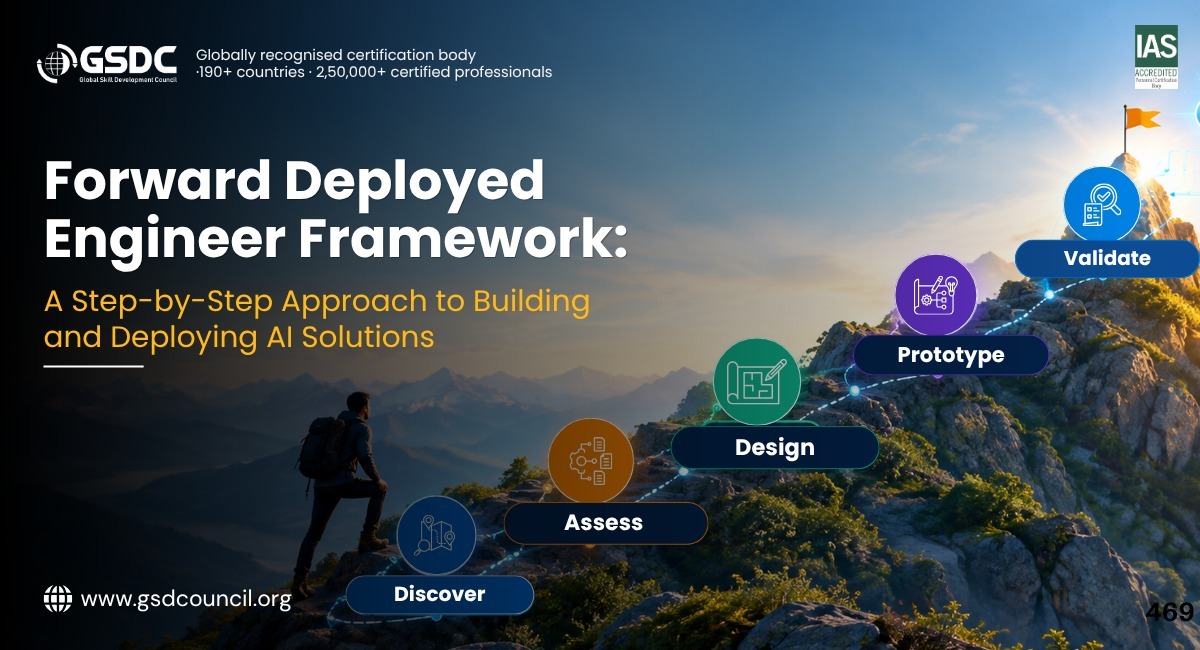
Forward Deployed Engineer Framework: A Step-by-Step Approach to Building and Deploying AI Solutions
Written by Emily Hilton
Building an AI solution is only one part of solving a business problem. The real challenge begins when that solution needs to work with existing systems, handle real customer data, and deliver reliable results in daily operations.
For example, a company might want to use AI to answer customer queries. A basic prototype may work well during testing, but deploying it in a real customer support environment introduces new challenges. The AI must retrieve accurate information, connect with the company's knowledge base, protect sensitive data, and know when to hand a query over to a human.
This is where forward deployed engineering becomes valuable. Forward Deployed Engineers work closely with customers and technical teams to understand business requirements, build practical solutions, and make sure those solutions work in real-world environments.
However, successful implementation requires a clear process. Engineers need to identify the right problem, choose suitable technologies, integrate systems, test performance, and continuously improve the solution after deployment.
This guide explains a practical Forward Deployed Engineer Framework that professionals can follow to build and deploy AI solutions. It also covers the tools, common challenges, and skills needed to apply this approach in real projects.
What Is Forward Deployed Engineering?
Forward deployed engineering is an approach to software and AI development in which engineers work closely with customers to solve specific business problems. Instead of building a solution in isolation, they understand how a business operates and adapt technology to its actual requirements.
A Forward Deployed Engineer (FDE) often works across several areas, including software development, AI engineering, system integration, deployment, and customer collaboration.
Consider a logistics company that wants to predict delivery delays. The company may already have shipment records, tracking systems, and operational dashboards. Simply developing a prediction model will not solve the problem.
An FDE would first understand how the logistics team identifies delays, determine which data is available, connect the necessary systems, and build a solution that helps employees take action. The engineer would then test the solution with real workflows and improve it based on feedback.
The goal is not just to build software. It is to make technology useful within the customer's working environment.
The Forward Deployed Engineer Framework
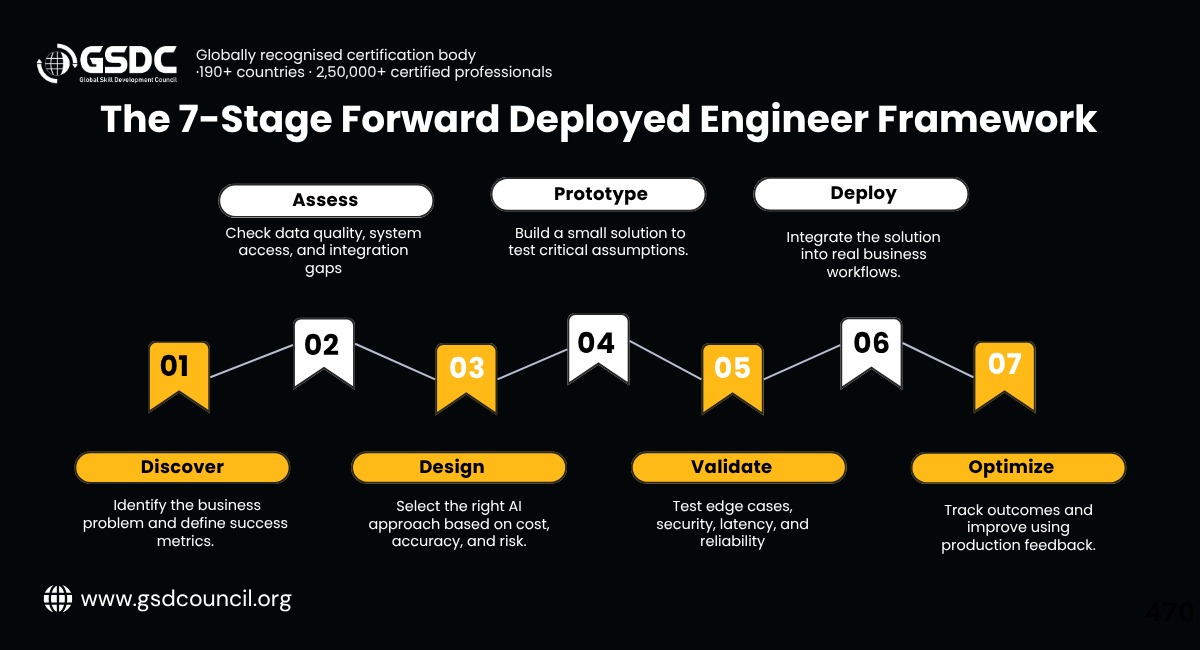
A practical FDE framework connects business understanding with technical implementation. The following seven steps provide a repeatable process for building and deploying AI solutions.
This is a practical implementation framework, not a claim that every organization follows one official FDE methodology.
Step 1: Understand the Business Problem
Before writing code or selecting an AI model, identify the problem the customer wants to solve.
Customers may describe a solution they want without fully explaining the underlying issue. For example, a customer might request an AI chatbot when the real problem is that employees spend hours searching for information across multiple internal documents.
An FDE must understand the workflow before deciding how technology should be used.
What to do:
- Interview customers and relevant stakeholders.
- Map the current business process.
- Identify repetitive tasks, delays, and operational problems.
- Understand user expectations and existing limitations.
- Define how success will be measured.
Example: A financial services company wants to automate document reviews. The FDE discovers that employees spend most of their time extracting information from documents and checking it against internal rules. This helps narrow the project to document extraction and validation instead of building a general-purpose AI assistant.
Expected outcome: A clearly defined problem statement, documented requirements, and measurable success criteria.
Step 2: Check the Data and Existing Systems
Once the problem is clear, the next step is to understand the technical environment.
AI solutions depend on the quality of available data and their ability to work with existing applications. A model may perform well in a demonstration but fail when it receives incomplete records, inconsistent formats, or information from disconnected systems.
An FDE needs to check what data exists, where it is stored, and how the solution can access it.
What to do:
- Identify relevant databases, APIs, applications, and data sources.
- Check data quality, completeness, and access permissions.
- Understand the customer's existing technology stack.
- Identify integration requirements and security restrictions.
- Document missing data and technical dependencies.
Example: A customer wants an AI assistant that answers questions using company policies. During the assessment, the FDE discovers that the policies are stored across PDFs, shared folders, and an internal portal. The engineer plans how to collect, process, and retrieve the correct documents before building the assistant.
Expected outcome: A data and system assessment that identifies what can be used, what needs improvement, and which integrations are required.
Step 3: Choose the Right AI Approach
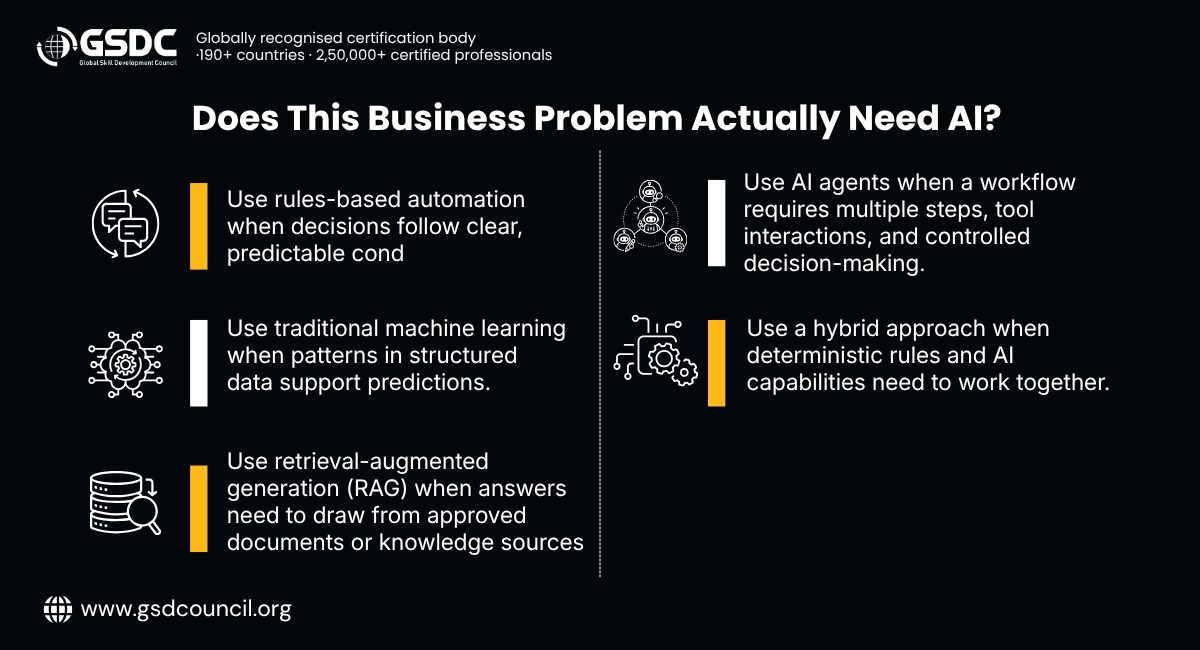
Not every business problem requires a large language model or a complex AI system. Sometimes, a traditional machine learning model, a rules-based workflow, or a simple API integration can solve the problem more reliably and at a lower cost.
A Forward Deployed Engineer must choose technology based on the business requirement rather than using AI simply because it is available.
What to do:
- Compare possible technical approaches.
- Select suitable models, APIs, frameworks, and infrastructure.
- Consider accuracy, latency, cost, privacy, and scalability.
- Decide whether retrieval-augmented generation (RAG), conventional machine learning, or rules-based logic is appropriate.
- Define when the system should involve a human.
Example: A customer support team wants AI-generated answers based on its product documentation. The FDE evaluates a RAG approach, which retrieves relevant information from approved documents before generating a response. This can help ground answers in the company's information, although retrieval quality and model behavior still need testing.
Expected outcome: A technical design that explains the chosen approach, its limitations, and the reasons behind the main technology decisions.
Step 4: Build a Working Prototype
With the requirements and technical approach defined, the FDE builds a small version of the solution.
The objective is to test the most important assumptions before investing in a full implementation. A prototype should demonstrate whether the proposed approach can solve the customer's problem under realistic conditions.
What to do:
- Build the core workflow with the minimum necessary features.
- Connect the required APIs or data sources.
- Test the solution using representative examples.
- Collect feedback from actual users.
- Record technical limitations and areas that need improvement.
Example: For the customer support assistant, the FDE connects a language model to a limited set of approved product documents. The prototype answers common questions, cites the relevant source documents where supported, and routes uncertain questions to a human agent.
The team then tests whether users can find answers more quickly and whether the responses are sufficiently accurate.
Expected outcome: A working prototype that demonstrates feasibility and provides evidence for the next development stage.
Step 5: Test the Solution Against Real Conditions
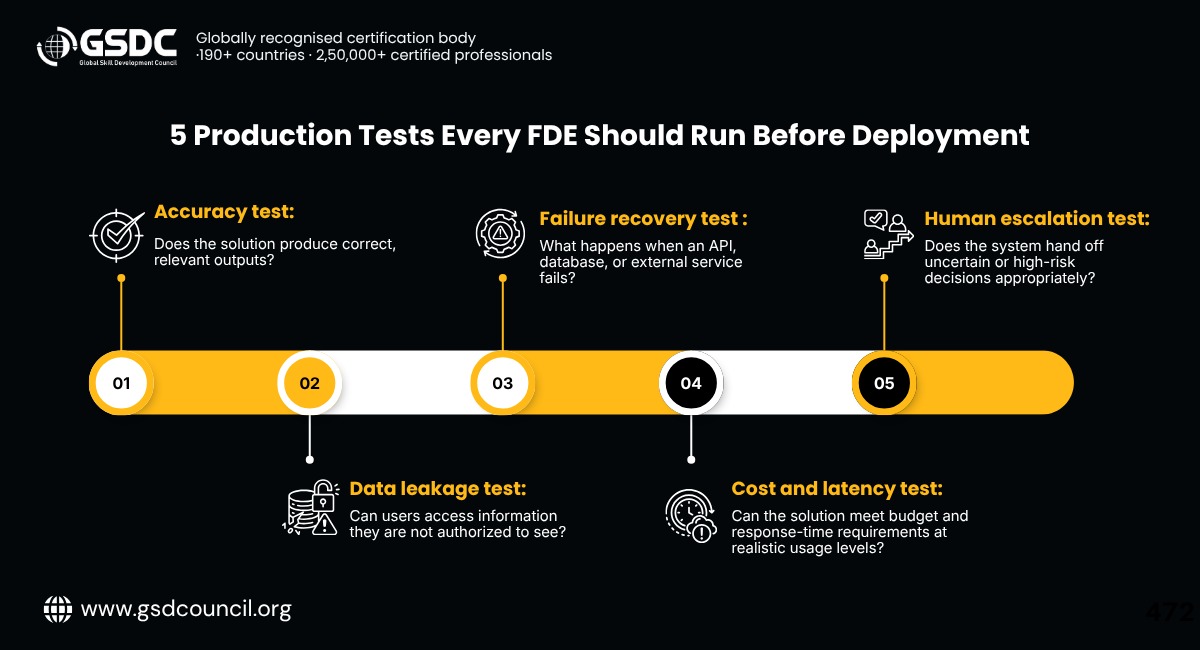
A successful demonstration does not guarantee a successful deployment. Real users ask unexpected questions, data changes, integrations fail, and AI models can produce incorrect responses.
Testing must therefore cover more than whether the application works under ideal conditions.
What to do:
- Evaluate accuracy and task completion.
- Test unusual inputs and failure scenarios.
- Check access controls and sensitive data handling.
- Measure response time and operating costs.
- Test integration failures and recovery behavior.
- Define when the system should refuse a request or escalate it to a person.
Example: During testing, the support assistant answers a question using an outdated policy document. The FDE identifies the document retrieval issue, improves the document update process, and adds tests to check whether responses use the latest approved information.
For AI applications, useful evaluation measures may include answer correctness, retrieval relevance, task completion rate, escalation rate, latency, and cost per request.
Expected outcome: A tested solution with documented limitations, acceptance criteria, and a plan for handling failures.
Step 6: Deploy the Solution Into the Customer's Workflow
Deployment means making the solution available to the people who need it and ensuring it fits into their existing work.
This stage often requires more than releasing an application. The FDE may need to configure permissions, connect production systems, set up monitoring, document operational procedures, and help users adopt the new workflow.
What to do:
- Deploy the application in the agreed environment.
- Configure authentication, permissions, and access controls.
- Connect production data sources and business applications.
- Set up logging, monitoring, and error reporting.
- Train users and document the workflow.
- Prepare a rollback or recovery plan.
Example: The support assistant is integrated into the company's customer service platform. Agents can review suggested answers, check supporting sources, and take over conversations when necessary. Monitoring helps the team identify errors and unusual usage patterns.
Expected outcome: A production-ready solution that users can access safely and that technical teams can maintain.
Step 7: Measure Results and Improve the Solution
The work does not end when the solution goes live. Business requirements change, new data becomes available, and users discover problems that were not visible during testing.
FDEs need to evaluate whether the solution continues to deliver value and make improvements based on evidence.
What to do:
- Compare actual results with the original success criteria.
- Collect user feedback and review recurring issues.
- Monitor accuracy, usage, latency, and cost.
- Investigate errors and unexpected behavior.
- Prioritize improvements based on business impact.
- Reassess security, data quality, and operational risks.
Example: After deployment, the support assistant resolves routine queries more quickly, but complex questions still require agent intervention. The FDE reviews these cases, identifies gaps in the knowledge base, improves retrieval, and adjusts escalation rules.
Expected outcome: A solution that improves through continuous feedback and remains aligned with business needs.
The FDE Playbook: What to Prepare at Each Stage
A useful FDE playbook turns the framework into practical project activities and deliverables. It helps engineers and customer teams understand what needs to happen before moving to the next stage.
Stage | Key activity | Deliverable |
| Discover | Understand the customer problem | Problem statement and success metrics |
| Assess | Review data and systems | Data and integration assessment |
| Design | Select the technical approach | Architecture and decision record |
| Build | Develop the core workflow | Working prototype |
| Validate | Test performance and risks | Evaluation report and test results |
| Deploy | Integrate into production | Deployment and monitoring plan |
| Improve | Measure outcomes and resolve issues | Improvement backlog |
These deliverables help reduce misunderstandings between customers, engineers, and business stakeholders. They also make project progress easier to review.
For example, if a project struggles during deployment, the team can revisit the integration assessment, technical decisions, and testing results instead of starting the investigation from scratch.
The playbook should remain flexible. A small API integration may need only a few of these deliverables, while a customer-facing AI agent handling sensitive information may require more detailed testing, security reviews, and operational controls.
Tools Used in Forward Deployed Engineering
The tools an FDE uses depend on the customer's technology stack, the project requirements, and the chosen AI approach. The goal is to select tools that support the solution, not to use every available technology.
Common tool categories include:
- Programming: Python, JavaScript, and TypeScript for application logic and integrations.
- AI and language models: Model APIs and frameworks for building AI-powered workflows.
- Data and retrieval: SQL databases, vector databases, document processing, and search tools.
- Integration: REST APIs, webhooks, authentication services, and enterprise connectors.
- Cloud and deployment: Cloud platforms, containers, CI/CD pipelines, and application hosting.
- Testing and evaluation: Automated tests, AI evaluation datasets, tracing, and monitoring tools.
- Security: Identity management, access controls, secrets management, and audit logging.
Tool selection should follow the problem assessment. For instance, an internal document assistant may need document parsing, retrieval, model evaluation, and permission-aware search. A forecasting solution may instead rely on structured data, statistical models, and a different set of deployment tools.
Common Challenges FDEs Need to Solve
Even a well-designed solution can face practical challenges during implementation. FDEs must be prepared to identify these problems and work with customers to resolve them.
Unclear requirements: Customers may change priorities or struggle to explain what they need. Regular discussions and measurable success criteria help keep the project focused.
Poor data quality: Incomplete or outdated data can reduce the usefulness of AI outputs. Data validation and clear ownership are important before deployment.
Integration problems: Existing applications may use different formats, authentication methods, or data structures. Early integration testing helps uncover these issues.
Unreliable AI outputs: AI systems can produce incorrect or unsupported answers. Evaluation, access to reliable sources, appropriate safeguards, and human escalation help manage this risk.
Cost and performance: A solution may be accurate but too slow or expensive for daily use. Engineers need to measure response times, resource usage, and cost alongside quality.
Low user adoption: Employees may avoid a tool that does not fit their workflow. Involving users during development and providing clear guidance can improve adoption.
Solving these challenges requires technical skills, clear communication, and the ability to make decisions based on real project conditions.
How a Forward Deployed Engineer Certification Can Help
A forward deployed engineer certification can provide a structured way to understand the role, its responsibilities, and the skills involved in customer-focused engineering.
The GSDC Certified Forward Deployed Engineer Certification is designed for professionals who want to explore this emerging career path and strengthen their understanding of customer requirements, AI applications, and technical implementation.
As you work toward an FDE role, combine structured learning with practical projects. Use the framework in this guide to practise defining business problems, assessing data, building prototypes, testing solutions, and planning deployment.
Explore the GSDC Certified Forward Deployed Engineer Certification to learn more about the certification.

Final Thoughts
A successful AI solution requires more than a working model. It needs a clear business objective, reliable data, suitable technology, effective integration, careful testing, and ongoing improvement. The Forward Deployed Engineer Framework provides a practical way to manage these stages, from understanding a customer problem to supporting a solution in production.
For professionals exploring forward deployed engineering, learning this process can help build the technical judgment and implementation skills needed for customer-focused engineering roles. Start with a real business problem, build a solution around measurable requirements, and document what you learn at every stage. These experiences can help you prepare for the responsibilities of an FDE and demonstrate your ability to turn technical ideas into practical outcomes.

Related Certifications
Frequently Asked Questions
The Forward Deployed Engineer Framework is a practical approach to identifying business problems, assessing data and systems, selecting technology, building prototypes, testing solutions, deploying applications, and improving them after launch.
An FDE works with customers and engineering teams to understand requirements, design and integrate AI solutions, test performance, deploy applications, and resolve issues that arise in real-world use.
An FDE playbook is a collection of processes, checklists, templates, and deliverables that guide engineers through customer discovery, solution development, testing, deployment, and continuous improvement.
Useful skills include programming, AI application development, API integration, database knowledge, debugging, cloud deployment, communication, and customer-focused problem-solving. Exact requirements vary by role.
Certification requirements depend on the employer. A forward deployed engineer certification can support structured learning, but practical project experience, relevant technical skills, and the ability to demonstrate end-to-end implementation are also important.
Learn software development and system integration, understand AI implementation, build a complete project around a real business problem, practise explaining your technical decisions, and review job descriptions to identify the skills employers expect.
Stay up-to-date with the latest news, trends, and resources in GSDC
If you like this read then make sure to check out our previous blogs: Cracking Onboarding Challenges: Fresher Success Unveiled
Not sure which certification to pursue? Our advisors will help you decide!