Forward Deployed Engineer Explained: What They Do and Why Companies Need Them

Written by Emily Hilton
- What Is a Forward Deployed Engineer?
- What Does a Forward Deployed Engineer Actually Do?
- Why Are Companies Hiring Forward Deployed Engineers?
- What Skills Does a Forward Deployed Engineer Need?
- Who Can Explore a Career as an FDE?
- What Are the Career Opportunities for Forward Deployed Engineers?
- What Is the Career Growth Path for an FDE?
- How to Become a Forward Deployed Engineer: A Practical Roadmap
- Advance Your Career with the GSDC Certified Forward Deployed Engineer Certification
- Final Thoughts
As more companies invest in artificial intelligence, cloud computing, and advanced software, the demand for professionals who can turn new technology into practical business solutions is growing. From automating customer support to improving financial operations, businesses are looking for ways to use technology to solve everyday problems.
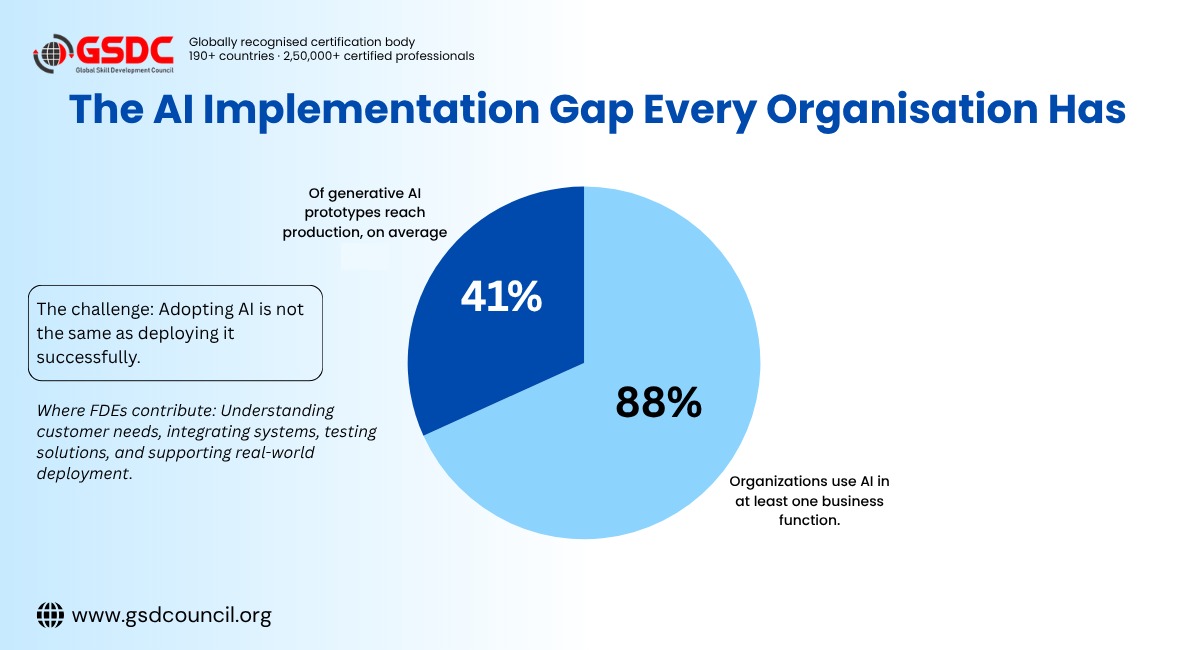
However, adopting a new technology is not always straightforward. Companies often struggle to connect AI applications with existing systems, understand their technical requirements, and ensure that a solution delivers the expected results.
This is where Forward Deployed Engineers (FDEs) play an important role. They work directly with customers to understand their challenges, develop technical solutions, and make sure those solutions work in real business environments.
Unlike traditional engineering roles that may focus primarily on product development, Forward Deployed Engineers combine technical expertise with customer collaboration and business problem-solving. They help organizations move from an idea or prototype to a solution that can be used in day-to-day operations.
In this blog, we will explore what a Forward Deployed Engineer is, what the role involves, the skills required, career opportunities, salary expectations, and how to become a Forward Deployed Engineer.
What Is a Forward Deployed Engineer?
A Forward Deployed Engineer (FDE) is a technical professional who works closely with customers to understand their business challenges and develop customized technical solutions.
The Forward Deployed Engineer definition combines software engineering, system integration, problem-solving, and direct customer interaction. Instead of focusing only on building a product for a broad audience, FDEs work with individual customers to understand their requirements and adapt technology to their specific environments.
For example, imagine a company wants to use AI to answer customer questions. It already has a customer relationship management system, a database containing customer information, and a support platform used by its employees. A new AI application may not work effectively until it is connected to these systems and configured around the company's requirements.
A Forward Deployed Engineer helps understand these requirements, develops the necessary integrations, tests the application, and addresses issues that emerge during implementation. The role can involve writing code, developing prototypes, connecting APIs, working with databases, evaluating AI outputs, and collaborating with engineering and product teams.
What Does a Forward Deployed Engineer Actually Do?
To understand what a Forward Deployed Engineer does, consider a practical business scenario.
Imagine a bank that receives thousands of customer queries every day. The bank wants to introduce an AI-powered customer support tool to help employees find information faster and respond to routine questions.
However, the bank has several requirements. The AI application must access approved information, connect with existing systems, protect sensitive customer data, and provide reliable responses. It must also fit into the support team's existing workflow.
Simply purchasing an AI tool will not solve these problems. The bank needs someone who understands both the technical requirements and the way its employees work.
A Forward Deployed Engineer helps make this happen by working with the bank's teams, identifying the technical challenges, developing the solution, and testing it in the actual business environment.
Here are some of the key responsibilities of a Forward Deployed Engineer:
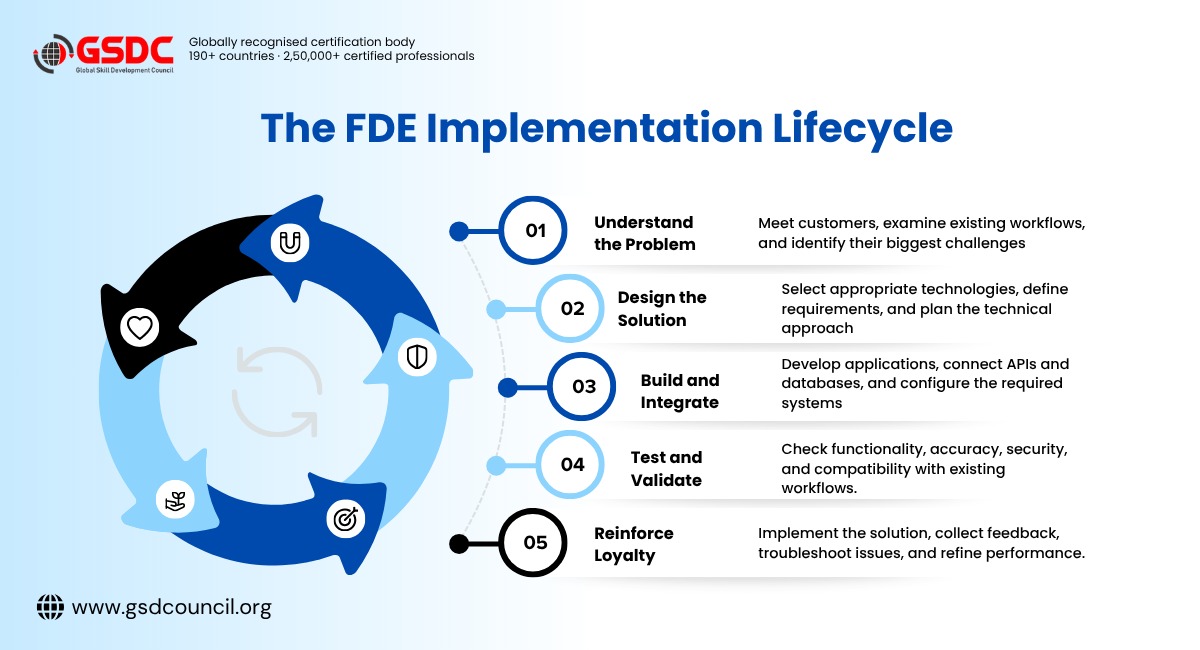
- Understand customer needs: Talk to customers, understand their business processes, identify operational challenges, and determine what they expect from a technical solution.
- Plan the solution: Evaluate possible approaches and decide which technologies, APIs, databases, AI models, or existing systems are needed.
- Build and test solutions: Write code, create prototypes, develop integrations, and test whether the solution meets the customer's requirements.
- Work with different teams: Coordinate with customers, software developers, product managers, data engineers, and other stakeholders to keep implementation on track.
- Troubleshoot technical problems: Investigate errors, integration failures, performance issues, and unexpected results that arise during deployment.
- Improve the results: Collect feedback, identify areas for improvement, and make changes to ensure the solution continues to meet business needs.
- Support implementation: Help customers understand how to use the solution and work with internal teams to address issues that affect adoption.
The FDE role can vary depending on the organization. An FDE working at an AI company may focus on integrating large language models into customer workflows, while an FDE at an enterprise software company may spend more time connecting applications and customizing product functionality.
In either case, the objective is the same: understand the problem, build a practical solution, and make sure it delivers value in the customer's environment.
Why Are Companies Hiring Forward Deployed Engineers?
Companies invest in technology to improve productivity, reduce operational challenges, serve customers more effectively, and make better decisions. However, the results depend on how well the technology fits their existing business processes.
A software product may work perfectly in a demonstration but encounter unexpected challenges when introduced into a customer's environment. Different data formats, older systems, security requirements, and unique workflows can all affect implementation.
Forward Deployed Engineers help companies overcome these challenges by connecting technical development with real business requirements.
Their work is particularly valuable when businesses need to:
- Introduce AI into existing business workflows.
- Connect new applications with legacy systems and enterprise software.
- Customize technical solutions for complex customer requirements.
- Test new products in real business environments.
- Identify implementation challenges before expanding a solution.
- Translate customer feedback into practical product improvements.
- Help teams adopt new technology more effectively.
The growing use of AI creates additional opportunities for this role. Organizations may have access to powerful AI models, but they still need professionals who can connect those models to business data, build suitable workflows, evaluate results, and address reliability and security concerns.
For example, an AI model may be capable of summarizing documents, but an organization still needs to determine which documents it can access, how information should be retrieved, where the summaries should be stored, and how employees will use the results.
An FDE can help turn that capability into a working business application.
This combination of engineering knowledge, customer understanding, and implementation experience makes Forward Deployed Engineers valuable to companies developing and deploying complex technology solutions.
What Skills Does a Forward Deployed Engineer Need?
Becoming a Forward Deployed Engineer requires more than programming knowledge. Professionals need to understand how systems work, identify customer problems, communicate technical decisions, and adapt solutions to different environments.
The exact requirements depend on the company and the type of projects involved. However, the following forward deployed engineer skills provide a useful foundation.
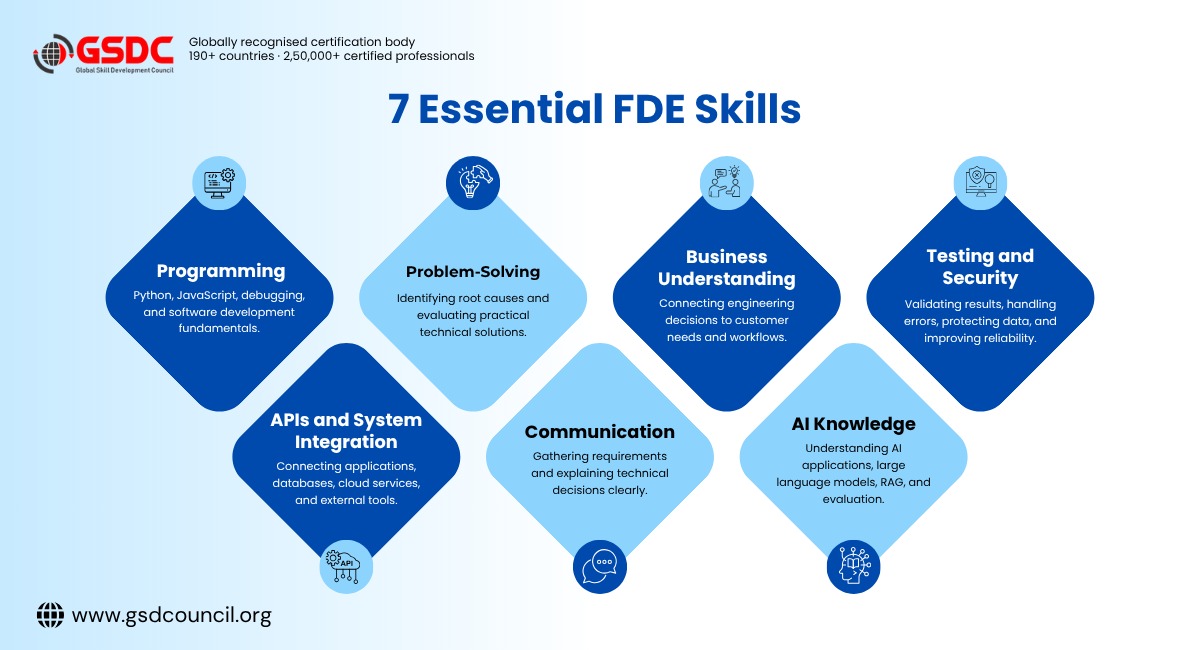
1. Programming and technical knowledge
FDEs often work with programming languages, APIs, databases, cloud platforms, and software systems. Python and JavaScript are useful starting points for many projects, although the preferred technologies vary by organization.
You should understand basic software development concepts, debugging, version control, and how applications communicate with one another.
2. Problem-solving and analytical thinking
Customers do not always describe their problems in technical terms. An FDE must identify the underlying issue, break it into manageable parts, evaluate different approaches, and determine what solution is practical.
For instance, if a customer complains that an AI assistant gives incorrect answers, the cause could be poor data quality, ineffective retrieval, unclear instructions, integration errors, or limitations in the model itself.
The ability to investigate the problem systematically is essential.
3. Communication and collaboration
FDEs regularly work with people who have different levels of technical knowledge. They must gather requirements, explain trade-offs, communicate project progress, and help customers understand what a solution can and cannot do.
Clear communication also reduces misunderstandings between customers and internal engineering teams.
4. Understanding business requirements
A technically impressive solution is not necessarily the right solution for a business. FDEs need to understand the customer's goals, existing workflows, operational limitations, and expected outcomes.
This helps them select appropriate technologies and avoid building features that do not address the actual problem.
5. Adaptability and learning
Customer environments can differ significantly. One project may require integrating an AI model with a cloud database, while another may involve working with an existing enterprise application.
FDEs must be comfortable learning new tools, exploring unfamiliar systems, and adjusting their approach when requirements change.
6. AI and system integration knowledge
AI-focused FDE roles may involve large language models, retrieval-augmented generation (RAG), prompt design, AI evaluation, data pipelines, and workflow automation.
Understanding APIs, authentication, data handling, and system integration helps engineers connect AI capabilities with the applications businesses already use.
7. Testing, reliability, and security
A solution must do more than work once during a demonstration. It should perform consistently, handle errors, protect sensitive information, and meet the customer's operational requirements.
Knowledge of testing, logging, monitoring, access controls, and secure development practices can help FDEs build solutions that are suitable for real-world use.
You do not need to master every skill at the beginning. A good starting point is to build strong programming fundamentals, practise integrating applications, and develop projects that solve clearly defined problems.
Who Can Explore a Career as an FDE?
Forward Deployed Engineering may be a good career direction for professionals who enjoy both building technology and understanding how people use it.
The role can be particularly relevant to:
- Software engineers who want to work directly with customers and apply their development skills to different business challenges.
- AI and machine learning engineers who want to move beyond model development and focus on deploying AI applications.
- Solutions engineers who want to develop deeper programming, integration, and implementation skills.
- Data and cloud engineers who enjoy connecting systems and building solutions around customer requirements.
- Technical professionals exploring AI careers who want to combine software development with business-oriented problem-solving.
The role may be less suitable for people who prefer working exclusively on isolated technical tasks without much customer interaction. FDEs often need to discuss requirements, explain decisions, manage changing expectations, and collaborate across teams.
If you are a beginner, start by learning programming fundamentals, APIs, databases, and basic AI concepts. Then build a small project that solves a real problem, such as automating a repetitive task or creating a simple customer support application.
As you gain experience, practise gathering requirements, connecting your application to external systems, testing different scenarios, and explaining why you selected a particular technical approach.
These experiences can help you understand the responsibilities involved and prepare for more advanced FDE projects.
What Are the Career Opportunities for Forward Deployed Engineers?
Forward Deployed Engineer jobs can be found in organizations that develop complex software products, implement AI solutions, or help businesses integrate technology into their operations.
Potential employers include AI companies, enterprise software providers, cloud technology companies, consulting firms, and technology startups.
Depending on their experience and interests, FDEs may work on AI application deployment, enterprise system integration, workflow automation, data platforms, customer-specific software solutions, or technical product implementation.
Common job titles to explore include:
- Forward Deployed Engineer
- AI Solutions Engineer
- Software Engineer, Customer Solutions
- Field Engineer
- Solutions Architect
- Customer Engineer
- Applied AI Engineer
These titles are not interchangeable, and their responsibilities vary by employer. Some positions focus heavily on coding, while others emphasize architecture, implementation, or technical consulting.
What Is the Career Growth Path for an FDE?
A forward deployed engineer roadmap does not follow one fixed path. Career progression depends on technical expertise, customer experience, leadership ability, and the type of organization you work for.
A possible progression could look like this:
Entry-level software or solutions role → Forward Deployed Engineer → Senior Forward Deployed Engineer → FDE Lead or Solutions Architect → Engineering Manager or Technical Leadership
Some professionals may move into AI engineering, product management, technical consulting, or enterprise architecture instead.
As you progress, the focus often shifts from completing individual implementations to designing larger systems, managing complex customer engagements, mentoring engineers, and helping organizations make technical decisions.
Building a strong project portfolio, developing system design knowledge, and gaining experience with real customer requirements can support this progression.
How to Become a Forward Deployed Engineer: A Practical Roadmap
If you are wondering how to become a Forward Deployed Engineer, focus on developing technical depth while learning how to apply that knowledge to real customer problems.
Here is a practical roadmap to get started.
Step 1: Build your programming foundation
Learn a programming language such as Python or JavaScript. Practise writing functions, working with data, debugging code, and building small applications.
Step 2: Learn APIs, databases, and cloud fundamentals
Understand how applications communicate, how data is stored and retrieved, and how software is deployed. These skills are useful when integrating different systems.
Step 3: Explore AI application development
Learn the basics of large language models, prompt design, RAG, AI APIs, and evaluation. Focus on how these technologies can be used to solve practical problems rather than studying them only in theory.
Step 4: Build end-to-end projects
Develop applications that solve identifiable business problems. For example, you could build a document search assistant, an AI-powered support tool, or a workflow automation application.
Try to connect your project to a database or external API instead of keeping it as a standalone demonstration.
Step 5: Learn to understand business requirements
Practice identifying the problem before choosing a solution. Define what the application should accomplish, what constraints it must follow, and how you will evaluate whether it works.
Step 6: Test and improve your solutions
Check how your application performs under different conditions. Document errors, improve reliability, and consider security, access controls, and user feedback.
Step 7: Create a project portfolio and explore relevant jobs
Document the problems you solved, the technologies you used, the decisions you made, and the results you achieved. Review job descriptions to identify the skills employers expect and address gaps in your knowledge.
Step 8: Consider structured professional learning
A forward deployed engineer certification can provide a structured way to explore the role, strengthen your understanding of relevant concepts, and identify areas for further development.
This roadmap is a starting point rather than a mandatory sequence. Experienced software engineers may already have many of the required skills, while beginners may need more time to develop their technical foundations.
Advance Your Career with the GSDC Certified Forward Deployed Engineer Certification
The Global Skill Development Council (GSDC) offers the Certified Forward Deployed Engineer Certification for professionals looking to develop a structured understanding of Forward Deployed Engineering and its role in solving customer problems through technology.
Forward Deployed Engineering brings together software development, technical implementation, customer collaboration, and practical problem-solving. Understanding these areas can help professionals see how engineering decisions connect with business requirements and real-world outcomes.
The GSDC FDE Certification may be relevant to software engineers exploring a new career direction, AI professionals interested in real-world deployment, and technology professionals looking to expand their understanding of customer-focused engineering.
Whether you are exploring forward deployed engineer jobs or looking to strengthen your existing technical knowledge, learning more about the field can help you make informed decisions about your professional development.
Explore the GSDC Certified Forward Deployed Engineer Certification to learn more about the certification and take the next step in exploring this emerging field.

Final Thoughts
Forward Deployed Engineering connects software development with the practical challenges businesses face when adopting new technology. FDEs work directly with customers to understand their needs, develop technical solutions, integrate systems, and improve implementations based on real-world feedback.
As AI adoption expands, this combination of technical knowledge, communication, and business understanding can be valuable across many industries.
If you are interested in this career, start with programming fundamentals, develop your understanding of APIs and system integration, and build projects that solve practical problems. As you gain experience, focus on learning how to work with customers, evaluate technical trade-offs, and deliver reliable solutions.
With the right combination of technical skills, practical experience, and structured learning, you can explore whether Forward Deployed Engineering aligns with your interests and long-term career goals.

Related Certifications
Stay up-to-date with the latest news, trends, and resources in GSDC
If you like this read then make sure to check out our previous blogs: Cracking Onboarding Challenges: Fresher Success Unveiled
Not sure which certification to pursue? Our advisors will help you decide!