How Do FDEs Work With Enterprise Clients?

Written by Dinesh Singh Panwar
- What Is a Forward Deployed Engineer?
- From AI Innovation to Enterprise Trust
- The Enterprise AI Challenge: Connecting AI With Existing Systems
- Security and Access Control Must Be Built In
- Why Observability and Audit Trails Matter
- Governance and Engineering Need to Work Together
- Measuring Whether AI Is Creating Business Value
- How FDEs Balance Immediate Needs With Long-Term Architecture
- What Skills Does an FDE Need?
- The Future of Forward Deployed Engineering
- Conclusion
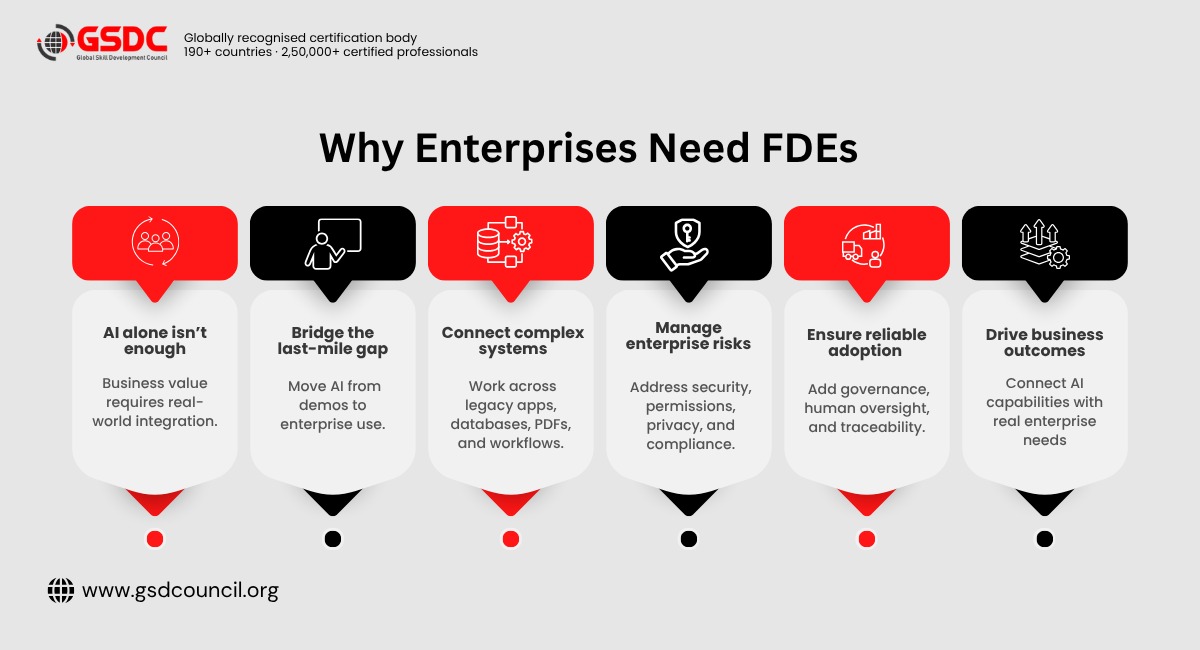
Artificial intelligence is moving quickly from experimentation to real business use. Organizations are building AI-powered applications for customer service, fraud detection, document analysis, decision-making, healthcare, finance, and many other areas. However, building an AI solution is only one part of the challenge.
For large enterprises, especially those operating in regulated industries, an AI system must also work with existing processes, data, security controls, legacy applications, governance requirements, and business goals. This is where the Forward Deployed Engineer (FDE) becomes important.
The webinar “How FDEs Work With Enterprise Clients?” explained how FDEs help organizations move from AI demonstrations and proof of concepts to secure, scalable, and measurable enterprise solutions.
What Is a Forward Deployed Engineer?
A Forward Deployed Engineer combines skills that traditionally belonged to several different roles.
A software engineer focuses on building technical solutions. A consultant understands business problems and recommends strategies. A solution architect designs how different technical components should work together.
An FDE brings elements of all three roles together.
The focus is not simply on building a product or recommending a solution. An FDE is outcome-driven and works closely with the client to make sure the technology solves a real business problem.
This requires understanding business priorities, technical limitations, enterprise architecture, stakeholder expectations, security requirements, and regulatory concerns.
In simple terms, the FDE acts as a bridge between what the business wants to achieve and what technology needs to deliver.
From AI Innovation to Enterprise Trust
The webinar identified three important areas that define successful AI implementation in large organizations: innovation, trust, and impact.
- Innovation: What can AI do? Analyze documents, detect fraud, answer questions, or support decisions.
- Trust: Can AI be used safely? Focus on security, privacy, access, governance, and reliability.
- Impact: Does AI create business value? Measure time saved, cost reduction, productivity, and adoption.
A successful enterprise AI implementation therefore needs to move beyond “the model works” to “the solution works safely and creates measurable value.”
The Enterprise AI Challenge: Connecting AI With Existing Systems
One of the biggest challenges for FDEs is interoperability. This is an important consideration in enterprise AI deployment and part of the forward deployed engineer responsibilities.
Many AI solutions are initially developed in controlled or “greenfield” environments. Enterprises, however, rarely operate in greenfield environments. They have legacy applications, older databases, disconnected workflows, different vendors, and systems that were built at different points in time.
An AI solution may need information from several systems before it can make a useful decision.
Data is another major challenge. Enterprise information may exist in structured databases as well as unstructured documents, PDFs, reports, emails, and other sources. AI applications need appropriate pipelines to extract, process, index, and retrieve this information.
In a typical retrieval-augmented generation system, for example, documents may need to be extracted, broken into smaller sections, converted into embeddings, and indexed so that relevant information can be retrieved when a user asks a question.
The technical model may be sophisticated, but the real work often lies in connecting it to enterprise data and workflows. This makes FDE skills in engineering, integration, and problem-solving important for successful enterprise AI deployment.
Security and Access Control Must Be Built In
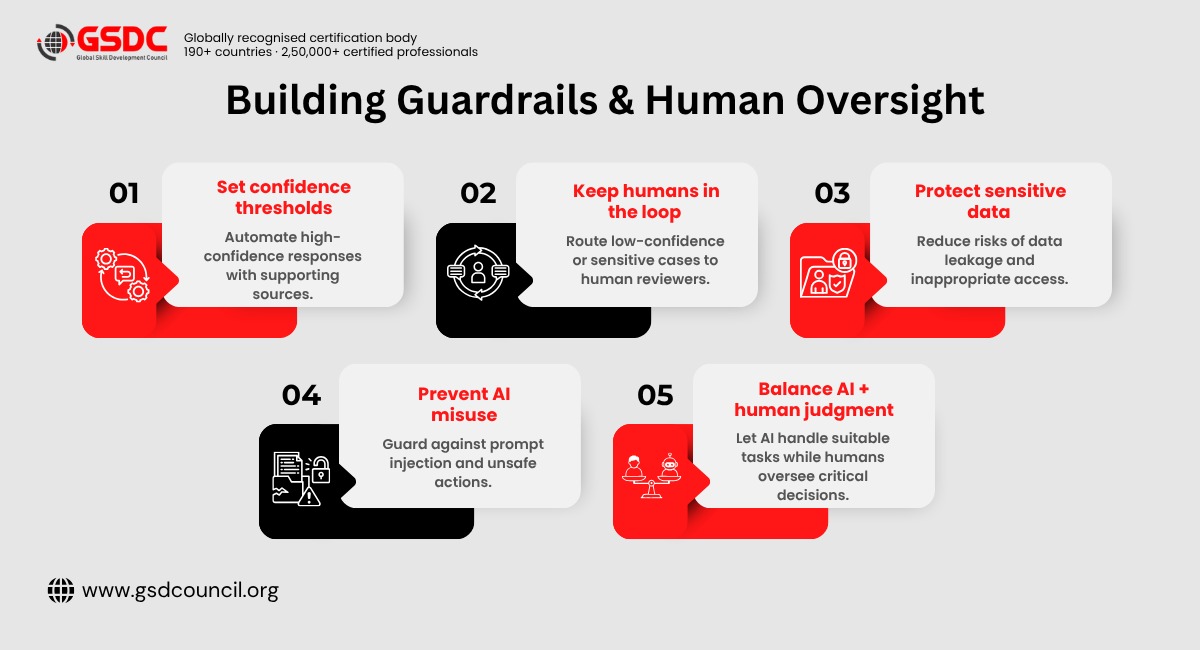
Enterprise AI systems often handle sensitive information. Therefore, security cannot be added just before deployment.
The webinar discussed several security considerations, including data leakage, prompt injection, excessive permissions, and unauthorized access.
Consider an AI chatbot used inside a bank. Not every employee should have access to every customer document. If an employee is not authorized to view a particular loan record, the AI system should not reveal that information simply because it can retrieve it.
This means access control must extend to the AI layer.
The same principle applies to AI agents that can interact with enterprise systems. An agent should have only the permissions required for its specific task rather than broad system-level access.
This is often referred to as the principle of least privilege.
Why Observability and Audit Trails Matter
Enterprise AI systems need to be observable.
Organizations should be able to understand what happened when an AI system produced a particular result. This can include information about the input, retrieved data, prompts, model response, system actions, and final decision.
This becomes especially important in regulated industries.
For example, if an AI system supports a financial decision or healthcare workflow and the decision is later questioned, the organization may need to determine how the system reached that result.
A strong audit trail can provide evidence of what happened and support investigation, compliance, and continuous improvement.
Observability also helps organizations identify problems such as model drift, unexpected behavior, performance degradation, or changes introduced by a new model version.
Governance and Engineering Need to Work Together
A key idea from the webinar was that AI governance and technical implementation should not operate as separate activities. Instead, an AI governance framework should be considered from the beginning of the project.
The FDE can help create a common understanding between business leaders, risk teams, security professionals, and engineers. Visual process models and standardized representations can make complex AI workflows easier for different stakeholders to understand.
For example, a business leader may not need to understand the underlying code. However, they should be able to understand where an AI decision is made, where permissions are checked, when a human reviews the result, and how the activity is logged.
This shared understanding improves accountability and reduces misunderstandings between business and technical teams, supporting effective enterprise AI deployment.
Measuring Whether AI Is Creating Business Value
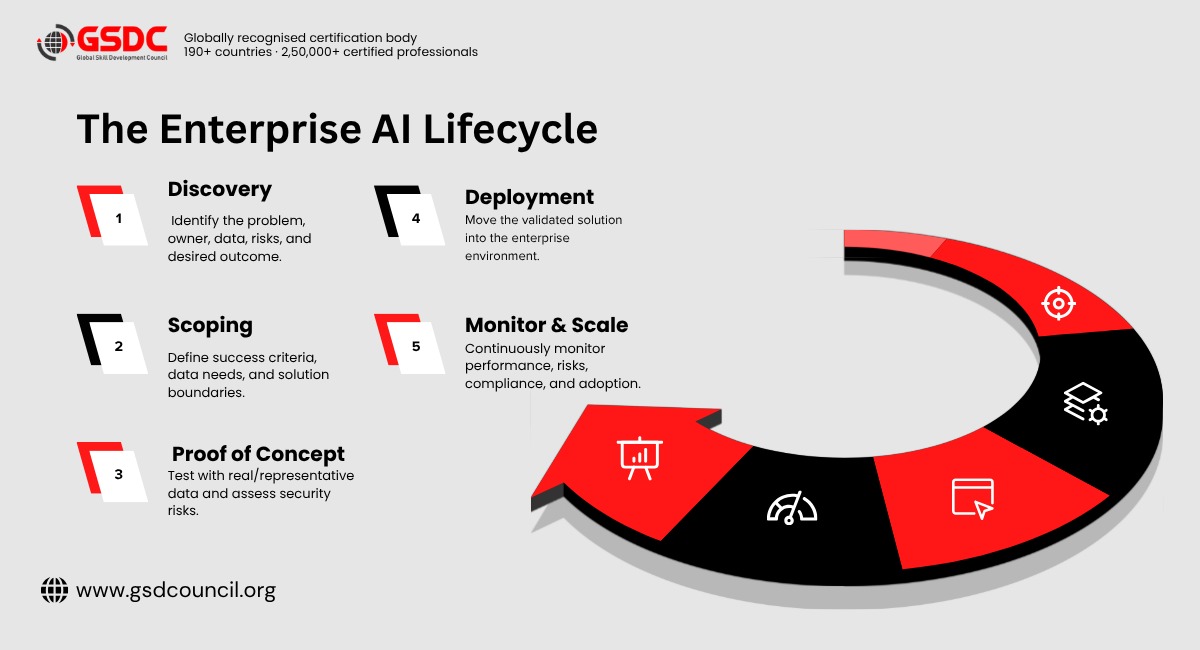
AI adoption should not be measured only by whether a system has been launched.
FDEs also need to help organizations measure business outcomes.
- Adoption: Track AI usage, eligible interactions, and repeat users.
- Speed: Compare process time before and after AI implementation.
- Cost: Measure AI processing costs against existing human and infrastructure costs.
- Risk: Track automated cases versus those escalated to human reviewers.
- Business Impact: Use measurable results to show whether AI is creating real value.
Risk-related measurements can also be useful. For example, organizations can monitor how many cases are automatically handled and how many are escalated to human reviewers because of low confidence or other risk conditions.
These measurements help executives understand whether an AI initiative is producing real value.
How FDEs Balance Immediate Needs With Long-Term Architecture
Enterprise clients often have immediate business requirements. At the same time, AI solutions need to be scalable and maintainable. This is an important part of the forward deployed engineer role and enterprise AI deployment.
The webinar explained that FDEs can address this by working with business owners to prioritize and sequence requirements. Understanding forward deployed engineer responsibilities helps ensure that implementation aligns with both business and technical needs.
For lower-risk use cases, an organization may start with a smaller implementation that combines AI with existing systems and human review. More complex integrations can be added over time.
In highly regulated environments, teams may begin with a use case where the risk and regulatory exposure are more manageable. This allows the organization to demonstrate value while building the necessary AI governance framework for future expansion.
The goal is to avoid choosing between short-term business value and long-term scalability. Instead, both should be considered as part of the implementation roadmap.
What Skills Does an FDE Need?
The FDE role requires more than technical AI knowledge. An effective FDE needs technical, business, architecture, security, and stakeholder management skills.
Strong communication helps FDEs connect business needs with technical solutions.
Understanding real business workflows helps identify practical needs beyond formal documentation.
Industry knowledge is also valuable for solving domain-specific enterprise challenges.
As FDE roles evolve, specialization in areas like banking, healthcare, and insurance may become more important.
The Future of Forward Deployed Engineering
GSDC’s Forward Deployed Engineer Certification helps professionals build the practical skills needed to work at the intersection of AI, engineering, and enterprise business needs. It covers key areas such as AI implementation, enterprise systems, solution architecture, client collaboration, problem-solving, and responsible AI practices.
The Forward Deployed Engineer Certification can help learners understand how to translate business requirements into practical AI solutions while considering scalability, security, governance, and human oversight. It is relevant for software engineers, AI professionals, solution architects, and technology professionals looking to develop skills for forward deployed engineer roles and support successful enterprise AI deployment.
Conclusion
Forward Deployed Engineers play an important role in closing the gap between AI innovation and real enterprise impact. As demand for forward deployed engineer jobs grows, organizations are looking for professionals who can combine technical expertise with business understanding.
Their work goes beyond developing or deploying AI models. They understand the client's business problem, connect AI with existing systems, address security and AI governance requirements, apply an AI governance framework, establish human oversight, and help measure whether the solution is delivering measurable value. Their forward deployed engineer responsibilities can therefore cover engineering, integration, consulting, and enterprise AI deployment.
The central idea from the webinar is simple: enterprise AI success is not just about building a capable model. It is about making that model work safely, reliably, and effectively within the real world of the organization.
As AI adoption grows, FDEs can become an important link between engineering teams, business leaders, risk functions, and enterprise customers. This makes the forward deployed engineer role increasingly relevant for professionals exploring careers as an AI forward deployed engineer or FDE engineer.

Related Certifications
Frequently Asked Questions
A Forward Deployed Engineer works directly with enterprise clients to solve real business problems using technology. The role combines engineering, architecture, consulting, and business understanding.
A software engineer mainly builds technical systems, while an FDE works closely with clients and business teams. FDEs connect technical solutions with business needs, risks, and enterprise requirements.
FDEs help integrate AI with existing data, systems, workflows, security, and business requirements. They help move AI solutions from proof of concept to production through effective enterprise AI deployment while considering AI governance requirements.
FDEs need skills in AI, engineering, architecture, problem solving, communication, and stakeholder management. These FDE skills are supported by business and industry knowledge, which helps professionals work effectively with enterprise clients.
Software engineers can learn by working closely with business teams and observing their daily workflows. Industry-specific courses or certifications can also help build business and domain knowledge, along with practical understanding of AI governance frameworks and enterprise requirements.
Stay up-to-date with the latest news, trends, and resources in GSDC
If you like this read then make sure to check out our previous blogs: Cracking Onboarding Challenges: Fresher Success Unveiled
Not sure which certification to pursue? Our advisors will help you decide!