Designing Production-Ready AI Agents: An FDE Guide
Written by Emily Hilton
- What Is Agentic AI Architecture?
- How to Build AI Agents for Production
- Building Effective Agentic Workflows
- The Role of a Forward Deployed Engineer
- Why Enterprises Need a Forward Deployed AI Engineer
- Enterprise AI Agents: Security, Reliability, and Scalability
- A Practical Roadmap for Production Deployment
- How GSDC’s Forward Deployed Engineer Certification Builds AI Agent Expertise?
- Conclusion
Artificial intelligence is evolving beyond systems that simply answer questions. Today, businesses are exploring AI agents that can understand objectives, make decisions, use tools, and execute multi-step tasks with minimal human intervention. From automating customer support to streamlining enterprise operations, AI agents are becoming an important part of modern business technology.
However, building an AI agent that works in a demonstration is very different from deploying one in a production environment. Real-world applications require reliable outputs, secure integrations, predictable costs, effective monitoring, and the ability to recover from failures.
This is where a well-designed agentic AI architecture and the expertise of a forward deployed engineer (FDE) become essential. By combining software engineering, AI capabilities, and an understanding of business workflows, FDEs help organizations transform experimental AI solutions into dependable production systems.
This guide explains the fundamentals of production-ready AI agents, how their architecture works, and the practical steps involved in building and deploying them.
What Is Agentic AI Architecture?
Agentic AI architecture refers to the components, processes, and infrastructure that enable AI agents to reason about tasks, interact with external systems, and take actions toward defined goals.
Unlike traditional AI applications that respond to individual prompts, agent-based systems can perform multiple steps, evaluate results, and adjust their approach when necessary.
For example, a customer service agent might receive a refund request, retrieve the customer's order details, check the refund policy, determine eligibility, and initiate a refund after obtaining the required approval.
A production-ready architecture typically includes the following components:
- Reasoning and planning: The language model interprets the request, breaks it into manageable steps, and determines the next action.
- Tools and integrations: APIs, databases, internal applications, and other services allow the agent to retrieve information and execute tasks.
- Memory and context management: Conversation history, relevant user information, and task state help the agent maintain context across multiple steps.
- Orchestration: Control logic manages task execution, tool calls, retries, and transitions between different stages.
- Guardrails and permissions: Validation rules, access controls, and approval mechanisms prevent unsafe or unauthorized actions.
- Observability and evaluation: Logs, traces, performance metrics, and evaluation tests help teams understand and improve agent behavior.
A strong AI agent architecture separates the language model's reasoning from the application logic responsible for permissions, data validation, and business rules. This separation improves reliability and makes the system easier to maintain.
How to Build AI Agents for Production
Understanding how to build AI agents starts with identifying a real business problem rather than choosing a model or framework first. Production success depends on how effectively an agent solves a specific task within operational constraints.
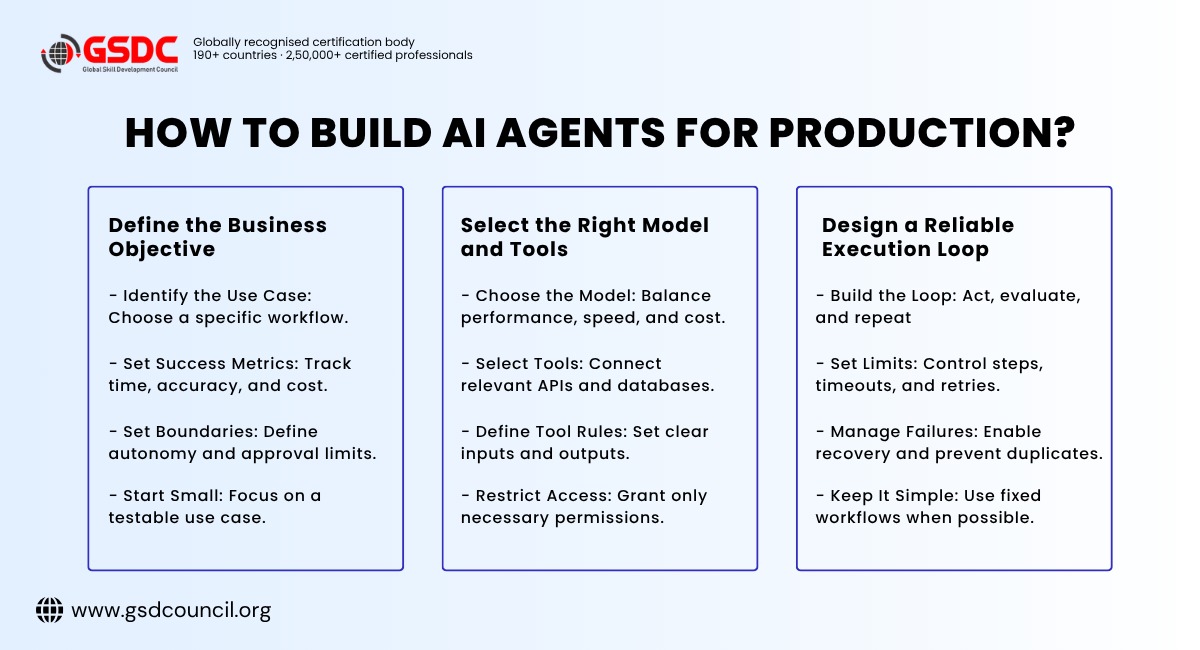
1. Define the Business Objective
Start by identifying the workflow the agent should improve. Examples include processing invoices, qualifying sales leads, resolving support tickets, or summarizing internal research.
Define measurable success criteria, such as reduced processing time, fewer manual interventions, improved accuracy, or lower operational costs.
Also establish clear boundaries. Determine which decisions the agent can make independently, which actions require human approval, and which activities are outside its scope.
A narrowly defined use case is generally easier to test, secure, and deploy than an open-ended agent expected to handle every possible request.
2. Select the Right Model and Tools
The model should match the complexity of the task, the required response speed, and the available budget.
Some workflows can use smaller, faster models for classification and extraction, while complex planning tasks may benefit from more capable models. A hybrid approach can balance performance and cost.
Next, provide the agent with carefully designed tools. These might include CRM APIs, search capabilities, document retrieval, payment systems, or internal databases.
Each tool should have a clear purpose, a well-defined input schema, validated outputs, and appropriate access permissions. Avoid giving an agent unrestricted access to enterprise systems simply because the underlying model can generate tool calls.
3. Design a Reliable Execution Loop
A typical agent execution loop involves receiving a task, selecting an action, calling a tool, evaluating the result, and deciding whether to continue or finish.
For production applications, this loop needs explicit limits. Set maximum execution steps, request timeouts, retry policies, and token budgets. Define what happens when a tool fails, the model produces an invalid response, or the task cannot be completed.
Idempotent operations, structured outputs, and durable task state can reduce duplicate actions and improve recovery after interruptions.
Importantly, not every workflow needs an autonomous reasoning loop. For predictable processes, conventional code and deterministic orchestration may be more reliable and cost-effective.
Building Effective Agentic Workflows
Agentic workflows combine AI reasoning with structured business processes to complete tasks that involve multiple steps or systems.
For example, an enterprise procurement workflow could receive a purchase request, verify budget availability, compare approved suppliers, prepare a recommendation, and route the request to the appropriate manager.
The AI agent handles tasks requiring interpretation or judgment, while conventional software enforces rules such as spending limits and approval requirements.
There are several common workflow patterns:
- Sequential workflows: Tasks execute in a predefined order, with each stage depending on the previous result.
- Conditional workflows: The system selects a path based on the request, available data, or business rules.
- Parallel workflows: Independent tasks run simultaneously to reduce processing time.
- Human-in-the-loop workflows: People review sensitive decisions or approve consequential actions.
- Multi-agent workflows: Multiple specialized agents collaborate, usually under a coordinating process.
Although multi-agent systems can be useful for complex problems, they also introduce coordination overhead, additional failure points, and higher costs. Organizations should begin with the simplest architecture that meets their requirements and introduce multiple agents only when there is a measurable benefit.
The Role of a Forward Deployed Engineer
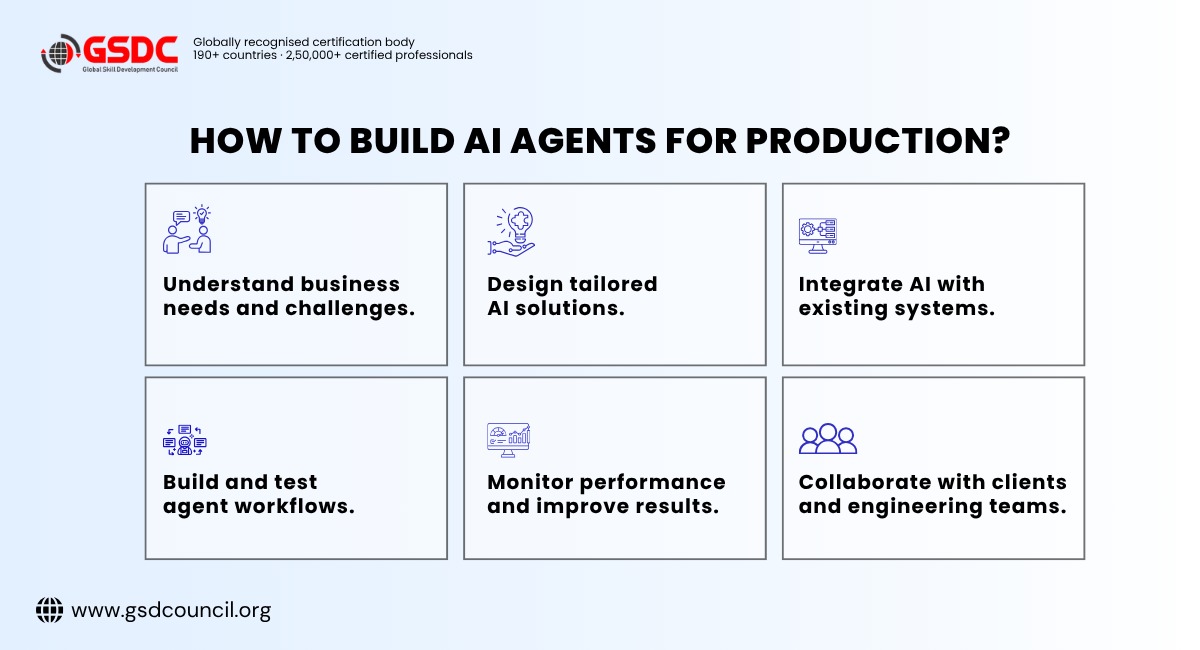
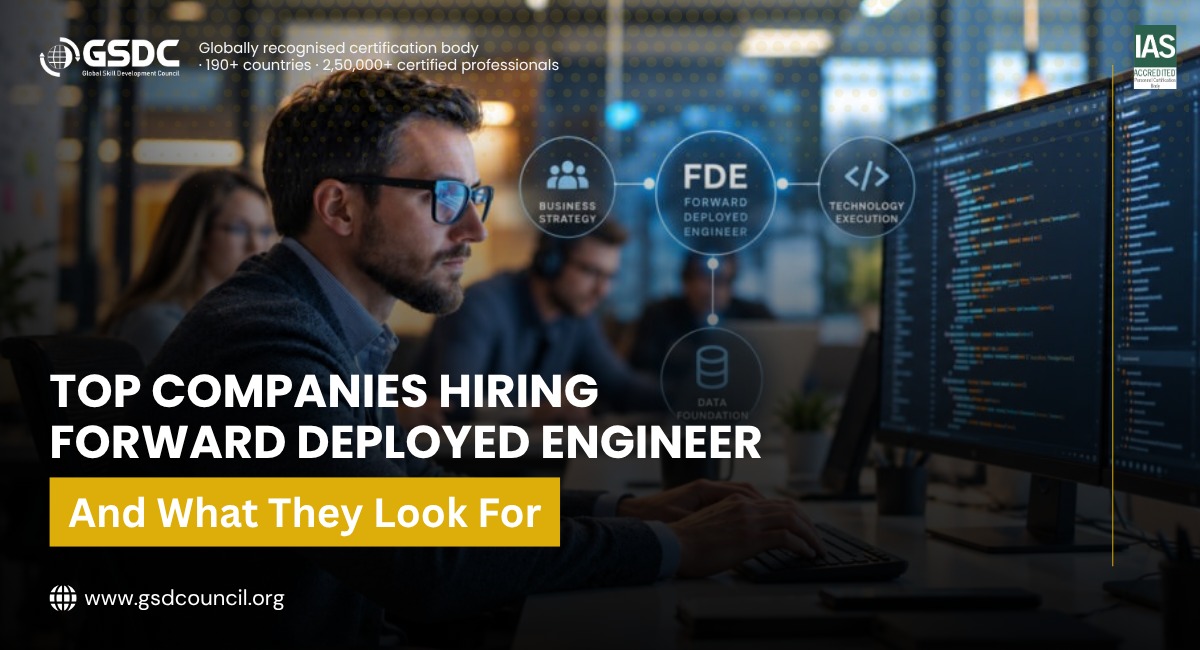
A forward deployed engineer works closely with customers or business teams to understand their operational challenges and build software solutions that address those needs.
Unlike engineers who work exclusively on general-purpose products, FDEs often operate at the intersection of product development, customer implementation, systems integration, and applied engineering.
Their responsibilities may include mapping business processes, integrating enterprise data sources, developing prototypes, testing real-world performance, and translating customer feedback into product improvements.
In agent development, an FDE must understand both the technical capabilities of AI systems and the practical realities of enterprise environments.
For example, an organization might want an AI agent to automate insurance claims processing. The FDE would examine existing workflows, identify required data sources, understand compliance obligations, define approval boundaries, and build integrations with the organization's systems.
The goal is not merely to demonstrate that an AI model can process a claim. It is to deliver a solution that fits into the organization's existing operations and performs reliably under real-world conditions.
Why Enterprises Need a Forward Deployed AI Engineer
A forward deployed AI engineer applies AI engineering expertise directly to customer-specific problems. The role combines model integration, application development, workflow design, evaluation, and deployment.
This position is particularly valuable because enterprise AI projects often face challenges beyond model quality. Legacy software, inconsistent data, security requirements, and complex approval processes can prevent otherwise promising solutions from delivering business value.
A forward deployed AI engineer helps address these challenges by:
- Connecting AI agents to enterprise applications and data sources.
- Designing retrieval systems that provide relevant, permission-aware information.
- Building evaluation datasets from realistic business scenarios.
- Improving prompts, tool definitions, and orchestration logic.
- Implementing authentication, authorization, audit logging, and data protection.
- Working with stakeholders to measure business outcomes and refine the solution.
The role also requires strong communication skills. Engineers must explain technical trade-offs, gather feedback from nontechnical stakeholders, and ensure the solution addresses the actual problem rather than simply showcasing AI capabilities.
Enterprise AI Agents: Security, Reliability, and Scalability
Enterprise AI agents operate in environments where mistakes can affect customer relationships, financial performance, regulatory compliance, or business continuity. Consequently, production readiness requires more than a capable language model.
Security and Governance
Apply least-privilege access so agents can use only the data and tools necessary for their assigned tasks. Enforce authorization in application services rather than relying on the model to follow instructions.
Treat retrieved documents, emails, and other external content as potentially untrusted. Prompt injection and malicious instructions embedded in data can influence agent behavior if appropriate safeguards are missing.
Sensitive actions, including financial transactions, account changes, and data deletion, should use deterministic policy checks and human approval where appropriate.
Reliability and Error Handling
Tool calls can fail because of network issues, rate limits, invalid inputs, or unavailable services. Production systems should implement bounded retries, timeouts, fallback behavior, and clear failure states.
Maintain task state so interrupted workflows can resume safely. Use idempotency controls for operations that could create duplicate transactions or records.
Monitoring and Evaluation
Monitor task completion rates, tool-call failures, latency, cost per successful task, and human escalation frequency.
Evaluate agents using realistic test cases, including ambiguous requests, missing information, unexpected tool responses, and adversarial inputs. Run regression tests whenever prompts, models, tools, or workflows change.
These measures help teams identify failures early and determine whether the agent delivers meaningful improvements over the existing process.
Scalability and Cost Management
Production workloads can increase rapidly as adoption grows. Use asynchronous execution for long-running tasks, queues for workload management, and caching where appropriate.
Route simple tasks to smaller models when possible, limit unnecessary context, and track the cost of complete workflows rather than individual model calls alone.
Scalability should also include operational planning: capacity limits, service-level objectives, incident response, and clear ownership of deployed systems.
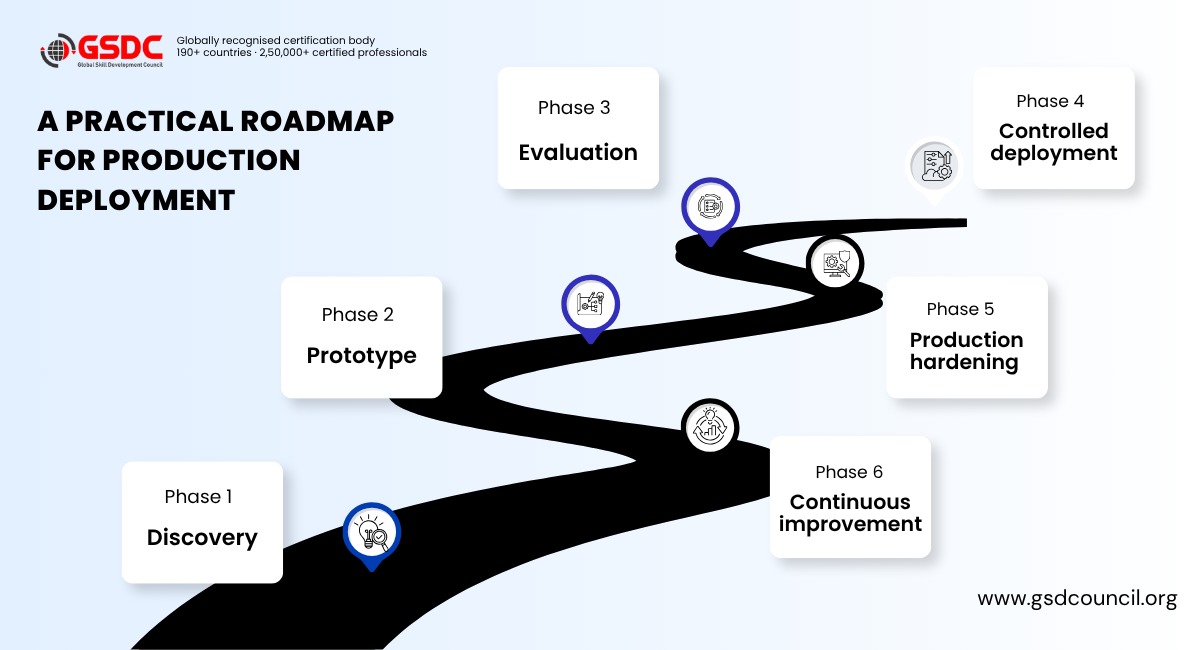
A Practical Roadmap for Production Deployment
A structured implementation process helps reduce risk and accelerate adoption.
Phase 1: Discovery.
Identify a high-value workflow, document its existing process, and establish measurable success criteria.
Phase 2: Prototype.
Build a focused agent with a small set of tools and representative test data. Validate whether the proposed approach solves the intended problem.
Phase 3: Evaluation.
Test normal scenarios, edge cases, security boundaries, and failure recovery. Compare results against the current workflow and define acceptable performance thresholds.
Phase 4: Controlled deployment.
Release the agent to a limited group of users or run it in shadow mode before enabling consequential actions. Collect feedback and monitor performance.
Phase 5: Production hardening.
Add comprehensive observability, access controls, human approval paths, incident handling, and automated regression testing.
Phase 6: Continuous improvement.
Review failures, refine workflows, update evaluation datasets, and expand capabilities only when evidence supports the change.
This approach allows organizations to validate business value before investing heavily in complex infrastructure or broad automation.
How GSDC’s Forward Deployed Engineer Certification Builds AI Agent Expertise?
GSDC’s Forward Deployed Engineer (FDE) certification helps professionals understand how AI agents are designed, developed, and deployed to solve real-world business challenges.
Forward Deployed Engineer (FDE) certification builds knowledge of agentic AI architecture, workflow automation, system integration, and production deployment. Professionals can learn how to connect AI models with enterprise systems, evaluate agent performance, and address reliability, security, and scalability challenges.
By developing these practical skills, professionals can better understand how to transform business requirements into effective AI solutions and prepare for roles involving AI engineering, enterprise automation, and production-ready agent development.
Conclusion
Designing production-ready AI agents requires a combination of AI capabilities, dependable software engineering, thoughtful workflow design, and strong operational controls. A well-planned agentic AI architecture provides the foundation, while reliable integrations, evaluation, and governance make the system suitable for real-world use.
For organizations learning how to build AI agents, the best starting point is a clearly defined business problem, a limited set of tools, and measurable success criteria. As requirements become more complex, structured agentic workflows can support broader automation without sacrificing control.
A forward deployed engineer or forward deployed AI engineer plays a crucial role in this process by bridging the gap between AI technology and business operations. By working closely with stakeholders and engineering teams, these professionals help turn experimental prototypes into secure, scalable, and valuable enterprise AI agents.

Related Certifications
Stay up-to-date with the latest news, trends, and resources in GSDC
If you like this read then make sure to check out our previous blogs: Cracking Onboarding Challenges: Fresher Success Unveiled
Not sure which certification to pursue? Our advisors will help you decide!