8 Customer Experience Skills to Build a Successful CX Career

Written by Matthew Hale
- Customer Experience Skills at a Glance
- Customer Service vs Customer Experience: What's the Difference?
- 1. Customer Service Skills: The Foundation of Every CX Role
- 2. Empathy in Customer Service: Understanding the Person Behind the Problem
- 3. Data and Feedback Analysis: Turning Comments Into Insight
- 4. Journey Mapping and Problem Solving: Finding Where the Experience Breaks
- 5. AI in Customer Experience: Knowing Where Technology Helps and Where It Doesn't
- 6. Cross-Team Collaboration: Getting Other Departments to Act
- 7. Business Thinking: Linking CX Work to Revenue and Cost
- 8. Leadership and Change Management: The Core of Customer Experience Manager Skills
- Putting the Skills Together: A Refund Example
- Customer Experience Career: Roles, Growth and Where to Start
- How to Build Customer Experience Skills Without Waiting for a Promotion
- Common Mistakes People Make in a CX Career
- Ready to Build a Stronger CX Career?
- Final Thoughts
Most unhappy customers don't complain. They just spend less. Nearly half of bad customer experiences lead to reduced spending, according to a global survey of more than 20,000 consumers, and companies often never find out why.
That silence is the reason businesses keep hiring people who can spot quiet problems, understand the customer behind them, and get the fix moving across teams. Those people share a set of customer experience skills, and the good news is that nearly all of them can be learned.
Maybe you work on a support desk and want a bigger role. Maybe you're starting a customer experience career from scratch, or building a team. Either way, the eight skills below are the ones that keep showing up in strong CX professionals. Each one comes with a plain explanation, a reason it matters, and a simple way to start building it.
Customer Experience Skills at a Glance
- Customer service skills: the base every CX role is built on
- Empathy: understanding what the customer actually feels
- Data and feedback analysis: turning comments and numbers into insight
- Journey mapping and problem solving: finding where the experience breaks
- AI and digital fluency: knowing where technology helps and where it hurts
- Cross-team collaboration: getting other departments to act
- Business thinking: linking CX work to revenue and cost
- Leadership and change management: the core of customer experience manager skills.
Customer Service vs Customer Experience: What's the Difference?
People use the two terms as if they mean the same thing. They don't.
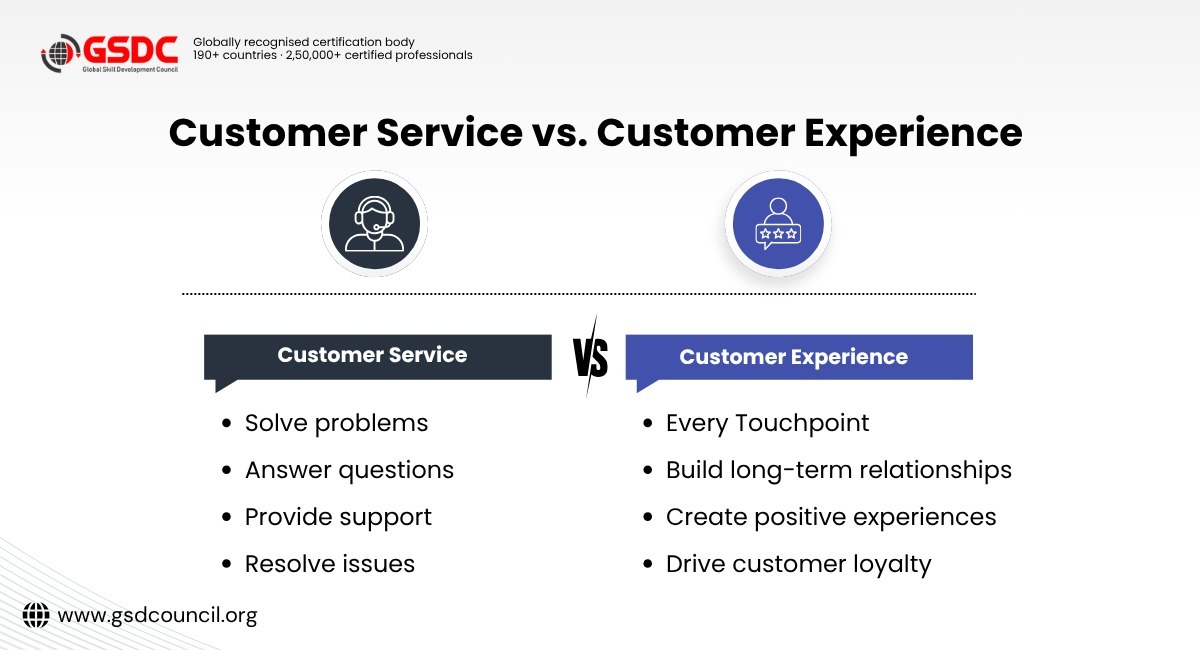
- Customer service is helping one customer solve one problem, usually after they ask for help.
- Customer experience (CX) is the whole relationship: every step from the first ad or website visit to billing, delivery, support and renewal.
Service is one part of experience. That's why strong customer service skills are the starting point, but CX roles ask for more: analysis, design thinking and the ability to change how a company works.
1. Customer Service Skills: The Foundation of Every CX Role
Before you can improve an experience, you need to know what it feels like to sit on the front line. The U.S. Bureau of Labor Statistics lists communication, listening, patience, interpersonal and problem-solving skills as the qualities that matter most in customer-facing work. That list still holds up for CX professionals at every level.
The customer service skills worth sharpening first:
- Active listening: hearing the real issue, not just the first sentence
- Clear writing: short, calm replies that don't need a second email to explain
- Patience: staying steady when a customer is upset
- Product knowledge: answering without bouncing people between teams
- Ownership: staying with a problem until it's actually solved
How to build it: Spend time on live chats or calls, even a few hours a month. Listen to recorded conversations from your best colleague and write down what they do differently.
2. Empathy in Customer Service: Understanding the Person Behind the Problem
Empathy in customer service means understanding what the customer feels and showing that you understand it, in words and in what you do next. It isn't the same as agreeing with everything, and it isn't a script.
Picture a customer whose birthday gift arrived three days late. Giving a refund fixes the order. Saying "I'm sorry this missed the birthday, that's frustrating" fixes the moment. Customers remember the second part.
Why it matters for a CX career: empathy is what helps you design better experiences, not just handle complaints. If you can picture how a confusing form feels at 11 pm on a phone screen, you'll fix it differently.
How to build it:
- Ask one more question before offering a solution
- Name the feeling in plain words ("that sounds stressful")
- Read real customer complaints out loud, without defending the company
- Follow up after the fix, because it shows the customer wasn't just a ticket number.
3. Data and Feedback Analysis: Turning Comments Into Insight
CX runs on listening, and listening produces a lot of messy information: surveys, reviews, call notes, social posts. The skill is making sense of it.
First, know the three metrics you'll meet in almost every CX team:
- NPS (Net Promoter Score): how likely customers are to recommend you
- CSAT (Customer Satisfaction Score): how satisfied they were with a specific interaction
- CES (Customer Effort Score): how hard it was to get something done
Scores tell you something is off. The written comments tell you why. Because fewer than one in three customers share negative feedback directly, good analysts also learn to read indirect signals such as reviews, social media and repeat contact reasons.
How to build it: Pull 100 recent support tickets, tag each by the main reason for contact, and count the top five. Present them in one page. That small exercise is a real portfolio piece.
4. Journey Mapping and Problem Solving: Finding Where the Experience Breaks
A customer journey map is a simple picture of every step a customer takes, from discovering a product to getting help or renewing. Next to each step, you note what the customer is trying to do, how they feel, and where they get stuck.
The real skill is problem solving. A slow refund isn't the problem. It's a symptom. The cause might be a manual approval step, a missing field, or a policy nobody has reviewed in years.
How to build it:
- Map one journey you know well, such as signing up or returning an order
- Mark the three biggest friction points
- Use the "five whys" habit: keep asking why until you hit a cause you can actually change.
5. AI in Customer Experience: Knowing Where Technology Helps and Where It Doesn't
AI in customer experience is no longer a side project. Chatbots, auto-summaries and smart routing now sit inside most service operations. The U.S. Bureau of Labor Statistics expects less demand for service representatives because self-service systems and mobile apps are taking over simple tasks, while some companies are expected to keep in-house service teams for complex inquiries.
That split matters, because AI doesn't always land well with customers. In a global survey of more than 20,000 consumers, nearly one in five people who used AI for customer service saw no benefit, a failure rate almost four times higher than for AI use in general. The same research found three common worries:
- 53% fear their personal data will be misused
- 50% worry AI will stop them from reaching a real person
- 47% worry about job losses
So the skill here isn't "use AI for everything." It's judgment:
- Know which requests are simple enough to automate and which need a human
- Test chatbots and review transcripts to see where customers get stuck
- Make it easy to reach a person when the bot can't help
- Understand basic data privacy, so personalisation doesn't feel creepy
How to build it: Ask your company's chatbot ten real customer questions and note where it fails. Then suggest one fix. That's the kind of practical example hiring managers like to hear about.
6. Cross-Team Collaboration: Getting Other Departments to Act
Here's something that surprises many new CX professionals: most experience problems don't live inside the CX team. Late deliveries sit with logistics. Billing confusion sits with finance. A clunky app sits with product.
So you'll spend a lot of time influencing people who don't report to you. That takes:
- Clear, short writing that makes the problem easy to understand
- Evidence, such as customer quotes, numbers and journey maps
- Patience with other teams' priorities
- The habit of sharing credit when a fix works
How to build it: Choose one recurring complaint and work with one other team to fix it. Even a small win teaches you more than a course on stakeholder management.
7. Business Thinking: Linking CX Work to Revenue and Cost
Leaders fund what they can measure. If you can say "fixing this step could cut repeat calls and keep more customers" you'll get a very different reaction than if you say "customers find this annoying."
Business thinking for CX means getting comfortable with a few ideas:
- Churn: customers who leave
- Retention: customers who stay
- Cost to serve: what it costs to handle each contact
- Lifetime value: how much a customer is worth over time
You don't need to be a finance expert. You need to explain a CX improvement in terms a CFO would care about.
How to build it: Next time you suggest a fix, add one line on what it would likely save or protect, even as a rough estimate, and state your assumptions.
8. Leadership and Change Management: The Core of Customer Experience Manager Skills
As you move up, the work shifts from doing to guiding. Customer experience manager skills lean heavily on leadership:
- Coaching: helping team members improve, not just measuring them
- Setting standards: defining what a good experience looks like and how it's checked
- Change management: helping people adopt new processes without resistance
- Prioritising: choosing which problems to fix first when everything feels urgent
- Reporting: explaining results clearly to senior leaders
How to build it: Volunteer to mentor a new joiner, lead a small improvement project, or run a monthly review of customer feedback with your team.
If you're aiming for a manager role, one structured option is the Certified Customer Experience Professional certification, which covers customer experience strategy and data-driven action planning.
Putting the Skills Together: A Refund Example
Skills make more sense when you see them work side by side. Here's an illustrative scenario, not a real case.
A CX specialist notices that customers keep contacting support about slow refunds. Here's how several skills come into play:
- Service skills and empathy: reading the tickets and hearing how stressful it is to wait for your money
- Data analysis: tagging a few hundred recent tickets and spotting that larger refunds take far longer than smaller ones
- Journey mapping: mapping every refund step and finding a manual approval that adds days
- AI fluency: checking whether the chatbot passes refund questions to a person or leaves customers going in circles
- Collaboration and business thinking: showing finance how many repeat contacts the delay creates, then proposing automatic approval for low-value refunds
- Leadership: tracking results after the change and sharing what worked with the wider team
No single skill solves this. The fix comes from using them together, which is exactly what employers look for in a CX career.
Customer Experience Career: Roles, Growth and Where to Start
What does a customer experience specialist do?
A customer experience specialist is often the first dedicated CX role. The work usually involves handling escalated customer issues, collecting and reviewing feedback, spotting repeat problems, and helping the wider team fix them. Many people reach this role from front-line support, which is why strong customer service skills and empathy count so much early on.
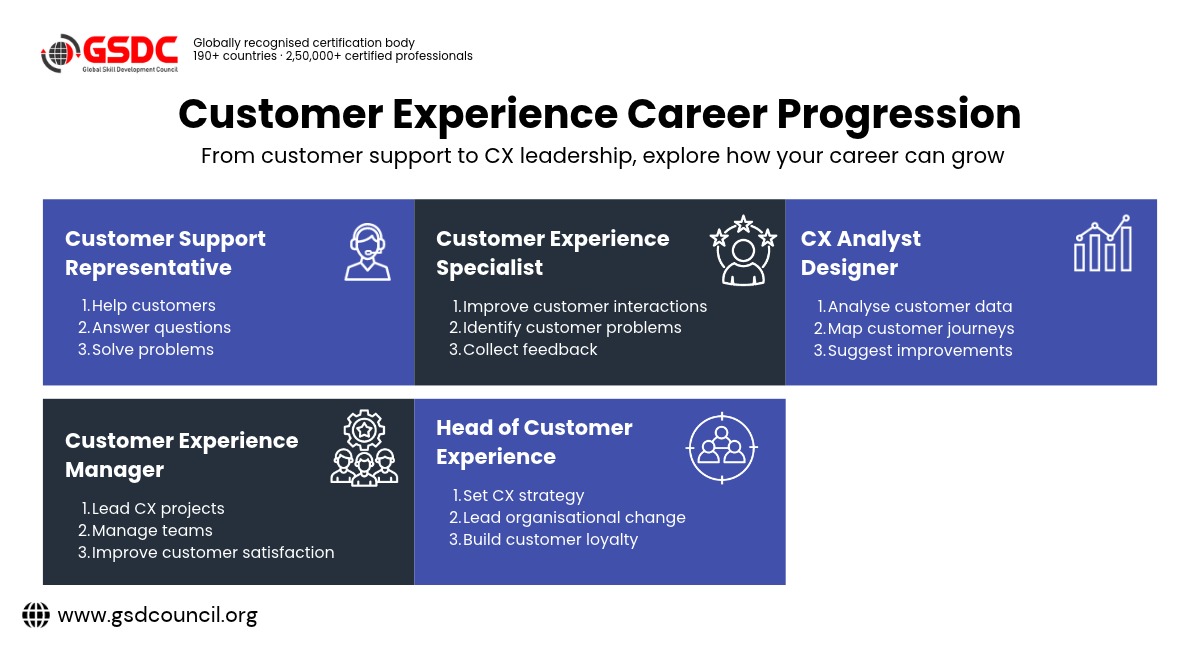
Common customer experience roles and the skills they lean on
Titles vary from company to company, but most customer experience roles fall into the pattern below.
Role | What the role does | Skills that matter most |
Customer experience specialist | Handles escalations, gathers feedback, supports CX projects | Customer service skills, empathy, basic data skills |
CX analyst | Tracks metrics, studies feedback, builds reports | Data analysis, AI fluency, clear writing |
Journey or service designer | Maps journeys and redesigns touchpoints | Journey mapping, empathy, collaboration |
Voice of customer manager | Runs surveys and listening programs | Data analysis, collaboration |
CX manager | Owns CX plans, leads a team, reports results | Leadership, business thinking, collaboration |
Head of CX | Sets CX strategy and drives company-wide change | Business thinking, leadership, change management |
From entry-level support to leadership: which skills to prioritise
Most people move through the roles above in stages. Each stage asks you to lean on a different mix of skills.
- Entry-level support: customer service skills and empathy. Learn the product and the customer first.
- CX specialist: add basic data skills and journey mapping so you can spot patterns, not just solve single cases.
- Analyst or designer: go deeper on data analysis, journey mapping and AI fluency.
- CX manager: focus on collaboration, business thinking and leadership.
- Head of CX: prioritise business thinking, change management and influence at executive level.
As the roles become more strategic, some people look for a formal way to build and show what they know. Professional bodies such as Global Skill Development Council (GSDC) offer structured learning in areas like customer experience strategy and data-driven planning. Like any formal learning, it helps most when it sits next to real examples of your work.
Why these skills matter more as routine work gets automated
The U.S. Bureau of Labor Statistics projects that customer service representative employment will decline about 5 percent over the decade, mainly because automation is absorbing simple tasks. It's not a reason to avoid the field. It's a signal about where the value is moving: toward judgment, analysis, empathy and problem solving, the things software handles poorly.
How to Build Customer Experience Skills Without Waiting for a Promotion
You don't need a new job title to start. These steps work from almost any starting point:
- Ask to read customer feedback: Offer to summarise it monthly for your team.
- Build a small portfolio: One journey map, one before-and-after fix, and one metric summary go a long way.
- Learn one analytics or survey tool. Spreadsheets and basic dashboards are enough to begin.
- Practise with AI tools: Test them, break them, and note what you learn.
- Find a mentor in CX or a nearby team: such as product or operations.
If you prefer a structured path, a credential can help. The Certified Customer Experience Professional certification from Global Skill Development Council (GSDC) covers customer experience strategy and data-driven action planning. A credential works best next to real examples of your work, so use both.
Common Mistakes People Make in a CX Career
- Treating CX as only surveys and scores
- Choosing a tool before understanding the problem
- Ignoring silent customers, who are often the ones about to leave
- Automating so much that customers can't reach a human
- Presenting problems without a suggested fix.
Ready to Build a Stronger CX Career?
Reading about CX skills is a start. Putting them into practice is what helps you grow. GSDC's Certified Customer Experience Professional certification offers a structured path to developing customer experience strategy and data-driven action planning. Pair your learning with practical work, such as a customer journey map or feedback analysis, to demonstrate what you can do. Explore the certification to see if it fits your career goals.

Final Thoughts
Customer experience skills fall into three layers. The first is people skills: service, empathy and listening. The second is thinking skills: analysis, journey mapping and judgment about AI. The third is influence skills: collaboration, business thinking and leadership. Strong CX professionals grow in all three over time, and nobody has them all on day one.
Pick one skill from this list, try one practical exercise this week, and keep notes on what you learn. In a few months you'll have real examples to talk about in an interview.

Related Certifications
Frequently Asked Questions
The most important customer experience skills are customer service skills, empathy, data analysis, journey mapping, AI fluency, collaboration, business thinking and leadership. Which ones matter most depends on your role: front-line roles lean on service skills and empathy, while manager roles lean on leadership and business thinking.
A customer experience manager needs leadership, coaching, change management, data interpretation and business thinking, along with a solid grounding in customer service. They also need to work well with other departments, because most CX problems are fixed outside the CX team.
Yes. Many CX professionals start in support. Moving across usually means adding skills in data analysis, journey mapping and cross-team work, and showing them through real examples, such as a feedback summary or a process fix you led.
AI is taking over simple, repetitive requests, so human roles are shifting toward complex problems, quality checks and experience design. Professionals who understand where AI works well, and where it frustrates customers, are in a stronger position.
Yes. Some people find it easier than others, but it can be practised: asking better questions, listening without interrupting, naming the customer's feeling, and following through after the fix.
Stay up-to-date with the latest news, trends, and resources in GSDC
If you like this read then make sure to check out our previous blogs: Cracking Onboarding Challenges: Fresher Success Unveiled
Not sure which certification to pursue? Our advisors will help you decide!