7 Ways Generative AI Is Improving Regulatory Compliance
Written by Matthew Hale
- What Is Generative AI and How Does It Work
- Generative AI Adoption in Risk and Compliance
- 7 Ways Generative AI Is Improving Regulatory Compliance
- Challenges of Using Generative AI in Compliance
- Why AI Skills Are Important for Compliance Professionals
- Building Skills in Generative AI for Risk and Compliance
- Conclusion
Due to the increasing number of regulations, data requirements, and reporting obligations, regulatory compliance is getting more complicated. For example, finance, healthcare, and financial services are heavily regulated industries that have to keep track of all regulatory developments, maintain detailed records, and manage all types of compliance risks.
First, doing all these things manually will take a lot of time and resources. For the most part, compliance teams need to sift through large volumes of data and regulatory content to verify that they are meeting all the relevant requirements.
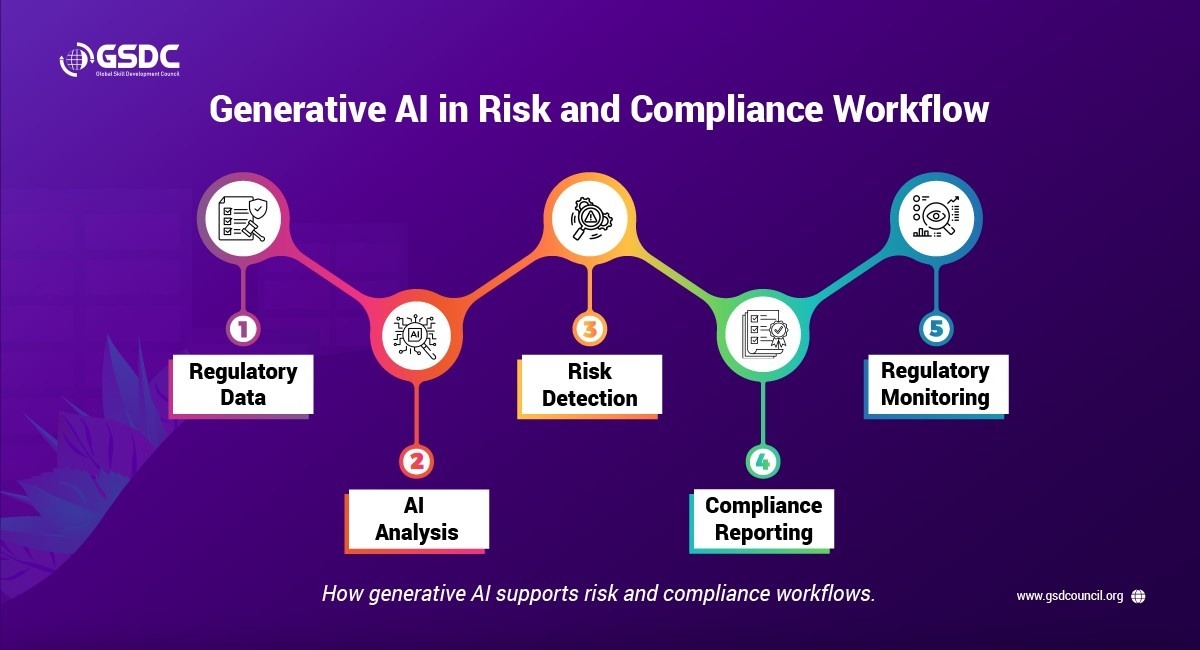
This is why generative AI is transforming risk and compliance processes. AI tools can analyze data, generate reports, summarize regulatory requirements, and help organizations manage compliance tasks faster.
According to a 2025 industry report surveying 224 senior risk and compliance professionals, 98.2% say generative AI is creating new challenges for risk and compliance teams, particularly in areas such as financial crime prevention, cybersecurity, and governance.
Before exploring its benefits, it is important to understand what is generative AI and how does it work.
What Is Generative AI and How Does It Work
Generative AI means artificial intelligence systems that can produce new content, like reports, summaries, insights, or even recommendations, based on existing information.
Generative AI uses machine learning models to process vast amounts of information and produce meaningful results. For instance, AI systems can analyze regulatory documents, identify key requirements, and even assist organizations with the development of their compliance reports.
However, many organizations are yet to gain trust in AI governance. Research indicates that few risk and compliance professionals are very confident in handling generative AI risks in their organizations.
Generative AI Adoption in Risk and Compliance
Recent research highlights how quickly generative AI is influencing compliance operations:
- 98.2% of professionals say generative AI introduces new risk and compliance challenges
- 45.3% say data quality and availability are the biggest barriers to AI adoption
- More than 620 potential generative AI applications have been identified across risk and compliance functions spanning the entire risk management lifecycle from initial identification through treatment, monitoring, and continuous improvement.
These insights show that while adoption is growing, organizations still need stronger governance frameworks and AI expertise.
7 Ways Generative AI Is Improving Regulatory Compliance
Generative AI is revolutionizing how organizations manage regulatory compliance in silence and with precision. Many tasks are being performed faster and more accurately. Here are the key ways in which this technology is making life easier for organizations:
1) Accelerating analysis of regulatory documents
Regulatory documents are voluminous and intricate. Hence, it takes a lot of effort for organizations to understand and comply with regulations.
Generative AI can quickly read through regulatory documents and identify key updates for organizations.
For example, a bank can use AI to quickly understand updates in banking regulations for its internal use.
2) Assisting in the generation of compliance reports
Regulatory reporting is another key aspect of regulatory compliance.
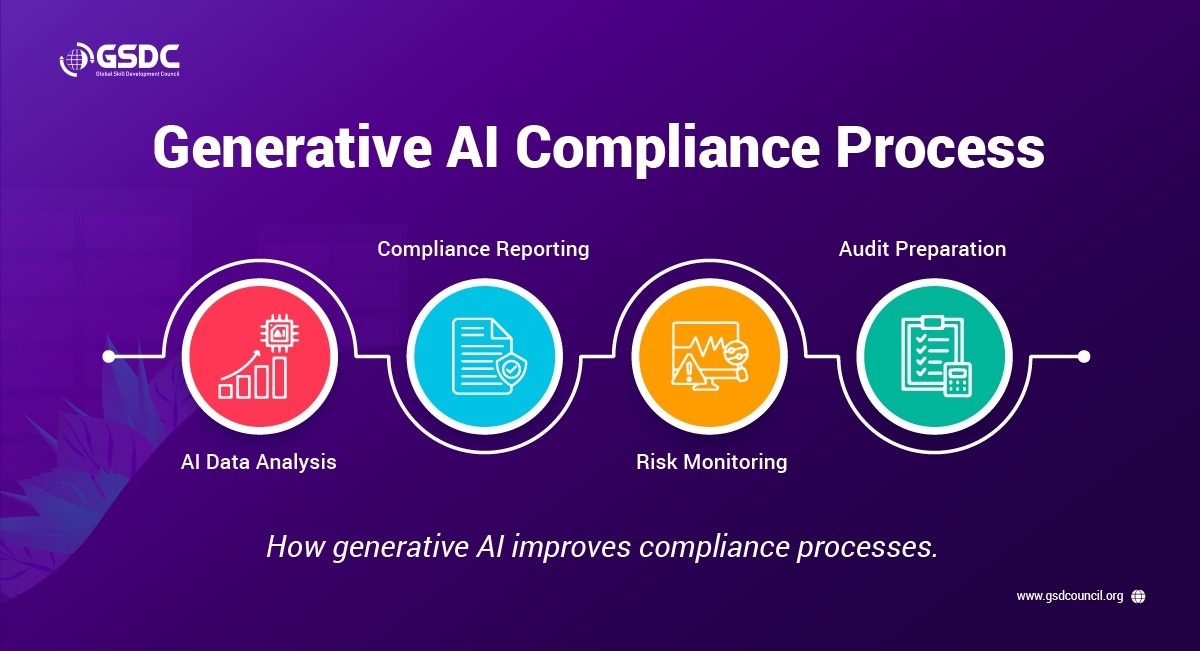
Gen AI can assist organizations in generating such reports by analyzing internal data and comparing it with regulatory guidelines.
For example, banks can use AI to generate anti-money laundering (AML) monitoring reports.
3) Detecting various types of regulatory risks
Regulatory risks come in many shapes and sizes. They can be related to regulations, data privacy, financial reporting, operational, and third-party risks.
Generative AI can help organizations identify various types of regulatory risks by analyzing internal data.
- Regulatory risk
- Data privacy risk
- Financial reporting risk
- Operational compliance risk
- Third-party compliance risk
Generative AI can analyze internal data and identify potential compliance issues before they become serious problems.
Example: AI systems can detect unusual transaction patterns that may indicate fraud or violations of regulatory requirements.
4) Assisting in policy formulation
The policies must be constantly updated to keep pace with the changing regulations.
AI tools can help create and update compliance documents, including a generative AI policy, by analyzing regulations and generating policy drafts.
Example: A compliance department can use AI to update its policies according to new data privacy regulations.
5) Improving Ongoing Compliance Monitoring
Monitoring is an essential aspect of compliance, and AI can help in this process.
Generative AI can help in monitoring employee communications or financial activities to detect any irregularities, such as insider trading.
Example: AI can monitor employee communications or financial transactions to identify potential insider trading or compliance breaches.
6) Improving Audit Preparation
Audits are often tedious, especially when there are many documents to gather for the audit process.
AI can help in preparing for the audit process by gathering all the necessary documents and preparing them for review.
Example: Before a regulatory audit, AI tools can compile compliance reports and summarize key risk controls for auditors.
7. Improving Regulatory Knowledge Access
There are many regulations, and these are constantly changing.
Generative AI can act as a guide to these regulations, providing necessary information to the compliance team.
Example: A compliance officer can ask an AI assistant about a specific regulatory requirement and receive a summarized explanation instantly.
Experts who understand Generative AI in Risk and Compliance are more likely to deal with issues arising from it as it becomes more popular. The importance of certification programs, such as the Generative AI in Risk and Compliance certificate, is that they provide practical skills to utilize AI in compliance and risk management skills that translate directly into premium pay, as detailed in GSDC's generative AI compliance salary report.
Challenges of Using Generative AI in Compliance
Despite all the benefits of using generative AI, there are also various challenges that organizations face when it comes to using this technology.
Some of the common challenges of using generative AI are:
- Data quality and availability issues
- AI governance and accountability concerns
- Regulatory clarity on AI usage
- Security and privacy risks
Organizations require proper governance and proper guidelines on generative AI policy to adopt AI properly. Organizations such as the Global Skill Development Council (GSDC) also work to spread awareness and develop skills on the proper usage of AI in risk and compliance, including through its ai governance certification program.
Why AI Skills Are Important for Compliance Professionals
Compliance work has become more technology-dependent, and therefore, compliance professionals need to be aware of what generative AI means and how it works. This will enable the effective handling of regulatory requirements.
Compliance professionals with AI skills will be in a position to assist their organizations in the following ways:
- Enhance their reporting capabilities through the use of AI, which will enable the production of accurate reports quickly
- Enhance their capacity to identify risks in good time, considering the large volumes of data handled by AI
- Enhance their capacity to automate their work, thereby reducing the workload associated with compliance requirements
- Enhance their capacity to manage regulatory requirements more effectively, considering the use of AI in governance and compliance functions.
As organizations continue to adopt AI in governance and compliance functions, developing AI skills is becoming increasingly important for compliance professionals.
Building Skills in Generative AI for Risk and Compliance
As AI is becoming more popular, professionals need to understand how they can utilize Generative AI in Risk and Compliance.
The Global Skill Development Council (GSDC) offers the Certified Generative AI in Risk and Compliance credential to help professionals learn how AI supports compliance management, governance frameworks, and different types of compliance risk.
This program helps professionals develop practical skills to use generative AI responsibly in risk and compliance operations.
Conclusion
Regulatory compliance is becoming more and more complicated and data-intensive. Organizations are expected to manage extensive amounts of regulations while also managing several compliance risks.
This is the reason for the significant impact of generative AI on compliance activities across different sectors. From managing regulations to generating reports and managing risks, AI technologies are helping organizations manage compliance more effectively.
As more and more organizations start using AI technologies, those that are also good at managing compliance will be able to manage regulatory complexities and risks.

Related Certifications
Frequently Asked Questions
Stay up-to-date with the latest news, trends, and resources in GSDC
If you like this read then make sure to check out our previous blogs: Cracking Onboarding Challenges: Fresher Success Unveiled
Not sure which certification to pursue? Our advisors will help you decide!