Generative AI in Enterprise Software: Adoption Trends 2026
Written by Matthew Hale
By early 2026, generative AI in enterprise software has shifted from experimentation to execution. What started with isolated chatbots and coding assistants is now embedded across software development, IT operations, analytics, customer experience, and decision support.
For those who are still unaware of what generative AI is and how it works, it is artificial intelligence that can create content, code, and analyze data based on context and company data. With more companies becoming aware of how generative AI works in real-life situations, the question of whether to adopt it has changed to how to make the most out of generative AI for enterprise transformation in an ethical, secure, and sustainable manner.
For those who have already adopted it, they are seeing real benefits, such as increased productivity, faster delivery, and better innovation.
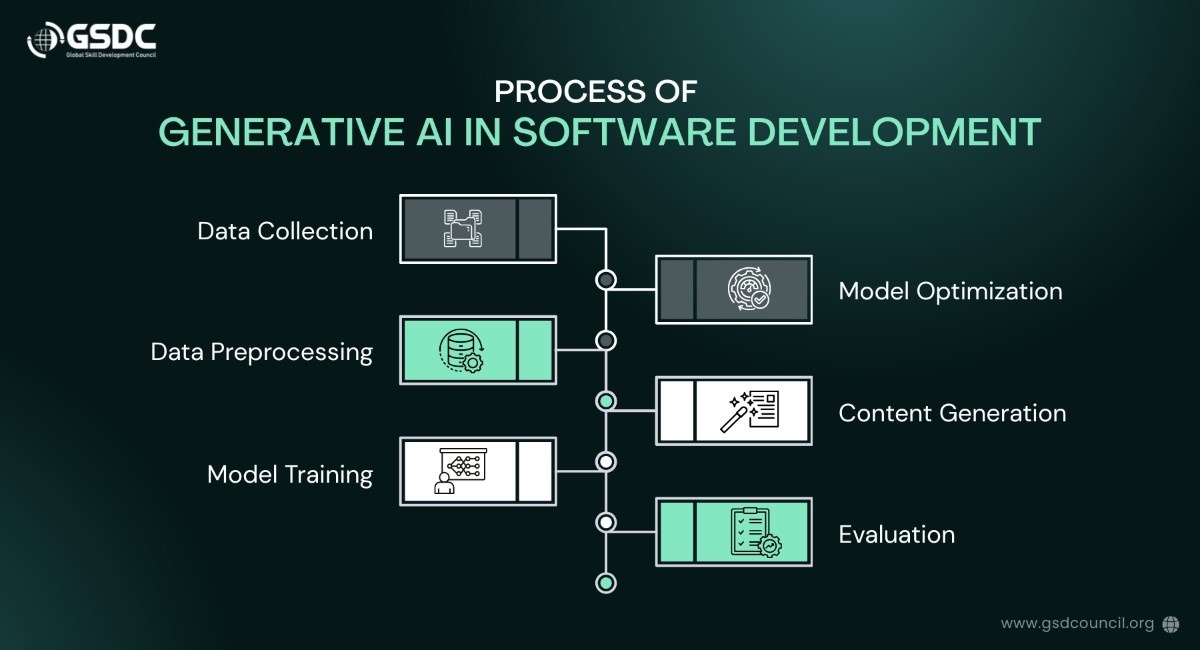
How Generative AI Is Being Used in Enterprise Software in 2026
In 2026, Generative AI is no longer limited to pilot projects; over 70% of organizations now employ generative AI across business functions, thus changing the very essence of the operation of core enterprise processes daily.
|
Enterprise Function |
How Generative AI Is Applied |
Business Impact |
|
Software Development |
AI-assisted coding, code reviews, refactoring, and documentation |
Faster release cycles, reduced technical debt |
|
Quality Assurance |
Automated test case generation, defect prediction |
Improved software reliability |
|
DevOps & IT Operations |
Incident analysis, predictive alerts, auto-remediation suggestions |
Reduced downtime, faster recovery |
|
Business Analytics |
Natural language queries on enterprise data, report generation |
Faster decision-making |
|
Customer Experience |
AI-powered service agents, workflow automation, in-app support |
Improved response times and user satisfaction |
|
Knowledge Management |
Auto-generated SOPs, internal knowledge bases |
Faster onboarding and training |
These examples represent practical enterprise use cases for generative AI, showing how organizations are embedding AI directly into core enterprise workflows. In customer-facing platforms, some enterprises are even adopting enterprise generative AI in-app marketing tools to personalize messaging, optimize user journeys, and improve engagement inside SaaS applications.
Key Enterprise Trends Shaping 2026
Generative AI adoption in company settings is predicted to grow rapidly in 2026, with a 2025 Wharton-GBK survey revealing that 82% of business leaders use generative AI for work at least weekly, and nearly half use it daily, which shows how AI is nowadays a work tool deeply integrated into the workflows.
1. From Simple AI Tools to AI-Enabled Workflows
Generative AI has ceased to be a matter of making single tools. It is now part of ERP, CRM, ITSM, and DevOps systems. Thus, the companies can go from the use of isolated AI to fully AI-enabled workflows that continuously support decision-making and business operations across all departments.
2. Enterprises Increasingly Invest in AI Governance
The organizations intensify their focus on governance frameworks, defining the responsible use of technology as the adoption rolls out rapidly. Most companies now include data privacy, auditability, explainability, and regulatory compliance in their generative AI for business transformation strategies, and this is particularly true of regulated industries.
3. Productivity at Scale
Organizations that use generative AI for enterprise productivity report that they have saved a significant amount of time in activities such as documentation, reporting, analysis, and repetitive operational tasks. As a result, knowledge workers are able to dedicate more time to strategic, innovative, and high-value work that has a direct impact on the company's results.
4. Domain-Specific AI Models
Instead of only relying on generic models, organizations are deploying domain-adapted AI that is trained with their own data and industry-specific knowledge. This leads to better precision and pertinence, thus cementing generative AI enterprise use cases in fields like finance, healthcare, manufacturing, and technology.
By mastering these capabilities, enterprises are reaching out to structured skill development and governance frameworks, such as those promoted by the Global Skill Development Council (GSDC), in increasing numbers to enable an accountable, generative AI integration in the enterprise that is ready for the market.
Business Value of Generative AI for Enterprises
Generative AI is no longer a capability of the future; it is a lever of present business. By 2026, enterprises continue to move beyond pilots to gain strengths in efficiency, speed, and decision quality through AI integration in core workflows, which will enhance human work and keep the human influence in the era of rapidly advancing technologies.
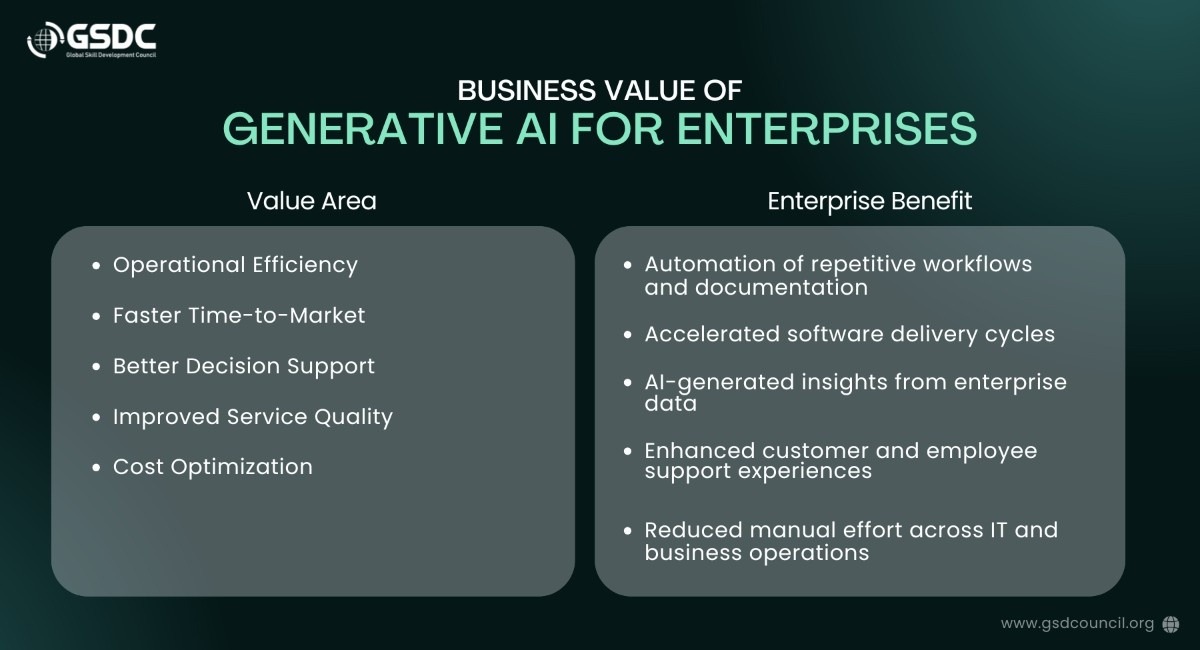 1. Operational Efficiency
Generative AI automates repetitive workflows such as translating, creating reports, knowledge updating, and routine process support. It cuts the manual work, reduces the number of mistakes, and raises the level of operational throughput not only in the core businesses but also in the IT departments.
2. Faster Time-to-Market
Generative AI enables software development, testing, and deployment cycles to be done much quicker, and as a result, enterprises can put their products and features on the market sooner than before. Teams can get from ideation to execution faster, keeping pace with the customer and market demands.
3. Better Decision Support
Generative AI makes it possible to communicate with enterprise data using natural language, and it can also extract insights from large datasets. Hence, it enables leadership and operational teams to get their decisions done faster and more accurately, even without deep technical expertise.
4. Improved Service Quality
Customer and employee support experiences are greatly improved by AI-powered assistants and workflow automation. Thus, it results in quicker response times, more uniform service quality, and an overall increase in satisfaction at all digital touchpoints.
5. Cost Optimization
Generative AI can help enterprises to optimize costs while still being able to maintain or even improve service levels through helping reduce manual work across IT operations, support functions, and business processes. Bit by bit, it will lead to measurable efficiency gains and better ROI from digital transformation initiatives.
In these areas, generative AI for software development is still amongst the fastest ways in delivering ROI, allowing engineering teams to increase velocity, lessen rework, and preserve higher code quality at scale.
Challenges Enterprises Must Address in 2026
Even though they are getting wiser, enterprises still experience difficulty in using generative AI to benefit their business:
-
Integration Complexity:
Using generative AI with old systems needs a new plan for architectures and changes in the organization that are hard to manage.
-
Data Security & Compliance:
Their privacy should be the first thing businesses think about when using AI to get work done.
-
Skill Readiness:
Besides getting new skills, teams also need to learn how to work with AI in various ways, like governance, validation, and learning the production environment of generative AI.
-
Trust and Reliability:
Before they can use AI-generated outputs for their vital processes, enterprises have to put certain checks in place to ensure the outputs are correct.
In order to solve these problems in a way that is not a one-time fix, a lot of companies are making the development of AI capabilities part of their formal training programs. For example, a Certification in Generative AI in Software Development can be the training that prepares the team technically, in governance, and operations for the rollout of AI at the enterprise level.
What Enterprises Should Focus on Going Forward
In order to unleash sustainable value from generative AI in the enterprise environment, companies should:
- Direct AI adoption towards achieving business goals rather than experimenting only
- Make generative AI for enterprise use an integral part of core platforms and workflows
- Set up effective governance and risk management’ structures
- Initiate workforce upskilling, training, and generative AI certification programs
- Regularly evaluate the business impact and fine-tune AI, enabling workflows
With enterprises striving to enhance internal AI capability and responsible adoption practices, formal learning paths and generative AI certification programs are becoming more and more critical.
Enterprise Readiness & Capability Building
With generative AI increasingly integrated into enterprise software and work processes, merely having the right tools will not be enough to ensure success. It will also require a combination of skills and governance. Consistently aligned global frameworks backed by the Global Skill Development Council (GSDC), and initiatives such as the Certification in Generative AI in Software Development serve as a means for organizations to develop the appropriate skills needed for the responsible use of Generative AI at scale.
Conclusion
As early as 2026, it is evident that generative AI in enterprise software is turning into a basic capability rather than a luxury innovation. The game changes to which organizations can most efficiently use generative AI for business transformation as part of their operations to gain a competitive edge.
The ones that mix good governance, technical preparedness, and employee activation will have the upper hand in leveraging enterprise generative AI for the creation of value over the long term and be the leaders in the subsequent generation of AI-driven transformation.
FAQ’s
What is generative AI in enterprise software?
Generative AI in enterprise is about artificial intelligence systems that produce content and code, and give insights via business software to improve productivity and decision-making.
How does generative AI work in enterprise environments?
By using pre-trained models, generative AI understands the context and hence produces output. These outputs are then blended with enterprise workflows and systems.
What are enterprise use cases for generative AI?
Generative AI in enterprises is largely utilized for software development, IT operations, analytics, customer support, and knowledge management.
How can organizations use generative AI for enterprise transformation?
An enterprise can transform itself by incorporating core generative AI platforms, utilizing governance controls, and ensuring that AI projects are in alignment with business goals.
Is certification useful for generative AI in enterprises?
A generative AI certification, such as a Certification in Generative AI in Software Development, effectively equips teams with the necessary skills to adopt generative AI in enterprise scenarios.

Related Certifications
Stay up-to-date with the latest news, trends, and resources in GSDC
If you like this read then make sure to check out our previous blogs: Cracking Onboarding Challenges: Fresher Success Unveiled
Not sure which certification to pursue? Our advisors will help you decide!