5 Ways Generative AI Is Transforming Supply Chain Management
Written by Matthew Hale
- What Is Generative AI in Supply Chain Management?
- AI Impact on Supply Chain Management: Where Real Value Is Created
- Key Challenges in Applying AI in Supply Chain Environments
- The Strategic Role of AI in Supply Chain Management
- The Future of Generative AI in Supply Chains
- Preparing the Workforce for AI-Driven Supply Chains
- Conclusion
- FAQs
Generative artificial intelligence (Gen AI) is rapidly changing the way modern supply chains work. The generative AI supply chain concept is not just a dream of the future anymore; it is gradually turning into a real-world scenario as companies incorporate AI-based systems for enhanced planning, performing, and decision-making.
The effects of AI on supply chain management are no longer confined to the aspect of automation only. Businesses are leveraging AI to develop robust, flexible, and highly efficient supply chain models that can readily adapt to the ever-changing scenarios. These applications of AI span the gamut from forecasting demand to managing risks.
According to EY, nearly 40% of supply chain organisations are already investing in GenAI, particularly in areas like knowledge management and scenario planning, a strong signal that the role of AI in supply chain management is shifting from experimental to strategic.
What Is Generative AI in Supply Chain Management?
Generative AI in supply chain management is the use of sophisticated AI models that have the ability to create innovative insights, strategies, recommendations, and simulations through learning from massive data sets. On the one hand, traditional analytics tools only show what has happened in the past; GenAI gives businesses the power to predict future situations and be ahead in their decisions.
AI-powered supply chain management also encompasses the use of different processes such as supply chain scenario planning, disruption modelling, intelligent forecasting, and decision support. In fact, this change is impacting the way supply chain resilience is thought of, as response-based strategies are being replaced with proactive and predictive strategies, even further with adaptive approaches.
AI Impact on Supply Chain Management: Where Real Value Is Created
The AI impact on supply chain management can be seen across the entire value chain, as adoption continues to accelerate. In fact, the implementation of AI technologies in supply chains has grown rapidly in recent years, as organisations increasingly seek real-time insights and automation to manage ongoing volatility.
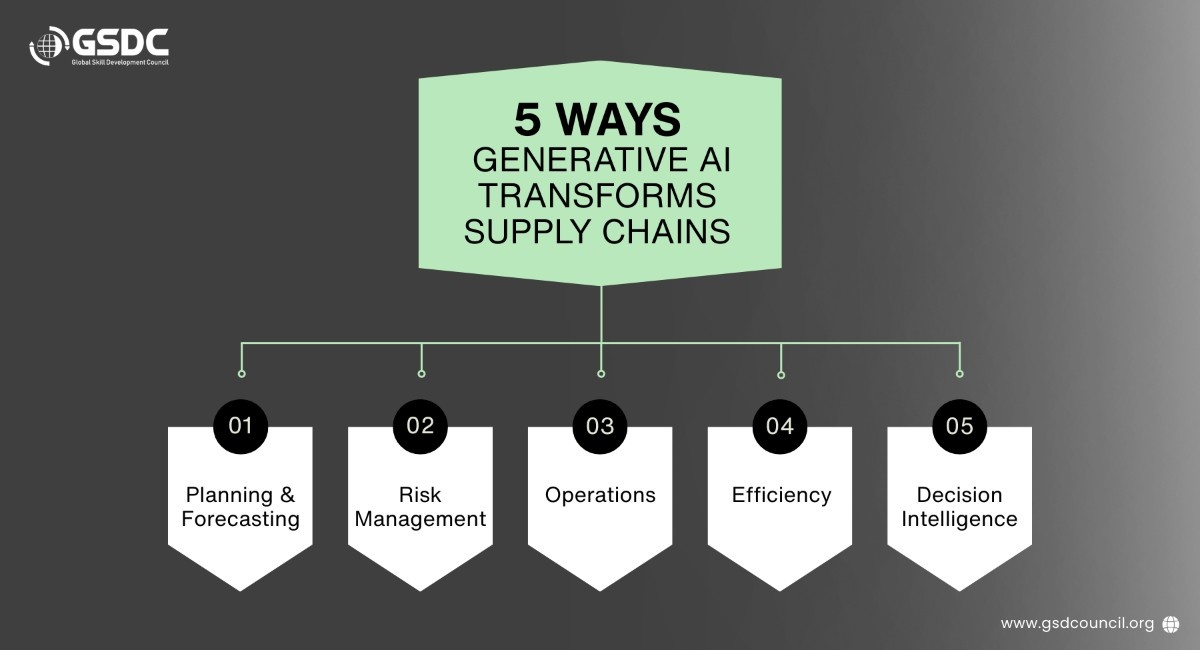
This is the way businesses are getting the genuine advantages of AI:
1. Smarter Planning and Forecasting
Generative AI enables a complex scenario simulation by evaluating multiple what-if scenarios, for example, interruptions of suppliers, geopolitical insecurities, or changes in demand. Studies show that AI-supported systems can improve the accuracy of demand forecasting by 20- 30% compared with traditional methods, thus reducing the amount of forecast errors and consequently facilitating the acquisition of more accurate information by the planners for their decisions.
2. Enhanced Risk Management
The improved view of risks remains one of the biggest benefits that are gained when AI is used in supply chain operations. Generative AI can reveal behind-the-scenes trends, draft disruption scenarios, and recommend preventive measures, thus giving companies the ability to respond at a faster rate to the changes in their supply and logistics network environment.
3. Improved Operational Execution
AI's influence in supply chain management is extending to the very operations of the day, from contract analysis to route optimisation. AI-driven optimisation facilitates dynamic routing and scheduling adjustments based on the actual operational situation, which helps in smoother execution and less delayed deliveries.
4. Generative AI in Supply Chain Efficiency and Cost Optimisation
The use of generative AI in supply chain efficiency projects is unlocking real cost savings. Through waste reduction, improved inventory accuracy, and support for predictive maintenance, businesses can achieve greater productivity and less operational waste.
As supply chains become increasingly dependent on AI analytics and automation, spending on these technologies is forecast to rise significantly, from about USD 14.5 billion in 2025 to more than USD 50 billion by 2032.
5. Natural Interaction With Complex Supply Chain Systems
With modern AI technologies, managers can now use conversational interfaces to interact with data. This significantly reduces technical barriers and speeds up the decision-making process. And, by doing so, it opens up the generative AI supply chain to business users, not just data scientists.
As the technology matures, the society around it, skills, standards, and capabilities, is likewise changing. Industry-led groups like the Global Skill Development Council (GSDC) are part of the solution in how professionals can efficiently grasp emerging technologies like generative AI in complex business functions such as supply chain management.
Key Challenges in Applying AI in Supply Chain Environments
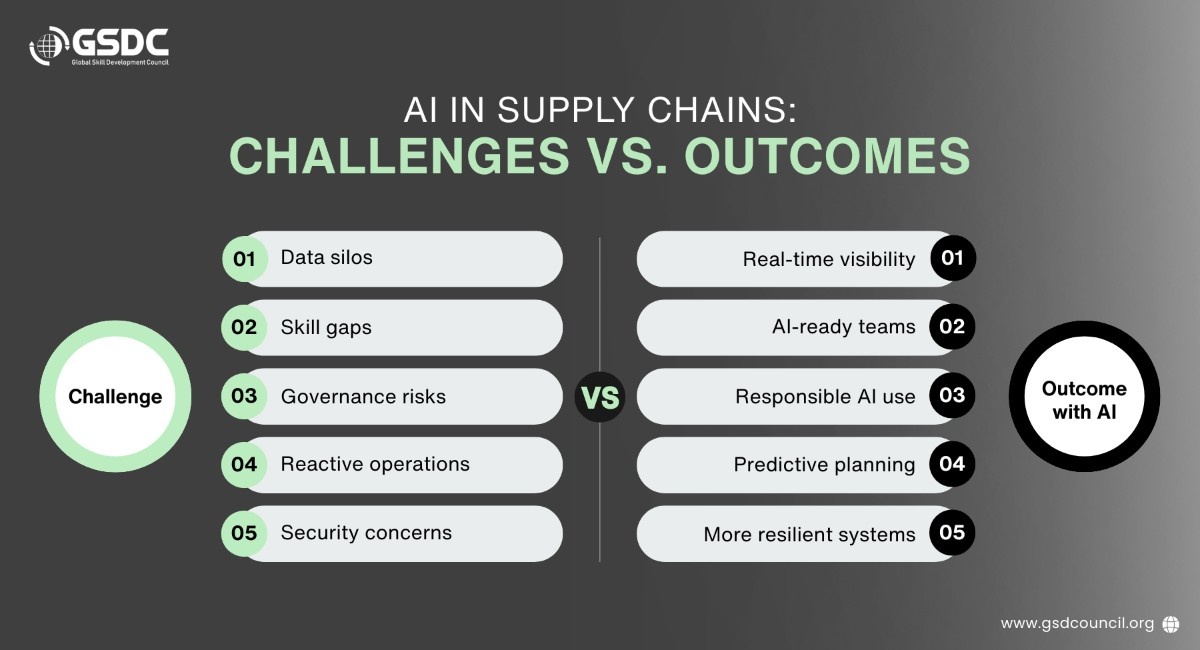
Despite its promise, the application of AI in supply chains comes with several practical challenges:
-
Data quality and integration
Legacy systems and siloed data often limit real-time visibility and reduce the accuracy of AI-driven insights.
-
Talent gaps
Organisations face shortages in both AI expertise and supply chain analytics skills, slowing adoption and effective use.
-
Ethical and governance risks
Transparency, accountability, and responsible AI practices are critical as automation increases across decision-making processes.
-
Change management and user adoption
Even well-designed AI tools fail without user trust. Resistance to change, low AI literacy, and unclear ownership can limit real-world impact.
-
Model reliability and explainability
Many AI models operate as “black boxes,” making it difficult for teams to understand or trust recommendations, especially in high-stakes supply chain decisions.
-
Cybersecurity and data privacy concerns
As supply chains become more connected, AI systems expand the attack surface, increasing the importance of strong security and data protection controls.
Addressing these challenges requires strong governance frameworks, robust data strategies, leadership alignment, and continuous capability-building. As organisations mature their AI adoption, structured learning pathways and professional certifications in areas such as Certified Generative AI for Supply Chain Management reflect a broader focus on developing the skills needed to deploy and govern AI responsibly in complex supply chain environments.
The Strategic Role of AI in Supply Chain Management
The role of AI in supply chain management is evolving from operational support to strategic enablement. As AI becomes embedded into planning, procurement, logistics, and risk management, supply chains are transforming into intelligent networks capable of continuous learning and adaptation. This shift is redefining how organisations design, run, and scale supply chain operations.
Key ways AI is shaping strategic supply chains include:
As AI becomes embedded across supply chain functions, its impact is shifting from operational gains to strategic transformation. Key ways AI is shaping strategic supply chains include:
1. End-to-End Visibility and Decision Intelligence
AI integrates data across suppliers, manufacturing, logistics, and distribution to provide real-time visibility. This enables faster, more informed decisions across the entire supply chain network.
2. Proactive and Predictive Supply Chain Operations
Instead of reacting to disruptions, AI enables predictive planning by identifying risks and demand shifts early, supporting proactive interventions and continuity planning.
3. Integrated Planning Across Functions
AI connects planning, procurement, inventory, and logistics into a more coordinated operating model, reducing silos and improving alignment between strategy and execution. Platforms like Klipboard that bring supply chain functions together in one system give AI tools a more complete and consistent dataset to work from.
4. Continuous Optimisation at Scale
With AI-driven learning loops, supply chains can continuously refine routes, inventory policies, and production plans based on changing conditions and performance feedback.
5. Building Strategic Capability, Not Just Technology
As AI becomes a strategic capability, organisations are investing in structured learning pathways and professional development, including generative AI supply chain management certification programs, to ensure teams can govern, deploy, and scale AI responsibly across complex ecosystems.
Together, these changes are helping supply chains become more intelligent, resilient, and strategically aligned.
The Future of Generative AI in Supply Chains
The future of the generative AI supply chain is more than just eliminating waste or driving costs. It’s about creating a true competitive advantage. With better planning, more resilient operations, faster decisions, and tighter costs, the role of AI in supply chain management will continue to evolve as the technologies advance
Organisations that invest early in AI strategy, talent development, and governance will be better positioned to turn supply chains into strategic assets rather than operational cost centres. In an era defined by uncertainty, the benefits of AI in supply chain transformation may well determine which organisations thrive and which struggle to keep up.
Preparing the Workforce for AI-Driven Supply Chains
As generative AI moves into everyday supply chain operations, the skills required across teams are changing. Beyond technology, organisations need people who can interpret AI-driven insights, apply them in real business contexts, and govern their use responsibly.
Industry-led bodies such as the Global Skill Development Council (GSDC) support this shift by encouraging structured skill development around emerging technologies. Learning pathways in areas like generative AI for supply chain management highlight a growing focus on building internal AI literacy alongside technological adoption.

Conclusion
Generative AI is causing fundamental changes in supply chains' planning, operations, and reaction to uncertainty. At first, only a few were testing the waters, but now it is rapidly turning into a key capability for those organisations that want to be more resilient, efficient, and have better strategic control.
Later, when adoption of AI reaches a certain level, the main differentiator will not simply be the possession of AI tools but rather the capability of integrating them sustainably into routine decision-making. Enterprises that bring together technology, data, governance, and people most closely will have the best chances to transform supply chain complexity into a long, term competitive advantage.
FAQs
1. What is generative AI in supply chain management?
Generative AI in supply chain management essentially uses AI models that are able to produce useful insights, scenarios, and actionable recommendations for planning, forecasting, and decision-making. This allows the organisation to switch from reactive to predictive supply chain operations.
2. How does AI impact supply chain management?
Among the impacts of AI on supply chain management, a few can be highlighted such as better forecasting, quicker response to disruptions, improved coordination with suppliers, and more efficient logistics planning leveraging real-time data.
3. What are the key applications of AI in supply chains?
Among the key applications of AI in supply chain are demand forecasting, scenario planning, inventory optimisation, route planning, supplier risk analysis, and predictive maintenance, which together can greatly enhance overall efficiency.
4. What are the benefits of AI in supply chain management?
Benefits of AI in supply chain management include better planning accuracy, lower operational risk, more visibility, cost optimisation, and quick, data-driven decision-making.
5. What skills are needed for generative AI in supply chain roles?
Generative AI in supply chain roles requires not only knowledge of the supply chain and data literacy but also an understanding of AI governance, since the use of AI in supply chain management keeps on growing.

Related Certifications
Stay up-to-date with the latest news, trends, and resources in GSDC
If you like this read then make sure to check out our previous blogs: Cracking Onboarding Challenges: Fresher Success Unveiled
Not sure which certification to pursue? Our advisors will help you decide!