Generative AI in Software Development: Market Growth & Productivity Stats
Written by Emily Hilton
Generative AI has transitioned from being a mere research curiosity to a main software development productivity tool. Estimates from the market suggest that the generative-AI industry is already in a multi-billion-dollar growth phase, and at the same time, other studies, such as controlled experiments and large surveys, report about the same expert adoption but through a substantial increase in the productivity of developers.
However, on the other hand, organizations have to deal with quality control, security, and the need to reorganize developer workflows as trade-offs.
The report provides you with the summary of current market and productivity figures, describes the transition of figures into engineering outcomes, and stresses the implications for product and engineering leaders in their daily practice.
Market Size and Growth
The Global Generative AI in Software Development Market is projected to reach a value of about USD 287.4 billion by the end of 2033, starting with USD 41.0 billion in 2023, while witnessing a CAGR of 21.5% over the period from 2024 to 2033.
Generative AI in the software development industry is the use of AI algorithms that can produce software components such as code, design, or other software-related artifacts. It relies on the power of machine learning models to create code, prototypes, or even complete software solutions automatically according to input data, requirements, or expected results.Main Points To Focus On
- Market Growth: The software development growth rate was worth USD 21.4 million in 2023. It is foreseen to grow up to USD 117.6 million in 2033, hence a CAGR of 19.10% during the period from 2024 to 2033.
- Component-wise: The generative AI solutions provide developers with algorithms, models, and training pipelines to develop applications that are AI-powered.
- Deployment Mode-based: Cloud-based AI software development process and solutions are gaining popularity due to their scalability, flexibility, and cost-effectiveness, which allow the fast development and deployment of software applications.
- Application-wise: One of the main advantages of generative AI is the ability to generate code, which can be used to automate repetitive coding tasks, thereby reducing development time and efforts, and at the same time increasing code quality and accuracy.
- Regional Dominance: North America leads the Generative AI in Software Development market with a 36.6% share.
- Growth Opportunity: The year 2026 marks a major expansion phase for Generative AI in Software Development, driven by automation of routine coding tasks and growing organizational readiness.
Implication (software development growth rate): As more organizations adopt generative AI across design, coding, testing, and operations, the overall software development capacity and throughput per engineer could increase significantly.
This doesn’t just mean faster coding but potentially more output per unit time, leading to accelerated delivery cycles, more frequent releases, and greater ability to scale teams and projects effectively, increasing software development growth rate.How to Utilize Generative AI in Software Development Practical Process?
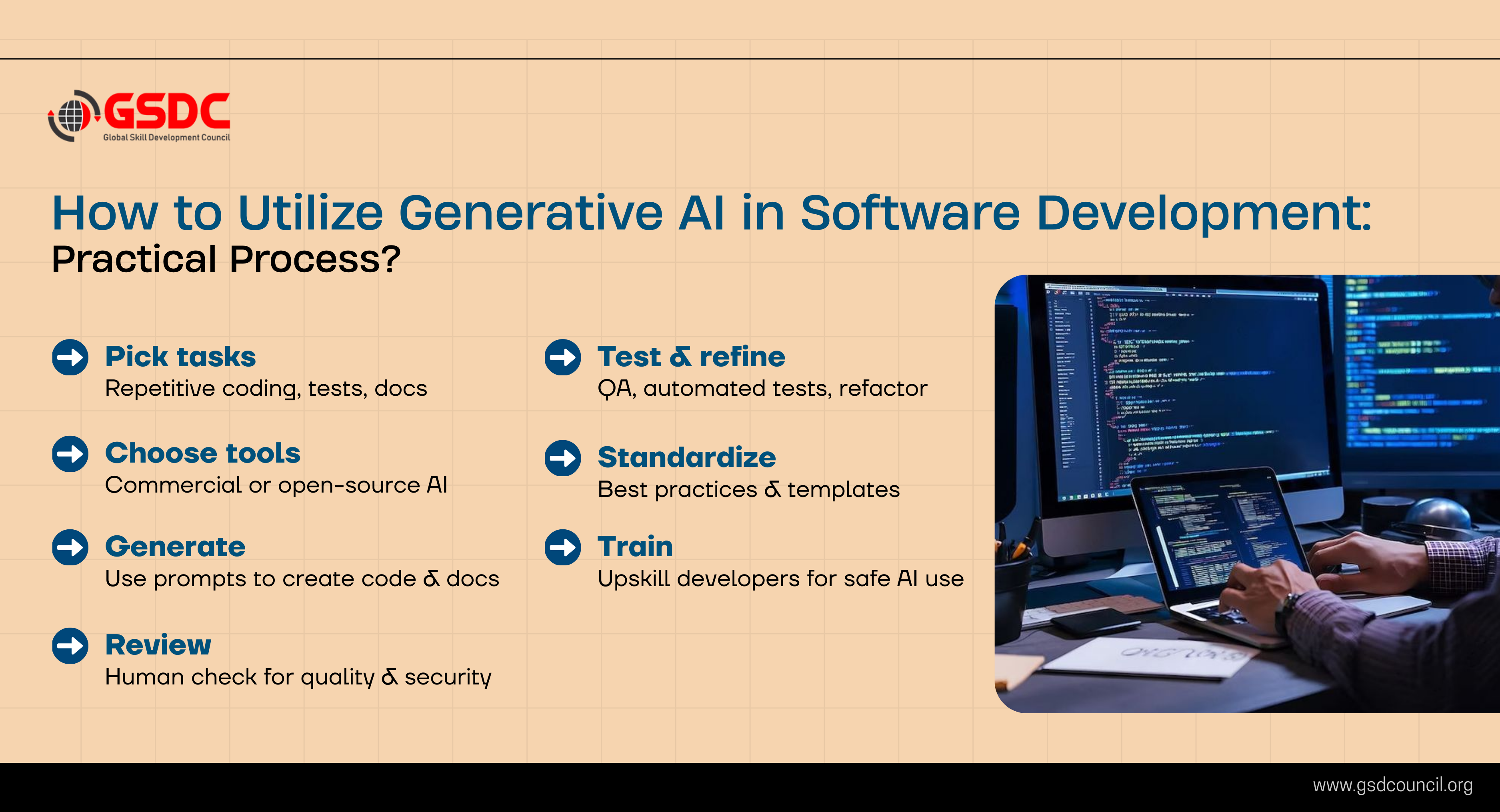
In case you are a developer or an engineering manager who wishes to cut down on other resources and make generative AI an indispensable part of your software development process, you can also consider following the approach:
- Identify appropriate use cases/tasks: Initially, direct your focus to the dull, repetitive tasks: CRUD APIs, scaffolding, unit tests, documentation, and code snippets. These are the tasks where generative AI can be applied with high output and low risk.
- Select the appropriate tools and models: Opt for well-established tools/assistants. There are numerous commercial products as well as open-source frameworks available.
- Feed the system and generate: Use natural-language prompts or partial code context to create code, tests, docs, or design skeletons.
- Assess, approve, and merge: A human developer must always verify the output of the system in terms of correctness, security, maintainability, and compliance with project standards.
- Experiment and improve: Perform automated tests, QA checks, and manual reviews. Refactor or correct as necessary.
- Repeat and normalize: Gradually, build internal best practices, coding standards, and prompt templates that will help give the team consistency.
- Training and upskilling staff: Organize training for developers so they know how to effectively “prompt” the AI, evaluate outputs, and incorporate AI-generated code securely and responsibly.
The decision to have generative AI certified for software development is being promoted by many organizations as part of their effort to guarantee the safe and effective use of generative AI by teams. Along with recognizing the professionals with the certifications, they will also acknowledge the AI-assisted coding, the security considerations, and the best practices for integrating AI into the application development process as well. Adding structured training increases the consistency, governance, and responsible adoption across the different teams in the organization.
The AI-supported software development workflow releases all the advantages and at the same time the least risks of poor quality, security vulnerabilities, or a chaotic mess of code.Synthesis: Why Generative AI Matters Growth + Real Value + Caution
Putting all pieces together, here’s why generative AI is rapidly becoming central to modern software development:
- The market growth indicates very strong organizational demand and expected widespread adoption as explained above.
- The breadth of use cases from code generation to testing, documentation, design, and planning shows generative AI is not a niche tool, but one touching many aspects of the SDLC.
- When used correctly, generative AI can accelerate development cycles, reduce boilerplate effort, improve test coverage, and lower time-to-market. This gives companies a competitive edge, i.e., faster feature delivery, faster prototyping, more experiments, and higher developer throughput.
- Through certification and training, developers and teams can build internal competence and governance, making AI adoption safer, scalable, and compliant.
Recommendations Based on Given Insights
To all engineering leads, product managers, and software development firms that are either contemplating or are already using generative AI:
- Begin with pilot projects: Initially, concentrate on performing tasks that are low-risk and have a high return to gain trust and check the impact.
- Implement solid governance and review procedures: Make certain that every piece of AI-generated code is subjected to human inspection, security checks, and complies with licensing and IP policies.
- Educate your personnel: Support your developers to enroll in the Generative AI in Software Development certification to unify the knowledge and standardize the practices.
- Evaluate actual impact: It is not only speed that should be monitored, but also the downstream metrics: code quality, bug rate, maintenance overhead, delivery frequency, and compliance issues.
- Slowly widen the range of use cases: When trust is built, AI assistance is to be expanded to the areas of testing, design, planning, refactoring, and other SDLC stages, but a blind trust approach is to be avoided.
Recent Development Activities
- Sept 2023: SourceAI introduced its Code Duplication Detector, capable of automatically identifying and eliminating redundant code, which in turn helps teams to possess cleaner and more efficient codebases.
- Feb 2024: EY reported in Tech Trends 2024 that generative AI is changing the paradigm of software development by requiring planning, improving developer productivity, DevOps being more efficient, and workload optimization.
Going Ahead
Generative AI is not just an interactive coding tool; it is the most important factor in the transformation of the entire software development process from requirement gathering to maintenance. It has a large and fast-growing market, its adoption by the workforce is increasing, it can be applied in various areas throughout the entire software development life cycle, and it is the topic of new certification programs; hence, it will be an essential component of future software engineering ecosystems.
Nevertheless, the advantages carry with them significant obligations. The largest organizations treating generative AI as the most important part of the machine instead of a shortcut, the cultural change, governance, upskilling, and continuous measurement that the transition entails will reap the greatest rewards.

Related Certifications
Stay up-to-date with the latest news, trends, and resources in GSDC
If you like this read then make sure to check out our previous blogs: Cracking Onboarding Challenges: Fresher Success Unveiled
Not sure which certification to pursue? Our advisors will help you decide!