PCI DSS Made Simple: Protecting Digital Payments and Card Data
Written by Matthew Hale
- What is PCI DSS?
- Why PCI DSS Compliance Matters
- Who must comply with the PCI DSS?
- What are the 12 PCI DSS requirements?
- The Cost of Non-Compliance
- How Organisations Work Toward Compliance
- Why Skilled PCI DSS Professionals Are in Demand
- Why PCI DSS Certification Matters for Professionals
- Conclusion
Digital payments have quietly become a part of everyday life. From tapping a card at a supermarket to paying through Apple Pay, billions of transactions happen around the world every single day.
These experiences feel instant and effortless. But behind each payment lies sensitive financial data that must travel securely between banks, merchants, and payment processors.
As digital transactions grow, so do the opportunities for cybercriminals. They constantly look for ways to steal card numbers or break into payment systems. That’s why cardholder data security is no longer optional; it's a global expectation.
To secure this enormous ecosystem of digital payments, the industry follows a unified security framework called PCI DSS. Its goal is straightforward: keep every card transaction anywhere in the world safe from start to finish.
What is PCI DSS?
PCI DSS stands for Payment Card Industry Data Security Standard. It’s a global security rulebook that protects card payments from fraud and data theft.
It was created because the world needed a uniform way to secure cardholder information. Without a standard, businesses used different practices to handle security, thus leaving many of their systems open to attack.
To manage this framework, the PCI Security Standards Council was formed by major payment brands, like:
- Visa
- Mastercard
- American Express
- Discover
- JCB
The council updates PCI DSS periodically to manage newly introduced threats in cyberspace.
PCI DSS compliance applies to any organisation that:
- Accepts card payments
- Stores cardholder data
- Processes transactions
- Sends card data through its systems
If your business is involved in handling card information in any form, then PCI DSS becomes compulsory for it.
Why PCI DSS Compliance Matters
Compliance with PCI DSS is instrumental in protecting companies and customers alike in today's digital economy. It is not just a technical requirement; it is an assurance of safety and trustworthiness when it comes to payment experiences.
Recent industry analysis shows that the average cost of a data breach in 2024 reached USD 4.88 million, highlighting how financially damaging a single incident can be.
1. Prevents Data Breaches and Fraud
PCI DSS enforces the implementation of encryption, secure systems, and strong access controls that together eliminate the possibility of cyberattacks and information leaks almost entirely.
2. Builds Customer Trust
People whose cards are used expect the information not to be misused. Compliance manifests a resolute attitude towards payment security, thereby increasing trust and loyalty.
3. Reduces Financial and Legal Risks
Non-compliance is associated with the possibility of heavy monetary penalties, legal problems, and expenses arising from investigation. By following PCI DSS, companies are kept away from such scenarios.
Implementing sift finance fraud detection helps organizations proactively identify threats that could lead to compliance violations.
4. Aligns With Global Best Practices
The standard is recognised worldwide, ensuring businesses follow internationally accepted security practices for secure transactions.
PCI DSS compliance applies to any organisation that handles cardholder data in any form. It doesn’t matter how big or small the business is if card information passes through your systems, the standard is mandatory.
Who must comply with the PCI DSS?
These are the primary groups that have to abide by the rules:
- Online merchants: E-commerce sites that accept card payments either directly or through third-party platforms.
- Retail stores: Brick-and-mortar businesses that have card terminals or POS systems.
- SaaS companies and payment processors: Platforms that carry out or make available card transactions on the merchant's side.
- Banks and financial institutions: financial Organisations that provide card issuance, payments, or data storage services.
- Service providers: Any vendor that offers hosting, billing, transaction management, or secure payment services.
In short, if your business is storing, processing, or transmitting cardholder information, you are required to be PCI DSS compliant.
What are the 12 PCI DSS requirements?
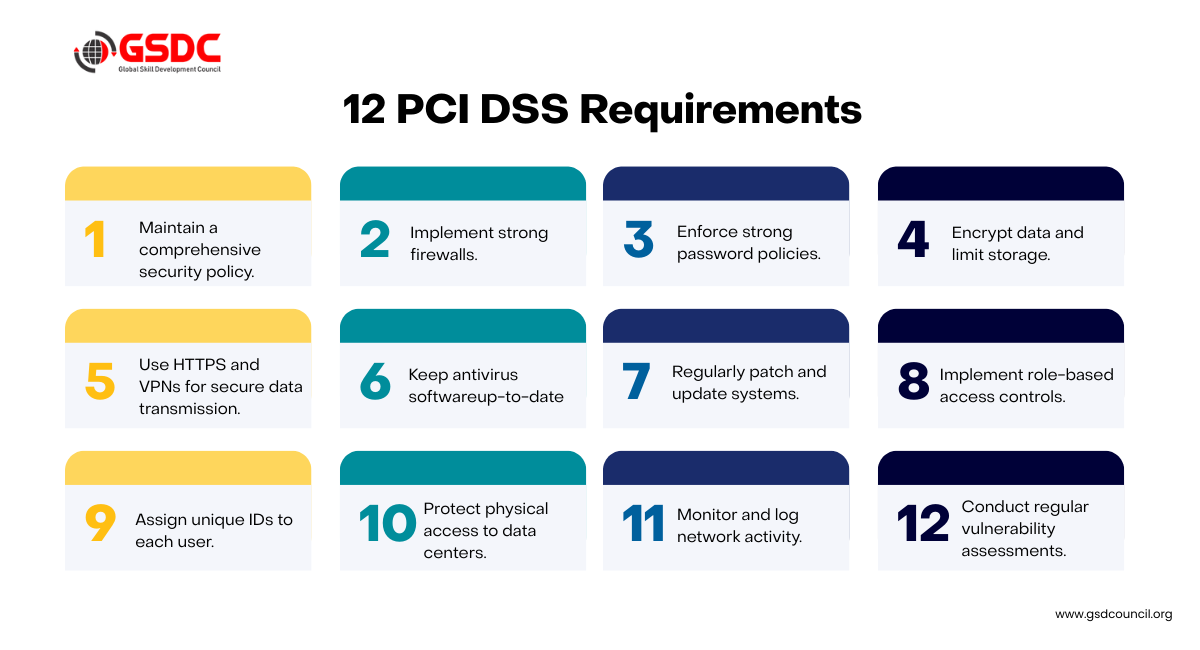
PCI DSS requirements aim to make it easier for organisations to establish secure payment processing systems and keep the cardholder data safe at every stage.
The complete standard mainly features 12 PCI DSS requirements, and the core elements can be understood easily.
We Can Simplify The PCI DSS Requirements as Follows:
1. Secure Networks and Systems: Firms are required to use firewalls, secure configurations, and systems that are protected to prevent unauthorised access.
2. Data Protection Measures: Cardholder data protection is key. This includes encrypting stored card data and securing information during transmission.
3. Strong Access Controls: Access to the most sensitive payment systems should be limited to the ‘right’ people only. PCI DSS demands compliance with very strict user privileges and authentication regulations.
4. Continuous Vulnerability Management: Systems must be regularly updated, patched, and scanned to stay protected against new threats.
5. Monitoring and Testing: Businesses need to track activity, maintain logs, and test their security controls frequently.
6. Clear Security Policies: Employees must follow documented information security policies to keep payment environments safe and consistent.
Many organisations also rely on professionals who hold a Certified PCI DSS (Payment Card Industry Data Security Standards) qualification to interpret these requirements and ensure they are implemented correctly
📘 Download the Cardholder Data Security Blueprint
⚡ Take the next step toward stronger PCI DSS readiness.
The Cost of Non-Compliance
Ignoring PCI DSS compliance means exposing businesses to enormous risks, and real cases prove it.
One cyberattack in UK retail forced Marks & Spencer to shut down online operations for almost seven weeks, causing estimated losses of over £300 million. This shows the potential damage one incident can cause.
Here's what non-compliance can lead to:
1. Fines and Penalties: Card networks can impose heavy non-compliance penalties, especially on account of a breach having occurred due to weak controls.
2. Loss of Capability to Accept Card Payments: Merchants may lose the privilege to handle card transactions either temporarily or permanently.
3. Damage to Reputation: A breach instantly erodes trust. Recovery is painfully slow and expensive.
4. Legal Implications: Organisations may be taken to court or forced to undergo investigations.
5. High Remediation Costs: The remediation of systems after a breach is much costlier than prevention.
Non-compliance increases the overall risk of payment security and endangers business continuity.
How Organisations Work Toward Compliance
Achieving PCI DSS compliance is not an overnight task. It’s a structured journey that helps organisations build stronger, safer payment environments.
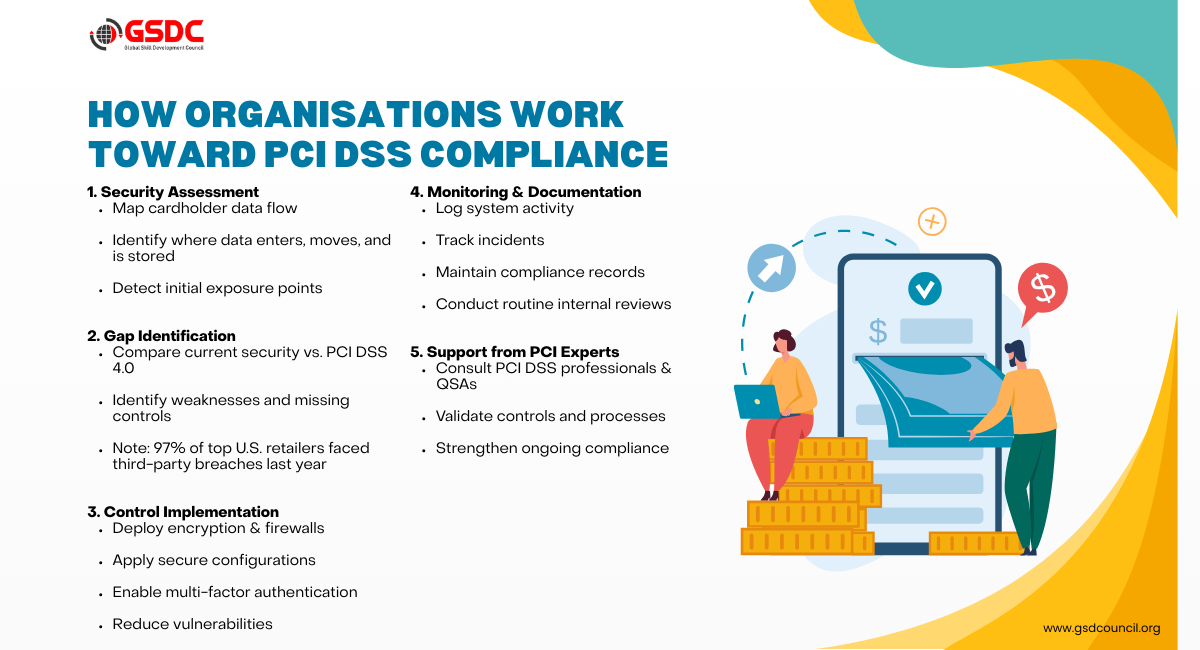
This process has become even more important after PCI DSS 4.0 became mandatory on April 1, 2025.
Here’s how most organisations approach the PCI DSS compliance process:
1. Security Assessment: The process begins with a complete security assessment. Businesses map how cardholder data flows through systems and identify areas of potential exposure.
2. Gap Identification: This step highlights weak points. With 97% of top U.S. retailers experiencing a third-party data breach in the last year, finding these gaps early is crucial.
3. Control Implementation: Organisations then implement PCI DSS controls, encryption, firewalls, multi-factor authentication, and more to close identified gaps.
4. Monitoring and Documentation: Compliance requires regular monitoring, logging, incident tracking, and maintaining clear documentation.
5. Support from PCI Professionals: Many organisations bring in PCI experts or QSAs to validate their compliance and guide them through ongoing improvements.
Some also refer to globally recognised bodies like the Global Skill Development Council (GSDC) for additional guidance and upskilling support as PCI DSS Standards evolve.
Why Skilled PCI DSS Professionals Are in Demand
The demand for PCI DSS professionals is rising quickly as businesses rely more on digital payments and face increasing cyber threats. Organisations need experts who understand how to keep cardholder data secure and maintain strong compliance practices.
Industry insights show a significant increase in roles requiring PCI DSS skills, with many compliance and security positions offering median salaries above £65,000 in the UK. This reflects how valuable specialised payment-security knowledge has become.
Here's what's driving the demand:
- Growth in digital payments across global markets
- Increasing cyberattacks against payment systems
- Organisations emphasise compliance with PCI DSS to avoid breaches and penalties.
- Growth of cybersecurity, risk, and auditing careers
- Specialised expertise to implement, audit, and maintain PCI DSS controls.
Why PCI DSS Certification Matters for Professionals
As payment systems grow more complex, organisations rely on professionals who understand evolving PCI DSS requirements and can support effective implementation and audits. A Certified PCI DSS (Payment Card Industry Data Security Standard) credential helps build these essential skills through structured, recognised training.
Many practitioners pursue this certification through global bodies like the Global Skill Development Council (GSDC), ensuring their knowledge aligns with current security and compliance needs. For those in cybersecurity or payment security roles, it’s a strong way to enhance credibility and contribute to safer payment environments.

Conclusion
In a world where digital payments power everyday life, PCI DSS is essential for keeping every transaction secure. It forms the backbone of payment security, helping businesses protect customer data and maintain trust.
PCI DSS isn’t a one-time requirement it demands continuous attention. As cyber threats evolve, organisations must update controls and stay aligned with the latest standards to ensure secure transactions.
For professionals, building strong PCI DSS skills has never been more important. It improves career opportunities and supports safer, more resilient payment environments.
By committing to ongoing security and compliance, both businesses and individuals can help protect the future of digital payments.

Related Certifications
Stay up-to-date with the latest news, trends, and resources in GSDC
If you like this read then make sure to check out our previous blogs: Cracking Onboarding Challenges: Fresher Success Unveiled
Not sure which certification to pursue? Our advisors will help you decide!