The FDE Technical Toolkit: APIs, Docker, Cloud, RAG, and Agent Frameworks
Written by Emily Hilton
- 1. APIs: Connecting AI with Business Systems
- 2. Docker: Making AI Applications Portable
- 3. Cloud Platforms: Deploying AI at Scale
- 4. RAG: Giving AI Access to Relevant Information
- 5. Agent Frameworks: Building AI That Can Take Action
- 6. How the FDE Technical Toolkit Works Together
- 7. How GSDC's FDE Certification Can Support Your Learning
- Conclusion
Building an AI application involves more than selecting a powerful language model. The application must connect with existing systems, retrieve relevant information, run reliably in production, and solve actual business problems. This is where a Forward Deployed Engineer (FDE) plays an important role.
An FDE works closely with customers to understand their challenges and turn them into practical technical solutions. This requires a combination of software engineering, AI development, system integration, deployment, and problem-solving skills.
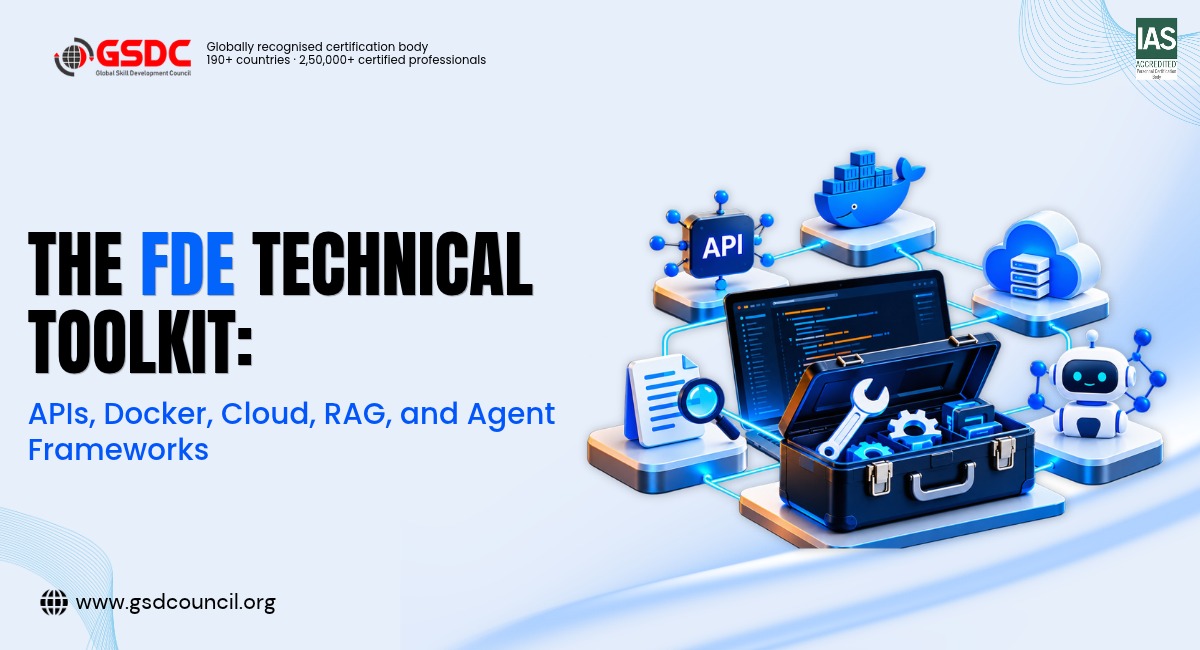
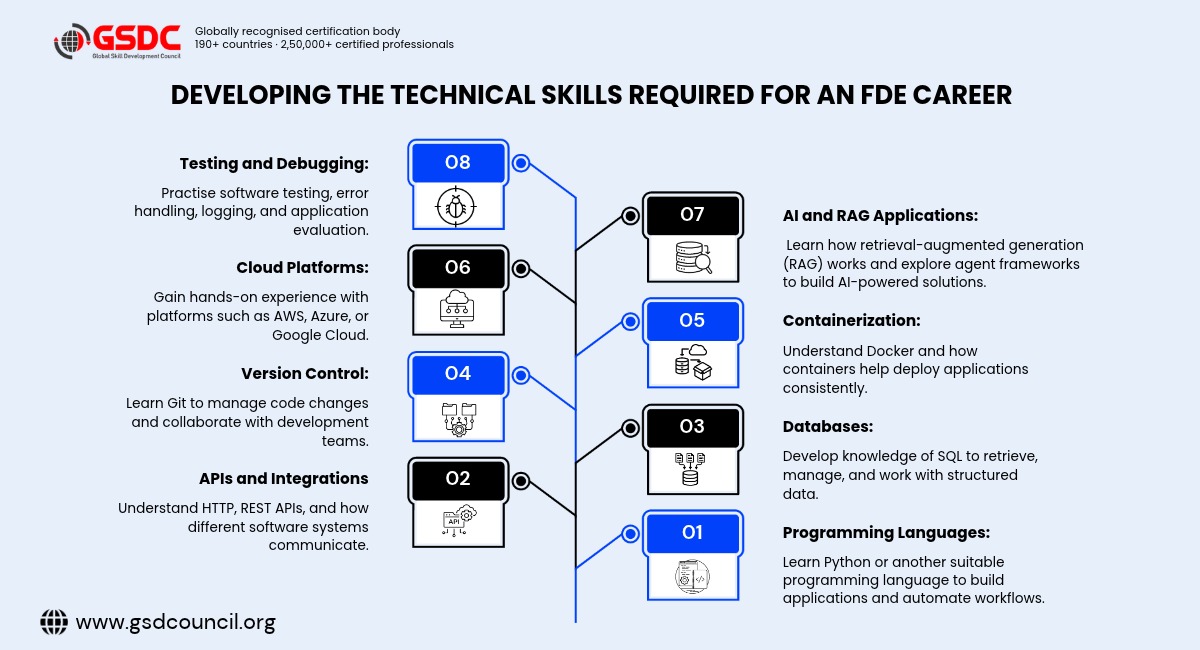
The FDE Technical Toolkit brings together the technologies that help make this possible. APIs connect applications and business systems, Docker simplifies deployment, cloud platforms provide scalable infrastructure, Retrieval-Augmented Generation (RAG) connects AI models with relevant information, and agent frameworks help AI systems perform multi-step tasks.
Understanding these technologies is an important part of developing the forward deployed engineer skills required to deliver AI solutions in real-world environments.
1. APIs: Connecting AI with Business Systems
Application Programming Interfaces (APIs) allow different software applications to communicate with one another. For FDEs, APIs are essential because AI applications rarely operate independently. They often need access to customer databases, CRM platforms, ticketing systems, internal tools, and other enterprise applications.
For example, a company might want an AI assistant that can check an order's status, answer customer questions, and create support tickets. The language model can understand the user's request, but APIs allow the application to retrieve order information or create a ticket.
Technical skills FDEs need
FDEs should understand REST APIs, HTTP methods, authentication, request and response formats, and error handling.
Common HTTP methods include:
- GET: Retrieves information, such as an order's current status.
- POST: Creates a resource, such as a support ticket.
- PUT/PATCH: Updates an existing resource.
- DELETE: Removes a resource when the operation is authorized.
Most REST APIs exchange data in JSON format. An example response might look like this:
{
"order_id": "ORD-1024",
"status": "Shipped",
"estimated_delivery": "2026-10-30"
}
An AI application can use this structured response to generate a user-friendly answer.
FDEs must also handle API timeouts, rate limits, invalid requests, and authentication failures. Secure implementations should protect API keys, validate inputs, and apply authorization checks. When an AI agent can trigger business actions, developers should also restrict which operations it can perform and require confirmation for sensitive actions.
Why it matters: Strong API integration skills help FDEs connect AI capabilities with existing business workflows instead of creating isolated demonstrations.
2. Docker: Making AI Applications Portable
An AI application may work correctly on a developer's laptop but fail in a customer's environment because of different dependencies, runtime versions, or configuration settings. Docker helps reduce these inconsistencies by packaging an application and its dependencies into a container image.
A container provides a consistent runtime environment across development, testing, and production systems.
How FDEs use Docker
Suppose an FDE develops a Python-based RAG application that uses FastAPI, a vector database client, and an embedding model API. Docker can package the application code and required Python libraries into a reproducible image.
A simple Dockerfile might look like this:
FROM python:3.12-slim
WORKDIR /app
COPY requirements.txt .
RUN pip install --no-cache-dir -r requirements.txt
COPY . .
CMD ["uvicorn", "main:app", "--host", "0.0.0.0", "--port", "8000"]
This example creates a container image for a FastAPI application. The application must still have its dependencies, configuration, and required services set up correctly.
Useful Docker concepts include images, containers, Dockerfiles, volumes, networks, environment variables, and container logs.
For example, Docker volumes can support persistent storage, while environment variables can supply configuration at runtime. Secrets such as API keys should be managed through appropriate secret-management mechanisms rather than embedded in an image.
For production deployments, FDEs should also consider non-root containers, dependency updates, image scanning, health checks, and resource limits.
Why it matters: Docker helps FDEs reproduce issues, test applications consistently, and deliver deployable solutions across different customer environments.
3. Cloud Platforms: Deploying AI at Scale
Cloud platforms provide the computing resources and managed services required to deploy and operate AI applications. Common options include Amazon Web Services (AWS), Microsoft Azure, and Google Cloud.
An FDE may use cloud infrastructure to host APIs, run containers, store documents, manage databases, monitor application performance, and connect to AI model services.
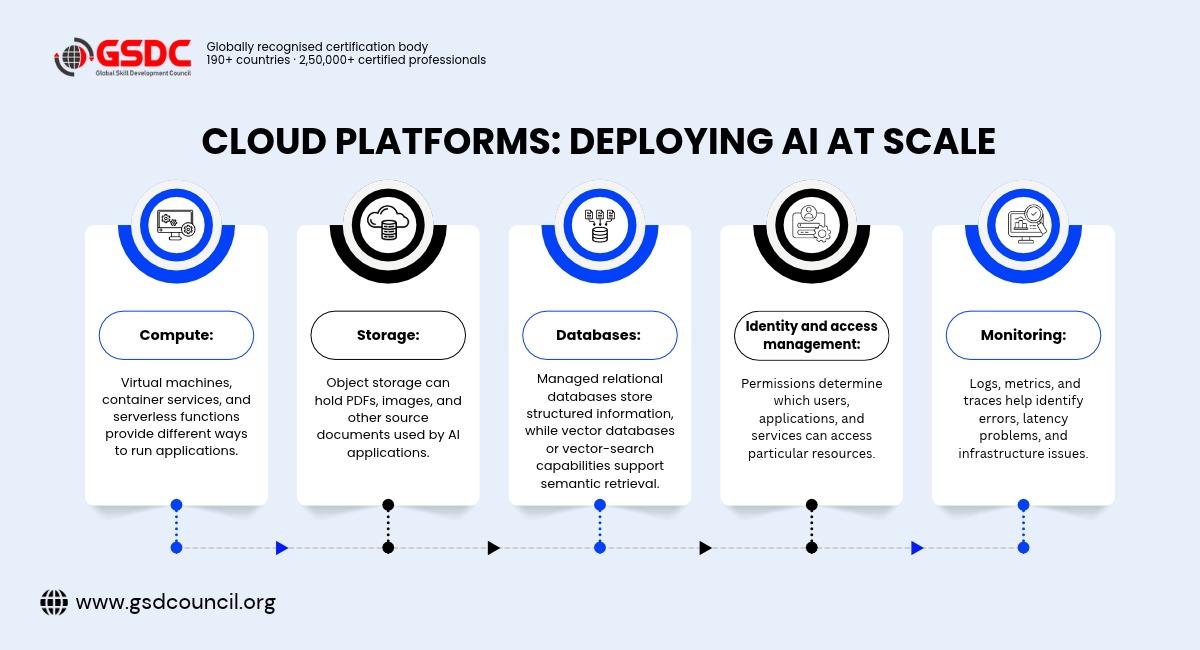
Consider an AI assistant deployed for a customer support team. The application may run in a managed container service, retrieve documents from cloud storage, search a vector index, and call an external language model API. Monitoring tools can track response times, failed requests, and resource usage.
FDEs must also understand cloud security, network configuration, encryption, availability, and cost management. AI applications can become expensive when they process large documents repeatedly, make unnecessary model calls, or use oversized infrastructure.
A practical FDE evaluates the customer's requirements before choosing an architecture. A small internal assistant may need a relatively simple deployment, while a high-volume enterprise application may require autoscaling, load balancing, redundancy, and stricter access controls.
Why it matters: Cloud skills help FDEs move AI applications from prototypes into reliable, secure, and maintainable production environments.
4. RAG: Giving AI Access to Relevant Information
Retrieval-Augmented Generation (RAG) is a technique that combines information retrieval with language model generation. It allows an AI application to retrieve relevant content from an external knowledge source before generating an answer.
This is useful when a company needs an AI assistant to answer questions using internal policies, product documentation, technical manuals, or customer-specific information.
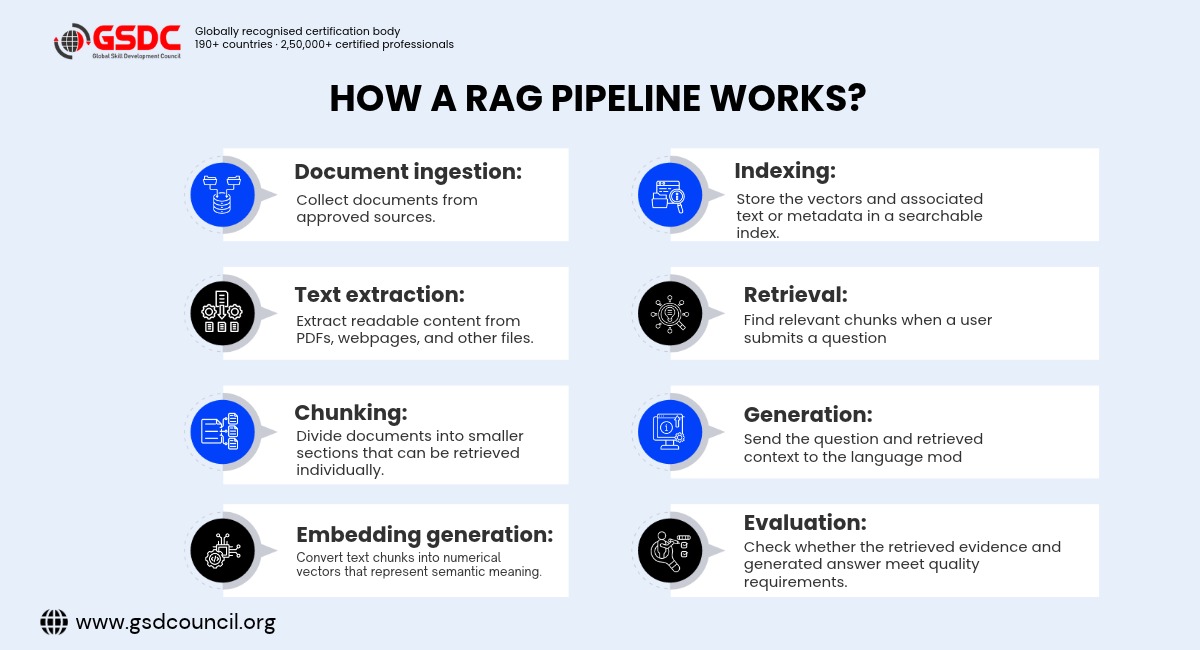
For example, an employee might ask, "How many days of leave can I carry forward?" The RAG application searches approved HR policies, retrieves the relevant section, and supplies it to the language model to generate an answer.
A simplified retrieval request could look like this:
results = vector_store.similarity_search(
query="How many leave days can be carried forward?",
k=4
)
Here, k=4 requests four candidate results from the vector store. The exact method and parameters depend on the library being used. A production implementation may also use metadata filters, keyword search, reranking, and access-control checks.
What FDEs need to understand about RAG
Effective RAG implementation requires more than connecting a vector database to a language model. FDEs need to consider chunk size, document quality, embedding models, retrieval precision, context limits, and the freshness of indexed information.
They should also evaluate whether the retrieved passages actually support the generated answer. Useful evaluation measures include retrieval recall, context relevance, answer correctness, citation accuracy, and end-to-end response latency.
Security is particularly important. A system must not retrieve confidential information that the requesting user is unauthorized to access. Document permissions should be enforced during retrieval, and retrieved text must be treated as data rather than trusted instructions.
Why it matters: RAG skills help FDEs build AI applications grounded in customer information, while reducing reliance on a model's general knowledge alone.
5. Agent Frameworks: Building AI That Can Take Action
A traditional AI chatbot usually responds to prompts. An AI agent can go further by selecting tools, executing steps, observing results, and deciding what to do next within defined boundaries.
An agent framework provides components for building these workflows. Depending on the framework, these may include tool calling, workflow orchestration, state management, memory, human approval steps, and execution tracing.
For example, an IT support agent could classify an incoming request, search troubleshooting documentation, check the status of an approved service, and prepare a response. If the request involves a sensitive action, it could ask a human for approval before proceeding.
What makes an AI agent work?
An agent commonly combines several components:
- Language model: Interprets requests and helps select actions.
- Tools: APIs, database queries, search functions, or other callable operations.
- State: Information about the current task and completed steps.
- Control flow: Rules that determine which actions are allowed and when the workflow ends.
- Guardrails: Validation, permissions, spending limits, and approval requirements.
- Observability: Logs and traces that help developers understand the agent's decisions and tool usage.
FDEs should understand how tool schemas are defined, how arguments are validated, how errors are handled, and how execution is limited. They should also know when a deterministic workflow is more appropriate than an autonomous agent. Not every business problem requires an agent.
Choosing an AI agent framework
There is no single best AI agent framework for every project. The right choice depends on the application's complexity, integration requirements, deployment environment, and operational constraints.
Frameworks worth evaluating include:
- LangGraph: Useful for stateful, multi-step workflows with explicit control flow and human-in-the-loop patterns.
- Microsoft Agent Framework: Relevant for developers building agent and workflow applications within Microsoft's ecosystem.
- LlamaIndex: Particularly useful for knowledge-intensive applications involving data connectors, retrieval, and agent workflows.
- AutoGen: Known for multi-agent conversation and orchestration patterns; evaluate the current project guidance and ecosystem status before adopting it.
- OpenAI Agents SDK: Provides tools for building agent workflows, tool use, handoffs, and tracing.
The best AI agent frameworks 2026 shortlist should be based on current documentation, active maintenance, licensing, security, deployment support, and fit for the intended use case. These options are not interchangeable, and their capabilities evolve over time.
When comparing the best AI agent framework options, build a small proof of concept. Measure task completion, tool-call accuracy, failure recovery, latency, cost, and the quality of execution traces. A simple workflow may not need a specialized framework at all.
Why it matters: Agent framework knowledge helps FDEs build controlled AI workflows that can interact with business systems rather than simply generate text.
6. How the FDE Technical Toolkit Works Together
The real value of the FDE Technical Toolkit comes from combining its components into one working solution.
Imagine a company wants an AI assistant that answers internal IT questions and creates support tickets when necessary.
The architecture could work as follows:
- Employees submit questions through a web application.
- An API receives the request and authenticates the user.
- A RAG pipeline retrieves relevant troubleshooting documents.
- An agent framework determines whether it can answer directly or needs to call a ticketing API.
- The application runs inside Docker containers.
- Cloud infrastructure hosts the service and supporting components.
- Monitoring captures errors, response times, retrieval quality, and tool execution.
- Feedback from users helps the FDE identify gaps and improve the application.
The FDE also tests failure scenarios. What happens if the ticketing API is unavailable? Can the system answer when no relevant document is found? Does it prevent unauthorized access? Can the team identify why a response was incorrect?
These questions demonstrate why FDE work requires both engineering depth and an understanding of business requirements.
7. How GSDC's FDE Certification Can Support Your Learning
A forward deployed engineer certification can provide a structured way to understand the responsibilities, technical concepts, and problem-solving approach associated with the FDE role.
GSDC's FDE Certification may be relevant to software engineers, AI practitioners, implementation specialists, and technical professionals who want to strengthen their understanding of customer-facing engineering and AI implementation.
When considering a Forward Deployed Engineer (FDE) Certification, review the curriculum carefully. Look for coverage of AI implementation, system integration, customer collaboration, technical problem-solving, and the connection between technical delivery and business objectives. Practical exercises and real-world scenarios are valuable additions to theoretical learning.
The Forward Deployed Engineer (FDE) Certification can complement independent practice, portfolio development, and hands-on experience with APIs, Docker, cloud services, RAG, and agent frameworks. Before enrolling, check the current official program details to confirm the learning outcomes, assessment format, and any practical components.
Certification should be viewed as one part of professional development rather than a guarantee of employment or production-level expertise. Combining structured learning with projects and measurable results can help professionals prepare for opportunities along the FDE Career Path.
Conclusion
The FDE Technical Toolkit combines APIs, Docker, cloud platforms, RAG, and agent frameworks to help engineers build AI applications that work in real business environments. Each technology solves a different problem: APIs connect systems, Docker supports consistent packaging, cloud platforms enable deployment, RAG grounds responses in relevant information, and agent frameworks coordinate multi-step actions.
Developing these capabilities requires practical experimentation, careful testing, secure implementation, and a clear understanding of customer needs. For professionals exploring the FDE Career Path, building integrated projects and strengthening their forward deployed engineer skills can provide a strong foundation. GSDC's FDE Certification can complement that journey by offering a structured learning path alongside hands-on engineering experience.

Related Certifications
Stay up-to-date with the latest news, trends, and resources in GSDC
If you like this read then make sure to check out our previous blogs: Cracking Onboarding Challenges: Fresher Success Unveiled
Not sure which certification to pursue? Our advisors will help you decide!