How FDEs Turn Customer Feedback into Better AI Products?
Written by Emily Hilton
- Why Customer Feedback Matters in AI Product Development
- What Is the Role of an FDE in Customer Feedback?
- How FDEs Collect Customer Feedback
- How AI Customer Feedback Analysis Helps Identify Patterns
- Turning Feedback into Better AI Products
- What Is Voice of the Customer in AI Development?
- How to Build a Customer Feedback Process for AI Products
- What Is AI Product Management, and How Does It Connect to FDE Work?
- Building an FDE Career Through Customer-Centered AI Development
- Conclusion
Building an AI product is not just about developing a powerful model. It is about solving real customer problems, understanding user expectations, and continuously improving the product based on how people use it.
An AI tool may perform well during testing but still frustrate users when it gives irrelevant answers, misunderstands requests, or fails to fit into existing workflows. These problems often become visible only after customers start using the product.
This is where Forward Deployed Engineers (FDEs) play an important role. They work closely with customers, understand their challenges, investigate technical issues, and turn real-world feedback into practical product improvements.
In this blog, we will explore how FDEs collect customer feedback, analyze it, and use technical insights to build more useful, reliable, and customer-focused AI products.
Why Customer Feedback Matters in AI Product Development
Customer feedback helps product teams understand what users expect, where they experience difficulties, and which features need improvement.
Traditional software often follows predictable rules. AI products, especially those powered by large language models (LLMs), can produce different responses to similar requests. A feature that works well for one customer may perform poorly for another because of differences in data, terminology, or workflow.
For example, an AI-powered customer support assistant might answer general questions correctly but struggle with company-specific policies. Users may report that the responses are too vague or contain outdated information.
Without feedback, developers might focus on improving the model when the actual problem is that it retrieves incorrect documents.
A structured customer feedback management process helps teams identify these problems, prioritize fixes, and evaluate whether changes improve the user experience.
What Is the Role of an FDE in Customer Feedback?
The forward deployed engineer role responsibilities extend beyond writing code. FDEs work directly with customers to understand how a product performs in real business environments.
Their responsibilities often include:
- Speaking with users to understand their challenges.
- Identifying technical problems behind customer complaints.
- Analyzing usage data, logs, and AI outputs.
- Collaborating with product managers and engineering teams.
- Testing improvements against real customer scenarios.
- Monitoring whether product changes deliver better results.
For example, if employees complain that an AI assistant provides incorrect answers about internal company policies, an FDE investigates the issue rather than simply forwarding the complaint to the development team.`
They may discover that the assistant retrieves outdated policy documents or that the retrieval system ranks irrelevant information too highly.
The FDE can then improve document indexing, retrieval settings, or data freshness and test whether the updated system produces more accurate answers.
This connection between customer experience and technical implementation makes FDEs valuable in AI product development.
How FDEs Collect Customer Feedback
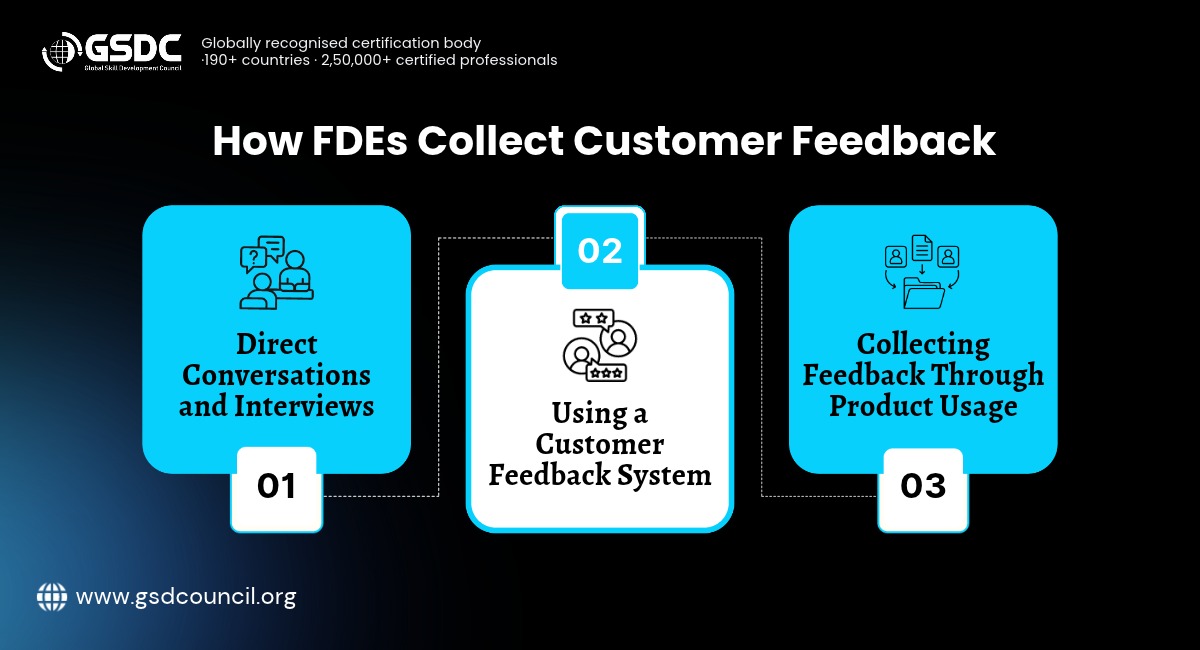
The first step is understanding what customers experience when using the product. Feedback should come from multiple sources because users do not always report every problem through formal channels.
1. Direct Conversations and Interviews
FDEs speak with customers, observe their workflows, and ask questions about specific problems.
Useful customer feedback questions include:
- Which task is the AI product helping you complete?
- Where do you experience difficulties?
- How often does the AI provide an incorrect or irrelevant response?
- What do you currently do when the AI cannot solve your problem?
- Which improvement would make the biggest difference to your work?
These questions focus on actual experiences rather than asking users whether they simply like the product.
For example, a customer might say that an AI assistant is difficult to use. A follow-up conversation could reveal that the assistant requires employees to switch between several applications to complete one task.
The underlying problem may therefore be workflow integration rather than the AI interface itself.
2. Using a Customer Feedback System
A customer feedback system provides a structured way to collect, organize, and track user responses.
Feedback can come from in-app surveys, support tickets, interviews, product reviews, or customer success teams. FDEs help ensure that this information reaches the people who can act on it.
A useful system records details such as the reported issue, affected feature, customer context, severity, and current status.
For example, feedback saying "the chatbot is not helpful" provides limited technical information. A report containing the user's question, the AI's response, the expected answer, and the relevant document makes the issue much easier to investigate.
Organizations should avoid storing unnecessary personal or confidential information in feedback records. Sensitive data should be protected through appropriate access controls and redaction.
3. Collecting Feedback Through Product Usage
Users do not always explain their problems directly. Their behavior can also reveal friction.
To collect customer feedback more effectively, teams can combine direct responses with product analytics, where appropriate.
Useful signals include:
- Repeated attempts to ask the same question.
- Users abandoning a workflow before completion.
- Frequent edits to AI-generated content.
- High rates of negative feedback on particular responses.
- Repeated transfers from an AI assistant to a human employee.
These signals do not automatically explain why a problem occurred. They help FDEs identify patterns that need further investigation.
For instance, repeated edits to AI-generated emails may indicate that the output is too formal, lacks relevant context, or does not match the organization's preferred writing style.
Combining user comments with actual usage patterns gives the team a more complete picture.
How AI Customer Feedback Analysis Helps Identify Patterns
When a product has thousands of users, reviewing every comment manually becomes difficult. This is where AI customer feedback analysis can help.
AI can process large volumes of feedback, identify recurring themes, classify complaints, and summarize common requests.
For example, an AI system might group hundreds of comments into categories such as:
- Incorrect or outdated answers.
- Slow response times.
- Difficult navigation.
- Missing features.
- Integration problems.
This allows teams to understand which issues appear most frequently and where further investigation is needed.
How AI for Customer Feedback Analysis Works
A typical process involves several technical steps.
Step 1: Gather the data. Feedback is collected from approved sources such as surveys, support tickets, and product reviews.
Step 2: Clean and organize the text. Duplicate entries, irrelevant content, and unnecessary personal information are removed or handled according to the organization's policies.
Step 3: Classify feedback. A language model or text-classification system assigns categories to each entry. It may also identify sentiment, urgency, or the product feature involved.
Step 4: Identify recurring themes. The system groups similar complaints and summarizes the most common issues.
Step 5: Validate the results. FDEs and product teams review the classifications and summaries to catch incorrect labels or misleading conclusions.
For example, consider these three comments:
- "The assistant keeps showing old policy information."
- "The answer does not reflect the latest company rules."
- "I received an outdated procedure from the chatbot."
An AI analysis tool may group all three under "outdated knowledge."
The team can then investigate document update frequency, indexing pipelines, and retrieval behavior instead of treating each comment as an unrelated issue.
AI-generated classifications should not be treated as perfect. Human validation remains important, particularly when feedback influences security decisions, customer commitments, or high-impact product changes.
Turning Feedback into Better AI Products
Collecting and analyzing feedback is useful only when it leads to improvements.
FDEs help connect customer problems to engineering solutions through a repeatable process.
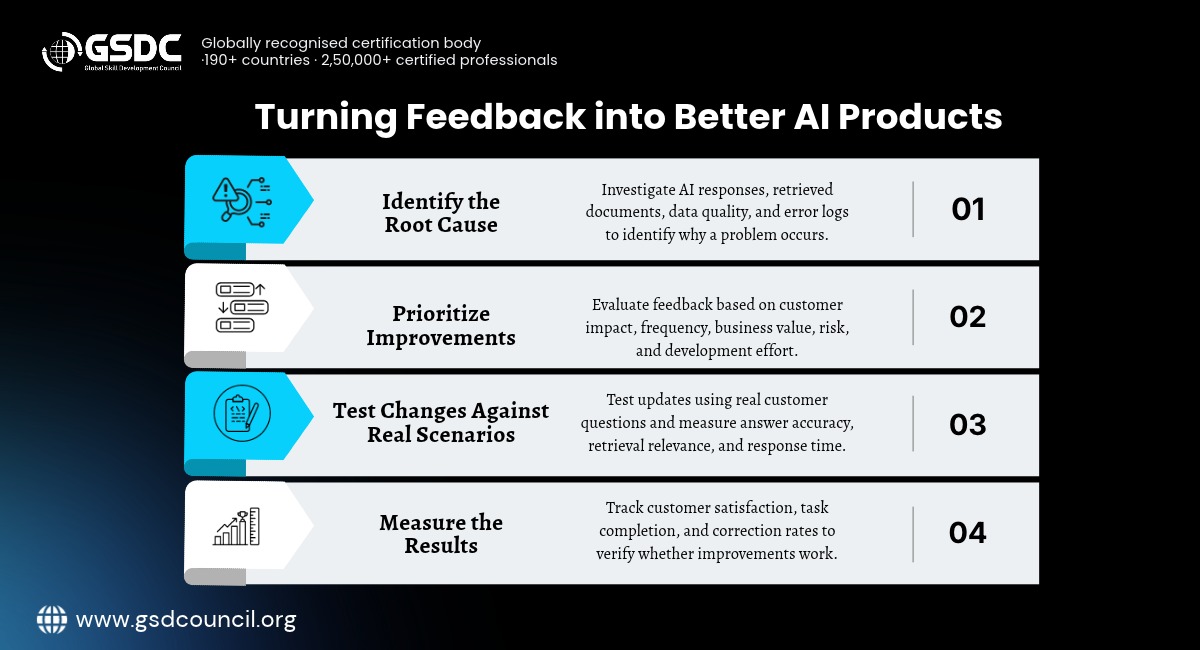
1. Identify the Root Cause
A customer complaint describes the problem from the user's perspective. The FDE investigates the technical reason behind it.
Suppose users report that an AI assistant frequently gives incomplete answers.
The FDE may inspect:
- The documents retrieved for each question.
- The relevance of search results.
- The context sent to the language model.
- The model's response and error logs.
- Whether the source documents are current.
This investigation helps distinguish between a retrieval problem, a data-quality issue, and a model-generation problem.
2. Prioritize Improvements
Not every customer request should become an immediate development task.
FDEs work with product managers to evaluate issues based on customer impact, frequency, business value, implementation effort, and risk.
For example, a minor interface preference may affect a small group of users, while incorrect AI-generated financial information may create significant operational risk.
The second issue would generally require faster attention.
A simple prioritization framework can score each issue across impact, frequency, and severity while considering the effort required to address it.
This makes product decisions more consistent and helps teams focus on meaningful improvements.
3. Test Changes Against Real Scenarios
Once the team identifies a solution, it must verify that the change works.
Suppose the problem involves outdated answers from a retrieval-augmented generation (RAG) system. RAG allows an AI model to retrieve relevant information from an external knowledge source before generating a response.
The FDE might improve document indexing, update retrieval filters, and ensure that recently revised policies replace older versions.
They can then test the updated system against a set of representative customer questions.
Useful evaluation measures include retrieval relevance, answer accuracy, source correctness, response latency, and the frequency of unsupported claims.
The team should also test whether the change causes regressions, such as making previously correct answers less accurate.
4. Measure the Results
After deployment, FDEs monitor whether the improvement actually solves the original problem.
For example, a team might track the percentage of AI responses accepted without correction, the number of repeated queries, customer satisfaction scores, and successful task completion rates.
Comparing results before and after a change helps determine whether the improvement made a meaningful difference.
The team can also collect follow-up feedback to identify remaining problems and guide the next development cycle.
What Is Voice of the Customer in AI Development?
What is voice of the customer (VoC)? It is the process of understanding and organizing customers' expectations, needs, preferences, and experiences with a product or service.
In AI product development, VoC includes survey responses, customer interviews, support requests, product usage signals, and feedback on AI-generated results.
FDEs help turn these insights into practical engineering requirements.
For example, customers may repeatedly request more accurate answers from an internal AI assistant. The VoC findings can be translated into measurable requirements, such as improving retrieval relevance, using current documents, and providing reliable source references.
This approach ensures that product improvements are based on actual customer needs rather than assumptions made during development.
How to Build a Customer Feedback Process for AI Products
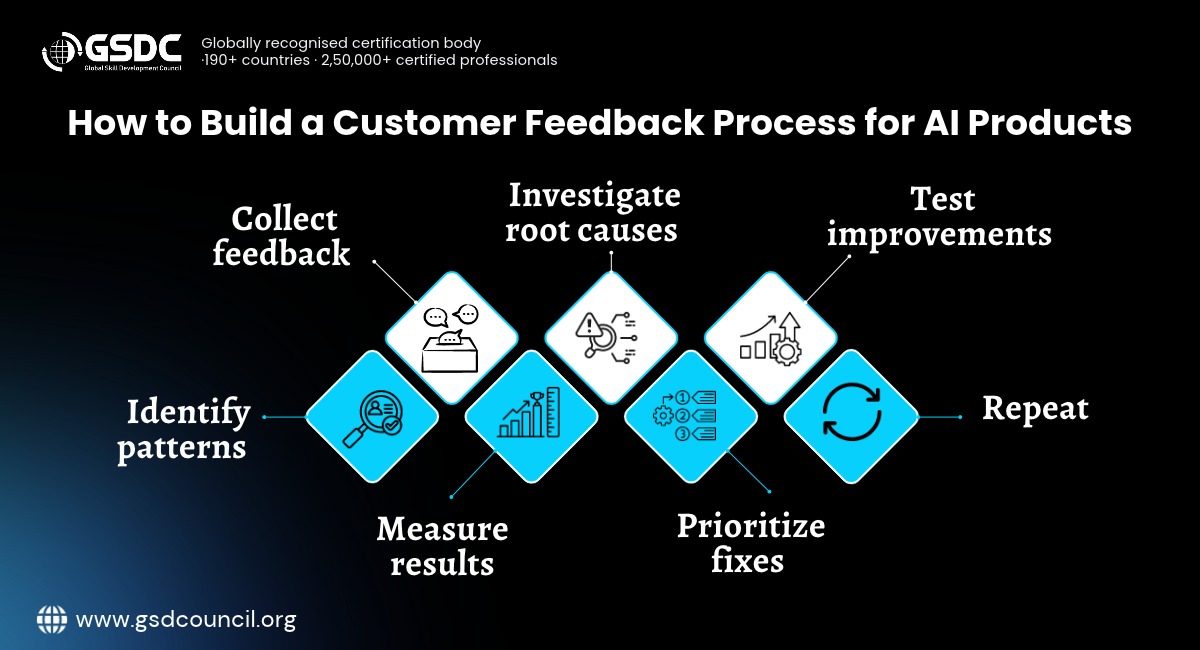
Teams wondering how to build a customer feedback process should begin with a clear objective and a manageable workflow.
First, identify which customer experiences need improvement. Next, choose suitable collection channels and define a consistent way to categorize feedback.
Connect feedback records with relevant product information, such as the affected feature, error logs, and AI evaluation results, while respecting privacy and access controls.
Then, assign owners to important issues, prioritize improvements, test solutions, and communicate relevant changes to customers.
Finally, review the results regularly. Feedback should be part of an ongoing product development cycle rather than a one-time activity.
What Is AI Product Management, and How Does It Connect to FDE Work?
What is AI product management? It is the process of defining, developing, evaluating, and improving AI-powered products to meet user needs and business objectives.
AI product managers determine which problems the product should solve, which features deserve priority, and how success will be measured.
FDEs support these decisions by providing direct customer insights and technical evidence. They can explain why users experience particular problems, what changes are feasible, and how proposed improvements perform in real environments.
Product managers guide product direction, while FDEs help connect that direction to practical implementation and customer outcomes. They often collaborate closely throughout the development cycle.
Building an FDE Career Through Customer-Centered AI Development
The FDE career path offers opportunities for professionals to move from software development, implementation, or technical support into roles that combine AI development, system integration, customer collaboration, and business problem-solving. As organizations adopt AI solutions, they need professionals who can understand customer challenges and turn them into practical, reliable technology. Here, Certified Forward Deployed Engineer Certification will help you.

GSDC's FDE Certification can help professionals build a structured understanding of the Forward Deployed Engineer role and its practical applications. It can support learning across key areas such as AI implementation, system integration, customer-focused engineering, and aligning technical solutions with business goals. The certification may be valuable for software engineers, AI professionals, and implementation specialists looking to strengthen their knowledge of this evolving career path.
Conclusion
FDEs help turn customer feedback into better AI products by connecting user experiences with technical improvements. Through structured feedback collection, AI-assisted analysis, root-cause investigation, and continuous testing, they help teams build solutions that address real customer needs.
The goal is not simply to collect more feedback. It is to understand what the feedback reveals, make informed engineering decisions, and measure whether the changes improve the product.
When customer insights and technical expertise work together, AI products become more reliable, useful, and aligned with the people who depend on them.

Related Certifications
Stay up-to-date with the latest news, trends, and resources in GSDC
If you like this read then make sure to check out our previous blogs: Cracking Onboarding Challenges: Fresher Success Unveiled
Not sure which certification to pursue? Our advisors will help you decide!