Top Agentic AI Frameworks in 2026: A Complete Comparison Guide
Written by Matthew Hale
- What Are Agentic AI Frameworks?
- Agentic AI vs AI Agents vs Traditional Automation
- Why Agentic AI Frameworks Matter in 2026: The Data
- How We Evaluated These Frameworks
- Top Agentic AI Frameworks in 2026: Quick Comparison
- A Closer Look at the Leading Frameworks
- Other Agentic AI Frameworks Worth Considering
- Why Governance Matters for Agentic Systems
- Agentic AI Trends Shaping 2026
- Where the Skills Gap Actually Sits
- Final Thoughts
Picture this: a customer support ticket comes in at 2 AM. Nobody's awake to read it. By the time your team logs on, it's already been triaged, researched, partially resolved, and escalated to the right person - with a full paper trail of every decision made along the way. No human touched it until step six.
That's not science fiction. That's what a well-built AI agent does today, and it's why "agentic" has quietly taken over product roadmaps, job descriptions, and every second LinkedIn post this year. The shift is real: AI has moved from answering questions to doing things.
None of that happens by accident. It happens because of agentic AI frameworks - the toolkits that give developers the building blocks to create, control, and scale AI agents.
And the shift is happening fast. According to Gartner's 2026 CIO and Technology Executive Survey, only 17% of organizations have deployed AI agents so far, but more than 60% expect to within the next two years, making this the most aggressive adoption curve among all emerging technologies the survey tracks. That's a lot of teams about to make one important decision: which framework to build on.
This blog gives you the comparison first, then the context of what these frameworks are, how they differ, and where AI governance fits in.
What Are Agentic AI Frameworks?
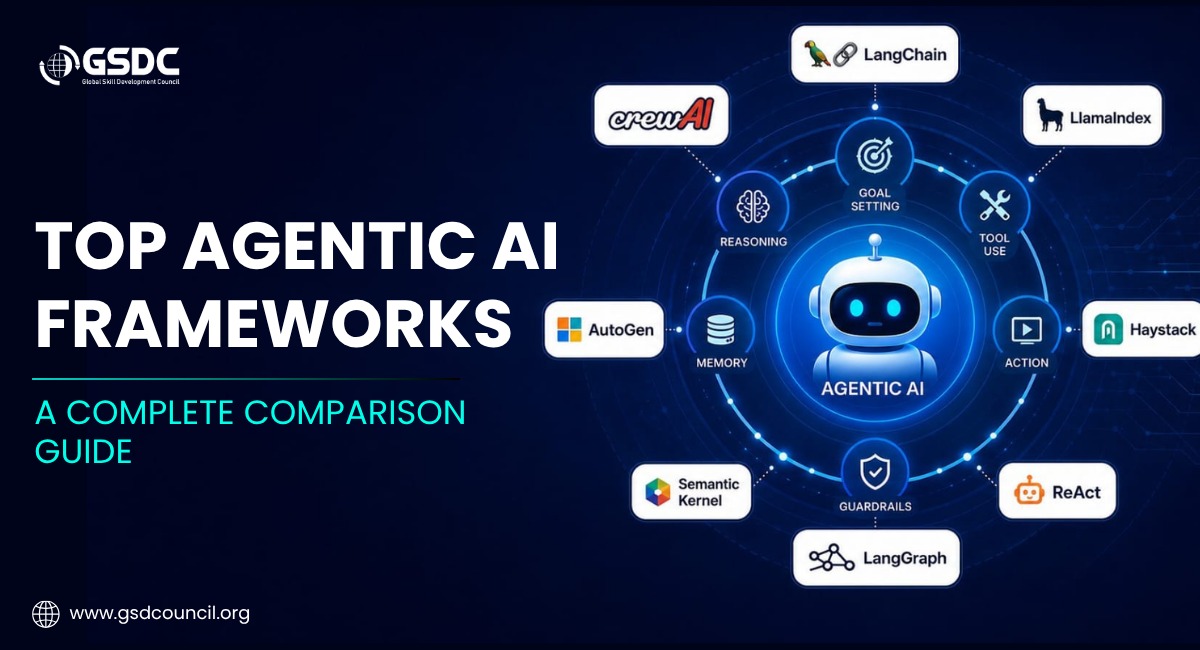
An agentic framework is the infrastructure layer for building AI agents. Instead of writing memory handling, tool access, decision logic, and error recovery from scratch, you use a framework that already has these pieces figured out. Most AI agentic frameworks give you three core capabilities:
- Orchestration – how agents are sequenced, coordinated, or allowed to work together
- Tools – how agents talk to external systems like APIs, databases, or search engines
- Memory – how agents remember what happened in the last step, or the last session
A growing number of AI teams are consolidating around one or two proven frameworks rather than mixing several, simply to keep maintenance manageable as these systems scale.
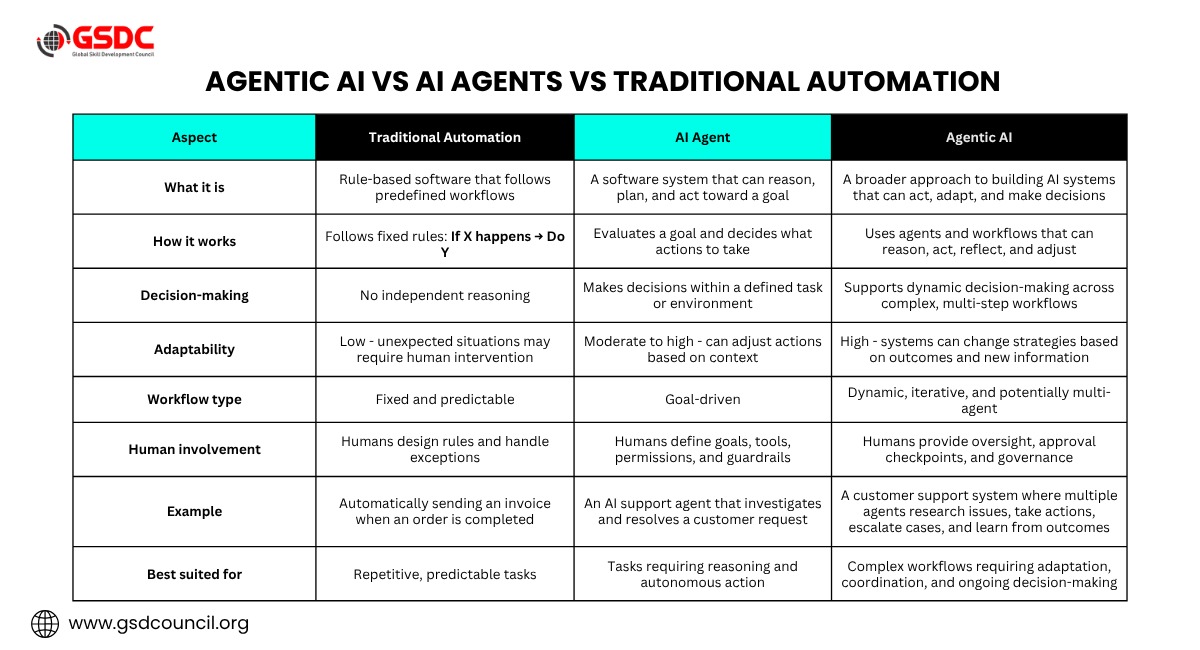
Agentic AI vs AI Agents vs Traditional Automation
Three terms get mixed up constantly, so here's the short version of each.
- AI agent vs agentic AI: An AI agent is a single instance - one piece of software that can reason, plan, and act on a goal without constant human prompts. Think of it as one employee. Agentic AI
- is the broader approach - building systems where AI acts independently, reflects on outcomes, and adjusts its next move. The agent is the thing you build; agentic AI is the approach you build it with.
- Automation framework vs agentic framework: A traditional automation framework - RPA tools, scripted workflows - follows fixed, pre-written rules: if X happens, do Y. There's no reasoning involved, so it's reliable but rigid, and breaks the moment something unexpected happens. Agentic frameworks let the AI reason about how to reach a goal instead - deciding which tool to use, trying an approach, and changing course if it doesn't work.
That reasoning shows up as agentic workflows - a loop of perceive, reason, act, and reflect (often called the PRAR cycle), rather than a fixed pipeline. A support workflow, for instance, might reason its way to escalating a ticket to a human instead of blindly following a script. And autonomous agents in AI are simply agents that run this loop with minimal hand-holding - though most production agents today still operate inside guardrails: approval steps for high-risk actions, spending limits, or human review for anything irreversible. Full autonomy remains the exception, not the rule.
Why Agentic AI Frameworks Matter in 2026: The Data
Numbers tell the story better than opinions do. Here's where the market actually stands, based on Gartner's and McKinsey's most recent published research:
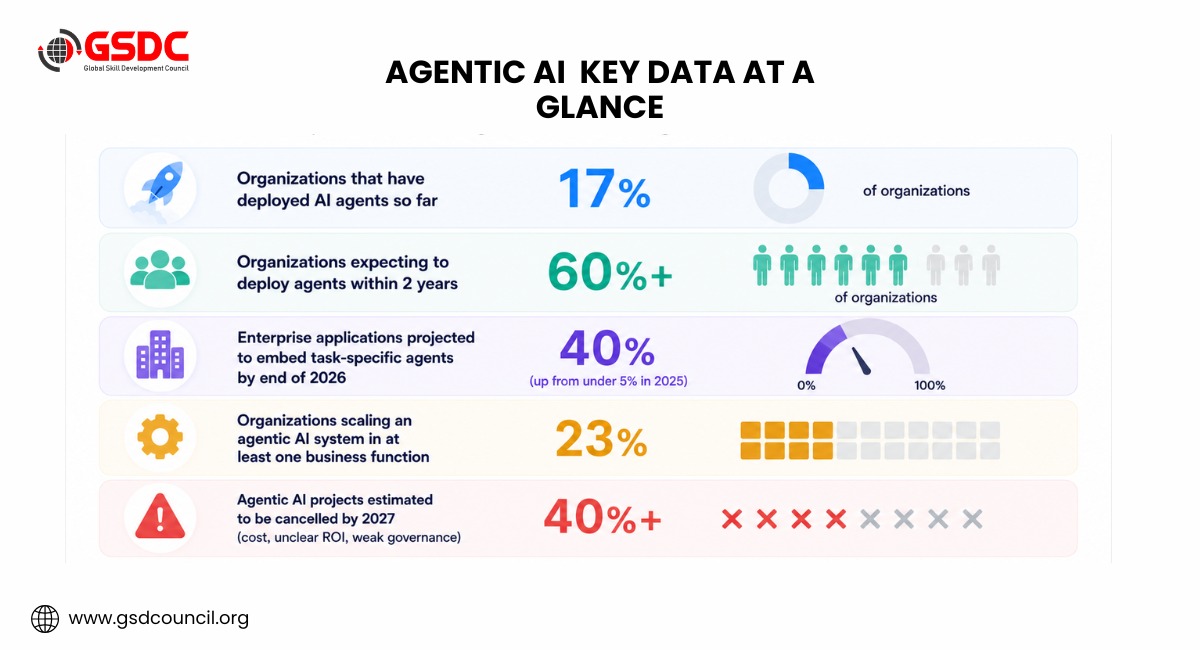
Read this table carefully: interest is high, but production maturity is still catching up. The gap between "we're experimenting with agents" and "we've scaled this safely" is exactly where the right framework and a solid governance layer make the difference. It's also a gap the Global Skill Development Council has flagged in its own work with employers: the bottleneck is rarely the technology itself; it's the shortage of people who know how to build, govern, and operate these systems responsibly.
How We Evaluated These Frameworks
Before jumping into the comparison, it's worth being upfront about what "best" means here. The categorizations and recommendations below are based on how each framework generally performs across ten practical dimensions:
- Orchestration and workflow control – how precisely you can define and constrain what the agent does at each step
- Multi-agent capabilities – how well the framework supports multiple agents collaborating on a task
- Human-in-the-loop support – how easily you can insert approval checkpoints or manual review
- Observability and tracing – how much visibility you get into what the agent perceived, decided, and did
- Memory and state management – how the framework handles short-term and long-term context
- Tool integration – how easily agents can call APIs, databases, and external services
- Model/provider flexibility – whether you're locked into one model provider or can swap freely
- Deployment options – how the framework fits into cloud, on-prem, or hybrid environments
- Learning curve – how quickly a developer can go from zero to a working agent
- Production maturity – how battle-tested the framework is in real deployments, not just demos
No framework scores highest on all ten; that's exactly why the "best" one depends on your specific priorities, which is what the use-case table below is built around. If this list of criteria feels like a lot to internalize, it's roughly the same lens taught in structured programs like the Agentic AI Foundation Certification. Evaluating a framework by its trade-offs rather than its marketing is a skill in itself, and one worth building deliberately.
Top Agentic AI Frameworks in 2026: Quick Comparison
Here's the list of agentic AI frameworks developers and enterprise teams keep coming back to in 2026, grouped by category rather than as one long flat list - it makes it easier to find what's relevant to your use case.
Best for production orchestration
Framework | Orchestration model | Multi-agent support |
LangGraph | Graph-based | Strong |
Best for ecosystem-native agent development
Framework | Orchestration model | Multi-agent support |
OpenAI Agents SDK | Managed/graph-based | Strong |
Google ADK | Code-first, workflow-based | Moderate |
Strands Agents | Model-driven | Moderate |
Best for multi-agent systems
Framework | Orchestration model | Multi-agent support |
CrewAI | Role-based | Strong |
AutoGen | Role-based, conversational | Strong |
Microsoft Agent Framework | Graph-based, enterprise | Strong |
Best for enterprise cloud ecosystems
Framework | Orchestration model | Multi-agent support |
Semantic Kernel | Planner-based | Moderate |
Best for RAG and knowledge systems
Framework | Orchestration model | Multi-agent support |
LlamaIndex Workflows | Retrieval-centric, event-driven | Limited |
Haystack | Pipeline-based | Moderate |
Best lightweight/structured frameworks
Framework | Orchestration model | Multi-agent support |
PydanticAI | Type-safe, structured | Limited |
smolagents | Minimalist, code-based | Limited |
Mastra | Agent + workflow hybrid | Moderate |
LangChain | Chain-based | Partial |
Phidata | Agent-centric, tool-heavy | Limited |
If You're Building... Here's What to Consider
Bringing the recommendations together in one place - this is the short answer to "what's the best agentic AI framework" for your specific situation:
If you're building... | Consider |
Regulated, production-grade workflows | LangGraph |
Multi-agent research or brainstorming systems | CrewAI / AutoGen |
OpenAI-native applications | OpenAI Agents SDK |
Google Cloud AI applications | Google ADK |
Azure enterprise solutions | Microsoft Agent Framework |
RAG and knowledge assistants | LlamaIndex Workflows |
Type-safe, validated Python agents | PydanticAI |
TypeScript / full-stack agent apps | Mastra |
A Closer Look at the Leading Frameworks
- LangGraph is what teams reach for when reliability matters more than speed of building. It models an application as a graph - clear nodes, clear transitions - so you always know exactly where the AI can act freely and where a human needs to sign off. It has a learning curve, but for customer support systems, financial workflows, or anything that needs to survive production complexity, it's a strong default choice.
- CrewAI takes the opposite approach: simplicity first. You assign agents roles - researcher, writer, reviewer - and let them collaborate like a small team. It's one of the fastest ways to get a multi-agent prototype working, though it needs more validation once you move toward production scale.
- OpenAI Agents SDK appeals to teams that want a clean, minimal setup. Agents, tools, handoffs, guardrails, and tracing are built in, without forcing a heavy orchestration model - especially natural if your stack already runs on OpenAI's models.
- Google ADK has become a common choice for teams already inside the Google Cloud ecosystem - Gemini, Vertex AI, Cloud Run - and includes a local development UI that developers have found useful for inspecting agents before deployment.
- PydanticAI solves a specific but common headache: getting reliable, structured output from an LLM instead of hoping the JSON comes back valid. Worth a serious look if your agent feeds a database, an API, or a financial process where a malformed field causes real problems.
- Mastra and Microsoft Agent Framework round things out for full-stack JavaScript teams and enterprise .NET/Azure shops respectively - both are newer, both are backed by serious engineering investment, and both are evolving quickly enough that version-pinning is a smart habit.
There's no single "best" framework across the board - the right pick depends on how much control you need over the workflow, whether you're coordinating one agent or several, and how tightly your stack already connects to a specific cloud provider.
Other Agentic AI Frameworks Worth Considering
- AutoGen (Microsoft Research) pioneered much of the conversational, role-based multi-agent pattern that CrewAI later made more accessible - it's still a solid pick for research-style setups where agents debate or refine each other's output.
- Semantic Kernel is Microsoft's planner-based framework built with enterprise copilots in mind, with particularly strong human-in-the-loop and plugin support for .NET and Azure-heavy teams.
- LlamaIndex Workflows grew out of LlamaIndex's retrieval-augmented generation (RAG) tooling, making it a natural fit for document-heavy agents that need to search, cite, and reason over large knowledge bases.
- Strands Agents, from AWS, is a model-driven framework designed to work smoothly with Amazon Bedrock - a sensible default if your infrastructure already runs on AWS.
- Haystack takes a pipeline-based approach and is widely used for production-grade RAG and document search systems, particularly where retrieval accuracy matters more than agent autonomy.
- LangChain remains one of the most widely adopted frameworks for rapid prototyping and tool-augmented chatbots, though many teams now graduate to LangGraph once they need tighter orchestration control.
- smolagents, from Hugging Face, is a deliberately minimal, code-first framework aimed at lightweight experiments and local prototyping without much orchestration overhead.
- Phidata focuses on agent-centric, tool-heavy use cases - particularly data, finance, and operations automation - with a lighter footprint than the larger enterprise frameworks.
Why Governance Matters for Agentic Systems
Here's the part most "best frameworks" lists skip - and it's arguably the most important one in 2026.
So, what is AI governance? In simple terms, it's the set of policies, controls, and oversight mechanisms that make sure an AI system behaves safely, fairly, and within legal and ethical boundaries - before, during, and after deployment. It covers who can approve an agent's actions, how decisions are logged, how bias is checked, and what happens when something goes wrong.
AI governance frameworks turn those principles into something teams can actually operationalize: audit trails, approval checkpoints, access controls, and monitoring dashboards built directly into how the agent runs.
Agentic AI governance is a different kind of problem. Traditional software governance assumes a human wrote every line of logic. Agentic systems make their own decisions about how to reach a goal - which tool to call, which data to pull, which step to skip. That unpredictability is why frameworks with strong human-in-the-loop support - like LangGraph, Semantic Kernel, and Microsoft Agent Framework - can be particularly useful in regulated environments where oversight, auditability, and approval workflows matter.
Good agentic AI governance frameworks typically include:
- Human-in-the-loop checkpoints for high-risk or irreversible actions
- Full observability - logs of what the agent perceived, decided, and did
- Access boundaries - strict limits on which tools and data an agent can touch
- Reproducibility - the ability to re-run an agent and get consistent, explainable results
This isn't a theoretical concern. Gartner estimates that more than 40% of agentic AI projects could be cancelled by 2027, with unclear governance consistently cited alongside cost and unclear business value as a top reason. Building governance into the framework layer early is generally far less costly than retrofitting it after an incident.
Agentic AI Trends Shaping 2026
A few patterns are worth watching heading into the rest of the year:
- Multi-agent architectures are gaining traction for complex workflows - a researcher agent, a validator agent, an execution agent working under central coordination - though most production deployments today are still narrower in scope.
- Governance is shifting left. More teams are building approval steps and audit trails into the framework layer itself, instead of adding them after launch.
- Framework consolidation is underway. With dozens of options on the market, more teams are standardizing on one or two frameworks to keep maintenance and training overhead manageable.
- Vertical, domain-specific agents are among the fastest-growing segments - legal, healthcare, finance, and engineering agents built on general-purpose frameworks but tuned for a specific industry's rules and data.
The agentic AI future looks less like fully autonomous systems replacing human judgment, and more like narrower, well-governed agents earning enough trust to take on more responsibility over time.
Where the Skills Gap Actually Sits
Reading through fifteen frameworks and a governance checklist, it's worth stepping back: none of this is really about which SDK has the cleanest API. It's about whether the people building these systems know the trade-offs - when to reach for LangGraph over CrewAI, when a workflow needs a human checkpoint, when "agentic" is overkill for a simple automation problem.
That judgment isn't something documentation teaches. It's what structured learning paths like the Global Skill Development Council's Agentic AI Foundation Certification are built around - covering the same evaluation thinking as this guide, but designed to get a whole team aligned before they commit to a framework, not just one person reading up alone.
Final Thoughts
The framework you choose today becomes the foundation for everything else - your agent's reliability, your team's ability to debug it, and ultimately, whether your organization trusts it with more responsibility. There's no single "best" framework in 2026, only the one that matches your control, scale, and governance needs.
As organizations move from experimenting with agents to deploying them responsibly, skills in agentic system design, orchestration, observability, and AI governance are only going to matter more.

Related Certifications
Frequently Asked Questions
Think of it as the scaffolding you'd otherwise have to build yourself - memory, tool access, error handling, all wired up so you can focus on what the agent actually does instead of the plumbing underneath it.
People use these interchangeably, but they're not quite the same. An AI agent is one specific thing you build - a single system handling a task. Agentic AI is the bigger idea: designing software that reasons and acts on its own, sometimes through several agents working together rather than just one.
It's the guardrails - who gets to approve what an agent does, how you'd trace back a decision if something went wrong, and how you catch bias or bad behavior before it becomes a real problem. Basically, accountability built into the system rather than bolted on afterward.
If you're just starting out, CrewAI and the OpenAI Agents SDK tend to be the least frustrating entry points - simpler mental models, not much setup ceremony before you get something working.
Not really. Automation frameworks run on fixed rules - if this happens, do that, every time. Agentic frameworks give the AI room to actually reason about how to get somewhere, which means it can change course when the first approach doesn't work.
Yes, and the reason comes down to unpredictability. A traditional AI model gives you an output and stops there. An agentic system keeps making decisions - which tool to use, what data to pull - so governance has to account for a lot more moving parts, including real-time human oversight when something risky is about to happen.
It's the loop an agent runs through to get a task done - perceive what's happening, reason about the next move, act on it, then reflect on how it went. Not a straight line like a traditional pipeline; more like a process that can double back, retry, or hand things off to a person when it needs to.
These are agents that don't need someone typing a new prompt at every single step - they observe, decide, act, and check the result on their own. That said, "autonomous" rarely means unsupervised in practice. Most production systems still keep guardrails in place for anything high-stakes.
Probably not the fully self-running systems some of the hype suggests. What's actually taking shape is narrower agents with real oversight built in - multiple agents coordinating on complex work, governance getting baked into the framework itself instead of added later, and a lot of movement toward industry-specific agents built for one domain rather than everything at once.
The comparison table earlier in this guide is a good starting point - it groups 15 of the frameworks people actually use in 2026 (LangGraph, CrewAI, AutoGen, OpenAI Agents SDK, Google ADK, PydanticAI, and others) by category, so you're not stuck scrolling through one long undifferentiated list.
Stay up-to-date with the latest news, trends, and resources in GSDC
If you like this read then make sure to check out our previous blogs: Cracking Onboarding Challenges: Fresher Success Unveiled
Not sure which certification to pursue? Our advisors will help you decide!