Forward Deployed Engineer Job Market: Skills, Employers, and Opportunities
Written by Emily Hilton
- What Is the Current Forward Deployed Engineer Job Market Like?
- What Does a Forward Deployed Engineer Job Description Include?
- Which Companies Hire Forward Deployed Engineers?
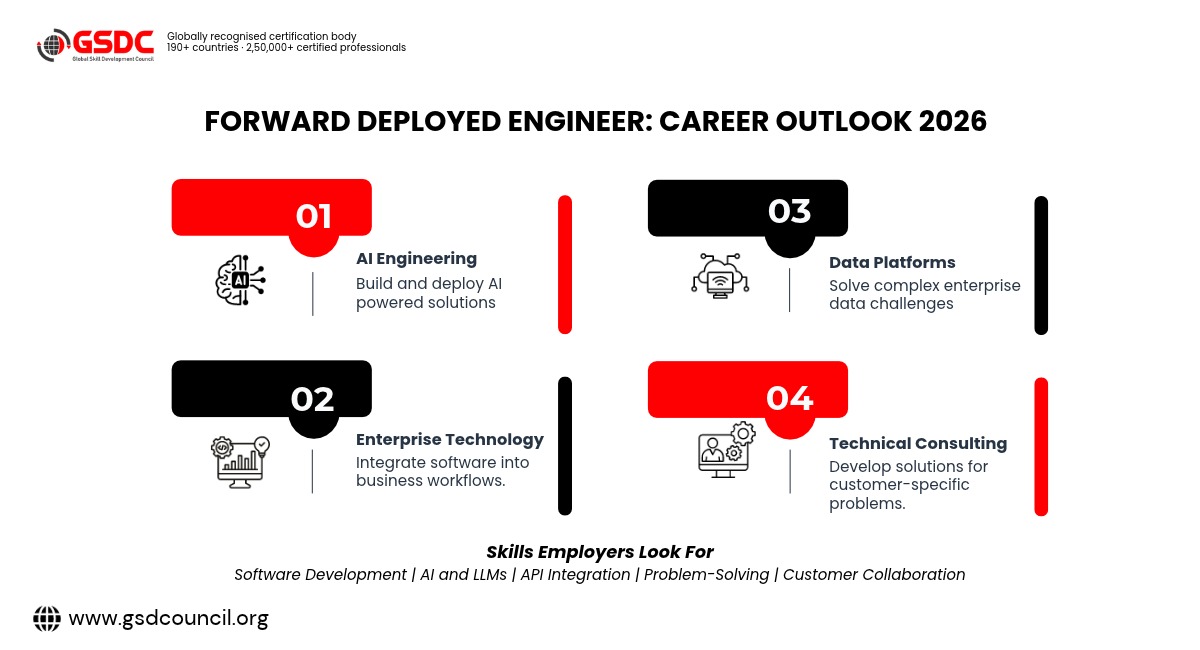
- What Forward Deployed Engineer Skills Do Employers Look For?
- What Is the Forward Deployed Engineer Salary?
- What Opportunities Are Available for Forward Deployed Engineers?
- Want to Become a Forward Deployed Engineer? Start Here
- Final Thoughts
Artificial intelligence is changing how companies build products, serve customers, and manage business operations. However, adopting new technology is not always easy. Businesses need professionals who can understand their challenges, develop technical solutions, and make sure those solutions work in real-world environments.
This is one reason Forward Deployed Engineering is gaining attention. Forward Deployed Engineers work closely with customers to solve technical problems, integrate applications, and help businesses use technology more effectively.
As companies invest in AI applications and enterprise software, Forward Deployed Engineer jobs are becoming an important career option for professionals who enjoy both engineering and problem-solving.
But what does the job market look like? Which companies hire Forward Deployed Engineers? What skills do employers expect, and what career opportunities are available? In this blog, we will explore the Forward Deployed Engineer job market, common job responsibilities, essential skills, employers, salary expectations, career growth, and ways to prepare for this role.
What Is the Current Forward Deployed Engineer Job Market Like?
Forward Deployed Engineering is expanding beyond its earlier association with specialized software companies. AI companies, enterprise technology providers, consulting firms, and startups are exploring roles that combine technical development with customer-facing implementation.
The reason is straightforward. A business may have access to powerful AI models and software tools, but it still needs to connect those tools to its existing systems, business processes, and customer requirements. Forward Deployed Engineers help bridge this gap.
The job market is also attracting attention because organizations want to move beyond AI experiments and implement solutions that can be used in everyday operations. This creates opportunities for professionals who can combine software development, system integration, and an understanding of business needs.
What Does a Forward Deployed Engineer Job Description Include?
A Forward Deployed Engineer job description usually combines software development, technical implementation, customer collaboration, and problem-solving.
The exact responsibilities depend on the company, its products, and the customers it serves. However, many roles involve the following activities.
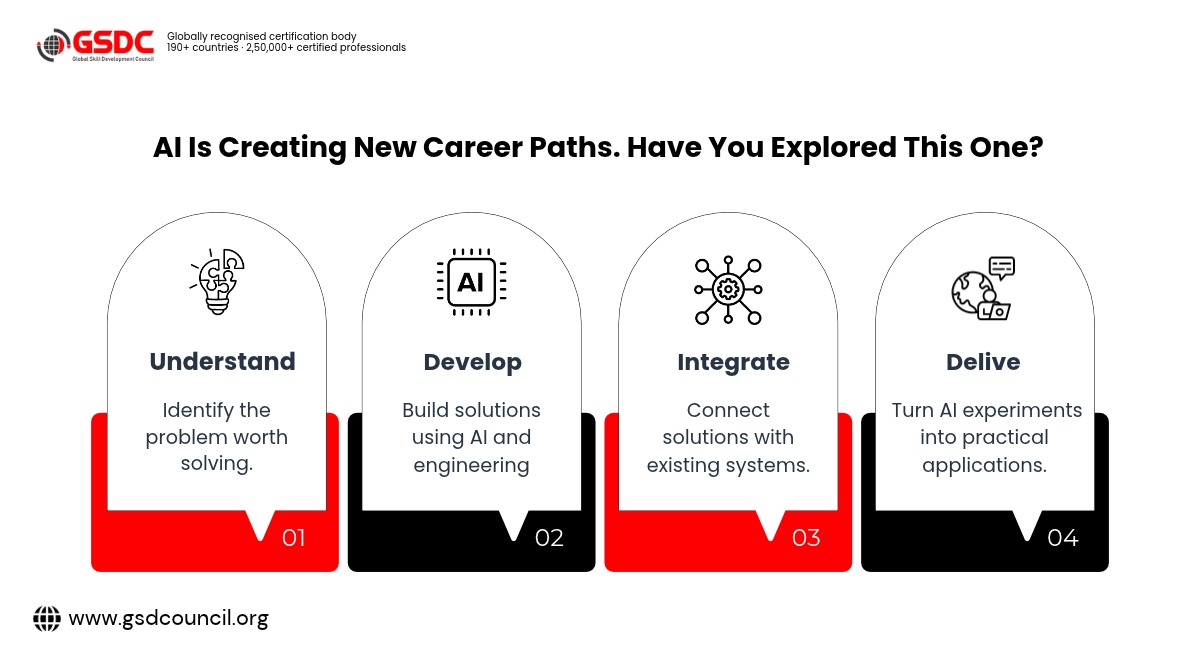
1. Understanding customer requirements
FDEs work with customers to understand their business processes, technical challenges, and expected outcomes. They identify the problem before deciding how to solve it.
2. Developing technical solutions
They write code, build prototypes, customize applications, and develop solutions based on customer requirements. Depending on the project, this may involve software development, AI applications, or workflow automation.
3. Integrating systems
Many businesses already use databases, cloud platforms, customer relationship management systems, and other enterprise applications. FDEs help connect these systems so that new solutions can work within existing workflows.
4. Testing and troubleshooting
They test applications, investigate errors, identify integration issues, and improve performance. When a solution does not work as expected, they help determine the cause and implement changes.
5. Collaborating with different teams
FDEs work with customers, software engineers, product managers, data teams, and other stakeholders. They communicate technical decisions and help ensure that the solution addresses the original business problem.
6. Supporting deployment and improvement
Their work often continues after development. They help deploy solutions, gather feedback, monitor performance, and make improvements based on how the technology performs in practice.
For example, a company may want to automate document processing using AI. A Forward Deployed Engineer could help understand the document workflow, connect the AI application to the company's database, test the results, and improve the solution based on employee feedback.
This combination of responsibilities makes the role different from positions that focus exclusively on coding, research, or customer support.
Which Companies Hire Forward Deployed Engineers?
Forward Deployed Engineer opportunities can be found across different types of organizations. The best employer for you will depend on your technical interests, experience, preferred industry, and the kind of problems you want to solve.
1. AI and technology companies
AI companies need professionals who can help customers integrate AI models and applications into real business workflows. These roles may involve large language models, AI agents, data integration, application development, and production deployment.
Companies such as OpenAI, Anthropic, and other AI-focused organizations have roles related to applied AI engineering and customer-facing implementation. The exact titles and hiring requirements vary.
2. Enterprise software companies
Enterprise software providers build products that organizations use for data management, analytics, customer operations, and business processes.
Companies such as Palantir, Databricks, and Salesforce are useful examples to explore when researching Forward Deployed Engineer and related engineering roles.
Professionals in this area may help customers configure products, integrate data, build applications, and address complex technical requirements.
3. Cloud and data technology companies
Cloud and data platforms allow businesses to store information, run applications, and manage large-scale workloads.
Forward Deployed Engineers and similar customer-facing technical professionals help organizations implement these technologies, connect data sources, and develop solutions that fit their infrastructure.
These roles may require knowledge of cloud services, databases, APIs, data pipelines, and application deployment.
4. Consulting and technology services firms
Consulting firms and technology service providers help organizations introduce new systems, modernize existing applications, and implement AI solutions.
Their projects can provide exposure to different industries and customer environments. Depending on the role, professionals may work on system integration, enterprise applications, AI deployment, or technical implementation.
5. Startups and growing technology businesses
Startups often need engineers who can take ownership of a problem and work across different stages of development. A single role may involve understanding customer needs, building a prototype, integrating systems, and improving the product.
Not every startup uses the Forward Deployed Engineer title. Similar work may appear under roles such as founding engineer, applied AI engineer, implementation engineer, or solutions engineer.
Tip: When searching for Forward Deployed Engineer jobs, review the responsibilities carefully. Some positions focus on hands-on coding and deployment, while others emphasize consulting, solution design, or customer relationships.
What Forward Deployed Engineer Skills Do Employers Look For?
The Forward Deployed Engineer skills required by employers usually combine technical knowledge with communication, analytical thinking, and an understanding of business problems.
You do not need to master every technology before applying. However, developing a strong foundation in the following areas can help you prepare.
1. Programming and software development
Programming is important for roles that involve building and customizing solutions. Python and JavaScript or TypeScript are useful languages to explore, although requirements vary by employer.
You should understand basic software development, debugging, version control, and how to build applications that solve specific problems.
2. APIs and system integration
FDEs often need to connect applications, databases, and external services. Understanding how APIs work, how data moves between systems, and how authentication is handled can help you develop practical solutions.
For example, an FDE may connect an AI assistant to a company's internal knowledge base or customer management system.
3. AI and large language models
For AI-focused roles, it helps to understand large language models, prompt design, retrieval-augmented generation (RAG), AI APIs, and evaluation methods.
The goal is not simply to know how AI tools work. You should also understand how to integrate them into applications, evaluate their output, and identify situations where they may fail.
4. Cloud and deployment fundamentals
Solutions need to run in real environments, not just on a developer's laptop. Familiarity with cloud platforms, application deployment, databases, and monitoring can help you understand how software operates after development.
The specific cloud platform required will depend on the employer and its technology stack.
5. Problem-solving and analytical thinking
Customers may describe a symptom rather than the underlying technical issue. FDEs need to investigate the problem, consider different explanations, and identify a practical solution.
For instance, if an AI application provides inaccurate answers, the issue may involve data quality, retrieval, application logic, or the model itself. A systematic approach helps identify the cause.
6. Communication and customer collaboration
FDEs often explain technical decisions to people who do not have an engineering background. They need to ask useful questions, gather requirements, discuss limitations, and communicate progress clearly.
These skills are important because a technically correct solution may still fail if it does not address the customer's actual needs.
7. Testing, reliability, and security
Employers need professionals who can build solutions that work consistently. Understanding testing, error handling, logging, monitoring, access controls, and data protection can help you prepare applications for real-world use.
These skills become particularly important when solutions handle business data or support critical workflows.
Together, these technical and professional abilities form the foundation of Forward Deployed Engineer skills requirements. Employers may prioritize different skills depending on whether the position focuses on AI, enterprise software, cloud infrastructure, or customer-specific development.
What Is the Forward Deployed Engineer Salary?
The Forward Deployed Engineer salary depends on several factors, including location, experience, technical specialization, company size, and the responsibilities of the role.
Professionals working on complex AI deployments or enterprise systems may have different compensation packages from those in entry-level implementation positions. Compensation may also include bonuses, equity, or other benefits, depending on the employer.
For example, Indeed's United States salary page reported an average base salary of approximately $178,540 per year, based on salary data from job postings over the preceding 36 months and updated in September 2026.
When evaluating an offer, consider the following factors:
- Experience: Employers may offer different packages for junior, mid-level, and senior professionals.
- Technical expertise: Skills in AI applications, software development, cloud platforms, and system integration may influence compensation.
- Location: Salaries vary across countries, cities, and local employment markets.
- Role responsibilities: A position involving production engineering and complex customer deployments may have different expectations from one focused mainly on implementation support.
- Total compensation: Compare base salary with bonuses, equity, benefits, travel expectations, and other conditions.
Instead of choosing a career based only on advertised salary figures, review current job postings in your target location and compare the requirements with your experience.
What Opportunities Are Available for Forward Deployed Engineers?
Forward Deployed Engineer opportunities are not limited to one industry. The role can be relevant wherever organizations need technical professionals to connect software, AI, and business processes.
Here are some areas worth exploring.
AI implementation: Help organizations integrate AI models and applications into existing workflows.
Enterprise software: Customize business applications and connect them with customer systems.
Data and analytics: Develop integrations that help organizations access, process, and use data more effectively.
Cloud solutions: Help customers deploy applications and integrate services within cloud environments.
Workflow automation: Build applications that reduce repetitive work and support business processes.
Technical consulting: Work with customers to understand requirements, evaluate solutions, and guide implementation.
The exact opportunities depend on the employer. Some roles require substantial software development, while others involve more solution design and technical consulting.
For job seekers, the key is to identify the type of FDE work that matches their interests and build the relevant skills.
Want to Become a Forward Deployed Engineer? Start Here
A career as a Forward Deployed Engineer combines technical problem-solving, customer collaboration, and real-world technology implementation. The GSDC Certified Forward Deployed Engineer Certification offers a structured learning path for professionals who want to understand this role and develop relevant knowledge for working at the intersection of business and engineering.
What Can You Gain from the GSDC FDE Certification?
- Understand the FDE Role: Learn how Forward Deployed Engineers translate customer requirements into practical technical solutions.
- Strengthen Your Technical Knowledge: Explore the technologies, tools, and engineering concepts relevant to customer-focused implementation.
- Bridge Business and Engineering: Understand how to connect business objectives with technical requirements and existing systems.
- Explore AI Implementation: Develop your understanding of applying AI technologies to real-world business challenges.
- Prepare for FDE Career Opportunities: Identify the skills and responsibilities associated with Forward Deployed Engineer roles.
- Follow a Structured Learning Path: Use the certification syllabus and learning outcomes to guide your professional development.
Who Should Consider the GSDC FDE Certification?
This certification is worth exploring if you are a software developer, AI or machine learning professional, solutions engineer, technical consultant, or technology professional looking to work more closely with customers and business teams.

Final Thoughts
Forward Deployed Engineering is an evolving career path that connects software development, AI implementation, customer collaboration, and business problem-solving. As organizations work to integrate technology into their existing operations, professionals who can understand customer needs and develop practical solutions have an opportunity to explore this field.
The job market includes AI companies, enterprise software providers, cloud and data businesses, consulting firms, and startups. However, the requirements vary, so it is important to research individual roles instead of assuming every employer expects the same skills.
Start by building your technical foundation, learning system integration, developing practical projects, and strengthening your communication skills. Then compare job descriptions, identify gaps in your knowledge, and prepare a portfolio that demonstrates how you approach real problems.
With consistent practice and a clear learning plan, you can assess whether Forward Deployed Engineering matches your interests and work toward relevant opportunities.

Related Certifications
Stay up-to-date with the latest news, trends, and resources in GSDC
If you like this read then make sure to check out our previous blogs: Cracking Onboarding Challenges: Fresher Success Unveiled
Not sure which certification to pursue? Our advisors will help you decide!