How FDEs Measure AI Impact: 5 Metrics That Prove Business Value
Written by Emily Hilton
Artificial intelligence is changing how businesses manage workflows, serve customers, and make decisions. However, implementing an AI solution does not automatically translate into measurable business value. Organizations need to understand whether their AI investments improve productivity, reduce costs, increase revenue, and solve real operational challenges.
This is where Forward Deployed Engineers (FDEs) play an important role. They work closely with customers to identify business problems, build practical AI solutions, integrate them into existing systems, and measure their impact after deployment. Their success depends not only on delivering functional technology but also on demonstrating tangible results.
According to Google Cloud's AI business value research, organizations are realizing value from AI through productivity improvements, business growth, and cost efficiency. These outcomes highlight why businesses need a structured approach to evaluating AI performance.
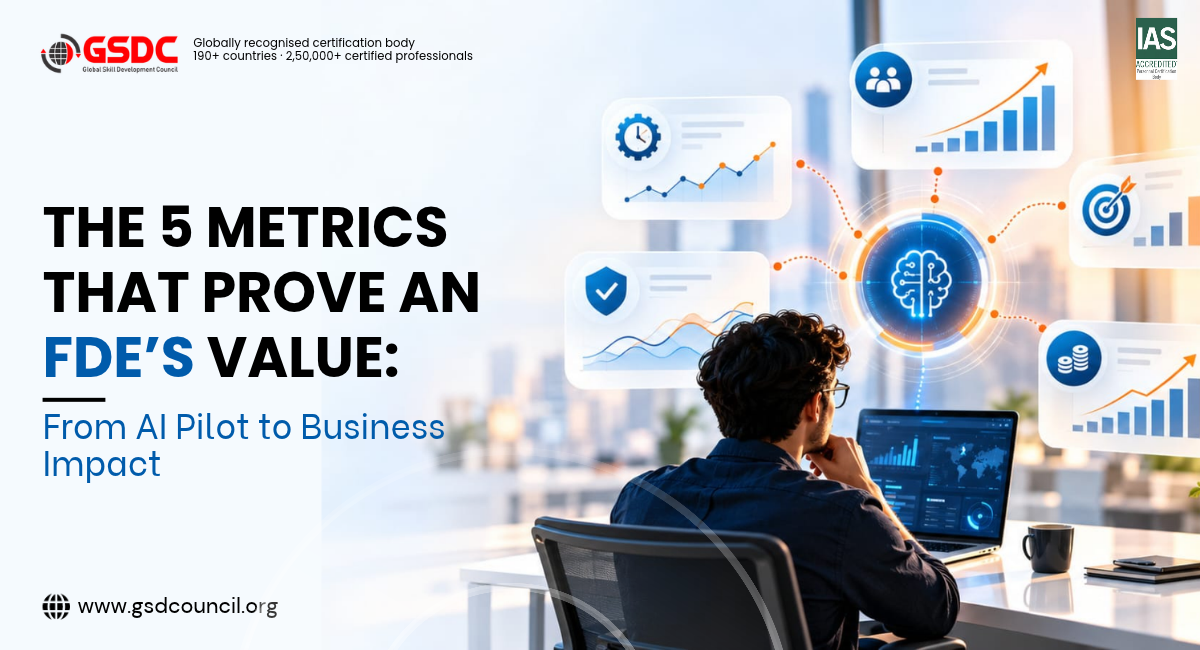
So, how can FDEs demonstrate that an AI solution is delivering value? Let's explore five essential metrics that connect AI implementation with measurable business outcomes.
What Is a Forward Deployed Engineer, and Why Does Measuring AI Impact Matter?
A Forward Deployed Engineer is a technical professional who works closely with customers to develop, implement, and improve solutions that address real-world business challenges. Unlike engineers who primarily build generalized software products, FDEs often work directly within customer environments, connecting technical capabilities with operational requirements.
For anyone exploring what is a forward deployed engineer, the key distinction is the role's emphasis on execution and outcomes. FDEs translate business needs into working solutions, address integration challenges, and help ensure AI systems deliver practical results.
Google Cloud's Generative AI Forward Deployed Engineer role description highlights responsibilities such as building production-grade AI applications, creating evaluation pipelines, monitoring system performance, and supporting end-user adoption.
Measuring impact is essential because AI projects can appear successful during demonstrations but struggle to deliver consistent results in production. FDEs need evidence that connects implementation efforts to business improvements. Well-defined FDE Metrics help teams establish accountability, identify performance gaps, and determine whether an AI solution should be improved, expanded, or reconsidered.
5 Metrics FDEs Use to Measure AI Impact
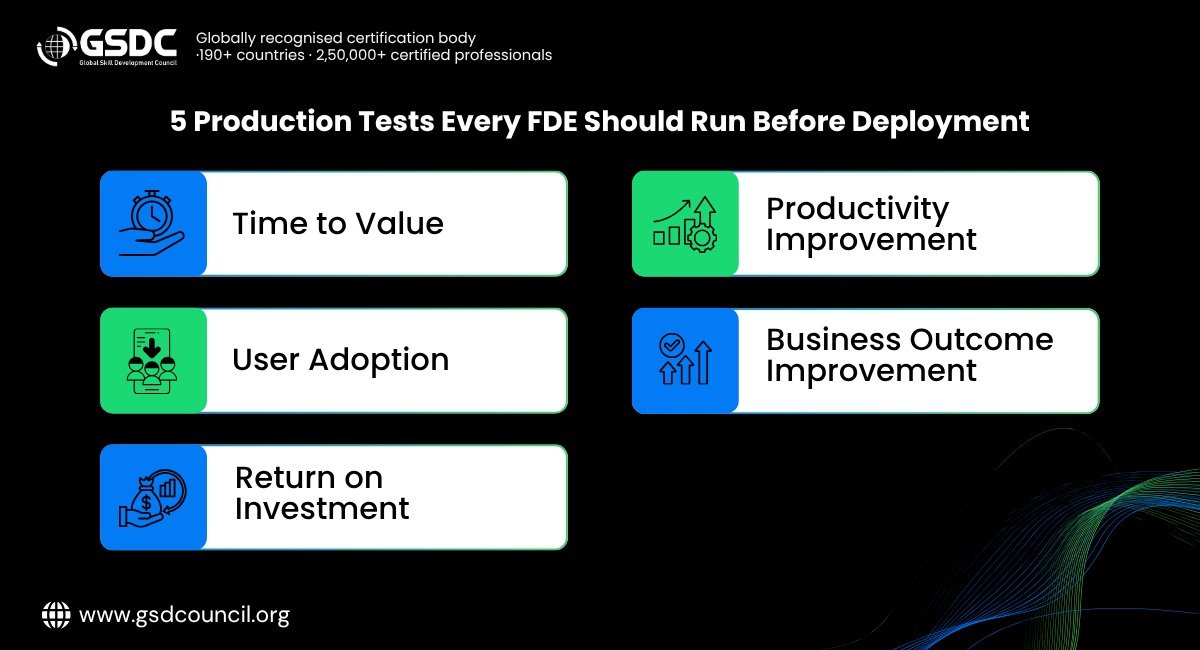
1. Time to Value: How Quickly Does AI Deliver Results?
The time to value metric measures how long it takes for an AI solution to produce its first meaningful, measurable business outcome.
For FDEs, this metric begins with understanding the customer's problem and continues through development, integration, deployment, and initial validation. A working prototype is an important milestone, but it does not necessarily represent business value. Value becomes measurable when the solution starts improving an actual workflow.
For example, consider an organization that spends several hours each day reviewing customer support tickets. An FDE develops an AI-powered classification system that automatically categorizes incoming requests and recommends appropriate responses.
Instead of measuring success by how quickly the prototype was built, the FDE tracks how long it takes to deploy the system, integrate it with the ticketing platform, and demonstrate a measurable reduction in ticket-processing time.
How to measure it:
Time to value = Date of first verified business outcome − Project start date.
FDEs can also track time to first production deployment and time to reach agreed performance targets.
Google Cloud's AI business value research emphasizes the importance of use cases that combine meaningful impact with a short time to value.
Why it matters: Faster value realization can strengthen stakeholder confidence, support investment decisions, and help organizations prioritize promising AI initiatives. However, speed should never come at the expense of security, reliability, or output quality.
2. Productivity Improvement: Is AI Helping Teams Accomplish More?
Productivity improvement measures whether AI helps employees complete tasks faster, process more work, or reduce repetitive manual effort without compromising quality.
This is one of the most practical AI success metrics because many enterprise AI applications aim to streamline existing workflows. FDEs need to establish how a process performs before AI implementation and compare it with performance after deployment.
For instance, an AI assistant may help a software engineering team generate code suggestions, summarize documentation, or identify potential defects. The FDE could measure changes in task completion time, review effort, rework rates, and the number of successfully completed tasks.
How to measure it:
Productivity improvement (%) = [(Baseline time per task − New time per task) ÷ Baseline time per task] × 100.
Suppose a team previously spent 40 minutes completing a task and now requires 30 minutes with AI assistance. The task takes 25% less time, assuming comparable task complexity and quality.
However, time saved is not automatically equivalent to financial savings. FDEs should determine how the recovered capacity is used, whether employees complete additional work, and whether the improvement reduces overtime, external spending, or operational bottlenecks.
Why it matters: Productivity measurements help organizations distinguish genuine efficiency gains from superficial improvements in task speed. They also support better decisions about scaling AI across teams and workflows.
3. User Adoption: Are People Actually Using the AI Solution?
Even a technically advanced AI application can fail if employees do not use it consistently. User adoption metrics help FDEs understand whether a solution fits existing workflows, meets user expectations, and provides enough value to encourage continued use.
Adoption should be evaluated beyond initial sign-ups or launch-day activity. A system may attract considerable attention during its first week but experience declining usage when users encounter inaccurate responses, confusing interfaces, or additional manual work.
FDEs can measure adoption through active users, repeat usage, workflow penetration, task completion rates, and user feedback.
How to measure it:
Adoption rate (%) = (Number of intended users actively using the solution ÷ Total number of intended users) × 100.
For example, if 75 out of 100 intended employees regularly use an AI assistant, the active adoption rate is 75% for the defined measurement period.
Effective ai adoption metrics should also examine how users interact with the system. For an AI-generated response, useful indicators include acceptance rates, the frequency of substantial edits, override rates, and the percentage of tasks completed with AI assistance.
These user adoption metrics help identify whether the solution is genuinely useful or merely available.
Why it matters: Adoption connects technical delivery with real-world behaviour. FDEs can use these insights to improve interfaces, refine workflows, provide training, and address trust concerns. Strong adoption, combined with operational improvements, increases the likelihood of sustained business value.
4. Business Outcome Improvement: Is AI Improving the Target Process?
Operational improvements demonstrate whether AI changes how work gets done. Business outcome improvement goes further by examining whether those changes support the organization's broader objectives.
For example, an AI-powered customer support assistant might reduce average handling time. However, if customer satisfaction falls or more requests require follow-up, faster handling alone does not establish success.
FDEs should select ai kpis that reflect the specific business problem being addressed. Relevant indicators may include:
- Customer service: First-contact resolution, customer satisfaction, complaint rates, and cost per interaction.
- Sales and marketing: Qualified leads, conversion rates, campaign performance, and revenue generated.
- Software engineering: Delivery cycle time, defect rates, rework, and successful release frequency.
- Operations: Processing time, error rates, throughput, and missed service-level agreements.
Consider an AI solution designed to process insurance claims. The FDE could monitor the percentage of claims processed within the target time, the number requiring manual correction, and the cost per completed claim.
The important distinction is that AI performance should be evaluated against the process outcome, not just the number of predictions or responses generated.
Why it matters: These measurements show whether AI contributes to meaningful operational change. They also help organizations identify unintended consequences, compare results across workflows, and decide where further investment is justified.
5. Return on Investment: Does AI Generate More Value Than It Costs?
Return on investment (ROI) connects AI performance with financial outcomes. It helps business leaders understand whether measurable benefits justify the total cost of building, deploying, operating, and maintaining an AI solution.
For FDEs, this metric is especially important when customers need evidence to support continued investment or enterprise-wide deployment.
A complete calculation should include development and integration costs, model and infrastructure expenses, monitoring, maintenance, human review, training, and ongoing operational support. Benefits may include verified cost reductions, additional revenue, reduced error-related expenses, or the financial value of productive capacity that the organization actually uses.
How to measure it:
ROI (%) = [(Total measurable benefits − Total AI investment) ÷ Total AI investment] × 100. The following image is for example like an AI solution generates ₹15 lakh in verified benefits over a defined period and costs ₹10 lakh to develop, deploy, and operate during that same period.
The resulting ROI is 50%.
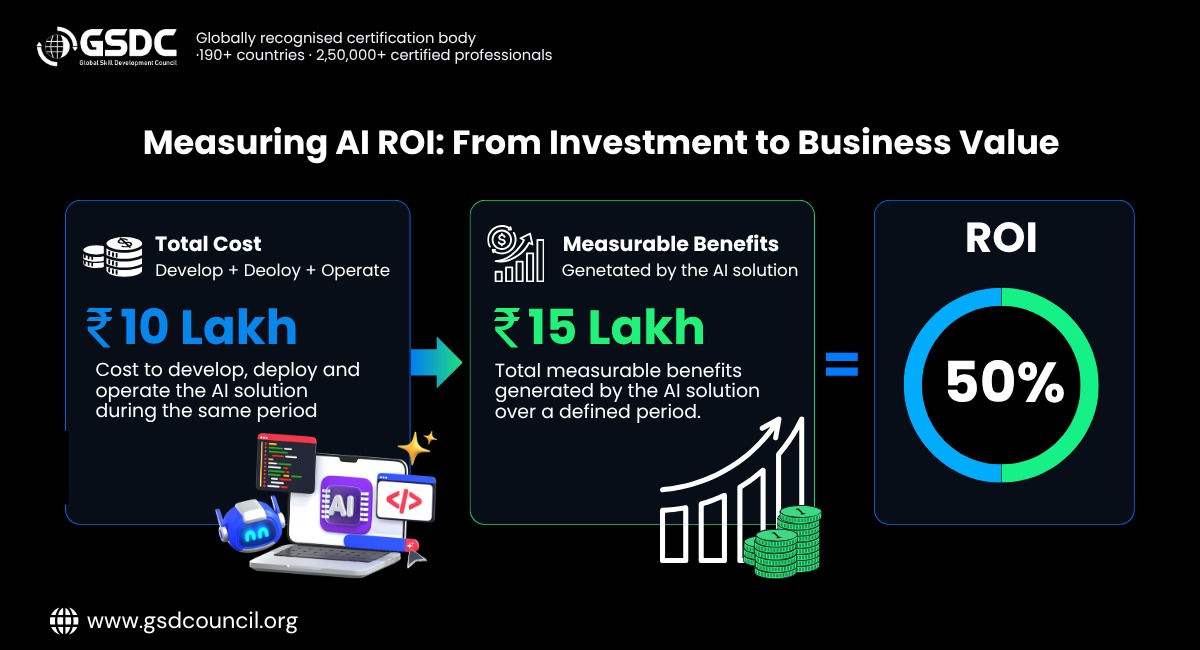
This is an illustrative calculation, not a guaranteed result. The business should use a consistent measurement period, account for relevant costs, and avoid counting the same benefit twice.
FDEs should also distinguish projected savings from realized savings. If AI reduces the time employees spend on a task, that improvement may create valuable capacity without immediately reducing payroll expenses.
Why it matters: ROI supports evidence-based investment decisions and provides a financial perspective on AI value realization. It helps organizations determine which solutions merit further investment, which require optimization, and which may not justify their costs.
How FDEs Build a Reliable AI Measurement Framework
Tracking five metrics is useful, but meaningful measurement requires a consistent process. Before development begins, FDEs should work with business stakeholders to define the problem, document baseline performance, establish measurable targets, and agree on how results will be evaluated.
Google Cloud's guidance for defining AI business use cases recommends starting with measurable business goals and working backward to identify suitable AI applications and user expectations.
FDEs should also evaluate technical performance, including response accuracy, latency, reliability, cost per interaction, and safety. These indicators help establish whether a solution is functioning correctly, but they should be connected to operational and financial results.
Where practical, teams can compare outcomes before and after deployment, use a pilot group or phased rollout, and account for other factors that may influence results. Measurement should continue after launch because user behaviour, data quality, costs, and system performance can change over time.
A structured approach makes ai success metrics more reliable and helps organizations connect technical improvements with measurable business outcomes.
How GSDC's FDE Certification Helps Professionals
As AI adoption grows, professionals need more than technical knowledge to deliver successful AI implementations. They must understand business requirements, work with customers, integrate AI solutions, and measure their real-world impact. GSDC's Forward Deployed Engineer (FDE) Certification helps professionals build a structured understanding of the skills and responsibilities involved in this evolving role.

Forward Deployed Engineer (FDE) Certification supports learning around AI implementation, problem-solving, technical integration, and aligning AI solutions with business objectives. The certification can be valuable for software engineers, AI professionals, technical consultants, and technology specialists looking to strengthen their capabilities in AI transformation. It also helps professionals understand how to evaluate AI performance, track adoption, and connect technical outcomes with measurable business value. By developing these competencies, professionals can better prepare themselves for opportunities where engineering expertise and business understanding come together.
Conclusion
Measuring AI impact requires more than tracking model performance or counting completed deployments. FDEs need to demonstrate that AI solutions deliver value through faster implementation, improved productivity, sustained adoption, better business outcomes, and measurable financial returns.
Together, these five metrics provide a practical foundation for evaluating AI initiatives and supporting responsible AI transformation. They help organizations move beyond experimentation, understand which solutions work in real environments, and make informed decisions about scaling successful implementations.
Ultimately, effective FDEs do more than build AI systems. They help businesses understand what has improved, why it matters, and whether the results justify continued investment.

Related Certifications
Frequently Asked Questions
FDE Metrics measure how effectively Forward Deployed Engineers deliver solutions and achieve business outcomes through AI.
It measures how quickly an AI solution delivers its first measurable business benefit.
Businesses should track active users, repeat usage, task completion, user satisfaction, and AI acceptance rates.
FDEs compare measurable financial benefits against the total costs of developing, deploying, and maintaining AI solutions.
They help organizations evaluate AI performance, measure business value, identify improvements, and scale successful solutions.
Stay up-to-date with the latest news, trends, and resources in GSDC
If you like this read then make sure to check out our previous blogs: Cracking Onboarding Challenges: Fresher Success Unveiled
Not sure which certification to pursue? Our advisors will help you decide!