Why Companies Are Hiring Forward Deployed Engineers

Written by Emily Hilton
- Why Are Companies Hiring Forward Deployed Engineers?
- Forward Deployed Engineer Job Description and Responsibilities
- What Skills Do Forward Deployed Engineers Need?
- How Companies Can Train Employees for FDE Roles
- Forward Deployed Engineer Jobs and Salary
- How the GSDC FDE Certification Can Support Team Upskilling
- Final Thoughts
Companies are investing in artificial intelligence, automation, and advanced software to improve business operations. Yet many organizations still struggle to turn these investments into solutions that work in their daily workflows. A technology may perform well in a demonstration, but connecting it with existing systems, business processes, and customer requirements can be much more challenging.
For example, a company might invest in an AI tool to automate customer support. However, the tool may need access to internal databases, integration with customer relationship management software, and safeguards to prevent inaccurate responses. Without the right implementation, the technology may never deliver the expected results.
This is one reason companies are paying greater attention to the Forward Deployed Engineer (FDE) role. These professionals work closely with customers, business teams, and engineering departments to understand complex problems and turn technical capabilities into practical solutions.
In this blog, we will explore why companies are hiring Forward Deployed Engineers, what the role involves, which skills these professionals need, and how organizations can prepare their teams through structured learning and the GSDC Forward Deployed Engineer Certification.
Why Are Companies Hiring Forward Deployed Engineers?
Businesses often have access to powerful technologies but lack the people who can connect them to real operational needs. Forward Deployed Engineers help close this gap.
Here are some of the main reasons organizations are investing in this role.
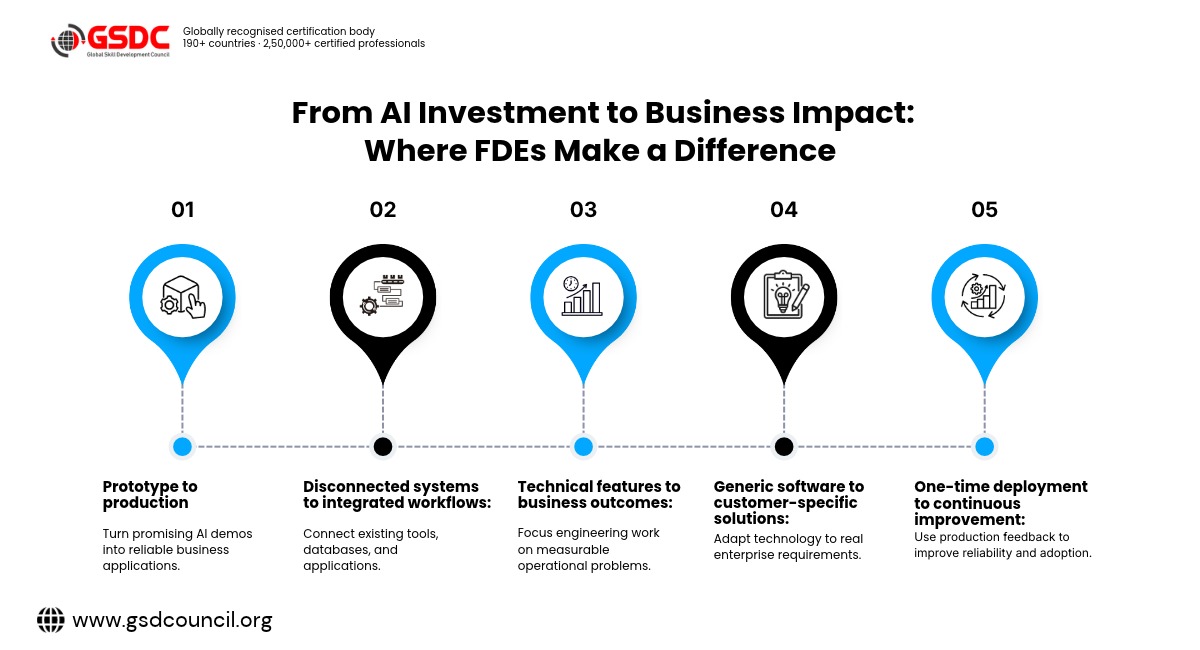
1. Turning AI Investments Into Working Solutions
Many companies experiment with AI but find it difficult to move from a proof of concept to a production-ready application. An AI prototype may work with sample data, but a real business environment introduces additional requirements. The solution must connect with existing systems, handle different user requests, protect sensitive information, and perform reliably.
FDEs help organizations manage this transition. They work with business stakeholders to understand the desired outcome and with technical teams to build, test, and deploy the solution.
For example, a manufacturing company might want to use AI to identify equipment failures. An FDE could help connect machine data, develop a predictive workflow, integrate alerts into existing systems, and test whether maintenance teams can use the results effectively.
The objective is to make AI useful in actual business operations rather than leaving it as an isolated experiment.
2. Solving Problems That Standard Software Cannot Fully Address
Off-the-shelf software can solve many common business problems. However, some organizations have specialized workflows, legacy applications, regulatory requirements, or unique customer needs that require additional development. A Forward Deployed Engineer helps adapt technology to these conditions.
Consider a financial services company that uses several applications to process customer documents. Its existing software may handle individual tasks, but employees still need to move information between systems manually.
An FDE can examine the entire process, identify where automation is possible, build the required integrations, and test the workflow with employees. This approach helps companies address specific operational challenges without assuming that every problem requires an entirely new product.
3. Connecting Business Teams With Engineering Teams
Business teams understand customer needs and operational challenges. Engineering teams understand the technical systems used to address them. However, these groups may interpret the same problem differently.
A business stakeholder might request an AI dashboard, while the underlying need is to reduce the time employees spend identifying high-priority cases. FDEs help translate business requirements into technical specifications. They also explain technical limitations to stakeholders and collect feedback during implementation.
This reduces the risk of developing a technically functional solution that does not address the original business problem.
4. Reducing the Gap Between Development and Deployment
Developing an application is only one stage of implementation. Companies must also manage integration, testing, deployment, user adoption, monitoring, and maintenance.
When these activities are handled by disconnected teams, projects can experience delays and communication problems. FDEs often work across these stages, helping teams identify dependencies early and resolve implementation issues closer to where they occur.
Their involvement can help organizations shorten feedback cycles and identify problems before they become expensive to fix. Actual improvements depend on the project, team structure, and complexity of the systems involved.
5. Building Solutions Around Customer Needs
Companies that work with enterprise customers often face requirements that vary from one client to another. A solution that works for one customer may require changes before it can be deployed for another. FDEs work directly with customers to understand these differences and adapt technical solutions accordingly.
Their responsibilities may include gathering requirements, connecting customer systems, configuring applications, testing workflows, and resolving technical issues. This customer-facing approach is particularly useful when implementing complex enterprise software, data platforms, and AI applications.
Forward Deployed Engineer Job Description and Responsibilities
A typical forward deployed engineer job description emphasizes software development, customer engagement, technical problem-solving, and implementation.
Although job descriptions vary, common forward deployed engineer responsibilities include the following:
- Understand business requirements: Work with customers to identify their challenges, workflows, and expected outcomes.
- Design technical solutions: Translate business requirements into application designs, integrations, and implementation plans.
- Develop software and AI applications: Build prototypes, APIs, automation workflows, and customer-specific features.
- Integrate existing systems: Connect databases, enterprise applications, cloud services, and AI tools.
- Test and troubleshoot: Identify performance issues, integration failures, and unexpected application behavior.
- Support deployment: Help move solutions into production and ensure they work within the customer's environment.
- Collect customer feedback: Use real-world feedback to identify gaps and prioritize improvements.
- Monitor results: Evaluate solution performance, reliability, usage, and business impact.
An FDE may also document technical decisions, coordinate with product teams, and help customers understand how to use the solution. The role is especially relevant when implementation requires close coordination between customers and engineering teams.
What Skills Do Forward Deployed Engineers Need?
The forward deployed engineer skills required for a role depend on its technical focus. An AI-focused position may emphasize language models and data pipelines, while an enterprise integration role may require stronger experience with APIs, databases, and cloud infrastructure.
However, several skill areas are useful across many FDE positions.
Software development: Programming knowledge, debugging, application development, and an understanding of software architecture.
AI and data: Familiarity with AI APIs, large language models, data processing, retrieval systems, and model evaluation when relevant to the project.
System integration: Experience working with APIs, databases, authentication, and enterprise applications.
Cloud and deployment: Understanding of application hosting, deployment pipelines, monitoring, and production environments.
Problem-solving: The ability to break down unclear requirements, investigate technical issues, and compare possible solutions.
Customer communication: The ability to ask the right questions, explain technical decisions, and collaborate with people from different departments.
Project ownership: The ability to follow a solution from initial requirements through testing, deployment, and improvement.
Companies should evaluate these skills against their actual implementation needs rather than expect every FDE to have identical expertise.
How Companies Can Train Employees for FDE Roles
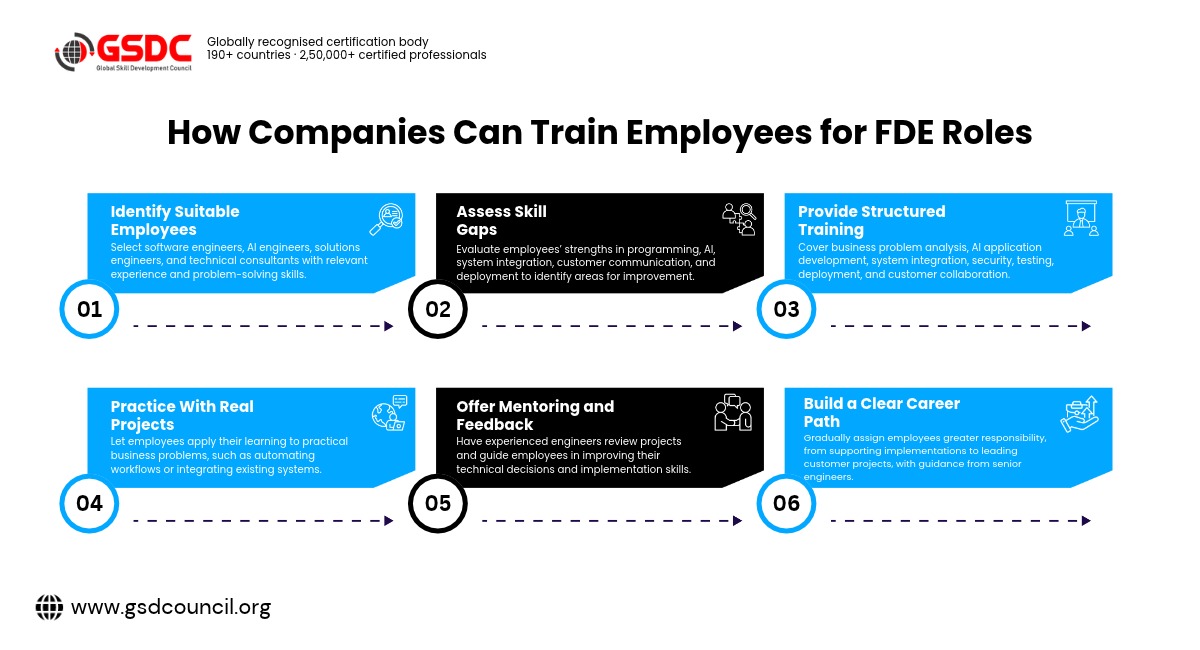
Companies can develop FDE teams by building on employees’ existing technical and business skills. A structured training approach can help employees learn to solve real-world problems and deploy practical solutions.
Step 1: Identify Suitable Employees
Select software engineers, AI engineers, solutions engineers, and technical consultants with relevant experience and problem-solving skills.
Step 2: Assess Skill Gaps
Evaluate employees’ strengths in programming, AI, system integration, customer communication, and deployment to identify areas for improvement.
Step 3: Provide Structured Training
Cover business problem analysis, AI application development, system integration, security, testing, deployment, and customer collaboration.
Step 4: Practice With Real Projects
Let employees apply their learning to practical business problems, such as automating workflows or integrating existing systems.
Step 5: Offer Mentoring and Feedback
Have experienced engineers review projects and guide employees in improving their technical decisions and implementation skills.
Step 6: Build a Clear Career Path
Gradually assign employees greater responsibility, from supporting implementations to leading customer projects, with guidance from senior engineers.
Forward Deployed Engineer Jobs and Salary
The number and type of forward deployed engineer jobs available depend on the market, employer, and technology focus. Opportunities may appear at AI companies, enterprise software providers, data platforms, technology consultancies, and organizations building customer-specific solutions.
Some employers use titles such as Forward Deployed Software Engineer, AI Engineer, Solutions Engineer, or Deployment Engineer for positions with overlapping responsibilities. Candidates should compare the actual job description rather than rely on the title alone.
The forward deployed engineer salary in the United States varies by experience, location, technical specialization, and employer. According to Indeed, the average annual base salary was approximately $180,000 as of October 2026, with reported salaries ranging from around $116,000 to $278,000. Specialized roles at leading technology companies may offer higher total compensation when bonuses and stock are included.
How the GSDC FDE Certification Can Support Team Upskilling
Companies planning to develop internal FDE capabilities can use structured learning to help employees build a shared understanding of the role.
The GSDC Certified Forward Deployed Engineer Certification can be considered as part of an employee development plan for teams that want to strengthen their understanding of customer-focused engineering, AI applications, and technical implementation.
For organizations, a certification-based learning initiative can help provide a common learning objective across employees from different technical backgrounds. It can also support a broader training plan alongside practical assignments, internal mentoring, and project-based assessment.
A company could use the certification as one part of an FDE upskilling program for software engineers, AI engineers, solutions engineers, and technical implementation teams.
Benefits of FDE Certification for Teams
- Build shared knowledge: Help employees develop a common understanding of the Forward Deployed Engineer role and its responsibilities.
- Support skill development: Give employees a structured way to explore relevant technical and implementation concepts.
- Encourage practical learning: Combine certification preparation with internal projects that address real business problems.
- Strengthen collaboration: Help technical and customer-facing teams understand how their responsibilities connect.
- Support career development: Give employees a learning pathway as they take on more customer-focused engineering work.
Certification should complement practical experience, not replace it. Companies should assess employees through real projects and role-specific evaluations to confirm they can apply what they learn.
Build your team's FDE capabilities: Explore the GSDC Certified Forward Deployed Engineer Certification to learn more about the certification and how it may fit into your employee development plans.

Final Thoughts
Companies are hiring Forward Deployed Engineers because implementing technology in real business environments requires more than software development alone. It requires professionals who can understand customer needs, work across systems, solve technical problems, and take responsibility for delivering useful solutions.
For organizations, the next step is to decide how to build this capability. Hiring experienced FDEs can address immediate needs, while training existing employees can help develop internal expertise and create new career opportunities.
A structured team development plan, supported by practical projects, mentoring, and relevant learning such as the GSDC FDE Certification, can help organizations prepare employees for these responsibilities.

Related Certifications
Stay up-to-date with the latest news, trends, and resources in GSDC
If you like this read then make sure to check out our previous blogs: Cracking Onboarding Challenges: Fresher Success Unveiled
Not sure which certification to pursue? Our advisors will help you decide!