What Should Companies Look for When Hiring a Forward Deployed Engineer?

Written by Emily Hilton
- 1. Practical Problem-Solving Skills
- 2. System Integration and Technical Understanding
- 3. Customer Communication and Collaboration
- 4. Real-World Deployment Experience
- 5. Business Understanding and Outcome-Oriented Thinking
- 6. Ownership and Adaptability
- How Companies Can Evaluate FDE Candidates During Hiring
- Conclusion
Artificial intelligence is changing how businesses build products, manage operations, and solve customer problems. However, adopting AI is not simply about hiring developers who understand machine learning models or know how to use the latest AI tools. Organizations need professionals who can turn technical capabilities into solutions that work in real business environments.
This is where Forward Deployed Engineers (FDEs) are becoming increasingly relevant.
An FDE works closely with customers and internal teams to understand business challenges, develop technical solutions, integrate them into existing systems, and ensure they deliver measurable outcomes. Their responsibilities extend beyond coding because they must understand both the technology and the environment in which it will operate.
For companies looking to hire FDEs, the challenge is identifying candidates who can do more than build a working prototype. A well-defined forward deployed engineer job description should cover technical expertise, customer collaboration, business understanding, and implementation skills. Evaluating forward deployed engineer qualifications is equally important to identify candidates who can handle complex real-world challenges.
As organizations explore how to hire AI engineers, they must also rethink their approach to hiring AI talent. Beyond traditional development skills, they need professionals who can take ownership of implementation, integrate AI into existing workflows, and solve problems in real-world conditions.
Let's explore six important capabilities companies should evaluate when hiring a Forward Deployed Engineer.
1. Practical Problem-Solving Skills
One of the first things companies should evaluate is how a candidate approaches unfamiliar problems.
In customer environments, requirements are not always clearly defined. A business team may explain that its support process is slow, its data is difficult to access, or its AI assistant frequently generates incomplete responses. The FDE must investigate the situation before deciding on a technical solution.
For example, if a company wants to automate customer support, the candidate should examine the existing workflow, identify repetitive tasks, understand where delays occur, and determine whether AI is actually required.
During interviews, companies can assess this ability through practical scenarios rather than relying entirely on theoretical questions.
What to evaluate:
- Ability to identify the root cause of a problem.
- Approach to solving ambiguous requirements.
- Ability to compare different technical solutions.
- Understanding of trade-offs between complexity, cost, and performance.
2. System Integration and Technical Understanding
An AI solution rarely operates independently. It often needs to communicate with databases, internal applications, customer platforms, APIs, and cloud infrastructure.
Therefore, companies should look for candidates who understand how different technologies work together.
An FDE should be comfortable working with APIs, handling data exchange, integrating third-party services, and troubleshooting connectivity issues. Knowledge of cloud platforms, containers such as Docker, databases, and deployment environments can also be valuable.
Consider a business implementing an AI-powered knowledge assistant. The solution may need to retrieve information from internal documents, connect with a customer relationship management (CRM) platform, and deliver responses through an existing application.
The FDE must ensure these components work together reliably.
What to evaluate:
- Experience with APIs and system integration.
- Understanding of databases and data pipelines.
- Familiarity with cloud environments and deployment.
- Ability to troubleshoot integration failures.
- Knowledge of AI application architecture.
3. Customer Communication and Collaboration
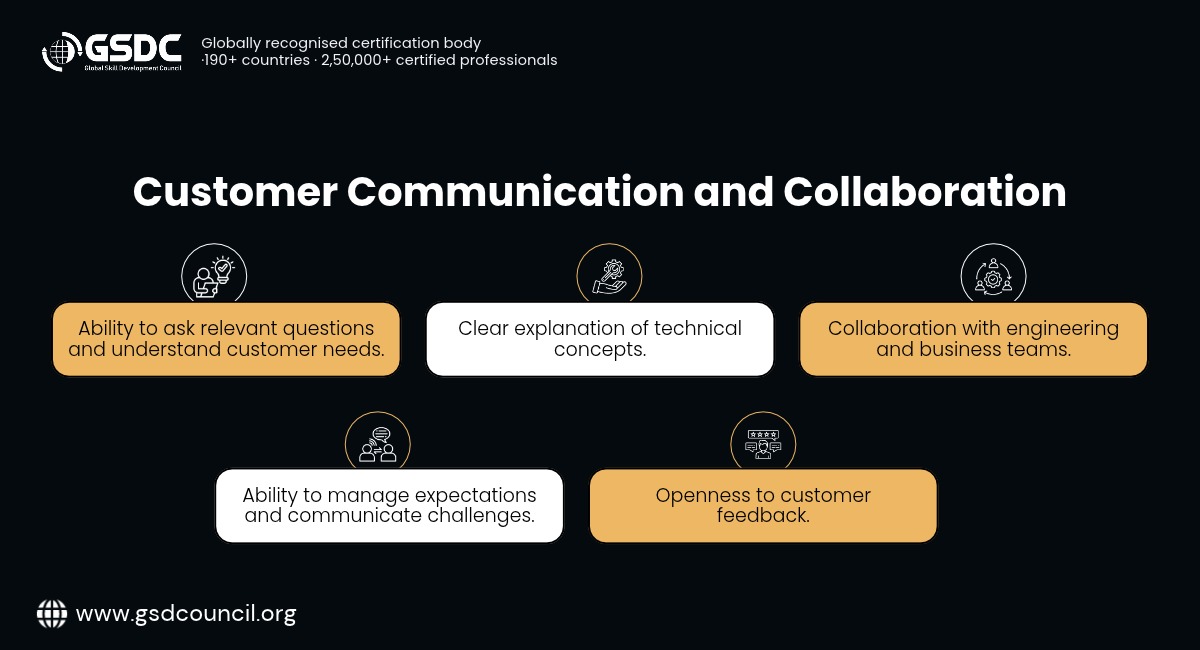
Technical expertise alone is not enough for an FDE. Much of the role involves working directly with customers, understanding their expectations, and communicating technical decisions in a clear way.
Customers may not always understand technical terminology. They are more interested in knowing how a solution will improve their operations, reduce manual effort, or address an existing challenge.
For example, a customer may request an AI chatbot without understanding the data preparation, integration, and maintenance involved. An effective FDE should explain the requirements, discuss limitations, and establish realistic expectations.
Companies should assess whether candidates can communicate with both technical and non-technical stakeholders.
4. Real-World Deployment Experience
Building a prototype and deploying a solution in a production environment are two different responsibilities.
A prototype may work with limited data and controlled inputs. However, a production system must handle actual users, changing requirements, unexpected errors, security considerations, and performance demands.
Companies should therefore look for candidates who understand the complete implementation process, from development and testing to deployment and ongoing monitoring.
For instance, an AI assistant may perform well during internal testing but produce inconsistent responses when employees begin using it. The FDE should be able to investigate the issue, evaluate the system's performance, improve retrieval quality, and monitor the results after making changes.
What to evaluate:
- Experience deploying applications in production.
- Understanding of testing and evaluation.
- Knowledge of monitoring and debugging.
- Awareness of security and reliability requirements.
- Ability to improve systems after deployment.
5. Business Understanding and Outcome-Oriented Thinking
A successful professional in a forward deployed engineer role should understand why a company wants a particular solution, not just how to build it. One of the key forward deployed engineer responsibilities is connecting technical implementation with business objectives.
Every technical implementation should support a business goal. This could involve reducing processing time, improving customer experience, increasing productivity, or minimizing operational errors.
For example, a company may want to introduce AI to automate invoice processing. Instead of focusing only on how accurately the AI extracts information, the FDE should also consider whether the solution reduces processing time, decreases manual corrections, and improves the overall workflow.
This requires candidates to think beyond technical performance and understand business priorities.
What to evaluate:
- Ability to translate business requirements into technical solutions.
- Understanding of operational workflows.
- Awareness of business KPIs and performance metrics.
- Ability to measure improvements after implementation.
- Focus on measurable outcomes rather than features alone.
6. Ownership and Adaptability
Customer environments are unpredictable. Requirements may change, integrations may fail, and solutions may need several improvements before they work as expected.
Companies should look for FDEs who take responsibility for solving problems instead of limiting themselves to assigned development tasks.
Ownership means following a problem through different stages, coordinating with relevant teams, communicating progress, and ensuring that the solution continues to perform after deployment.
Adaptability is equally important because FDEs often work with different technologies, industries, and customer requirements.
What to evaluate:
- Willingness to take responsibility for outcomes.
- Ability to work independently when required.
- Flexibility when requirements change.
- Continuous learning and technical curiosity.
- Ability to manage challenges without losing sight of business objectives.
How Companies Can Evaluate FDE Candidates During Hiring
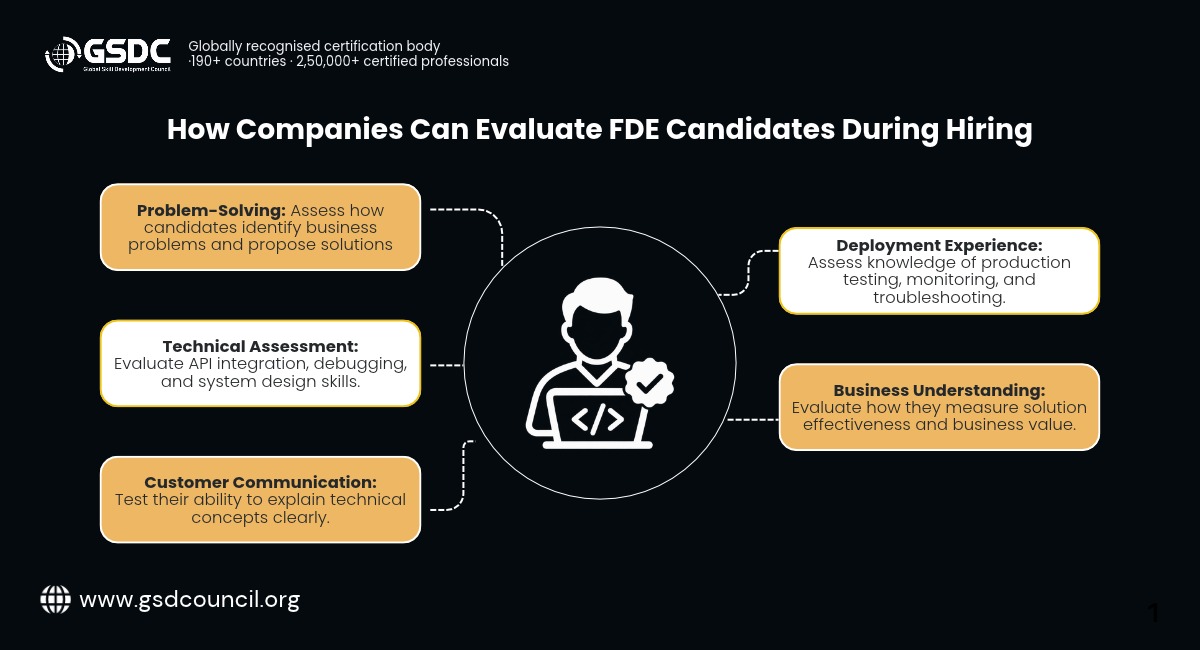
Beyond reviewing resumes and conducting technical interviews, companies should consider practical assessments that reflect actual FDE responsibilities. Evaluating forward deployed engineer qualifications and forward deployed engineer requirements should involve both technical capabilities and the ability to solve real business problems.
A useful hiring process for a forward deployed engineer role can include:
- Problem-solving exercise: Present a business challenge and ask the candidate to identify the underlying problem and propose a solution.
- Technical assessment: Evaluate API integration, debugging, system design, and familiarity with relevant technologies.
- Customer scenario: Ask the candidate to explain a technical solution to a non-technical stakeholder.
- Deployment discussion: Explore their experience handling production issues, testing, and monitoring.
- Business case: Ask how they would measure whether their proposed solution delivers meaningful business value.
Companies should also consider candidates' previous projects and the decisions they made during implementation. Understanding how someone handled unexpected challenges can reveal more than simply checking which tools they know.
Conclusion
Hiring a Forward Deployed Engineer requires companies to look beyond programming knowledge and familiarity with AI tools. A well-defined, forward-deployed engineer job description should highlight the ability to understand business challenges and integrate complex systems, communicate with customers, manage production deployments, and take ownership of outcomes.
Companies looking to hire forward-deployed engineer professionals should evaluate their technical expertise, problem-solving abilities, customer collaboration, and business understanding. The right forward-deployed engineer qualifications go beyond coding and include the ability to connect technical capabilities with practical business requirements.
As AI adoption expands, organizations will need professionals who can move beyond AI experimentation and deliver solutions that work in real business environments.

Related Certifications
Stay up-to-date with the latest news, trends, and resources in GSDC
If you like this read then make sure to check out our previous blogs: Cracking Onboarding Challenges: Fresher Success Unveiled
Not sure which certification to pursue? Our advisors will help you decide!