AI Is Changing Coding Jobs. Could Forward Deployed Engineering Be Your Next Career Move?
Written by Emily Hilton
- Is AI Changing Software Engineering Jobs?
- What Does This Mean for the Future of Coding?
- What Is a Forward Deployed Engineer?
- How Is an FDE Different From a Traditional Software Engineer?
- Why Could Forward Deployed Engineering Be Worth Exploring?
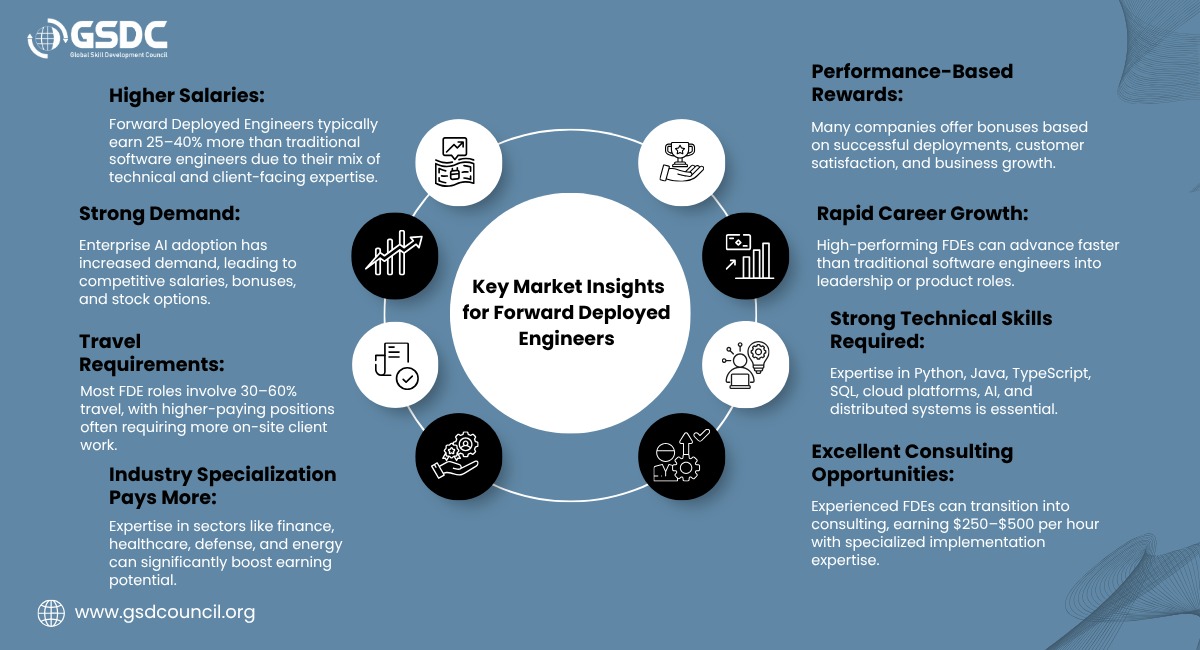
- What Is the Career Scope for Forward Deployed Engineering?
- Get Certified With GSDC as a Forward Deployed Engineer
- Final Thoughts
AI is changing how software gets built. Tasks that once required hours of coding can now be completed faster with AI coding tools. Developers can generate code, fix bugs, write tests, and build prototypes with the help of AI.
This shift has raised an important question for people working in technology: Will AI reduce the need for software engineers, or will it change the skills companies expect from them?
The answer is not as simple as AI replacing developers. AI tools are changing software development, but businesses still need people who can understand complex problems, connect different systems, evaluate AI-generated results, and make sure applications work in real environments.
This is where the Forward Deployed Engineer (FDE) role becomes worth exploring. It combines software engineering, AI implementation, customer collaboration, and business problem-solving.
If you are a software engineer, a student planning a career in technology, or someone interested in AI, understanding this role can help you explore new opportunities in the changing technology landscape.
Is AI Changing Software Engineering Jobs?
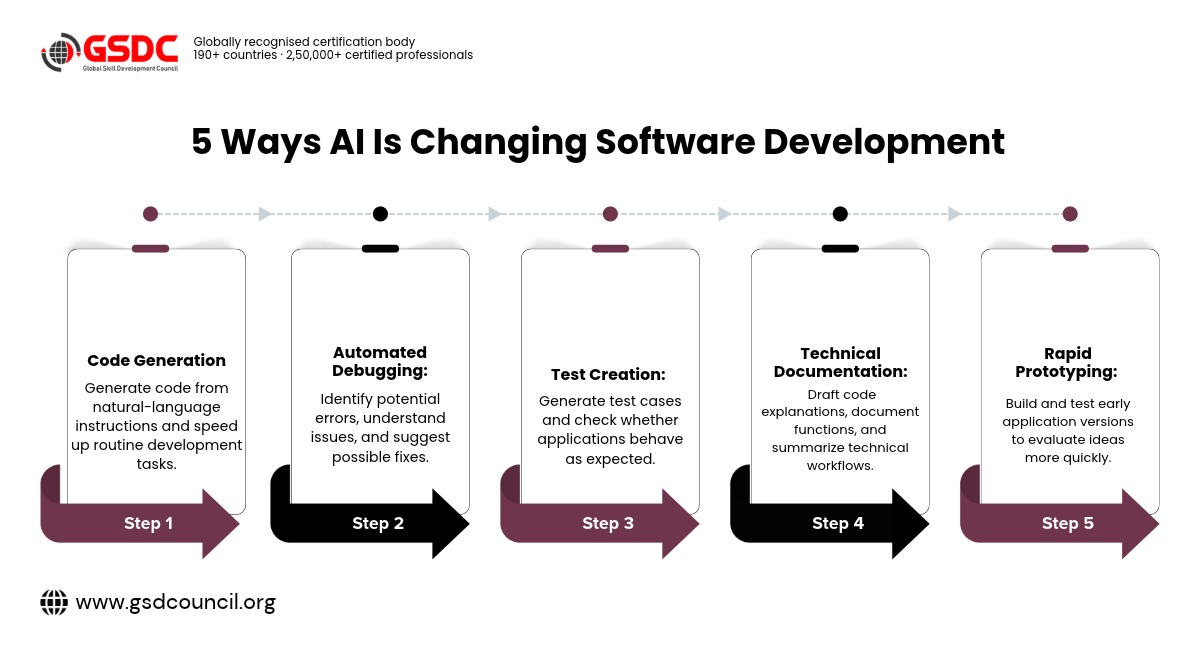
AI is already changing how developers write and maintain code. AI-powered tools can generate functions, suggest fixes, explain unfamiliar code, create test cases, and help developers work through technical problems.
Research published in 2026 by the Federal Reserve Bank of San Francisco found that employment growth among coding-intensive occupations had slowed considerably compared with the period before ChatGPT, although coder employment continued to grow. This suggests that AI's impact on software engineering deserves attention, but it does not establish that AI is replacing all software engineers.
For developers, the change is becoming visible in everyday work.
- Writing code: AI tools can generate initial implementations from natural-language instructions.
- Debugging: Developers can use AI to investigate errors and suggest possible fixes.
- Testing: AI can help generate test cases and identify potential problems.
- Documentation: Developers can create explanations and technical documentation more quickly.
- Prototyping: Teams can test ideas and build early versions of applications with less manual effort.
These capabilities can improve productivity, but generated code still needs to be reviewed, tested, secured, and maintained. A working code snippet does not automatically become a reliable production application.
The important question is not just how quickly developers can write code. It is how effectively they can use technology to solve problems.
What Does This Mean for the Future of Coding?
The future of coding is likely to involve a combination of human engineering and AI-assisted development. As tools handle more routine coding tasks, developers may spend more time defining requirements, designing systems, reviewing generated code, and ensuring that applications solve the intended problem.
This does not mean that programming knowledge is becoming irrelevant. Developers still need to understand data structures, APIs, databases, system architecture, testing, security, and debugging to evaluate AI-generated solutions effectively.
Consider a company that wants to automate customer support using AI.
An AI tool might help generate the application code. However, the company still needs to determine which customer questions should be automated, where the answers should come from, how the application will access internal information, and what should happen when the AI gives an uncertain answer.
The coding task is only one part of the project. This is why learning to work with AI while developing strong engineering fundamentals can be more useful than focusing only on writing code faster.
What Is a Forward Deployed Engineer?
A Forward Deployed Engineer is a technical professional who works closely with customers and business teams to build, integrate, and deploy software or AI solutions in real-world environments.
Unlike roles focused mainly on developing a general-purpose product, FDEs often work directly on the technical problems a specific customer needs to solve. Their work can include understanding business requirements, developing applications, integrating APIs, building AI workflows, testing solutions, and supporting deployment.
For example, a company may want an AI assistant that helps employees find information across internal documents. Building a prototype is only the beginning. The solution must retrieve relevant information, respect access permissions, connect with existing applications, handle incorrect responses, and fit into employees' daily work.
An FDE helps connect these requirements with the engineering work needed to deliver the solution.
The role brings together three areas:
- Engineering: Building applications, APIs, integrations, and AI workflows.
- Business understanding: Identifying the real problem and defining what success looks like.
- Implementation: Testing, deploying, and improving the solution in the customer's environment.
This combination makes Forward Deployed Engineering a career worth investigating for people who enjoy both technical development and practical problem-solving.
How Is an FDE Different From a Traditional Software Engineer?
Both roles require technical knowledge, but their responsibilities can differ depending on the company.
Area | Software Engineer | Forward Deployed Engineer |
| Main focus | Building and maintaining software products or systems | Solving specific customer and business problems through technology |
| Requirements | Often works from product specifications | Frequently works directly with customers to clarify requirements |
| Coding | Develops and maintains application features | Builds or adapts applications and integrations for customer needs |
| AI implementation | May develop AI features or infrastructure | May integrate AI into existing business workflows |
| Deployment | Works within the team's release and operations process | Often works closely with customer teams during implementation |
| Success measures | Product quality, reliability, performance, and delivery | Technical quality and whether the solution addresses the customer's needs |
These are general differences, not fixed rules. Software engineers can also work directly with customers, and FDEs may spend substantial time writing code.
The main distinction is the emphasis on customer-specific implementation and connecting technical work with business outcomes.
Why Could Forward Deployed Engineering Be Worth Exploring?
As AI tools become more capable, businesses still need to decide how to apply them, connect them to existing systems, and manage their performance in real environments.
Forward Deployed Engineering brings these responsibilities together.
1. It Combines AI With Practical Engineering
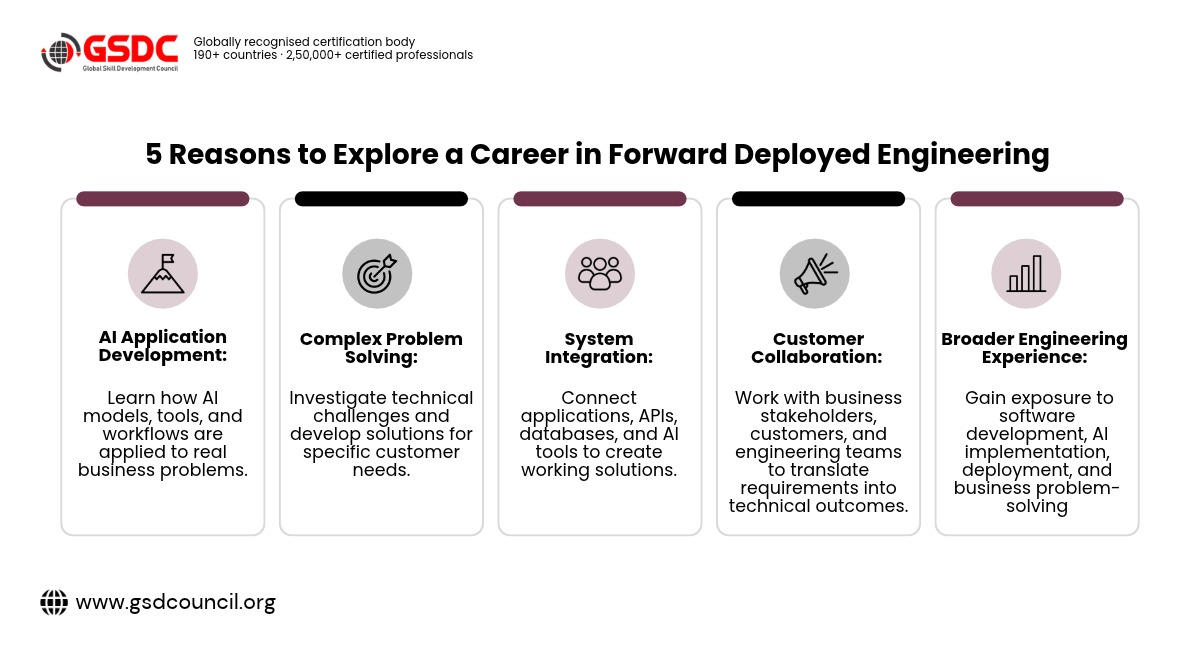
FDEs can work with AI models, APIs, databases, cloud services, and existing applications. Their work involves more than experimenting with AI tools. They help make the resulting solutions usable in business operations.
2. It Requires Problem-Solving Beyond Code Generation
AI can generate possible solutions, but someone still needs to understand the problem, choose an appropriate approach, evaluate trade-offs, and verify that the implementation works.
FDEs use technical judgment to make these decisions in the context of actual customer requirements.
3. It Connects Technical Work With Business Needs
Some professionals enjoy understanding why a business has a problem as much as they enjoy building the solution. FDE roles can offer opportunities to work with customers, product teams, and engineers throughout the implementation process.
4. It Builds Skills Across Different Areas
The role can involve software development, AI applications, system integration, cloud deployment, testing, and customer communication. This can be useful for professionals who want to develop a broader engineering skill set.
5. It Offers an Alternative Career Direction for Developers
Software engineers do not necessarily need to leave coding to explore another career path. Those interested in customer-facing technical work can build on their existing experience and develop additional skills relevant to FDE roles.
However, FDE is not automatically the right choice for everyone. It can involve changing requirements, customer deadlines, unfamiliar systems, and responsibility for solving problems outside a narrowly defined development task.
It is worth exploring if you enjoy both building technology and working directly with the people who use it.
What Is the Career Scope for Forward Deployed Engineering?
Forward Deployed Engineering is an emerging career path for professionals interested in combining software development, AI implementation, and business problem-solving. As organizations explore AI applications and automation, they need professionals who can connect technical solutions with real business requirements.
FDE opportunities may be available across AI companies, enterprise software providers, data platforms, technology consultancies, and businesses implementing customer-specific solutions.
Professionals can explore roles such as:
- Forward Deployed Engineer: Build and deploy solutions based on customer requirements.
- Forward Deployed Software Engineer: Develop software and integrations for specific customer environments.
- AI Engineer: Build and integrate AI-powered applications and workflows.
- Solutions Engineer: Help customers understand, implement, and use technical products.
- Deployment Engineer: Focus on integrating, configuring, and launching applications in customer environments.
The responsibilities and requirements vary by employer, so reviewing individual job descriptions is important.
For software engineers, AI engineers, and technical consultants, moving toward FDE roles may involve developing additional skills in customer communication, system integration, AI application development, and production deployment.
The career's long-term opportunities will depend on employer demand and how organizations adopt AI and customer-focused engineering. Building practical skills and experience can help professionals prepare for these roles.
Get Certified With GSDC as a Forward Deployed Engineer
If you want to explore this career path, the GSDC Certified Forward Deployed Engineer Certification can provide a structured learning pathway to understand the role and its technical responsibilities.
The certification is designed for professionals who want to strengthen their knowledge of customer-focused engineering, AI applications, and technical implementation.
Through structured learning, you can develop an understanding of key areas such as:
- Understand the FDE role: Learn how Forward Deployed Engineers connect business requirements with technical solutions.
- Explore AI implementation: Understand how AI can be applied to practical business problems.
- Build technical knowledge: Learn about software development, APIs, integrations, and AI workflows.
- Understand deployment: Explore the process of testing, deploying, and improving technical solutions.
- Prepare for career opportunities: Build a foundation for exploring FDE responsibilities and related technical roles.
Certification is most useful when combined with hands-on projects and practical experience. Apply what you learn by building solutions, documenting your technical decisions, and demonstrating how your work addresses real business problems.
Ready to explore Forward Deployed Engineering?
Learn more about the GSDC Certified Forward Deployed Engineer Certification and take the next step in your learning journey.
Final Thoughts
AI is changing how developers write code, build applications, and solve technical problems. AI coding tools can help automate parts of software development, but turning generated code into a reliable business solution still requires engineering knowledge, testing, integration, and an understanding of customer needs.
Forward Deployed Engineering brings these responsibilities together. It offers a career path worth exploring for professionals who want to combine technical development with AI implementation and real-world problem-solving.
If this sounds like the kind of work you want to pursue, start by strengthening your engineering fundamentals, experimenting with AI tools, and building practical projects. Explore the skills employers expect from Forward Deployed Engineers and consider the GSDC FDE Certification as part of your learning journey.

Related Certifications
Stay up-to-date with the latest news, trends, and resources in GSDC
If you like this read then make sure to check out our previous blogs: Cracking Onboarding Challenges: Fresher Success Unveiled
Not sure which certification to pursue? Our advisors will help you decide!