Agentic AI Architecture: How It Works in 7 Layers
Written by Matthew Hale
- Agentic AI vs Generative AI: What's Actually Different?
- Agentic AI Architecture vs Traditional AI Architecture
- What Is Agentic AI Architecture?
- The 7 Layers of Agentic AI Architecture
- Agentic AI Architecture Components: What Each Layer Actually Needs
- How Does Agentic AI Work? A Step-by-Step Example
- Common Agentic AI Architecture Patterns
- Popular Agentic AI Frameworks Worth Knowing
- How to Build Agentic AI Workflows: A Practical Starting Point
- Where This Leaves Most Teams
- Why the Layers Matter More Than the Hype
Agentic AI refers to AI systems built to pursue a goal with a meaningful degree of independence. Instead of waiting for a human to spell out every step, an agentic system can break a broad objective into smaller tasks, decide which tools or data sources it needs, take action, check whether that action worked, and adjust course if it didn't.
That's the short answer to what is agentic AI. The longer, more useful answer - and the one that actually explains how does agentic AI work - comes down to architecture: a stack of distinct layers, each with its own job, working together to turn a goal into a completed task. This guide breaks down that architecture layer by layer, compares it to generative AI and traditional AI systems, and walks through the components, patterns, and frameworks you'd actually use to build one.
According to Gartner's 2026 CIO and Technology Executive Survey, only 17% of organizations have deployed AI agents so far - but more than 60% plan to within the next two years, which Gartner calls the most aggressive adoption curve of any emerging technology it currently tracks. Most companies, in other words, are still figuring this out.
Agentic AI vs Generative AI: What's Actually Different?
This is one of the most searched questions on the topic, and the confusion is understandable - both terms get used loosely by vendors trying to sound current.
Generative AI | Agentic AI | |
What it does | Produces content - text, images, code - in response to a prompt | Pursues a goal by planning, acting, and adapting across multiple steps |
Interaction style | Reactive - one prompt, one response | Proactive - sets sub-goals and keeps going until the objective is met |
Memory | Typically limited to the current conversation | Maintains context across sessions and tasks |
Tool use | Usually none, unless explicitly wired in | Core capability - agents call APIs, databases, and other software |
Human involvement | Required for every new instruction | Required mainly for approval, oversight, or edge cases |
Example | "Write me a product description" | "Monitor inventory, reorder stock when it's low, and notify the supplier" |
Generative AI is the engine - the component that writes, summarizes, and reasons in language. Agentic AI is what happens when that engine is placed inside a system with memory, tools, and a feedback loop, and given a goal to work toward. Most agentic systems, in fact, use a generative model (an LLM) as their reasoning core. It isn't really an either/or - agentic AI is generative AI plus orchestration, memory, and autonomy.
It's a distinction we spend a fair amount of time clarifying in the Global Skill Development Council's (GSDC) training sessions, mainly because so many teams walk in assuming their generative AI tools already qualify as agentic - right up until someone asks them to point to the orchestration logic and there isn't one.
Agentic AI Architecture vs Traditional AI Architecture
Before getting into the layers, it's worth contrasting agentic architecture with the AI systems most organizations already run - rule-based automation, traditional machine learning pipelines, and single-turn chatbots.
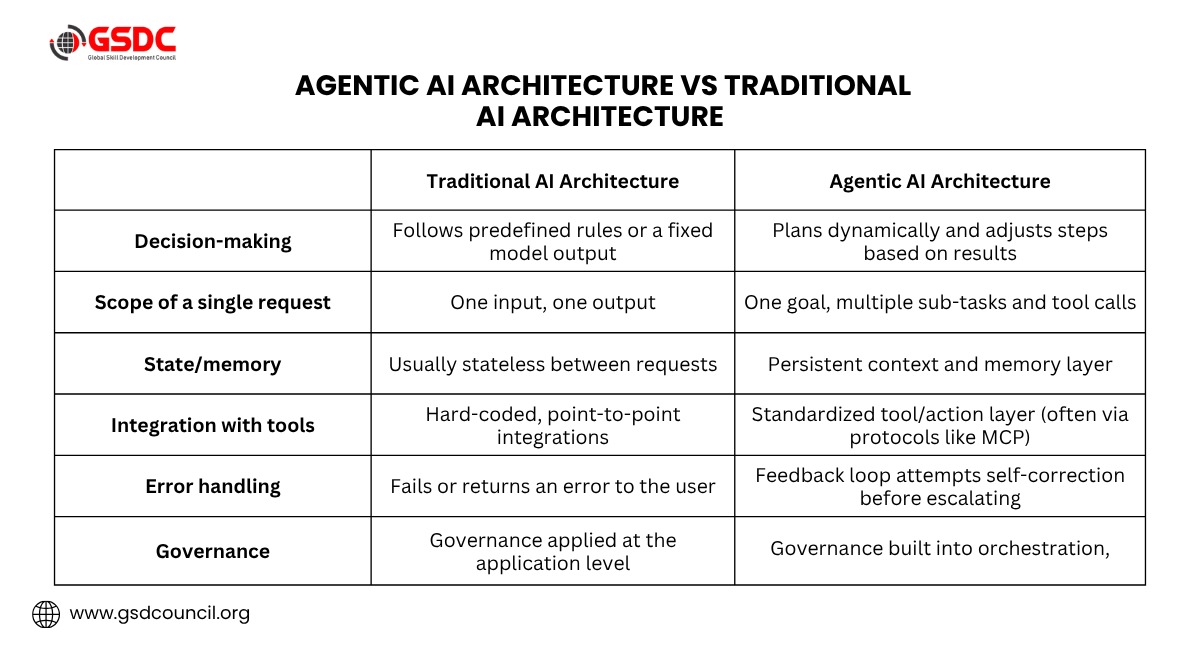
The practical difference is resilience. Traditional AI systems are typically optimized for predefined tasks and may struggle when inputs or conditions fall outside their training distribution or programmed workflow. An agentic system, by contrast, is architected to notice that something went wrong, try an alternative approach, and only fall back to a human when it genuinely needs one.
What Is Agentic AI Architecture?
Agentic AI architecture is the structural blueprint that organizes how an autonomous AI system perceives information, reasons about it, decides on actions, and executes them - broken into distinct layers, each handling one responsibility. This layered design is what separates a genuinely agentic system from a scripted chatbot with extra steps.
Without this structure, you get the mess a lot of enterprises are currently dealing with: AI tools that can't talk to each other, no clear record of why an agent made a decision, and no easy way to fix one broken piece without breaking three others. A well-designed agentic AI architecture keeps every function contained, auditable, and replaceable on its own. It's also the exact skill the Agentic AI Professional Certification is built to teach - not just naming the layers, but actually designing one that holds up under real conditions.
The 7 Layers of Agentic AI Architecture
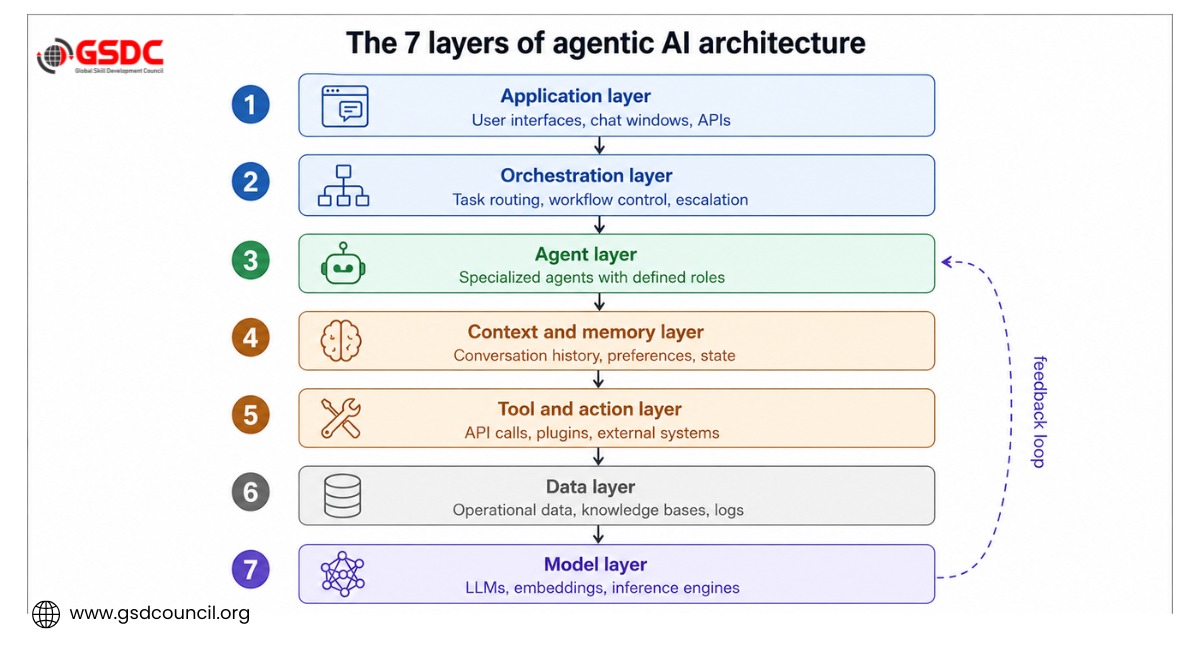
There is no single universally accepted architecture for agentic AI systems. However, a practical way to understand how these systems work is through seven functional layers - from the application where users interact with the system to the underlying model responsible for reasoning and inference.
1. Application Layer
This is the part of the system people actually see - the chat window, the dashboard, the API endpoint a developer's app talks to. Its job is to take input from a human or another system and pass it along cleanly. In practice, it also has to handle user consent, disclosure that the user is interacting with an AI, and accessibility - details regulators increasingly care about.
2. Orchestration Layer
Once a request comes in, the orchestration layer decides which agent (or agents) should handle it, in what order, and what happens if something goes wrong. If a task needs three specialists - one to pull customer data, one to check inventory, one to process a refund - this layer sequences that work and hands off results between them. This is also where most agentic AI workflow logic lives, which is why the terms "workflow" and "architecture" are so closely tied together in how this space is discussed and searched.
3. Agent Layer
This is where the individual agents live - each built for a narrower job. One agent might draft customer replies, another might query a database, another might run compliance checks. Keeping agents specialized, rather than building one agent that tries to do everything, tends to produce systems that are easier to debug and more reliable in production.
4. Context and Memory Layer
Unlike a typical chatbot that forgets everything once a session ends, agentic systems need to remember. This layer stores conversation history, user preferences, and task state, so an agent handling step four of a process actually knows what happened in steps one through three. It's also the layer most exposed to privacy regulation, since it often holds personal data.
5. Tool and Action Layer
This is where an agent stops reasoning and starts acting. API calls, database writes, sending an email, updating a CRM record - this layer connects an agent's decisions to real systems. The Model Context Protocol (MCP) is an open standard Anthropic introduced in November 2024 for exposing tools and data sources to agents in a consistent way. Since then it has been adopted by OpenAI, Google DeepMind, and Microsoft, and in December 2025 it was donated to the Linux Foundation's Agentic AI Foundation - making it the closest thing the industry currently has to a common standard at this layer.
6. Data Layer
Underneath everything sits the data the system runs on - operational records, knowledge bases, and logs of what every agent did and why. This layer matters enormously for compliance: if a regulator asks why an AI system denied a particular application, the data layer - along with good logging in the orchestration layer - is where you'd find the answer.
7. Model Layer
At the base is the actual AI model: the large language model or specialized model performing the reasoning, language understanding, and inference. Every layer above exists to give the model the right context, the right tools, and the right guardrails to act usefully and safely.
This seven-layer breakdown lines up closely with how integration platforms describe their own stacks. Boomi, for instance, organizes its agentic architecture into application, orchestration, agent, context, data, and model layers for the same underlying reason: modular layers make governance and audits dramatically simpler to manage at scale.
Agentic AI Architecture Components: What Each Layer Actually Needs
Beyond the seven layers, a handful of core components run through the stack and do most of the technical heavy lifting.
- Planner/reasoner - This is usually the LLM in the model layer, tasked with decomposing a broad goal into an ordered sequence of smaller steps. It re-plans mid-task when a step fails or new information changes what's needed, which is what separates true planning from a fixed if-then script.
- Memory store - Split into short-term memory (the current task's working context) and long-term memory (facts, preferences, and history that persist across sessions). Getting this split right matters: too little memory and the agent repeats mistakes; too much unmanaged memory and retrieval gets slow and noisy.
- Tool registry - A catalog of every action and API an agent is permitted to call, along with the parameters each tool expects. This registry is also where access control lives - an agent should only ever see the tools relevant to its role, not the entire enterprise API surface.
- Guardrails and policy engine - The rules layer that stops an agent from taking actions outside its permitted scope, regardless of what the model itself "decides" to do. This is typically enforced outside the model, at the orchestration or tool layer, so a bad output can't bypass the restriction.
- Feedback loop - A mechanism for the agent to check its own output against the goal - did the API call succeed, does the result look reasonable - and retry with a different approach if not. Without this, a single failed step can silently derail an entire multi-step task.
- Human-in-the-loop checkpoint - A defined pause point where a human must approve an action before it executes, typically reserved for high-stakes or irreversible steps like large financial transactions or anything affecting customer data.
The exact combination varies by use case, but removing components such as planning, tool access, feedback, or appropriate controls can significantly limit a system's ability to operate reliably as an agentic system.
How Does Agentic AI Work? A Step-by-Step Example
Say a mid-size e-commerce company sets up an agentic system to handle returns.
- A customer submits a return request through the chat widget (application layer).
- The orchestration layer receives the request and routes it to a "returns agent" (orchestration + agent layer).
- The returns agent checks the order history and return policy, pulling that data through the context layer, which recalls this customer's past interactions (context layer).
- It calls the inventory and payments APIs to verify the item and process a refund (tool/action layer).
- Every step gets logged for audit purposes (data layer).
- The underlying LLM handles the reasoning - interpreting the customer's message, deciding if the return qualifies, and drafting the response (model layer).
- If the refund amount exceeds a set threshold, the system pauses and routes it to a human for approval before completing the transaction (human-in-the-loop checkpoint).
No single "AI" did all of that. A coordinated stack of layers did - which is the whole point of building it this way.
Common Agentic AI Architecture Patterns
Not every system needs to be structured the same way. A few recurring agentic AI architecture patterns show up across most real deployments:
- Sequential (pipeline) orchestration - Agents work in a fixed order, each one's output feeding the next. Common in document processing: classify, extract, validate.
- Hierarchical orchestration - A "supervisor" agent delegates to specialized worker agents. Common in loan processing, where a coordinator splits work between credit-check, document-verification, and risk-assessment agents.
- Hub-and-spoke - A central orchestrator directs everything, giving strong central control over how work is routed.
- Peer-to-peer / decentralized - Agents coordinate directly with each other without a central controller, useful in scenarios like manufacturing quality checks where inspection agents need to react independently and fast.
- Federated orchestration - Independent agents collaborate without sharing raw underlying data, which is popular in healthcare, where hospitals want shared insight without exposing patient records.
Picking the right pattern comes down to how much central control versus flexibility a given use case needs. Customer support tends to favor hierarchical control; real-time fraud detection tends to favor decentralized speed.
Popular Agentic AI Frameworks Worth Knowing
If you're planning to build something, you'll run into a handful of names repeatedly. Each agentic AI framework takes a different approach to how agents plan, communicate, and call tools, but they all exist to solve the same underlying problem: giving developers a structured way to implement the layers above instead of building the plumbing from scratch.
Framework | Best For | Architecture Style | Key Strength |
LangGraph | Workflows needing tight, explicit control over each step | Graph-based state machine | Predictable, debuggable step-by-step execution |
AutoGen | Tasks where agents need to negotiate or divide work | Multi-agent conversation | Flexible agent-to-agent dialogue and role assignment |
CrewAI | Team-style workflows with clearly defined agent roles | Role-based multi-agent crews | Fast to prototype with simple role/task definitions |
Semantic Kernel | Enterprise .NET/Microsoft-stack integrations | Plugin-and-planner model | Strong enterprise integration and skill/plugin reuse |
MCP-based stacks | Standardizing tool and data access across any framework | Protocol layer, not a full framework | Vendor-neutral tool connectivity across models and platforms |
As a rough rule of thumb: frameworks built around graphs and explicit state (like LangGraph) suit workflows where you want tight control over each step. Frameworks emphasizing multi-agent "conversations" (like AutoGen or CrewAI) suit tasks where agents need to divide work more fluidly.
How to Build Agentic AI Workflows: A Practical Starting Point
If you're an engineering lead or product manager trying to stand one of these up, here's a practical order of operations:
- Start small. Pick one narrow, well-defined task - not "automate customer service," but "auto-draft replies to shipping-status questions."
- Map the layers before writing code. Decide upfront what your orchestration logic looks like, what memory the agent actually needs, and which tools it's allowed to touch.
- Build in guardrails from day one. Define what the agent can never do without human approval. Retrofitting safety controls later is significantly harder.
- Instrument everything. Log every decision and tool call - you'll need this for debugging, and increasingly, for compliance.
- Pilot with a human in the loop, then gradually reduce the human's role as confidence in the system grows.
- Measure outcomes, not activity. Track whether the agent is resolving tasks correctly, not just whether it's producing output.
This mirrors what's happening industry-wide. Gartner predicts that over 40% of agentic AI projects will be canceled by the end of 2027 due to escalating costs, unclear business value, or inadequate risk controls - which, in most cases, traces back to skipping steps 2 through 4 above in favor of a fast demo.
Where This Leaves Most Teams
Reading about the seven layers is the easy part. Actually mapping your own orchestration logic, deciding what an agent should never touch, wiring up a tool registry that won't become a security headache - that's where most teams stall, usually because nobody on the team has built one of these before.
That's the gap the Global Skill Development Council's Agentic AI Professional Certification is built for. It follows the same layered thinking this article walks through - architecture, orchestration, governance, tool integration - except you're designing and stress-testing the system yourself, not just reading about someone else's. If you're the person your organization is going to lean on to make this work, it's worth a look.
Why the Layers Matter More Than the Hype
Agentic AI isn't a single product you buy off a shelf. It's an architecture - a way of organizing interfaces, orchestration, agents, memory, tools, data, and models so they work together predictably and can be audited when something goes wrong.
The key takeaway: agentic AI isn't magic, and it isn't a model simply getting smarter. It's disciplined systems design, applied to software that can act on its own. Understand the seven layers, and "how does agentic AI actually work" stops being mysterious and starts being something you can build, govern, and trust.

Related Certifications
Frequently Asked Questions
Agentic AI is AI built to work toward a goal on its own, rather than just responding to a single prompt. It can break a task into steps, decide what tools or data it needs, act on that decision, and check whether the action actually worked before moving on. The "agentic" part refers to that independence - it's not a bigger model, it's a different way of using one.
It's the underlying structure that makes that independence possible - the arrangement of layers, memory, tools, and controls that let an AI system plan and act instead of just replying. Without that structure, you basically have a chatbot with a longer to-do list, not something that can actually operate on its own.
In practice, a request moves through several layers before anything happens: an interface takes it in, an orchestration layer figures out who should handle it, a specialized agent does the reasoning, and a tool layer carries out the actual action - an API call, a database update, whatever the task needs. Each layer has one job, and that's what keeps the whole thing from turning into a black box.
Generative AI answers a prompt. Agentic AI pursues a goal. A generative model will happily write you an email if you ask, but it won't decide on its own that an email needs writing, send it, and follow up if nobody responds - that's the agentic layer doing the deciding, with a generative model usually doing the actual "thinking" underneath.
Most systems can be described with seven functional layers: application (where users interact), orchestration (task routing), agent (the specialized workers), context and memory (what the system remembers), tools and action (where it actually does things), data (records and logs), and model (the LLM doing the reasoning). Not every implementation uses all seven exactly this way, but this is the shape most real systems end up taking.
Underneath the layers, you need a planner to break goals into steps, a memory store to hold context, a tool registry so the agent knows what it's allowed to touch, guardrails to keep it inside its lane, a feedback loop so it can catch its own mistakes, and usually a human checkpoint for anything high-stakes. Skip enough of these and you don't really have an agentic system anymore - you have a script that's one weird input away from breaking.
It's the actual sequence an agent follows to get something done - request comes in, gets routed, gets acted on, gets logged, maybe gets escalated to a person. The workflow is really just the orchestration layer in motion, and it's usually the first thing to map out before writing any code.
Start with one narrow task, not a whole department's worth of work. Map out the layers before touching code, decide upfront what the agent should never be allowed to do without approval, and log everything from day one - retrofitting guardrails after the fact is a much harder job than building them in from the start.
Sequential pipelines (one agent's output feeds the next), hierarchical setups (a supervisor agent delegates to specialists), hub-and-spoke (one orchestrator controls everything), decentralized peer-to-peer (agents coordinate directly with each other), and federated patterns (agents collaborate without sharing raw data). Which one fits depends mostly on how much central control the task actually needs.
The names that come up most are LangGraph, AutoGen, CrewAI, and Semantic Kernel, along with the Model Context Protocol for connecting agents to tools and data. They all solve the same basic problem - giving developers a structured way to build the layers above - just with different opinions on how rigid or flexible that structure should be.
Stay up-to-date with the latest news, trends, and resources in GSDC
If you like this read then make sure to check out our previous blogs: Cracking Onboarding Challenges: Fresher Success Unveiled
Not sure which certification to pursue? Our advisors will help you decide!