Top Interview Questions and Answers for ISO 42001:2023 AI Governance Professionals
Written by Matthew Hale
- Understanding ISO and Why It Matters in AI Governance
- Career Growth Opportunities and Why It Matters in AI Governance
- How ISO 42001 Lead Implementor Certification Accelerate Your Career
- 15 Basic Interview Questions & Answers
- 10 Expert-Level Interview Questions & Answers
- Want more expert-level interview questions?
- Lead the Future of Responsible AI with GSDC’s ISO 42001:2023 Certification
- Conclusion
With Artificial Intelligence (AI) rapidly transforming industries, organizations are realizing the need for structured governance frameworks. ISO 42001:2023 provides a comprehensive standard for establishing, implementing, maintaining and improving an Artificial Intelligence Management System (AIMS), ensuring responsible, transparent and ethical AI deployment.
Understanding ISO and Why It Matters in AI Governance
ISO (International Organization for Standardization) is a global, independent body that develops international standards to ensure consistency, quality, safety and efficiency across products, services and systems. In the age of AI, ISO 42001:2023 plays a crucial role by helping organisations implement responsible AI practices, manage risks effectively and maintain transparency and accountability.
Career Growth Opportunities and Why It Matters in AI Governance
The global AI governance market, valued at USD 227.6 million in 2024, is expected to reach USD 1,418.3 million by 2030, growing at a CAGR of 35.7%. This rapid growth drives demand for professionals skilled in ISO 42001 and AI compliance.
Expertise in ISO 42001 enables roles like AI Compliance Manager, Governance Lead, and Lead Implementer-ensuring AI systems meet ethical and regulatory standards. With ISO 42001 certification, professionals are well-equipped to lead governance initiatives and manage AI risks effectively.
How ISO 42001 Lead Implementor Certification Accelerate Your Career
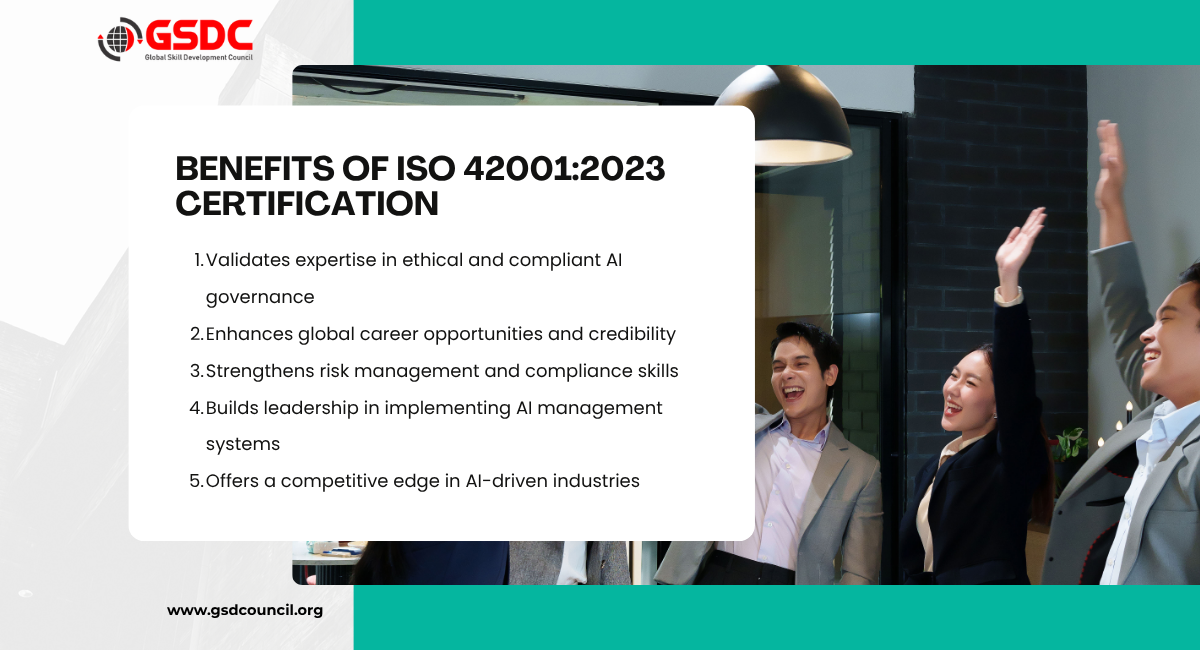
Earning the Certified ISO 42001:2023 Lead Implementer credential demonstrates your ability to design, implement, and lead AI Management Systems that align with international ISO standards. It validates your expertise in managing AI risks, strengthening governance, and ensuring continuous compliance with ethical and operational frameworks.
Through structured programs by globally recognized certification bodies such as GSDC, professionals gain the tools to drive responsible AI initiatives, integrate compliance into enterprise systems, and lead cross-functional teams with confidence.
Achieving this certification not only enhances your credibility but also positions you as a trusted leader in the evolving landscape of AI governance and accountability.
15 Basic Interview Questions & Answers
Building a career in AI governance and compliance begins with understanding the fundamentals of ISO standards, management systems and the principles behind the ISO 42001 framework. These foundational questions help professionals prepare for interviews by strengthening their conceptual and practical knowledge of Artificial Intelligence Management Systems (AIMS) and the ISO 42001:2023 standard.
1. What is ISO 42001:2023?
ISO 42001:2023 is the world's first international standard dedicated to establishing, implementing, maintaining and improving an Artificial Intelligence Management System (AIMS). It provides a structured approach to help organisations manage AI risks, ensure ethical use and maintain transparency throughout the AI lifecycle. The standard guides companies in creating governance systems that align with the international norms, fostering accountability and trust in AI-driven decisions.
2. Why is ISO Important?
ISO standards are crucial because they validate that an organisation follows globally recognised frameworks of quality, security and efficiency. FOr AI systems, adherence to ISO principles reinforce an organisation's commitment to responsible practice and continuous improvement. It also strengthens stakeholder confidence, ensures regulatory compliance, reduces operational risk and supports market competitiveness in an increasingly standards-driven world.
3. What Does ISO 42001 Compliance Mean?
Being compliant with ISO 42001 signifies that a company has in place a well-organized Artificial Intelligence Management System which aligns with global standards. This reflects that the company is practicing good governance for AI which comprises, inter alia, transparency, data ethics, accountability and risk management. In effect, it tells customers and regulators that AI systems are utilized in a responsible and ethical manner.
4. What Are the Major Requirements of ISO 42001?
The major requirements are setting out the AIMS scope, obtaining leadership commitment, recognizing internal and external factors influencing AI governance, carrying out AI risk assessments, managing model lifecycle processes, ensuring data quality and supporting continual improvement. Besides, organizations are required to set up policies and controls that ensure AI systems comply with legal, ethical, and operational standards.
5. How Different Is a Lead Auditor from a Lead Implementor?
A Lead Auditor is the person who, mainly from an external point of view, checks and verifies if a company complies with ISO standards. In contrast, a Lead Implementer is the person who works inside, devising, introducing and maintaining the systems that secure the organisation that meets the ISO criteria. The Implementer is the one who assures that the organisation’s processes are always compatible with the ISO 42001 structure.
6. Which Organisation benefits most from ISO 42001?
Organisations that develop, deploy, or rely heavily on AI-such as technology firms, financial institutions, healthcare providers, government agencies and manufacturing enterprises-stand to benefit the most from ISO 42001. This standard helps these entities implement trustworthy AI systems, mitigate bias, enhance transparency and ensure compliance with emerging global AI regulations.
7. WHat is an “Annex” in ISO standards?
An Annex in ISO standards offers additional information, control frameworks, or guidelines that support the main clauses of the standard. The Annex in ISO 42001 may contain detailed AI governance controls, data management guidelines, and ethical frameworks that organizations can use to support their AIMS.
8. What is a gap analysis in ISO implementation?
A gap analysis is a gap evaluation, comparing an organization's current processes with the requirements of ISO 42001. It points out areas where the organization is not meeting the standard, operational inefficiencies, or where there are missing controls for AI operations. A comprehensive gap analysis is the starting point for developing a detailed plan for achieving compliance.
9. How do you define the “context of the organisation” for ISO 42001?
Setting up the organisational context means figuring out the internal and external factors that influence AI management and those factors might be stakeholder needs, technological dependencies, ethical considerations and regulatory obligations. This stage is a way of confirming that the Artificial Intelligence Management System (AIMS) is a perfect fit for the operational environment and the strategic objectives of the organisation.
10. What are the fundamental principles of information security and how do they relate to AI governance?
The CIA Triad-Confidentiality, Integrity and Availability-is at the core of information security. In AI governance, these concepts are utilised to keep data and AI models safe, accurate and to ensure that only authorised users have access to them. By observing these principles, organisations deter data breaches, model manipulation and operational downtime, hence, they are able to maintain the trustworthiness of AI decision-making systems.
11. What is the role of risk assessment in ISO 42001?
Risk assessment forms the core of ISO 42001 application. It deals with the identification and evaluation of risks that are related to AI, for instance, bias in the algorithm, model drift, lack of explanation, and data misuse. Next, companies set up measures to lessen these risks and track their progress. Implementing a well-organized risk management plan helps ensure that AI systems are used within ethical and legal limits.
12. How do you monitor and review an AIMS?
Monitoring and reviewing of an Artificial Intelligence Management System (AIMS) is normally done through internal audits, key performance indicators, management reviews, and corrective actions on a continuous basis. Conducting regular checks ensures that the AIMS remains efficient, is in line with the company’s goals and is prepared for any changes in AI technologies or regulations.
13. Why should organisations align with ISO 42001:2023?
Conforming to ISO 42001:2023 is a clear signal of an organisation’s dedication to good AI governance and operational excellence. It raises the trust of stakeholders, makes compliance with the ethical and legal standards easier and enhances the organisation’s competitiveness. Besides, it gives the organisation the advantage of being the first mover in responsible AI utilisation and management.
14. What is a common challenge in implementing ISO 42001 and how can it be addressed?
One challenge in the implementation of ISO 42001 is the unavailability of pre-set AI governance controls that are specific to certain industries. The solution is to have the company undertake pilot projects, evaluate the level of governance maturity, seek the participation of the different functional teams and keep improving the processes based on the feedback of stakeholders. Through this iterative strategy, compliance with ISO standards will be ensured both in the short and long term, as well as being scalable.
15. How does ISO 42001 support ethical AI development?
ISO 42001 sets up a governance structure that emphasizes the major pillars of transparency, accountability, and fairness throughout the AI lifecycle. It guarantees that AI systems are created and implemented responsibly with a focus on bias mitigation, explainability, and privacy of the user. By integrating ethical principles into the management processes, organisations can raise the level of trust and ensure that AI technologies become tools for the benefit of society and humans interests.
By mastering these foundational questions, professionals can confidently discuss the core concepts of ISO standards, AI governance and management systems during interviews. These insights not only demonstrate technical understanding but also reflect strategic awareness of how ISO 42001 supports ethical, transparent and compliant AI implementation across industries.
10 Expert-Level Interview Questions & Answers
As professionals advance toward ISO 42001:2023 Lead Implementer or similar leadership roles, interviewers expect not just theoretical understanding but also strategic insight. These expert-level questions help you demonstrate your ability to design, lead and continuously improve an Artificial Intelligence Management System (AIMS) aligned with ISO 42001 principles.
1. How would you align the AI lifecycle with ISO 42001 principles?
To align AI lifecycle with ISO 42001, connect every stage-from data collection to model deployment and retirement- with specific clauses of the standard. In this way it is ensured that governance, traceability and accountability are present in each stage of AI development and operation.
2. How would you integrate ISO 42001 with existing standards like ISO 27001 or ISO 9001?
Implementing an Integrated Management System (IMS) approach, allows merging common factors such as documentation, audits and leadership review, and at the same time AI-related governance controls can be integrated in the existing frameworks of ISO 27001 (Information Security) and ISO 9001 (Quality Management).
3. How do you develop an AI risk treatment plan based on ISO 42001 requirements?
You first perform a structured risk assessment-identify potential AI risks, evaluate their impact, define treatment measures and assign ownership. After that, you create a documented plan that provides for the inclusion of timelines, KPIs and periodic review mechanisms, which are the means to ensure that the risks will be properly managed.
4. What key artefacts are required for an ISO 42001:2023 audit?
The most important artefacts are the AIMS scope, AI governance policy, risk register, compliance checklist, roles and responsibilities matrix, management review records and continual improvement logs that show evidence-based governance.
5. How would you define KPIs for an AI management system?
Key Performance Indicators (KPIs) might be the number of AI incidents detected, the model drift occurrence, the rate of governance audit completions, training coverage and the percentage of risk treatment plans carried out within the set timelines.
6. How would you manage stakeholder engagement during implementation?
Good stakeholder engagement starts with identification and needs analysis of the stakeholders. To maintain the alignment and ensure transparency during the implementation process, you have to provide communication, awareness workshops and governance committee meetings on a regular basis.
7. Provide a scenario where ISO 42001 mitigated AI risk.
By using ISO 42001, a financial institution was able to identify the bias in its AI-based credit scoring model through a systematic risk assessment. The changes such as data rebalancing and bias auditing made it possible to both stop discriminatory outcomes and avoid any problems with regulations.
8. What are the biggest challenges in achieving ISO 42001 compliance?
Typically the challenges are setting up AI-specific controls, ensuring coordination across different functions, keeping a full record and, most importantly, being able to keep up with the rapidly changing AI regulations. Despite these, a structured gap analysis, proper documentation and regular training programs will help overcome them.
9. How do you ensure continual improvement post-implementation?
Continual improvement is ensured through use of the PDCA cycle (Plan, Do, Check, Act) to drive it. AIMS performance is monitored through indicators, internal audits are done regularly, management is involved through review meetings and because of both technological and regulatory changes, controls are updated accordingly.
10. Why is leadership critical in ISO 42001 implementation?
One of the most important factors contributing to success of AI governance would be strong leadership, as it provides clear vision, responsibility and resource allocation. The leaders play a pivotal role in creating a culture of accountability, maintaining stakeholder trust and leading the process of continuous improvement in the Artificial Intelligence Management System.
Mastering these expert-level ISO 42001:2023 interview questions demonstrates a professional’s ability to apply AI governance principles in real-world scenarios. It reflects strong skills in risk management, compliance and ethical AI deployment-key qualities for leading organizations toward responsible and sustainable AI governance.
Download the checklist for the following benefits:
💡 Download the ISO 42001:2023 Lead Implementer Interview Guide for expert Q&As, real-world templates, and AI governance checklists.
🚀 Boost your confidence and ace your next ISO 42001 certification interview with ease!
Want more expert-level interview questions?
You can access our comprehensive ISO 42001 Interview Toolkit, which includes over 50 practice questions and answers, detailed templates, audit checklists and AI governance framework examples to help you prepare confidently for your next ISO 42001 interview.
Lead the Future of Responsible AI with GSDC’s ISO 42001:2023 Certification
The Global Skill Development Council (GSDC)is an internationally recognized certification body focused on building professional expertise in governance, compliance and emerging technologies. Its Certified ISO 42001:2023 Lead Implementer helps professionals master the implementation and management of Artificial Intelligence Management Systems (AIMS) based on ISO 42001 standards.
This globally valued credential enhances credibility, leadership potential and compliance skills in the fast-growing field of AI governance-empowering professionals to ensure that innovation aligns with ethics, transparency and international standards.
Conclusion
Preparing for an ISO 42001 interview requires not only a solid understanding of foundational ISO principles but also the ability to apply them in real-world AI governance scenarios. By mastering these frequently asked questions about ISO 42001, professionals can demonstrate their readiness to lead, implement and manage Artificial Intelligence Management Systems effectively.
Developing expertise in ISO 42001:2023 empowers professionals to stand out in the competitive AI governance landscape. It validates their ability to ensure compliance, promote ethical AI deployment and achieve operational excellence - essential competencies driving the future of responsible AI management worldwide.

Related Certifications
Stay up-to-date with the latest news, trends, and resources in GSDC
If you like this read then make sure to check out our previous blogs: Cracking Onboarding Challenges: Fresher Success Unveiled
Not sure which certification to pursue? Our advisors will help you decide!