Agentic AI Architecture in 2026: 7 Design Patterns Every Architect Should Know
Written by Matthew Hale
- What Is Agentic Architecture?
- Why Every Architect Needs an AI Agent Architecture Diagram
- The Core Agentic AI Architecture Patterns Every Architect Should Master
- Agentic AI System Architecture: 6 Technical Layers That Hold It Together
- Real-World Agentic AI Architecture Examples
- How to Choose the Right Pattern
- How to Become an AI Architect - and What It Pays
- Where to Go From Here
- Bringing It All Together
If you've sat in on an architecture review in the last year, you've probably noticed a shift. Nobody's asking "should we add an AI feature?" anymore. They're asking, "How do we structure the agent?" That second question is a lot harder, and it's the one this piece is here to help you answer.
Agentic AI has gone from research demo to production line item almost overnight. Estimates vary by source, but most analysts put 2026 somewhere in the $9–11 billion range, with a compound annual growth rate well above 40%. The exact number matters less than the shape of the curve: this is one of the fastest-growing categories in enterprise tech right now.\
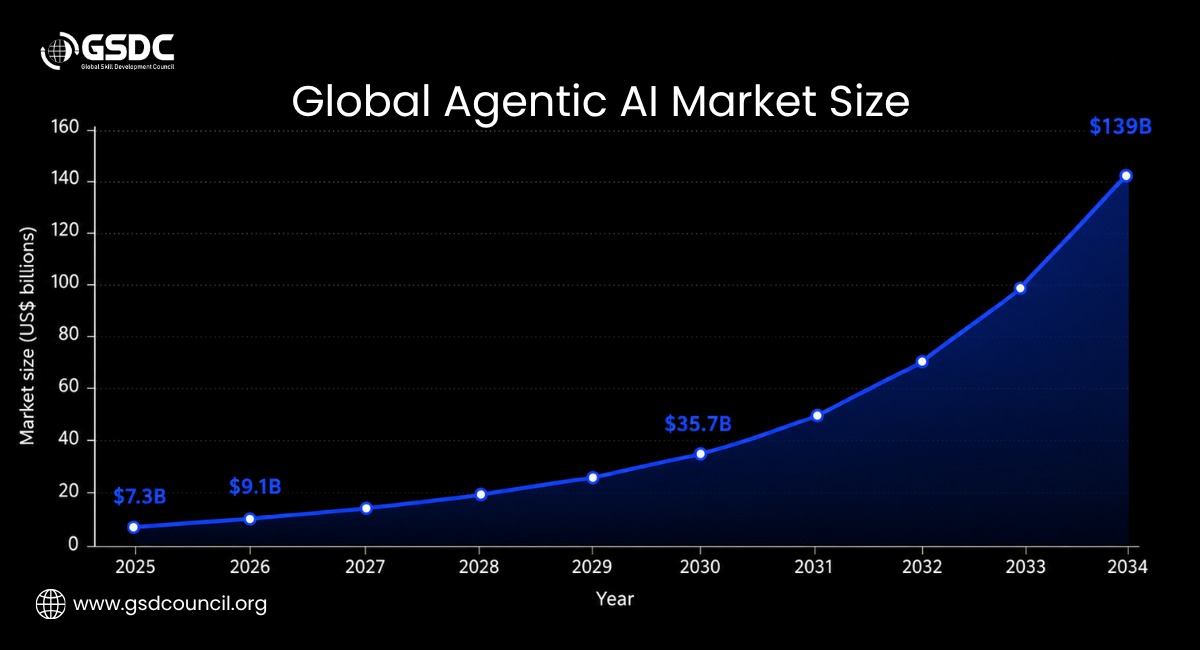
That curve isn't gradual - it's closer to a hockey stick. And that's exactly where things get messy. An agent that looks great in a demo can fall apart the moment it hits a real, messy production environment: looping endlessly, calling the wrong tool, quietly making a decision nobody actually signed off on. The difference between an agent that scales and one that gets quietly switched off usually comes down to one thing - architecture.
That's where agentic AI architecture patterns come in - the reusable blueprints experienced architects reach for instead of reinventing the wheel on every project. This guide covers what agentic architecture means, the core AI agent design patterns worth knowing, how to think about an AI agent architecture diagram, real-world examples, and what an AI architect earns and how to become one.
What Is Agentic Architecture?
Let's start with the basics, because the term gets thrown around pretty loosely.
Agentic architecture is the structural design of an AI system that can perceive information, reason about a goal, decide what to do next, perform actions using tools, evaluate results, and adjust its behavior during execution. That makes it fundamentally different from a traditional software workflow, where developers define the execution path in advance:
Input → Predefined Logic → Output
Agentic systems introduce a dynamic decision-making loop instead:
Goal → Observe → Reason → Act → Evaluate → Adapt → Continue or Stop
The system works out at least part of the execution path needed to reach the goal, rather than following one that's fully specified ahead of time.
So what does that look like in practice? Three capabilities working together:
- Reasoning: the agent decides what should happen next based on the goal, the information available, and the current state of the task.
- Action: the agent interacts with tools, APIs, databases, enterprise applications, search systems, or other environments to actually do something.
- Memory and feedback: the system retains relevant information, observes the results of its own actions, and uses that context to make better decisions going forward.
Get this structure wrong, and you can end up with an agent that does nothing useful or does far too much, too unpredictably. Get it right, and you can build systems that handle complex, multi-step work while staying observable and under control.
Why Every Architect Needs an AI Agent Architecture Diagram
Before you write a line of orchestration code, sketch the system. An AI agent architecture diagram forces the uncomfortable questions early: Where does the agent get its instructions? What happens when a tool call fails? Who signs off on a high-risk action before it fires? Skip this and you'll end up debugging agent behavior in production instead of on a whiteboard - a much more expensive place to find the hole.
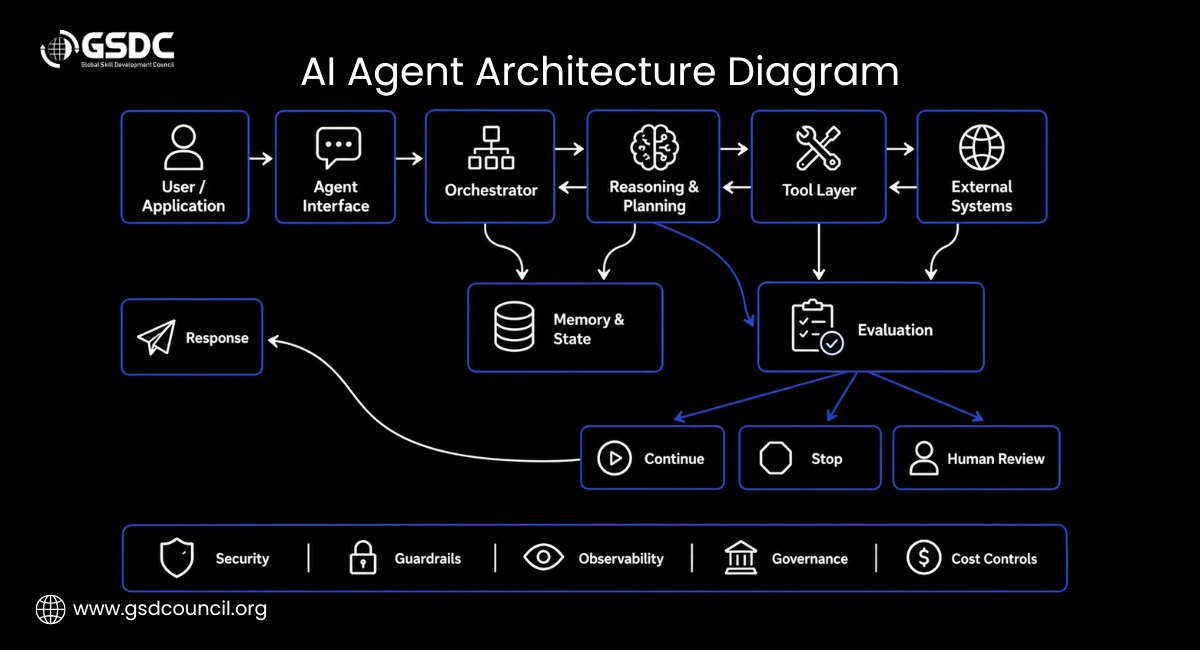
The diagram provides the reference point for the patterns below. Each pattern changes how one or more parts of the system reason, act, coordinate, evaluate, or remain under control.
The Core Agentic AI Architecture Patterns Every Architect Should Master
These are the patterns that show up again and again in real, production agentic AI system architecture not theoretical constructs, but the building blocks teams actually ship on, and the same seven patterns covered in depth in the Agentic AI Foundation Certification if you want to go further than a single blog can take you. They aren't competing approaches; most production systems combine several of them depending on the problem.
1. The ReAct Pattern (Reason + Act)
The agent reasons about what to do next, acts by calling a tool, then observes the result before its next move - a loop that runs until the task is done.
Because tool calls, observations, and intermediate execution steps can be logged, teams get more visibility into where an agent's execution path broke down than they would from a single model response.
The trade-off is cost and consistency: more loops mean more model calls, and identical inputs won't always produce identical execution paths.
Use it when: the solution path isn't known ahead of time - research, variable-complexity support, adaptive troubleshooting.
2. The Reflection Pattern
The agent generates an output, critiques it against defined quality criteria, and revises - generate, critique, refine, repeat until it clears the bar. Works best when the critique step is specialized and ideally deterministic (a linter, a schema validator, a compliance checklist), and when the critic is kept independent from the generator so it isn't rubber-stamping its own mistakes.
Use it when: output quality matters more than speed, and you can define what "good" looks like.
3. The Tool Use Pattern
This is what turns a language model from something that talks into something that does - calling APIs, querying databases, running code. Nearly every production agent sits on this. Three things make or break it: a tightly defined tool catalog with clear schemas, explicit handling for tool failures, and sandboxing plus approval gates for any hard-to-reverse action. The moment an agent can submit a form or trigger a transaction, a mistake's blast radius grows fast.
4. The Planning Pattern
Where ReAct improvises step by step, planning breaks a goal into ordered subtasks before execution starts - either a full plan-and-execute upfront, or adaptive planning, where the agent plans a few steps, executes, and re-plans as it learns.
Use it when: the task needs real coordination - a multi-system integration in a specific order, or research that requires synthesizing several sources first.
5. The Multi-Agent Orchestration Pattern
A coordinator routes work to specialist agents, each with a narrow scope and its own tools, then merges what they produce - usually sequential (A hands to B hands to C), concurrent (parallel, merged at the end), or debate (agents critique each other before a final answer). It's common in agentic workflow architecture, though far from universal - plenty of production systems deliberately stay single-agent because that's easier to evaluate and run. Rule of thumb: start with one well-built agent, and split only when you hit a concrete bottleneck it can't solve.
6. The Human-in-the-Loop (Escalation) Pattern
Not everything should run fully autonomously. Routine, low-risk actions can run unwatched; anything hard to reverse, high-cost, sensitive, or carrying real accountability should go to a person for approval first.
7. The Guardrail and Observability Pattern
Step-level tracing - logging tool calls, state transitions, and important execution decisions - is what lets a team understand what happened when something breaks. Rate limiting, input validation, output filtering, and execution budgets round this out. Guardrails AI and the OWASP Top 10 for LLM Applications are reasonable places to start.
Agentic AI System Architecture: 6 Technical Layers That Hold It Together
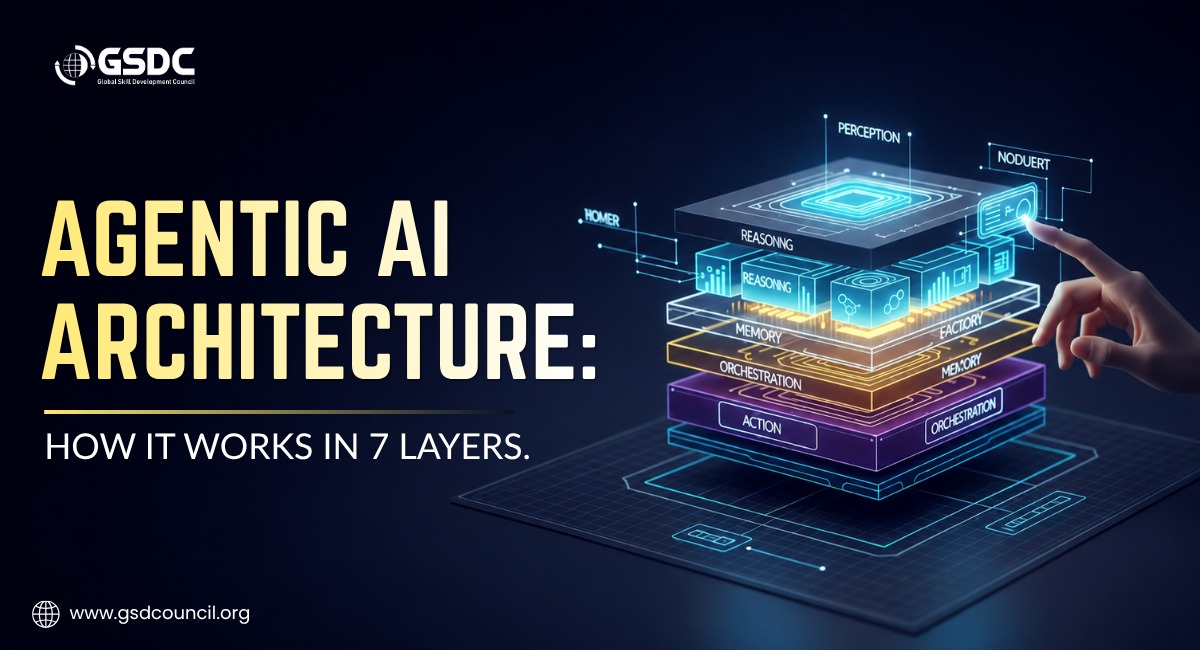
Zoom out, and most production systems share the same underlying agentic AI technical architecture, built from six layers:
- Perception / Input - ingests the request, documents, or events that trigger the agent.
- Memory - short-term within a task, long-term across sessions where it matters.
- Reasoning / Planning - decides the next action, builds and adapts plans.
- Tool / Action - the catalog of APIs and systems the agent can call.
- Orchestration - coordinates steps or agents, manages state and routing.
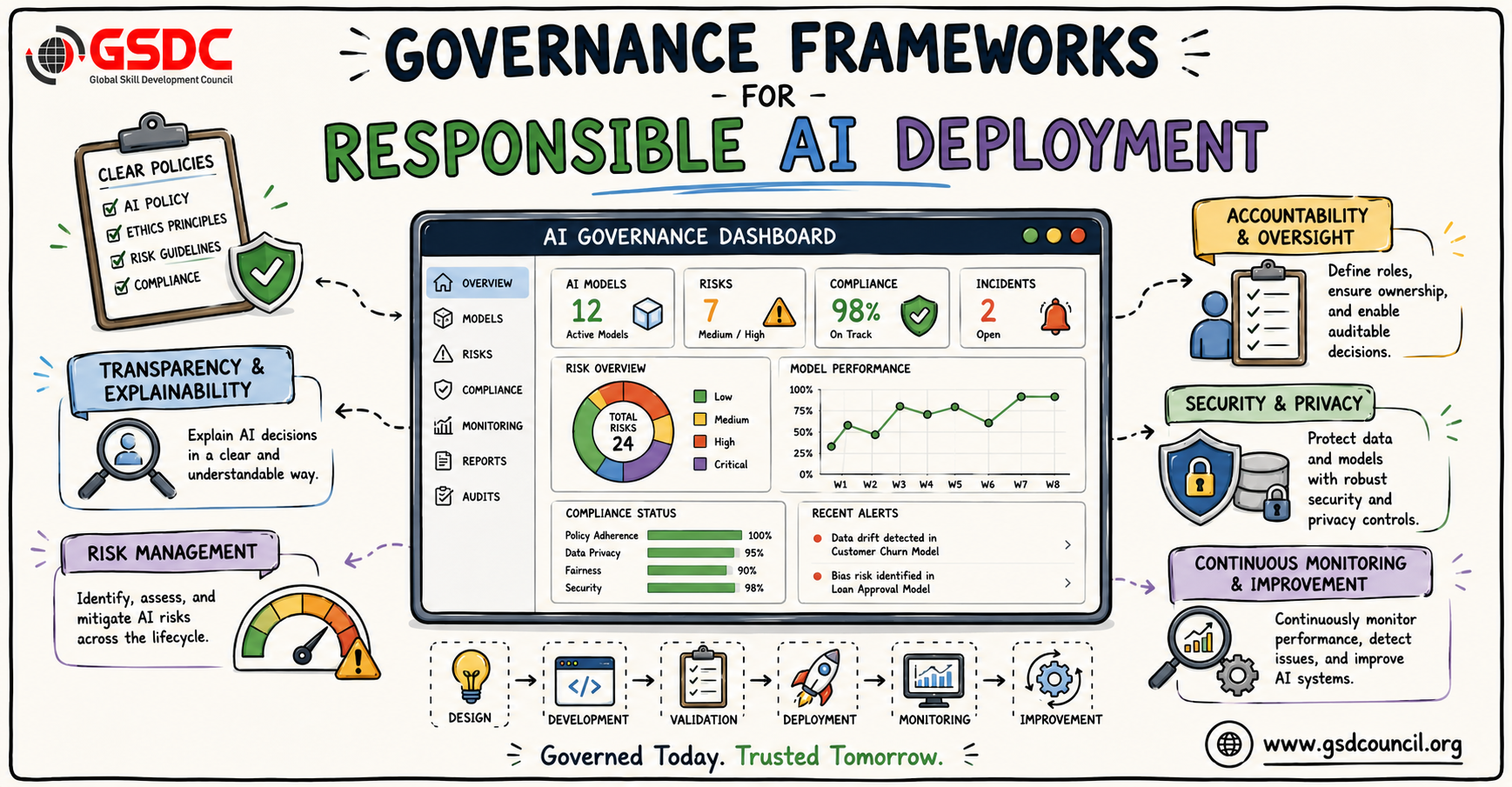
- Governance - guardrails, approval gates, logging, evaluation.
Mapping your system against these six layers is a quick way to spot gaps - teams tend to over-invest in reasoning and under-invest in governance, which matters more as autonomy grows, and it's the same layer breakdown GSDC uses when walking architects through this material in more depth.
Real-World Agentic AI Architecture Examples
- Klarna - its OpenAI-powered support agent was handling the equivalent of 853 full-time agents by Q3 2025, saving roughly $60 million. Less discussed: Klarna later increased its emphasis on human support again - arguably the more useful lesson. Automate the high-volume, predictable work, but keep a real escalation path for anything complex.
- Siemens built an Industrial AI agent architecture around orchestrated agents for engineering and manufacturing workflows.
- Enterprise platforms increasingly bundle orchestration, tools, memory, evaluation, and security into one package - a sign of where the hard problems actually are.
None of these are one monolithic agent doing everything. They combine patterns, infrastructure, and governance around a specific business problem.
Build vs. Buy
Frameworks like LangGraph, AutoGen, and CrewAI already handle state management, routing, and tool integration - leaning on one saves development time, at the cost of some control. The decision comes down to security needs, customization, vendor comfort, and team expertise. Most teams land on using established orchestration infrastructure while keeping tight control over tools, permissions, and governance themselves.
The Adoption Gap
In McKinsey's Global Survey on the State of AI, 23% of respondents said their organization was actively scaling an agentic AI system, and another 39% had only begun experimenting - roughly six in ten somewhere on the journey, but fewer than one in four at scale.
That gap isn't one single cause - it's reliability, security, cost, integration, and governance, usually all at once. Strong models matter, but architecture is what determines how they behave once embedded in a real system with real consequences.
How to Choose the Right Pattern
- Predictable solution path? Skip ReAct - use a simpler fixed workflow.
- Quality matters more than speed? Add Reflection.
- Touching real systems? Tool Use is non-negotiable, with permissions and logging.
- Multi-step coordination needed? Consider Planning.
- Hit a real bottleneck with one agent? Only then consider Multi-Agent Orchestration.
- Hard to reverse or high-stakes? Route through human review, no matter how confident the agent seems.
Start simple. Add complexity only when a real limitation forces your hand.
How to Become an AI Architect - and What It Pays
Agentic architecture skills are reshaping the AI architect role itself: connecting models with cloud infrastructure, security controls, evaluation, and governance into one coherent system. A practical path in:
- Build a foundation in software architecture, cloud platforms, and core ML/LLM concepts.
- Get hands-on with LangGraph, AutoGen, or CrewAI, using several patterns above in real projects.
- Learn governance, not just modeling - guardrails, evaluation, access controls, AI security.
- Consider certifications like TOGAF alongside hands-on agentic AI and MLOps experience.
- Document your decisions - an AI agent architecture diagram, decision records, and trade-off explanations go further than a working demo alone.
On pay: in the US, Glassdoor puts average AI architect compensation around $190,000 a year, with a wide reported range. In India, upGrad's 2026 analysis puts it around ₹28–37 lakh, higher for senior roles. Treat both as market estimates, not guarantees.
The more durable career signal is that AI architecture roles increasingly require professionals who can connect models, infrastructure, security, evaluation, and governance into reliable production systems.
Where to Go From Here
Reading through seven patterns is one thing. Actually building with them, under a deadline, with a stakeholder asking why the agent did what it did - that's a different skill, and it's usually learned the hard way, on a live system, at the worst possible time.
If you'd rather build that muscle somewhere lower-stakes first, the Global Skill Development Council (GSDC) runs the Agentic AI Foundation Certification, which goes deeper into exactly the stuff this guide only has room to sketch - the governance layer, the trade-offs between patterns, what "production-ready" actually looks like once an agent is touching real systems and real money. It's less about collecting a credential for a resume and more about having someone push back on your architecture decisions before your users do.
Worth a look if you're past the "what is agentic AI" stage and actually shipping something.
Bringing It All Together
ReAct, Reflection, Tool Use, Planning, Multi-Agent Orchestration, Human-in-the-Loop, Guardrails - these aren't competing options. They're building blocks you combine differently depending on the problem, the constraints, and how much risk you can carry.
The market is growing fast, and the gap between experimenting and running at scale is still wide. Mastering these agentic architecture patterns is what turns a promising prototype into something an enterprise can actually rely on.

Related Certifications
Frequently Asked Questions
The structural design of an AI system that can perceive information, reason about a goal, take actions through tools, evaluate results, and adapt - largely without a human in every step.
ReAct, Reflection, Tool Use, Planning, Multi-Agent Orchestration, Human-in-the-Loop, and Guardrails and Observability.
The agent interface, orchestration, reasoning and planning, tool integrations, external systems, memory and state, evaluation, and governance and human oversight running across the whole system.
Agentic AI architecture is the broader structure for systems that reason, use tools, and adapt during execution. Multi-agent architecture is one pattern within that, where several specialized agents coordinate - plenty of solid agentic systems only need one agent.
Stay up-to-date with the latest news, trends, and resources in GSDC
If you like this read then make sure to check out our previous blogs: Cracking Onboarding Challenges: Fresher Success Unveiled
Not sure which certification to pursue? Our advisors will help you decide!