13 Best Agentic AI Tools & Platforms to Watch in 2026
Written by Matthew Hale
- What Are Agentic AI Tools?
- Why Agentic AI Adoption Is Accelerating in 2026
- What Are the Best Agentic AI Tools? A Practical List for 2026
- Which Agentic AI Tools Are Best for Complex Decision Workflows?
- How to Use Agentic AI: A Practical Starting Point
- How to Choose the Best AI Agent Tools for Your Business
- Where It's Being Used, and Where It Gets Hard
- Build the Skills to Evaluate These Platforms Yourself
- Final Thoughts
A year ago, most "AI tools" were really just chat windows. You typed a request, got a reply, and did the rest of the work yourself. That's no longer where the interesting action is. The tools people are actually talking about in boardrooms and dev teams right now can plan a task, pull data from three different systems, make a judgment call, and finish the job - with a human checking in only when it matters.
That's the promise behind agentic AI tools, and 2026 is the year this category stopped being a research curiosity and became a line item in enterprise budgets. Gartner projects that by 2028, roughly a third of enterprise software will ship with agentic capabilities built in, up from under 1% just two years earlier. At the same time, research from the Capgemini Research Institute shows adoption is still genuinely early; most organizations are piloting or exploring rather than running agents at scale. Both things are true at once: the direction is clear, but most companies are still figuring out how to do this well.
If you're trying to make sense of the crowded market of agentic AI platforms which ones are worth a pilot, which ones fit your tech stack, and how to actually get started this blog walks through it in plain language, backed by real numbers.
What Are Agentic AI Tools?
Let's start with the basics, because the term gets thrown around loosely.
Agentic AI tools are software systems that can pursue a goal with a fair amount of independence. Give it a task like "review these 200 invoices and flag anything that doesn't match our purchase orders," and it will break that goal into steps, decide what information it needs, go fetch it, make judgment calls on ambiguous cases, and report back without you having to prompt it at every single stage.
That's different from a regular chatbot or a generative AI tool, which mostly waits for your next instruction. It's also different from older rule-based automation (think basic RPA bots), which follow a rigid script and break the moment something unexpected happens.
What are tools in agentic AI, technically? Most credible platforms share four ingredients:
- Goal-directed planning - the system can take a broad objective and figure out its own sequence of steps, rather than just following a pre-set script.
- Tool use - it can call APIs, query databases, browse the web, or run code to actually get things done, not just talk about them.
- Adaptive execution - if step three fails or returns something unexpected, it adjusts the plan instead of simply erroring out.
- Memory and context - it remembers what happened earlier in the workflow, so decisions stay consistent over a long, multi-step task.
If a product is missing more than one of these, it's probably closer to a smart chatbot or a workflow automation tool than genuine agentic AI technology. That distinction matters when you're comparing vendors, because plenty of tools use the word "agentic" as a marketing label without the underlying capability.
Why Agentic AI Adoption Is Accelerating in 2026
A few forces are converging at once: cost pressure to automate judgment calls, not just repetitive clicks; foundation models that plan and reason well enough to make fewer costly mistakes than a year ago; and integration maturity - cloud providers and CRM vendors have built agent-friendly connectors, so plugging an agent into existing systems now takes days, not months.
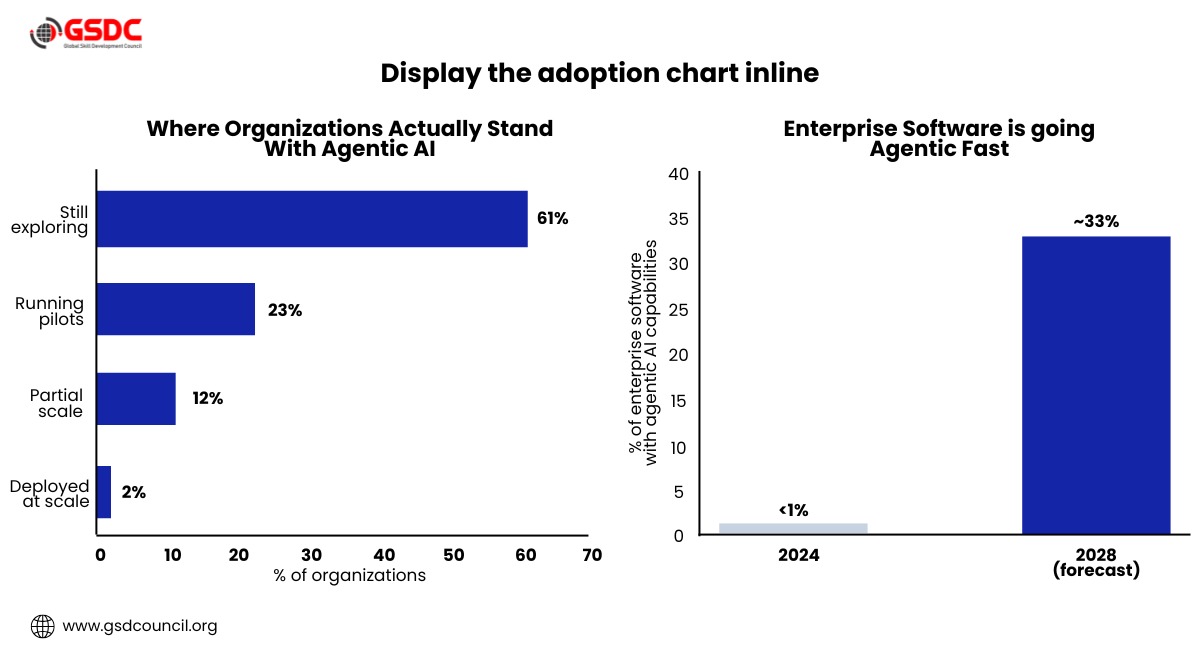
The two charts tell slightly different stories. Enterprise software is going agentic fast - from under 1% to roughly a third of all applications by 2028. But actual organizational deployment is still catching up: only 2% of companies have agents running at scale today, and the majority (61%) are still in the exploration phase. Worth flagging too - the same Gartner forecast predicts over 40% of current agentic AI projects will be scrapped by the end of 2027 due to unclear ROI or weak risk controls. It's a genuinely early market, and a lot of pilots won't survive contact with real budgets.
What Are the Best Agentic AI Tools? A Practical List for 2026
There's no single "best" platform - the right pick depends heavily on your stack, industry, and whether you're building custom agents or buying something ready-made. Below is a working agentic AI tools list grouped by what they're actually good at, based on current market use.
For Developers Building Custom Agents
1. OpenAI Agents SDK - Built-in tool-calling, agent handoffs, and tracing; best if you want full control and plan to build something custom.
2. LangGraph (LangChain ecosystem) -Models workflows as a graph with explicit state, branching, and human checkpoints; popular for teams that need observability over black-box automation.
3. CrewAI - Assigns specialized roles (researcher, analyst, writer) that collaborate on a task; a favorite for research, compliance review, and content pipelines.
4. Microsoft AutoGen - Open-source framework where multiple agents "talk" to each other to solve a problem jointly; useful for coding, testing, and QA workflows.
Cloud-Native Agent Platforms
5. Google Agent Development Kit (ADK) - Plugs directly into Google Cloud, Vertex AI, and Gemini models; the path of least resistance if you already run on Google Cloud.
6. Amazon Bedrock Agents - Native ties to Lambda, S3, and Amazon's RAG tools; solid for AWS-native businesses that need agents grounded in internal documentation.
Business Operations & No-Code Platforms
7. Microsoft Copilot Studio - Low-code agent building inside Teams, Outlook, SharePoint, and Dynamics 365, with enterprise governance built in.
8. n8n - Open-source, self-hostable workflow automation with hundreds of integrations; strong pick for privacy-conscious organizations.
9. Salesforce Agentforce - Built into the Salesforce ecosystem for sales, service, and CRM automation - qualifying leads, resolving tickets, pulling customer context for reps.
10. UiPath - Evolved from RPA into agentic automation, adding LLM-based reasoning to handle unstructured documents and exceptions older bots couldn't manage.
11. Automation Anywhere - A close UiPath competitor with a similar RPA-to-agentic evolution via its "AI Agent Studio"; best for finance and insurance back-office work.
12. Moveworks - Resolves IT and HR requests end-to-end (password resets, access, benefits questions) rather than just routing tickets to a human.
13. Glean - Unifies enterprise knowledge across Slack, Drive, Confluence, and email so agents and employees can find sourced answers instead of hunting through folders.
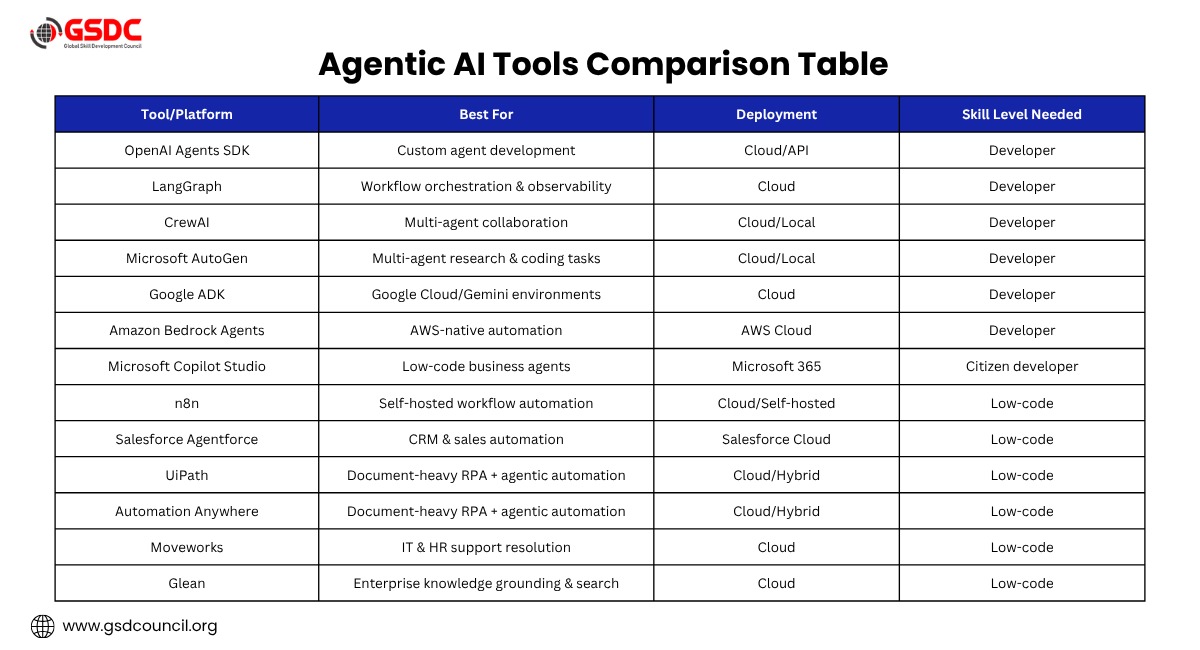
This is a useful reference if you're being asked internally for the top agentic AI tools worth shortlisting before a formal evaluation, and if you want a more structured way to run that evaluation itself, the Agentic AI Foundation Certification covers the underlying framework in more depth.
Which Agentic AI Tools Are Best for Complex Decision Workflows?
Not every agentic tool is built for high-stakes judgment calls - some are just faster automation for simple, low-risk tasks. If a workflow involves real business risk (approving a refund, flagging fraud, prioritizing a compliance case), the tool needs more than speed. It needs to be evaluated against a few concrete criteria:
Grounding:
Does the agent pull from your actual company data - via retrieval-augmented generation or a connected knowledge base - instead of relying on general training data? Amazon Bedrock Agents and Glean are both built around this kind of grounding, which reduces the chance of a confidently wrong answer.
Human approval checkpoints:
Can you insert a mandatory review step before an irreversible action? LangGraph is explicitly designed for this - you can define exactly where a human needs to sign off before the agent proceeds.
Observability and tracing:
Can you see the full chain of steps an agent took to reach a decision after the fact? Both LangGraph and the OpenAI Agents SDK provide built-in tracing for this, which matters a lot when you need to explain a decision to a compliance officer or an auditor.
Deterministic workflow control:
Does the tool let you constrain the agent to a defined set of allowed paths, rather than letting it improvise freely? Graph-based frameworks like LangGraph and orchestration-heavy platforms like UiPath tend to offer more of this than fully autonomous, loosely scoped agents.
Evaluation:
Does the platform support running the agent against test cases before it goes live, so you can catch bad decisions in a sandbox instead of production?
Auditability:
Is there a persistent, exportable log of every decision and the data behind it? This is a hard requirement in regulated industries like finance, insurance, and healthcare.
The general pattern: tools built for enterprise orchestration and grounding, not just raw autonomy, tend to produce decisions that are easier to trust, explain, and defend later. Building the judgment to apply criteria like these consistently, rather than platform by platform, is exactly the kind of governance skill the Global Skill Development Council (GSDC) focuses on in its AI certification programs.
How to Use Agentic AI: A Practical Starting Point
If your organization is new to this, don't start with a company-wide rollout. Start narrow.
- Pick one bounded workflow with a clear start, a clear end, and a way to measure success, like invoice matching, IT ticket triage, or sprint report generation.
- Choose a tool that already lives where the work happens - if your team runs on Jira, start with its built-in agentic features before evaluating a separate platform.
- Set a time-boxed pilot; four to six weeks is usually enough to tell whether an agent is genuinely saving time or just adding new problems.
- Define success metrics before you start - task completion rate, error rate, and time saved - instead of evaluating on gut feeling.
- Keep a human in the loop for the first few cycles, since even a well-reviewed agent will make mistakes early on.
- Scale gradually, department by department, once the pilot proves its value - not all at once.
This same sequence works whether you're testing agentic AI platforms for the first time or expanding an existing pilot into new departments.
How to Choose the Best AI Agent Tools for Your Business
With so many ai agent platforms on the market, judge each one against the same short list: does it meet the four baseline agentic requirements, how deep is the integration with your existing stack, what's the total cost once implementation and training are included, and is the vendor stable enough to still be supporting this in three years? (The full evaluation checklist further down covers this in more detail.)
Avoid picking a platform purely because it's the most talked-about name. The right tool is the one that solves your specific bottleneck with the least disruption to your existing systems.
Where It's Being Used, and Where It Gets Hard
Adoption is spreading fastest in banking and finance (fraud review, compliance checks), healthcare (clinical knowledge retrieval, admin automation), retail (personalized engagement, inventory decisions), IT and software (coding assistants), logistics (routing and exception handling), and HR (onboarding, ticket resolution).
The friction is fairly consistent across all of them: too many near-identical vendor options to compare, integration work with legacy systems that weren't built with APIs in mind, governance gaps around who owns audit trails and escalation rules, skill shortages in cloud and security expertise, and change management - employees need reassurance that agents are there to remove drudgery, not replace them. None of that is a reason to avoid agentic AI; it's a reason to plan the rollout deliberately instead of rushing it.
Build the Skills to Evaluate These Platforms Yourself
Choosing between a dozen-plus agentic AI platforms isn't really a tooling problem - it's a skills problem. Most teams don't lack access to good tools; they lack a repeatable way to evaluate them, govern them, and roll them out without creating new risk in the process.
That's the gap the Global Skill Development Council (GSDC)'s Agentic AI Foundation Certification is built to close. Rather than teaching any one vendor's platform, it walks through the vendor-agnostic fundamentals covered in this guide - how to assess grounding, governance, and control before committing budget, and how to run a pilot that actually tells you something before you scale it. For teams making these decisions regularly, that structure tends to save more time than another product demo.

Final Thoughts
The agentic AI tools landscape in 2026 is crowded, fast-moving, and - frankly - a little overhyped in places. But underneath the noise, the underlying shift is real: organizations that once relied on rigid automation are now deploying systems that can plan, adapt, and finish work with far less hand-holding. The businesses moving fastest aren't the ones chasing every new agentic AI platform that launches - they're the ones running focused pilots, measuring results honestly, and scaling what actually works.
As agentic AI moves from experimentation to deployment, professionals who can evaluate platforms, manage governance risks, and lead responsible adoption will become increasingly valuable. That's less about mastering any single tool and more about building a repeatable way to tell real capability from hype - a skill that will matter more, not less, as the market keeps shifting.

Related Certifications
Frequently Asked Questions
They're software platforms that let AI systems plan, decide, and act across multi-step tasks with minimal human input at each stage - going well beyond simple prompt-and-response chatbots.
It depends on your use case. OpenAI Agents SDK and LangGraph lead for custom development; Microsoft Copilot Studio and Salesforce Agentforce lead for low-code business use; n8n and CrewAI are strong open-source choices for teams that want flexibility without heavy licensing costs.
Pick one narrow, measurable workflow, choose a tool that already integrates with your existing systems, run a 4–6 week pilot with clear metrics, and scale only once you've proven the value.
Look for platforms that ground answers in your real company data, let you insert human approval checkpoints, and provide tracing so you can audit how a decision was reached. LangGraph, the OpenAI Agents SDK, and Amazon Bedrock Agents are commonly used for this because they're built for exactly that level of control.
It can be, but safety depends on governance, not just the tool. Audit logging, role-based access, and human review checkpoints are non-negotiable for any serious enterprise deployment.
Mostly, it removes repetitive and low-judgment work, freeing people for tasks that need context, empathy, and strategic thinking - but it does require reskilling teams to work alongside these systems effectively.
Stay up-to-date with the latest news, trends, and resources in GSDC
If you like this read then make sure to check out our previous blogs: Cracking Onboarding Challenges: Fresher Success Unveiled
Not sure which certification to pursue? Our advisors will help you decide!