Agentic AI Is Changing Procurement. Here's What Actually Changes
Written by Matthew Hale
- What Is Agentic AI in Procurement?
- From RPA to Generative AI to Agentic AI
- Five Procurement Activities AI Agents Are Already Changing
- Real-World Examples
- What Humans Still Need to Own
- The Skills Procurement Professionals Need Next
- How to Introduce Agentic AI Safely
- Building the Team This Shift Requires
- The Bottom Line
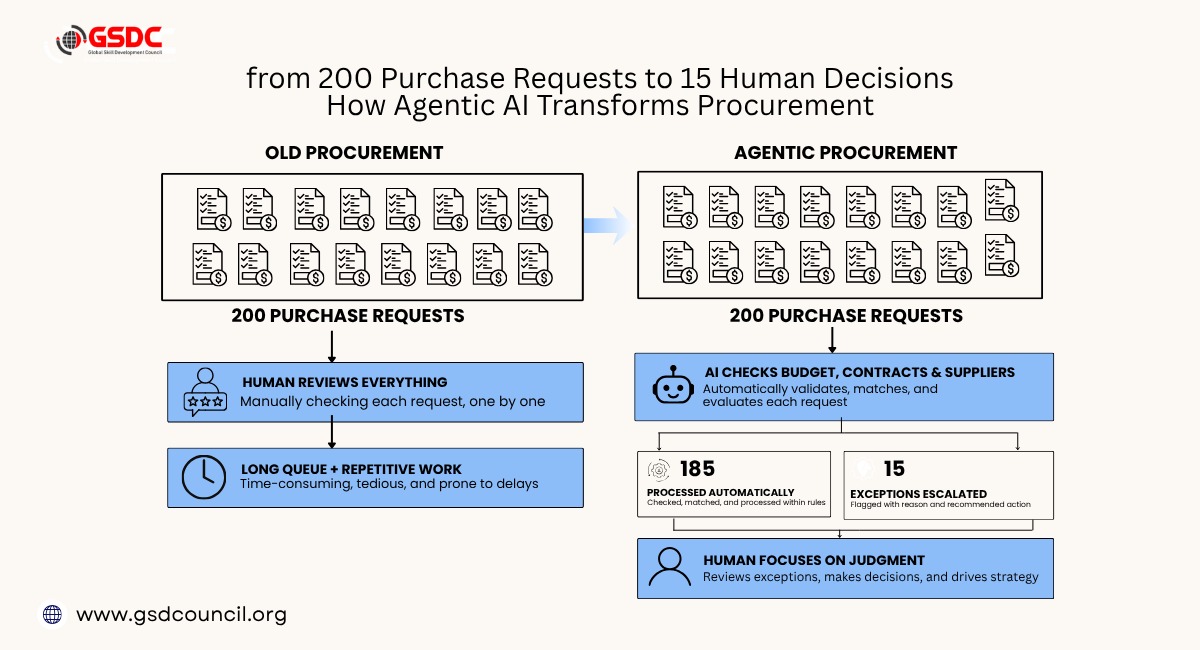
Picture a procurement manager on a Monday morning. In the old world, their inbox holds 200 routine purchase requests waiting for review, most of them low-value, low-risk, and honestly, not that interesting to look at one by one. In the new world, that same manager opens their dashboard to find 15 exceptions: the handful of cases an AI agent couldn't resolve confidently on its own, each one flagged with a reason and a recommendation. The other 185 were already checked, matched against budget and contract terms, and processed overnight.
That's the practical difference between AI in procurement, as most people have known it, a reporting and automation layer, and agentic AI in procurement, where software takes on judgment, not just tasks. For years, procurement automation meant faster paperwork: digitized purchase orders, e-invoicing, catalog-based buying. Useful, but passive. It could tell you what happened. It couldn't decide what to do next. Agentic AI crosses that line, and it's worth understanding clearly, not as a buzzword, but as a real shift in how purchasing decisions get made and who (or what) makes them.
What Is Agentic AI in Procurement?
Agentic AI in procurement refers to AI systems, often called "agents," that can plan, decide, and act on multi-step purchasing tasks with limited human input, rather than simply analyzing data or producing content on request.
It helps to see it as the third step in a progression:
- Analytical AI answers "show me the data." It builds dashboards, flags anomalies, and generates reports, but a person still decides what to do with that information.
- Generative AI in procurement answers "write this for me." It drafts RFPs, summarizes contracts, or writes supplier emails, still directed and edited by a person.
- Agentic AI answers "handle this for me." It sets a goal, breaks it into steps, gathers the data it needs, weighs the trade-offs, takes an action (or recommends one), and learns from the outcome.
Rather than a category manager opening ten browser tabs to compare supplier quotes by hand, an agent does that comparison itself, checks it against budget and contract terms, and either acts within its mandate or hands a ready-made recommendation to a human for sign-off. This shifts procurement's focus away from transaction tasks and toward being a strategic driver of growth, sustainability, and resilience.
That said, the word "agentic" gets used loosely. It doesn't automatically mean "fully autonomous," and the distinction matters enough that it deserves its own section further down.
From RPA to Generative AI to Agentic AI
To see why this is a bigger deal than the last wave of procurement software, it helps to line up the technologies side by side.
Technology | What it does | Human involvement | Typical use |
Robotic process automation (RPA) | Follows fixed, rule-based scripts (e.g., "if invoice matches PO, approve") | High - breaks on any exception | Data entry, auto-filling PO fields |
Procurement process automation | Digitizes and streamlines workflows | Medium - people still make most decisions | E-procurement portals, approval routing |
Generative AI tools | Creates content and summaries from prompts | Medium - people direct and edit the output | Drafting RFPs, summarizing contracts |
Agentic AI | Plans, reasons, decides, and acts across multiple steps | Low to selective - people set the guardrails and handle exceptions | Autonomous sourcing, negotiation prep, compliance checks |
Traditional robotic process automation was always brittle: it worked beautifully until something unexpected happened, and then it needed a human to step in and fix it. Agentic systems are built for exactly the opposite situation: reasoning through ambiguity and continuing to work even when a case doesn't match a predefined script.
Five Procurement Activities AI Agents Are Already Changing
This is where the shift becomes concrete. Here's what changes when agents take over the routine parts of the job and why it matters on an ordinary Monday.
Purchase orders and tail spend stop piling up in a queue.
Low-value, high-volume purchases of office supplies, MRO items, and routine restocking are exactly the kind of decisions agents handle well. They check inventory levels, compare pre-approved suppliers, and place the order, so a manager isn't triaging a queue of near-identical requests all morning.
Sourcing becomes continuous instead of an annual event.
Rather than running an RFP once a year and hoping the market hasn't moved since, agents can monitor supplier pricing, market indices, and risk signals in the background and trigger a new sourcing event the moment conditions actually change.
Compliance checking happens automatically, not during a quarterly audit.
Agents can cross-reference every invoice against contract terms and delivery data as it comes in, catching mismatched pricing or "leakage" before it turns into a write-off nobody notices until year-end.
Negotiation prep shrinks from days to minutes.
Instead of a category manager manually pulling market benchmarks and pricing history before a supplier call, an agent assembles the full fact base and can even draft opening counteroffers in the background.
Human attention moves to exceptions, not everything.
The "185 versus 15" idea from the opening: the manager's day stops being defined by volume and starts being defined by judgment calls the system flagged as genuinely uncertain. It's a pattern that keeps coming up in conversations with procurement teams working through this transition with GSDC: the job doesn't get smaller; it gets sharper, concentrated on the calls that actually need a person.
Real-World Examples
Here's what this looks like in companies that have already deployed it, with the source, the problem, and the result kept close together so the numbers are easy to trace.
Walmart - autonomous supplier negotiation
Challenge: Negotiating commercial terms across a vast, complex supplier base at a scale no human team could cover alone
AI approach: Pactum's autonomous negotiation agents, which close commercial outcomes directly rather than just recommending them
Result: Notable enough that it became the subject of a dedicated Harvard Business Review case study on AI-led supplier negotiation
Honeywell - negotiation at scale
Challenge: Standardizing terms and capturing savings across a long tail of indirect spend
AI approach: Pactum's autonomous negotiation agents, operating within predefined guardrails
Result: Reported to have concluded more than 2,500 supplier negotiations autonomously, securing savings and standardized terms
Bristol Myers Squibb - autonomous sourcing
Challenge: Sourcing cycles too slow to keep pace with the volume of events the business needed
AI approach: Globality's AI sourcing agent, running full sourcing events with minimal manual intervention
Result: 10x more sourcing events run, with RFP cycle times cut 6–10x, without adding headcount
Samsung - sourcing optimization
Challenge: Manual, Excel-based sourcing that couldn't scale with complex, multi-factor decisions
AI approach: Keelvar's AI sourcing optimization platform
Result: 85 percent reduction in time spent running sourcing events
Alkermes - strategic sourcing in a regulated category
Challenge: Turning procurement from a support function into a value driver inside a pharmaceutical company
AI approach: JAGGAER's AI-assisted sourcing and category management tools
Result: $30 million unlocked in project cost savings
OpenAI - intake and purchase-request automation
Challenge: Manual, repetitive procurement intake tasks slowing the team down during a period of rapid growth
AI approach: More than 10 AI agents deployed through Zip's orchestration platform, including a dedicated Intake Validation Agent
Result: Around 1,400 hours saved annually from the Intake Validation Agent alone
These aren't isolated pilots, either. Broader research backs up the pattern: one 2026 survey of procurement executives found 92 percent believe agentic AI will fundamentally change how work gets done, though nearly 80 percent still require a human sign-off on every decision - a reminder that even at companies moving fast, full autonomy remains the exception rather than the rule. It also explains why credentials like the Certified Procurement Professional (CPP) certification are gaining traction. Teams running these tools day-to-day need a way to formally validate the judgment and governance skills the maturity curve below actually demands.
What Humans Still Need to Own
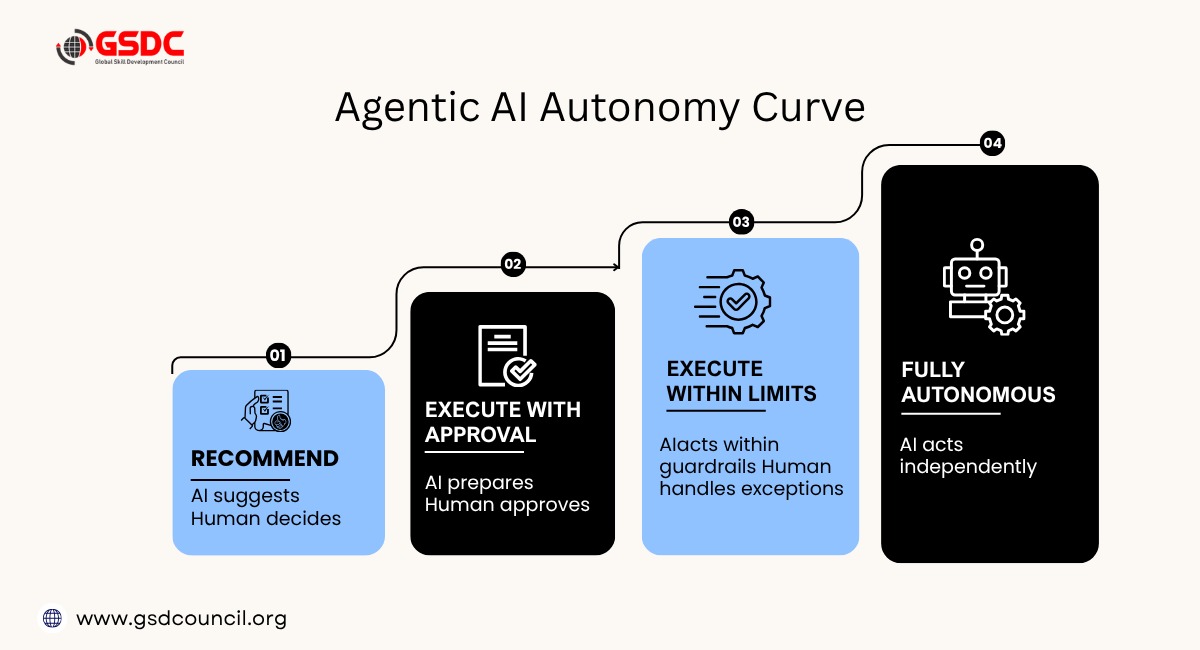
It's worth being precise here, because "agentic" and "autonomous" are not the same thing, and treating them as interchangeable oversells what's actually happening in most companies today. A useful way to think about it is as a maturity curve rather than a switch:
- Recommend - the agent surfaces options and analysis; a person decides everything.
- Execute with approval - the agent prepares the action (a PO, a counteroffer, a compliance flag) and a person signs off before it goes live.
- Execute within limits - the agent acts on its own within pre-set thresholds (spend caps, approved supplier lists, category boundaries) and only escalates exceptions.
- Fully autonomous - the agent acts without a human checkpoint at all, which is rare in procurement today and, for anything above routine tail spend, probably should stay that way for a while.
Most of the real deployments described above sit at stage 2 or 3, not stage 4. That's not a limitation; it's the sensible way to hand over decision-making gradually while keeping accountability clear.
What doesn't move down the maturity curve, at any stage, is the part of the job that depends on relationships and context: reading a supplier's tone in a tense negotiation, deciding when a "good deal on paper" isn't actually a good deal for the business, and owning the consequences when something goes wrong. Agents can prepare the ground for those calls. They can't make them.
The Skills Procurement Professionals Need Next
As routine decisions move to agents, the value of the job shifts from doing the transaction to directing and interpreting it. A few capabilities are becoming genuinely important to build:
- Reading and questioning agent output, rather than accepting a recommendation because it came from a system
- Framing the goals and guardrails an agent should optimize for - what "good" looks like, and where the limits are
- Exception handling and judgment, stepping in exactly where a case needs human context an agent doesn't have
- Supplier relationship management, which remains the part of the job that's hardest to automate and easiest to differentiate on
- Understanding governance and risk well enough to know where automation should - and shouldn't - be trusted
- Category and commercial strategy, the "what should we even be sourcing, and why" questions no agent asks on its own
On a resume or in an interview, this increasingly means being able to talk about experience working alongside AI-assisted workflows, not just traditional negotiation and category management - because that's the combination hiring managers are starting to look for.
How to Introduce Agentic AI Safely
Not every tool that markets itself as "agentic" deserves autonomy over real spending decisions. Before extending purchasing authority to any system, a few things are worth checking for:
- Explainability - can it show why it made a recommendation, not just what the recommendation is?
- Guardrails and spend thresholds - clear limits on what it can approve alone versus what needs a person's sign-off
- Audit trails - a complete, timestamped record of every decision and the data behind it
- A governance layer - a dedicated check (sometimes another agent) that reviews outputs for bias, error, or policy violations before anything is acted on
- Gradual rollout - starting in "recommend only" mode and expanding permissions as trust builds, rather than granting full autonomy on day one
This is exactly the gap the Genpact/HFS research pointed to: belief in agentic AI is ahead of organizations' comfort in actually handing over control. That gap closes through governance and a deliberate rollout, not by moving faster.
Building the Team This Shift Requires
None of this happens by installing software and hoping the skills catch up on their own. The gap between where most procurement teams are today and where the maturity curve above is heading has to be closed deliberately - through training, not just tooling.
This is the space the Global Skill Development Council (GSDC) works in. Its Certified Procurement Professional (CPP) certification is built around the same shift this article has been describing: less time spent on transactional tasks, more time spent on the judgment, governance, and strategic thinking that agentic systems can't replace. For a procurement professional trying to figure out where to focus first, a structured credential like this is less about adding a line to a resume and more about having a framework for the parts of the job that are becoming more important, not less.
The Bottom Line
Agentic AI isn't replacing procurement teams; it's replacing the parts of the job that never really needed a person in the first place: chasing paperwork, re-keying data, and manually assembling facts before a decision could even be made. What's left is the work procurement professionals have always wanted more time for: strategy, supplier relationships, and the judgment calls that actually move a business forward.
The organizations getting this right aren't the ones automating everything overnight. They're the ones building a solid data foundation, starting with low-risk use cases, moving deliberately up the autonomy curve, and investing in the skills their teams need to work alongside, not compete with, their new AI colleagues.

Related Certifications
Frequently Asked Questions
It's the use of AI agents that can plan, decide, and act on multi-step procurement tasks like sourcing, negotiation prep, and compliance checks with limited manual input, as opposed to traditional automation that only follows fixed rules.
It's the broader practice of using technology to reduce manual work in purchasing, from digitized purchase orders and approval workflows to e-invoicing. Agentic AI is the newest layer on top of that, adding reasoning and decision-making rather than just executing fixed steps.
Robotic process automation follows fixed, rule-based scripts and breaks when something unexpected happens. Agentic AI is built to reason through ambiguity, adapt to new situations, and make judgment calls closer to how a human analyst would work through a problem.
No, and this is a common misconception. Most agentic AI deployments today operate at a "recommend" or "execute with approval" stage, where a person still signs off on meaningful decisions. Full autonomy, where an agent acts with no human checkpoint at all, is still rare in procurement.
It can be, with the right guardrails: spend thresholds, explainability, audit trails, and a human checkpoint for exceptions. Most companies start with agents in an advisory role and expand what they're allowed to do as trust is established.
Autonomous sourcing and tendering, invoice-to-contract compliance checks, AI-assisted negotiation prep, inventory and order-execution automation, and continuous supplier-risk monitoring are among the most common live use cases today.
Stay up-to-date with the latest news, trends, and resources in GSDC
If you like this read then make sure to check out our previous blogs: Cracking Onboarding Challenges: Fresher Success Unveiled
Not sure which certification to pursue? Our advisors will help you decide!