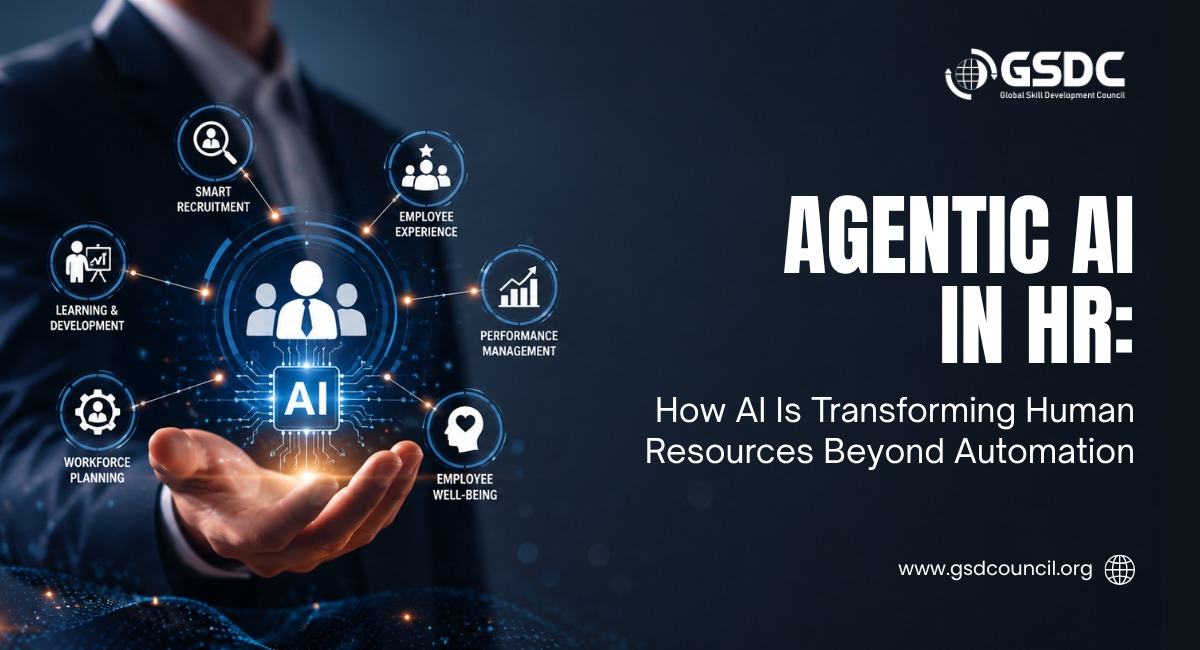
Agentic AI in HR: How AI Is Transforming Human Resources Beyond Automation
Written by Matthew Hale
- HR Before AI: The Manual Baseline
- Generative AI in HR: The Copilot Phase
- Why Generative AI Isn't Enough
- What Is Agentic AI in HR?
- HR AI Agents vs. Chatbots: What's the Real Difference?
- Real-World Agentic AI Use Cases in HR
- More AI in HR examples worth knowing:
- Benefits of AI in HR
- Will AI Replace Human Resources?
- Skills HR Professionals Need Now
- How GSDC Certifications Can Prepare You for This Shift
- The Bottom Line
Imagine opening your laptop on a Monday morning to find that your AI has already shortlisted candidates for three open roles, scheduled next week's interviews, answered forty employee policy questions, assigned onboarding tasks to a new hire starting Wednesday, and generated a turnover report flagging two flight risks on your team. You didn't ask it to do any of that today - you set it up to do it, once, weeks ago.
That's not hypothetical. It's what's already running inside a growing number of HR functions right now.
AI is no longer just helping HR professionals write job descriptions or draft policy answers. A new generation of AI can screen candidates, coordinate interviews, onboard employees, and run entire HR workflows with minimal human involvement. This shift is called agentic AI, and it may be the biggest change HR has seen in decades - not because the technology is flashy, but because of what it changes about who actually owns the outcome of a process.
Here's the full journey where HR technology has been, where agentic AI in HR is taking it, and what it means for your career or your team.
HR Before AI: The Manual Baseline
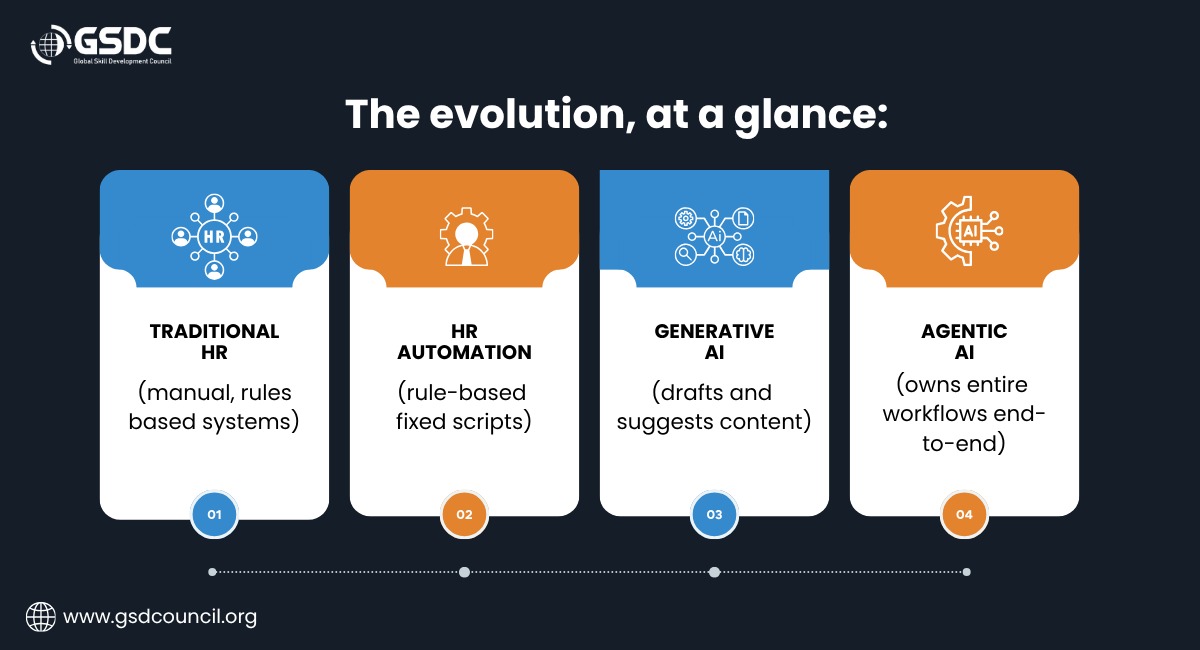
For most of HR's history, "technology" meant a system of record - an HRIS to store employee data, an ATS to track candidates, a payroll system to run numbers. These tools stored information and executed fixed rules. They didn't think, suggest, or adapt. A recruiter still read every resume. A generalist still manually checked every policy question against a handbook.
This baseline matters because it's the yardstick everything since has been measured against. When people say AI is "saving time," they usually mean it's cutting into work that used to be entirely manual.
Generative AI in HR: The Copilot Phase
The first real disruption came with generative AI in HR - tools that could draft, summarise, and respond on request. Ask it to write a job description, and it writes one. Ask it to summarise a policy, and it does. This is the copilot model: you prompt, it produces, you review and approve. It's also the layer most Certified Agentic AI HR Professional programs focus on today, since it's where the majority of HR teams are still operating.
Over the past two years, this has become the dominant way HR teams talk about AI tools for HR. Job description generators, interview question suggesters, policy chatbots - nearly all of them followed the same pattern. Useful, but bounded. The human still initiated every step and made every decision.
Why Generative AI Isn't Enough
Here's the uncomfortable data point: McKinsey's research found that 88% of companies now use AI in at least one business function - but only 39% of those companies report any material contribution to profit from their AI deployments. Adoption raced ahead of impact.
The reason is straightforward. A copilot only helps within a single step of a process. It doesn't reduce the number of steps, the handoffs between systems, or the waiting time between them. If a recruiter still has to manually move a candidate from sourcing to screening to scheduling - even with an AI draft at each stage - the workflow itself hasn't actually gotten shorter.
This is the gap that hr automation solutions built on generative AI alone kept running into: better content, same bottlenecks.
What Is Agentic AI in HR?
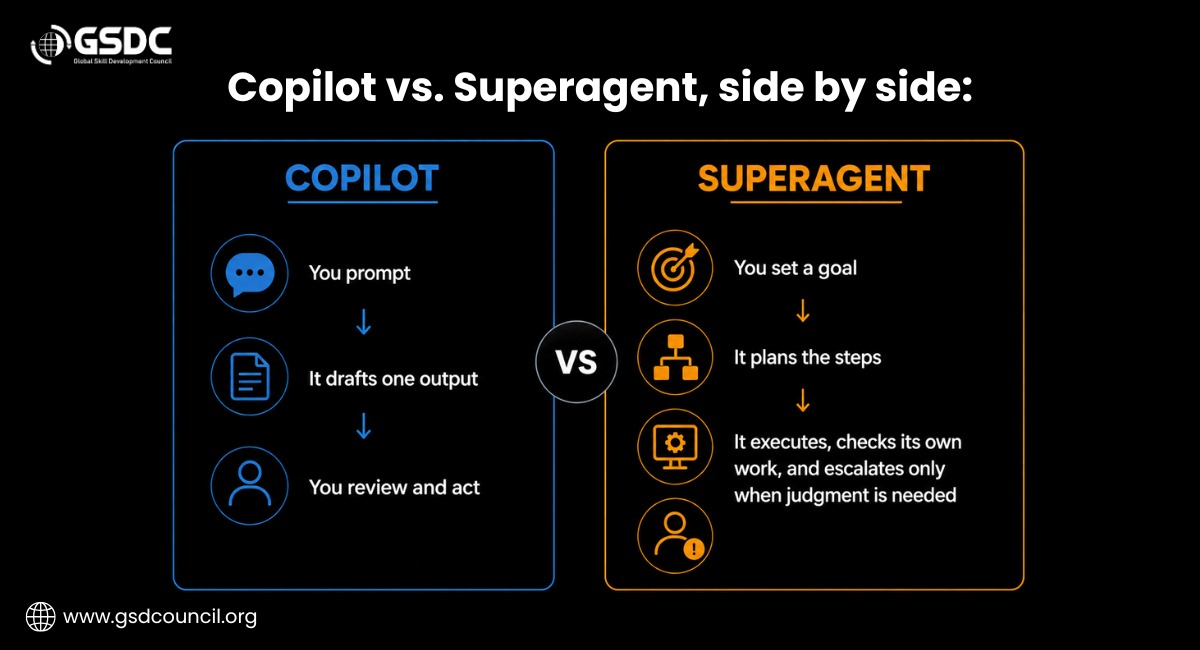
Quick definition: Agentic AI is AI that pursues a goal rather than responding to a single prompt. Instead of producing one output and stopping, it plans a sequence of steps, chooses which tools to use, checks its own progress, and only pauses for a human when a decision genuinely needs judgment or approval.
That's the practical answer to what is agentic AI and how will it change work. Instead of "draft this email," the instruction becomes "fill this open role" or "onboard this new hire" - and the system works through everything in between: sourcing, scheduling, follow-ups, documentation, and escalation when something falls outside its confidence range.
Industry researchers, including analysis from The Josh Bersin Company, describe this shift as HR moving from copilots that assist a human to "superagents" that run entire workflows end-to-end, with a person checking in rather than driving each step. That reframing is landing fast: a CNBC Workforce Executive Council survey of senior HR leaders found that 89% expect AI to reshape jobs in 2026, with about 45% expecting it to affect half or more of all roles.
HR AI Agents vs. Chatbots: What's the Real Difference?
It's easy to lump every AI tool into one bucket, but hr ai agents and traditional chatbots solve different problems:
Traditional Chatbot | HR AI Agent | |
Trigger | Responds to a single question | Pursues a defined goal |
Scope | One task, one exchange | Multi-step workflow across systems |
Memory | Little to none between sessions | Retains context across the process |
Decision-making | Follows a fixed script | Adapts, reprioritises, escalates when needed |
Example | Answers "how many PTO days do I have?" | Runs the full leave-request workflow: checks eligibility, updates the calendar, notifies the manager, logs the record |
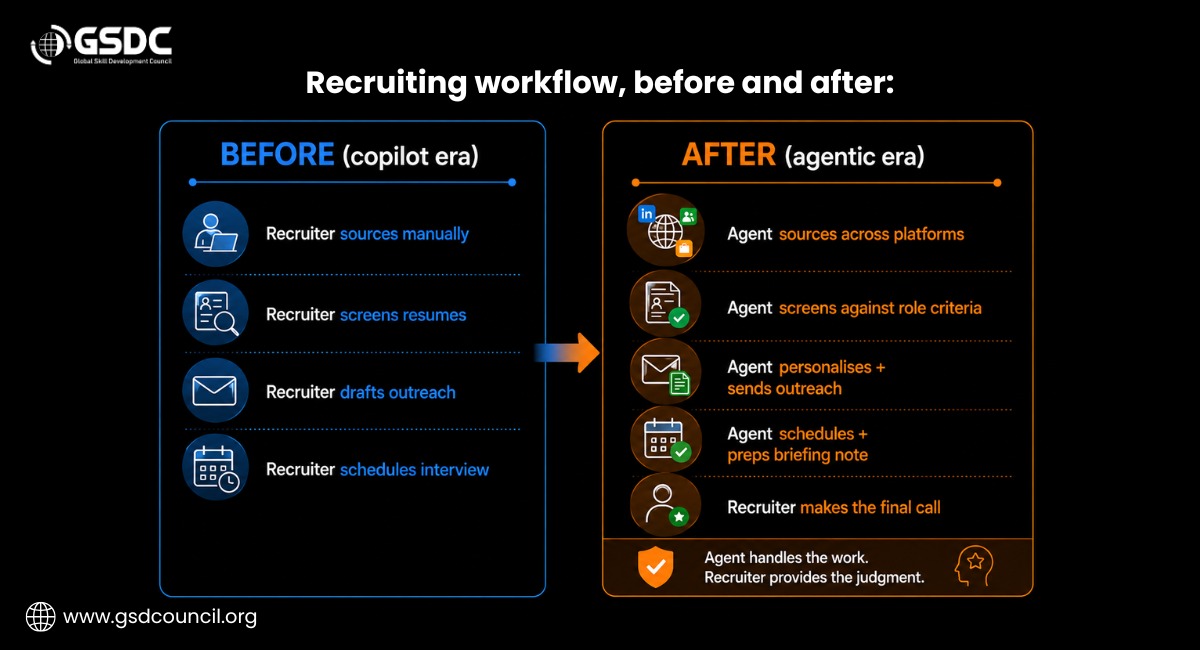
An AI recruiting chatbot, for instance, might answer a candidate's questions about a role. An AI recruiting agent goes further - it sources candidates, screens them against role criteria, personalises outreach, schedules interviews, and preps a briefing note for the hiring manager, largely without a human touching each step. It's this jump - from answering questions to owning a workflow - that organizations like the Global Skill Development Council (GSDC) l flag as the real skills gap in HR teams right now: most recruiters were trained to manage chatbots, not to design and oversee agents.
Real-World Agentic AI Use Cases in HR
Here's where this stops being theoretical. These are live ai in hr examples, not lab demos:
Recruiting.
This is the most mature use case today. Some multiagent recruiting systems now handle sourcing, screening, and scheduling end to end, cutting time-per-hire by as much as 80% in reported deployments. If you're wondering how to use AI for recruiting responsibly, the pattern that works best is: start with a single bounded stage (sourcing or initial screening), keep a human checkpoint at the offer stage, and feed the system clean, well-structured job and competency data.
Employee services.
AI-powered service platforms are now handling millions of employee interactions a year - resolving routine HR queries and case work without a human touch, while reportedly reducing voluntary turnover and speeding up resolution times.
Onboarding.
One of the clearest agentic ai use cases in hr, because onboarding spans multiple disconnected systems (IT provisioning, payroll setup, training assignments) that used to require manual handoffs between departments.
Workforce planning and HR analytics.
This is where ai in hr analytics gets genuinely strategic. Instead of a static headcount report, agentic systems can model how work splits between people and AI, forecast skill gaps, and run "what-if" scenarios - shifting HR analytics from reporting on the past to anticipating what's next.
Performance and decision support.
Emerging agentic ai solutions for hr decision-making help surface patterns across large volumes of performance data that would be nearly impossible for a person to catch manually - while leaving the actual judgment calls (promotions, terminations, compensation) with a human reviewer.
A quick look at where the value is concentrated, based on McKinsey's research:
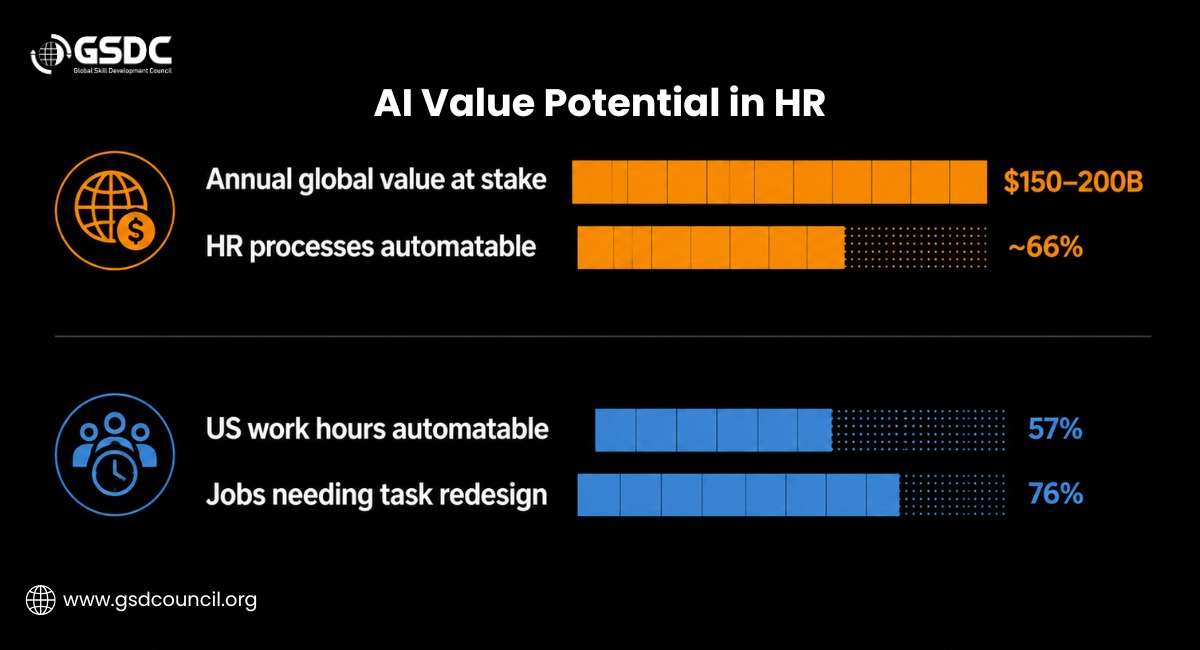
That last figure is the one worth sitting with. Only a small share of jobs are fully automatable - but a much larger share (76%) fall into what McKinsey calls a "messy middle": not replaceable, but in real need of redesign. That's the practical reality behind most ai use cases in hr today.
More AI in HR examples worth knowing:
Beyond recruiting and onboarding, agentic systems are showing up in less-discussed corners of HR too:
- Payroll anomaly detection - flagging unusual pay runs or compliance risks before they reach an employee's paycheck
- Learning recommendations - suggesting personalised upskilling paths based on role, performance, and skill gaps
- Performance review drafting - pulling together a first-draft narrative from goals, feedback, and project data for a manager to refine
- Succession planning - modelling internal readiness for key roles and flagging gaps before they become urgent
- Internal talent mobility - matching employees to open internal roles based on skills rather than job title alone
- Compensation benchmarking - cross-referencing internal pay data against market rates in real time
- Employee engagement analysis - synthesising survey, sentiment, and attrition data into a coherent read on team health
10 Popular AI Tools for HR in 2026
If you're evaluating hr ai tools for your own stack, here's where the market currently stands:
Tool | Best For |
Workday Illuminate | AI embedded directly in Workday's core HCM platform |
Eightfold AI | Talent intelligence, skills-based hiring, and internal mobility |
Paradox (a Workday company) | Conversational, high-volume hourly and frontline hiring |
HireVue | AI-assisted video interviews and structured assessments |
SAP Joule | Agent-based workflows across SAP SuccessFactors (payroll, hiring, workforce planning) |
Microsoft Copilot | General HR productivity - drafting, summarising, and meeting notes inside Microsoft 365 |
Lattice | AI-assisted performance management and reviews |
HiBob | HRIS with AI-assisted people analytics for mid-market teams |
Visier | Predictive workforce analytics and planning |
Leena.ai | AI-powered employee service agent for HR case resolution |
Vendor capabilities move fast - worth a quick check against each provider's current documentation before publishing, since features and pricing shift often in this market.
Benefits of AI in HR
Pulling from what's actually being reported by early adopters, the benefits of AI in HR tend to cluster around four areas:
- Speed - meaningfully shorter time-to-hire and faster case resolution
- Consistency - fewer manual errors in high-volume, rules-heavy work like payroll and benefits
- Capacity - HR teams freed up from administrative load to focus on culture and leadership development
- Sharper decisions - analytics surfacing patterns a person reviewing hundreds of cases would likely miss
The honest caveat: none of this is automatic. McKinsey's research notes that for every dollar spent on the AI technology itself, organisations typically need to invest several times that amount in the process redesign, data cleanup, and governance that let the technology actually create value. Buying the tool is the easy part - rebuilding the workflow around it is the real work.
Will AI Replace Human Resources?
This is the question most people are quietly Googling, so it deserves a direct answer: no - but the shape of the job changes.
The Josh Bersin Company's research puts a specific number on it: CEO Josh Bersin says agents and superagents could eliminate up to 30% of traditional HR roles - not 30% of HR as a function, but the transactional, administrative roles built around processing and routing. Notably, the firm frames this as a shift in role count, not a straight headcount cut: some roles disappear while new ones - like HR application developers who build and manage their own agents - emerge in their place. Roles built around judgment, negotiation, culture, and governance aren't disappearing - they're becoming more central, not less.
McKinsey's research frames the emerging structure around a few new archetypes:
- Builders - who create and maintain the AI systems
- Orchestrators - who design and oversee human-agent workflows, deciding where automation belongs and where human judgment stays essential
- Strategists - who focus on higher-order problem-solving that agents can't replicate
So the more accurate framing isn't "AI replacing HR" - it's HR redefining what its own roles are for.
Skills HR Professionals Need Now
If the job is shifting from doing tasks to orchestrating agents, the skills that matter shift too. Based on how the market is evolving, five capabilities stand out:
- AI literacy - understanding what agentic AI can and can't do, without needing to code it yourself
- Workflow design - mapping which parts of a process should go to a human vs. an agent
- Governance and data judgment - setting decision rights, escalation paths, and bias checks before scaling any AI system
- HR analytics fluency - reading and acting on the kind of predictive, scenario-based data agentic systems now produce
- Change leadership - helping employees and managers adapt as their own workflows change around them
None of these require a technical background. They require deliberate upskilling - which is exactly the gap most HR teams are currently facing.
How GSDC Certifications Can Prepare You for This Shift
As HR evolves from managing people to managing human-AI collaboration, professionals need new capabilities in AI literacy, governance, workflow design, and analytics - these skills don't build themselves through on-the-job exposure alone. The Global Skill Development Council offers a structured way to build them deliberately, rather than catching up after the shift has already happened around you.
A good starting point is the Certified Agentic AI HR Professional - built for professionals still at the copilot stage, covering prompt design, content generation, and how to get real ROI out of drafting and summarisation tools before moving further into agentic workflows.
Whichever stage you're at - still relying on copilots or beginning to explore agentic workflows - the underlying skill gap is the same: understanding how to design and oversee systems that make decisions, not just produce content.
The Bottom Line
Agentic AI won't replace HR professionals - it will redefine what makes them valuable. As AI takes over repetitive coordination and administrative work, the most successful HR leaders will focus on strategy, culture, ethics, workforce planning, and AI governance. Those who understand how to work alongside AI agents, rather than around them, will be the ones positioned to lead the next generation of HR.

Related Certifications
Frequently Asked Questions
Generative AI drafts something when you ask it to -a job description, a policy summary -and then it stops and waits for you. Agentic AI doesn't wait. Give it a goal like "fill this role" and it plans the steps, works through them, and only comes back to you when something needs a human call. Think of one as a very fast writer and the other as someone you can actually delegate to.
Short answer: no, not the profession itself. Some roles will shrink -especially the ones built around routing, processing, and scheduling -but the work that depends on judgment, negotiation, and reading a room isn't going anywhere. If anything, that side of HR becomes more valuable once the admin work gets handed off. The honest way to think about it is less "replacement" and more "reshuffling."
More than you'd guess. Recruiting agents that source, screen, and schedule without much hand-holding. Onboarding systems that coordinate IT setup, payroll, and training in one go instead of five separate emails. There's also quieter stuff happening in the background -payroll anomaly checks, performance review drafts, succession planning models. None of it makes headlines, but it's the part doing the heavy lifting.
It used to be. The shift now is from "here's what happened last quarter" to "here's what's likely to happen next quarter, and here's why." Instead of a static headcount report, you get systems that can model how work splits between people and AI, flag skill gaps before they become a problem, and run what-if scenarios on workforce planning. It's a genuinely different use of the same data.
Don't hand it your whole hiring funnel on day one -that's how trust breaks fast. Start with one narrow stage, usually sourcing or first-pass screening, where the decision space is smaller and mistakes are cheap to catch. Keep a person involved at the offer stage no matter what. And feed it clean data -a recruiting assistant is only as sharp as the job requirements and candidate criteria you give it.
Stay up-to-date with the latest news, trends, and resources in GSDC
If you like this read then make sure to check out our previous blogs: Cracking Onboarding Challenges: Fresher Success Unveiled
Not sure which certification to pursue? Our advisors will help you decide!