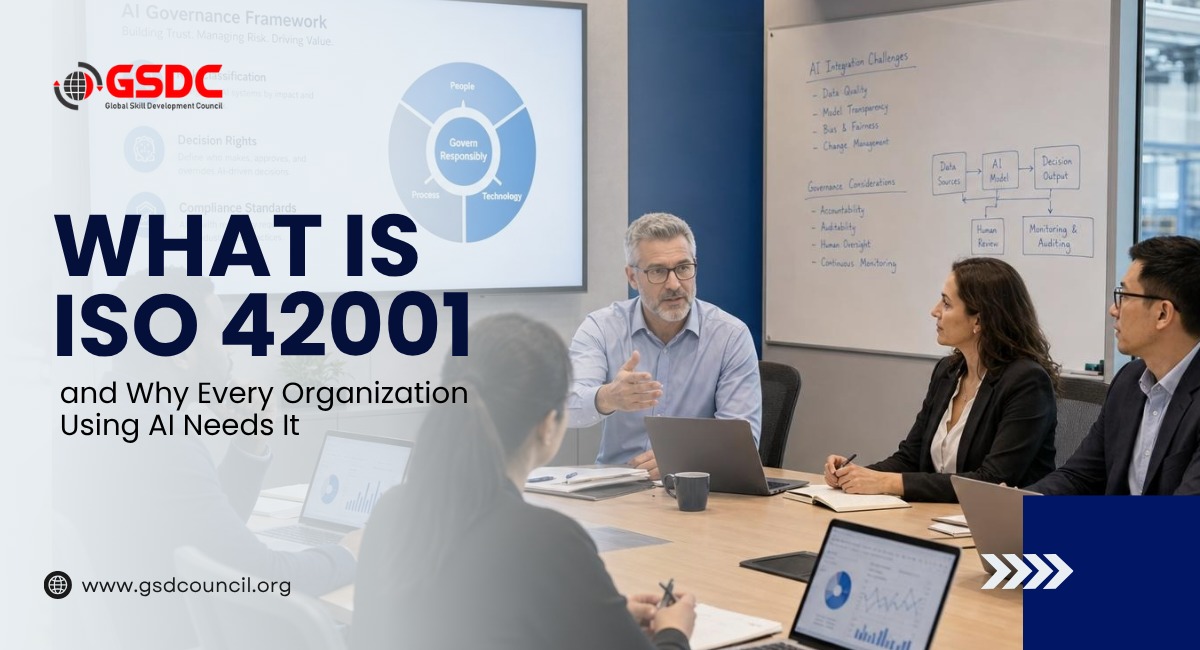
What Is ISO 42001 and Why Every Organization Using AI Needs It
Written by Matthew Hale
Artificial intelligence is changing the way organizations work. It is helping businesses automate tasks, improve customer service, analyze data, and make faster decisions. Today, AI is used in industries such as healthcare, banking, retail, manufacturing, education, and many others.
As organizations continue to adopt AI, they also face new challenges. AI systems must be secure, transparent, fair, and reliable. They should protect sensitive information, reduce risks, and support responsible decision-making. Without proper governance, AI can create problems such as biased outcomes, data privacy issues, security risks, and regulatory non-compliance.
This is why organizations need a structured way to manage AI throughout its lifecycle. ISO 42001 provides that structure. It is the world's first international standard for an AI management system, helping organizations establish effective AI governance, manage risks, and improve compliance.
In this guide, you will learn what ISO 42001 is, why it is important, its benefits, how organizations can implement it, and how professionals can build their careers by becoming certified ISO 42001 Lead Auditors.
What Is ISO 42001?
ISO 42001 is the first international standard developed specifically for managing artificial intelligence. Published by the International Organization for Standardization (ISO), it provides organizations with a framework for establishing, implementing, maintaining, and continuously improving an AI management system.
The purpose of ISO 42001 is to help organizations use AI responsibly while reducing risks and meeting legal, ethical, and business requirements.
The standard focuses on creating clear governance processes for AI systems. It encourages organizations to define policies, assign responsibilities, assess risks, maintain documentation, monitor AI performance, and continuously improve their governance practices.
Unlike technical AI standards that focus only on building AI models, ISO 42001 focuses on how organizations manage AI throughout its entire lifecycle. It supports important areas such as AI governance, AI risk management, AI ethics, Responsible AI, and AI governance compliance.
Organizations of all sizes can implement ISO 42001, regardless of their industry or the type of AI solutions they use. Whether an organization develops AI applications or uses AI tools from external providers, the standard helps ensure AI is managed in a responsible and structured manner.
What Is an AI Management System?
An AI management system is a structured set of policies, processes, procedures, and controls that helps an organization manage artificial intelligence responsibly.
Just as organizations use management systems for quality, information security, or environmental management, an AI management system provides a consistent approach for governing AI technologies.
An effective AI management system helps organizations:
- Define AI governance policies.
- Assign clear roles and responsibilities.
- Identify and manage AI risks.
- Protect sensitive data.
- Maintain documentation.
- Monitor AI systems regularly.
- Improve governance processes over time.
- Support regulatory and legal compliance.
An AI management system is not only about controlling technology. It also helps organizations build trust among customers, employees, regulators, and business partners by ensuring AI systems are transparent, reliable, and accountable.
ISO 42001 provides the framework organizations need to build and maintain an effective AI management system.
Why Every Organization Using AI Needs ISO 42001
Organizations are using AI to improve efficiency and make better decisions. However, without proper governance, AI can introduce new risks that affect business operations, customer trust, and regulatory compliance. ISO 42001 helps organizations establish a structured approach to managing these challenges.
Here are some of the main reasons why every organization using AI should implement ISO 42001.
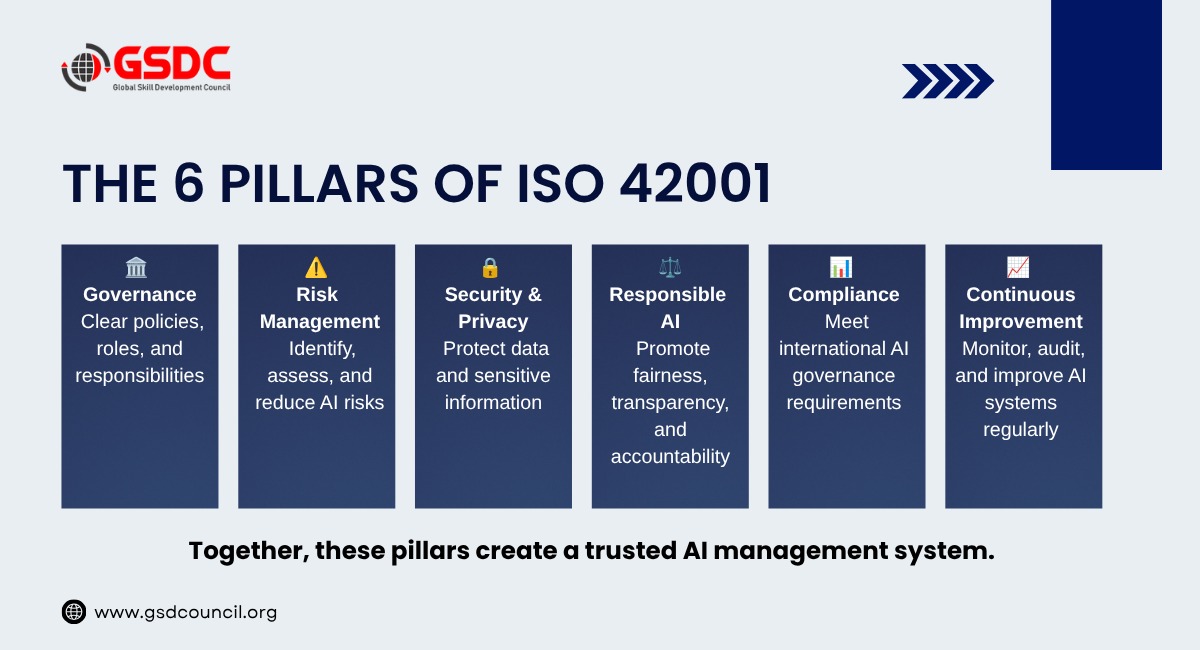
1. It Helps Build Strong AI Governance
One of the biggest advantages of ISO 42001 is that it helps organizations establish a strong and structured AI governance framework. As AI is adopted across different departments, it becomes important to have consistent rules and processes for developing, using, and monitoring AI systems. ISO 42001 provides guidance for creating AI governance policies, assigning clear roles and responsibilities, and defining how AI systems should be managed throughout their lifecycle. This ensures that every AI project follows the same governance standards, regardless of the team involved. A well-defined governance framework improves accountability, supports better decision-making, reduces operational risks, and helps organizations maintain responsible and consistent AI practices.
2. It Improves AI Risk Management
Every AI system comes with certain risks that can affect an organization's operations if they are not properly managed. These risks may include inaccurate predictions, biased outcomes, data privacy concerns, security vulnerabilities, or failures caused by poor-quality data. ISO 42001 provides a structured approach to AI risk management by helping organizations identify potential risks, evaluate their impact, and implement controls to reduce them. It also encourages regular monitoring and periodic risk assessments so that new risks can be detected early. By managing risks proactively, organizations can improve the reliability of their AI systems, protect sensitive information, and ensure that AI continues to support business objectives safely and responsibly.
3. It Supports Regulatory Compliance
As the use of artificial intelligence continues to grow, governments and regulatory bodies are introducing new laws and guidelines to ensure AI is used responsibly. Organizations must be able to demonstrate that their AI systems follow these requirements and operate in a transparent and accountable manner. ISO 42001 supports AI governance compliance by providing a structured framework that aligns with internationally recognized best practices. It helps organizations establish clear policies, maintain proper documentation, perform regular risk assessments, and monitor AI systems effectively. Following ISO 42001 makes it easier to prepare for regulatory reviews, internal assessments, and external audits while reducing the risk of non-compliance.
4. It Promotes Responsible AI
Organizations are expected to use AI in a way that is fair, transparent, and accountable. Customers, employees, regulators, and business partners want confidence that AI systems make reliable decisions without creating unnecessary risks or unfair outcomes. ISO 42001 encourages organizations to adopt Responsible AI practices by establishing governance processes that promote transparency, accountability, fairness, and human oversight throughout the AI lifecycle. It also encourages regular monitoring and continuous improvement to ensure AI systems remain trustworthy over time. By following these practices, organizations can build confidence in their AI systems while supporting ethical and responsible decision-making.
5. It Protects Sensitive Information
AI systems often process large amounts of customer, employee, financial, and business data. If this information is not properly protected, it can lead to privacy violations, security breaches, and loss of customer trust. ISO 42001 helps organizations establish strong controls for protecting sensitive information throughout the AI lifecycle. It encourages the development of policies for data protection, access management, secure data handling, and privacy compliance. Organizations are also encouraged to monitor how data is collected, stored, and used within AI systems. These practices reduce security risks, protect confidential information, and help organizations maintain a secure and reliable AI management system.
6. It Improves Decision-Making
Many organizations rely on AI to support important business decisions. However, AI can only provide reliable results when it is properly managed and monitored. ISO 42001 helps organizations improve decision-making by encouraging regular monitoring of AI systems, validating model performance, reviewing outputs, and updating models when needed. It also promotes proper documentation and continuous evaluation to ensure AI systems remain accurate and effective over time. By following these governance practices, organizations can make informed business decisions based on reliable information while reducing the risk of errors, inconsistencies, and poor outcomes.
7. It Builds Customer and Stakeholder Trust
Trust plays an important role in the successful adoption of artificial intelligence. Customers, investors, regulators, and business partners want to know that AI systems are secure, transparent, and used responsibly. When organizations implement ISO 42001, they demonstrate their commitment to following recognized AI governance practices and managing AI in a structured and accountable way. The standard encourages organizations to establish clear policies, monitor AI performance, manage risks, and maintain proper documentation. These efforts help build confidence among stakeholders by showing that AI systems are reliable, ethical, and aligned with international best practices, ultimately strengthening the organization's reputation.
8. It Encourages Continuous Improvement
Artificial intelligence is constantly evolving, and organizations need to ensure their governance practices evolve as well. ISO 42001 promotes a culture of continuous improvement by encouraging organizations to regularly review their AI management system, monitor AI performance, conduct internal audits, and update governance policies whenever needed. It also helps organizations evaluate lessons learned from audits, risk assessments, and operational experiences to improve their processes over time. By continuously improving their AI governance framework, organizations can adapt to changing technologies, address new risks, meet evolving regulatory requirements, and ensure their AI systems remain effective, secure, and compliant.
How to Implement ISO 42001
Implementing ISO 42001 does not happen overnight. It requires planning, collaboration, and continuous improvement. Following a structured approach helps organizations build an effective AI management system while supporting long-term compliance.
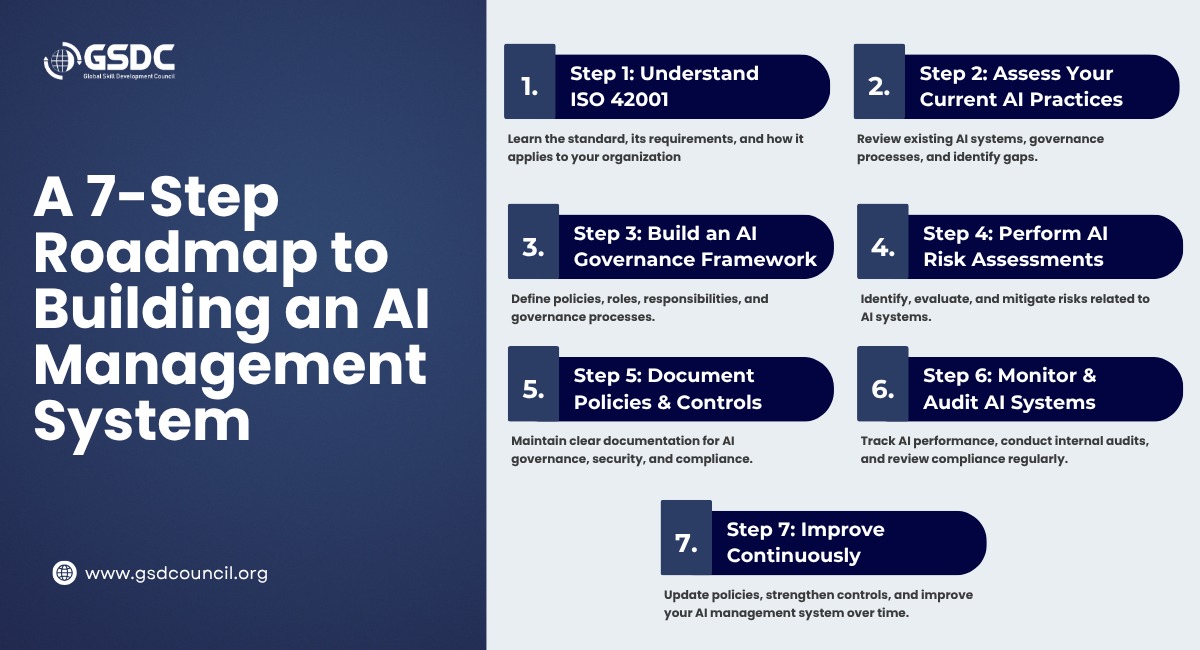
Step 1: Understand the Requirements
Start by learning the requirements of ISO 42001 and understanding how they apply to your organization. Review the standard carefully and identify the areas that need improvement.
Step 2: Assess Your Current AI Practices
Evaluate how AI is currently being used across the organization. Review existing governance processes, policies, documentation, security controls, and AI risk management practices. This assessment helps identify gaps that need to be addressed.
Step 3: Establish an AI Governance Framework
Create a clear AI governance framework that defines policies, responsibilities, governance processes, and approval procedures. The framework should also include risk management, documentation, monitoring, and continuous improvement activities.
Step 4: Develop Policies and Procedures
Document the organization's AI governance policies and operating procedures. These documents should explain how AI systems are developed, tested, deployed, monitored, maintained, and reviewed throughout their lifecycle.
Step 5: Perform AI Risk Assessments
Identify potential risks associated with AI systems and evaluate their impact on the organization. Risk assessments should cover areas such as security, privacy, fairness, compliance, data quality, and operational performance.
Step 6: Train Employees
Everyone involved in AI projects should understand the organization's governance policies and responsibilities. Regular training helps employees follow governance processes consistently while reducing compliance risks.
Step 7: Monitor and Improve
Once the AI management system is implemented, organizations should continuously monitor AI performance, review governance processes, conduct internal audits, and update policies whenever necessary. Continuous improvement is one of the key principles of ISO 42001.
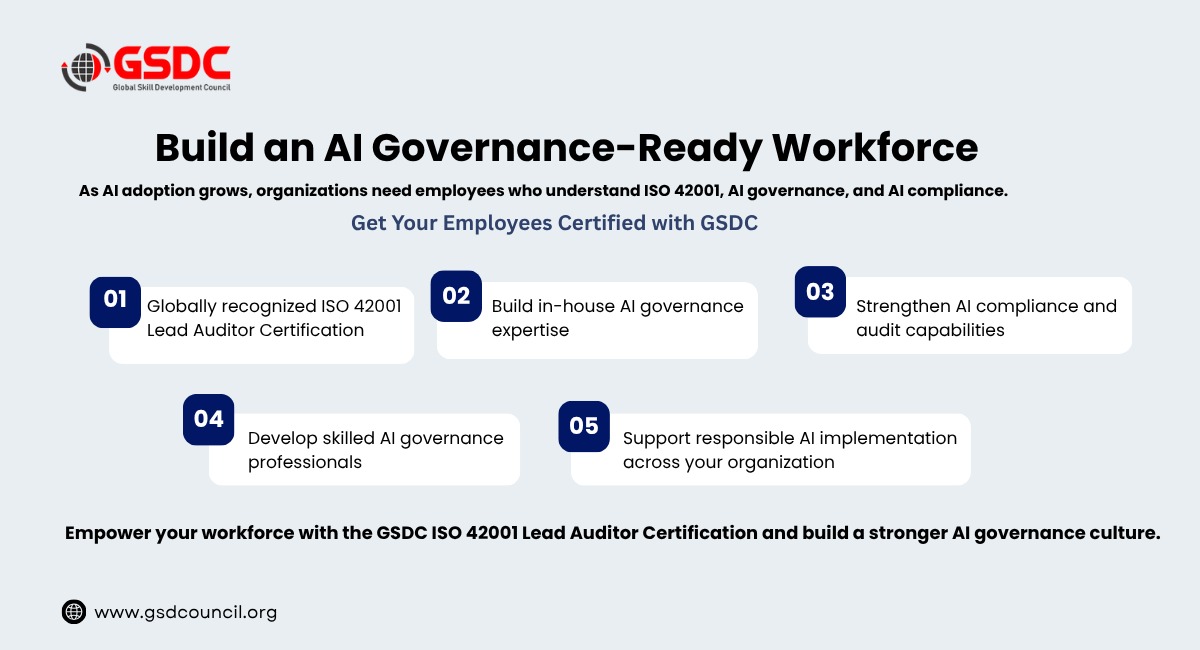
Certify Your Employees in ISO 42001 with GSDC
Implementing ISO 42001 is not only about creating policies and processes. Your employees also need the knowledge to understand AI governance, AI risk management, and the requirements of an AI management system.
One of the best ways to build these capabilities is by getting your employees certified. A certified workforce understands international best practices and can contribute more effectively to implementing and maintaining ISO 42001 across the organization.
The GSDC ISO 42001 Lead Auditor Certification helps professionals develop practical knowledge of AI governance, AI governance audits, compliance requirements, and audit methodologies based on the ISO 42001 standard. The program is available for individuals and also supports organizations that want to certify multiple employees.
Why Certify Your Employees with GSDC?
- Build organization-wide knowledge of ISO 42001 and AI governance.
- Develop internal expertise in AI governance audits and compliance.
- Create a common understanding of AI governance policies and controls.
- Help teams identify and manage AI risks more effectively.
- Strengthen your organization's AI governance capabilities.
- Demonstrate your commitment to responsible AI and international best practices.
- Equip employees with a globally recognized ISO 42001 Lead Auditor Certification.
Whether your teams work in AI, compliance, risk management, cybersecurity, quality management, or internal auditing, certifying them with GSDC can help your organization build the skills needed to support responsible AI adoption and long-term governance.

Related Certifications
Frequently Asked Questions
ISO 42001 is the world's first international standard for an AI management system. It provides a structured framework that helps organizations establish AI governance, manage AI risks, improve compliance, and ensure the responsible use of artificial intelligence.
As organizations increasingly rely on AI, they need a structured approach to manage risks, protect data, and maintain compliance. ISO 42001 helps organizations build a strong AI governance framework, improve decision-making, and demonstrate their commitment to responsible AI practices.
An AI management system is a set of policies, processes, and controls that helps organizations manage AI throughout its lifecycle. It supports AI governance, risk management, compliance, monitoring, and continuous improvement.
Implementing ISO 42001 helps organizations strengthen AI governance, improve AI risk management, enhance regulatory compliance, protect sensitive information, build stakeholder trust, and establish a culture of continuous improvement.
ISO 42001 is suitable for any organization that develops, deploys, or uses AI. It is beneficial for technology companies, healthcare providers, financial institutions, manufacturers, retailers, government organizations, educational institutions, and any business looking to strengthen its AI governance practices.
Professionals looking to build expertise in AI governance and auditing can benefit from the GSDC ISO 42001 Lead Auditor Certification. The certification provides practical knowledge of ISO 42001 requirements, AI governance frameworks, AI risk management, compliance, and auditing techniques, making it valuable for auditors, compliance professionals, AI specialists, and consultants.
Yes. Organizations can strengthen their AI governance capabilities by certifying employees through the GSDC ISO 42001 Lead Auditor Certification. A certified workforce develops a common understanding of AI governance, compliance, risk management, and audit best practices, helping organizations build stronger internal expertise.
ISO 42001 provides a structured management system that helps organizations establish governance policies, perform AI risk assessments, maintain documentation, monitor AI systems, and continuously improve their processes. These practices support better AI governance compliance and prepare organizations for internal and external audits.
The GSDC ISO 42001 Lead Auditor Certification is a valuable credential for professionals who want to advance their careers in AI governance. It helps build practical auditing skills, deepen knowledge of ISO 42001 requirements, and demonstrate expertise in AI governance, compliance, and risk management. It is also recognized globally, making it a strong addition to a professional's credentials.
Organizations can begin by understanding the requirements of ISO 42001, assessing their current AI practices, establishing an AI governance framework, performing AI risk assessments, and implementing an AI management system. To further strengthen internal expertise, organizations can also encourage their teams to earn the GSDC ISO 42001 Lead Auditor Certification, helping them apply international best practices in AI governance and compliance.
Stay up-to-date with the latest news, trends, and resources in GSDC
If you like this read then make sure to check out our previous blogs: Cracking Onboarding Challenges: Fresher Success Unveiled
Not sure which certification to pursue? Our advisors will help you decide!