Agentic AI Hiring Boom: What a 280% Rise in Jobs Means for Your Career
Written by Matthew Hale
- What Is Agentic AI, and Why Is It Different From "Regular" AI?
- So, What Is an AI Engineer (And How Is an Agentic AI Engineer Different)?
- What Does an Agentic AI Job Description Actually Look Like?
- Skills Required for an Agentic AI Engineer
- Agentic AI Engineer Salary: What the Market Is Actually Paying
- Where the Jobs Are: Remote Roles, Developer Positions, and Global Demand
- The Tools Shaping This Field
- Building an Agentic AI Career: A Realistic Learning Path
- How to Prove You Have These Skills
- The Bottom Line
A year ago, "agentic AI" barely showed up on any recruiter's radar. Today, it's one of the fastest-growing job categories in tech, and the numbers back it up in a way that's hard to ignore.
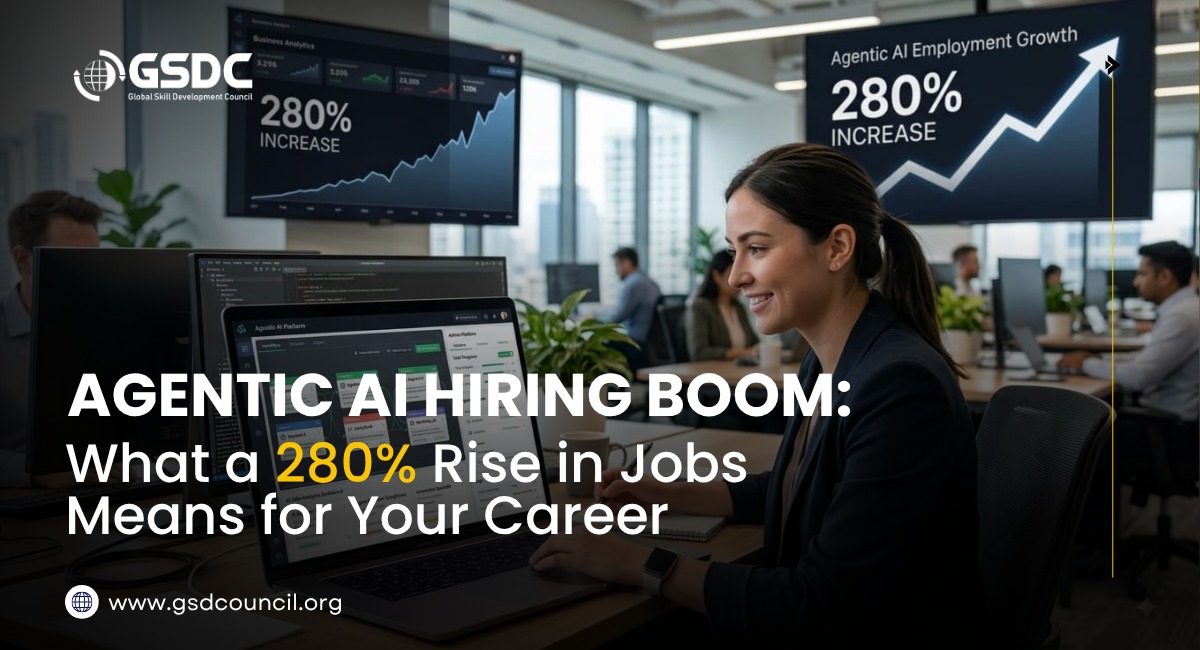
According to the Stanford HAI 2026 AI Index, produced with labor-market data from Lightcast, postings asking for agentic AI skills grew from just 0.06% of all job listings in 2024 to 0.23% in 2025. That's a jump of more than 280% in a single year, and it works out to roughly 90,000 new job postings in the US alone. Put that next to the wider trend - AI skills of any kind now show up in about 2.5% of all US job postings, up 55% from the year before - and agentic AI is clearly growing several times faster than AI hiring overall.
If you're an engineer, a computer science student, or someone thinking about a career pivot, this isn't just an interesting statistic. It's a signal about where the next five years of tech hiring are headed. Let's break down what's actually happening, what companies are hiring for, and what it means for your career.
What Is Agentic AI, and Why Is It Different From "Regular" AI?
Most people's first experience with AI was a chatbot: you type a question, it types back an answer. That's useful, but it's passive. The AI waits for you.
Agentic AI flips that around. Instead of just answering questions, an AI agent can plan a multi-step task, use tools like APIs or databases, check its own work, and take actions on its own to reach a goal, booking something, updating a record, running a script, coordinating with other agents, and so on. Think of the difference between a calculator and an assistant who actually finishes your to-do list while you're at lunch.
This shift is exactly what shows up in the hiring data - companies aren't just experimenting with AI anymore; they're building it into how work actually gets done, and that requires a different, more specialized kind of engineer.
So, What Is an AI Engineer (And How Is an Agentic AI Engineer Different)?
The title means different things depending on who's hiring.
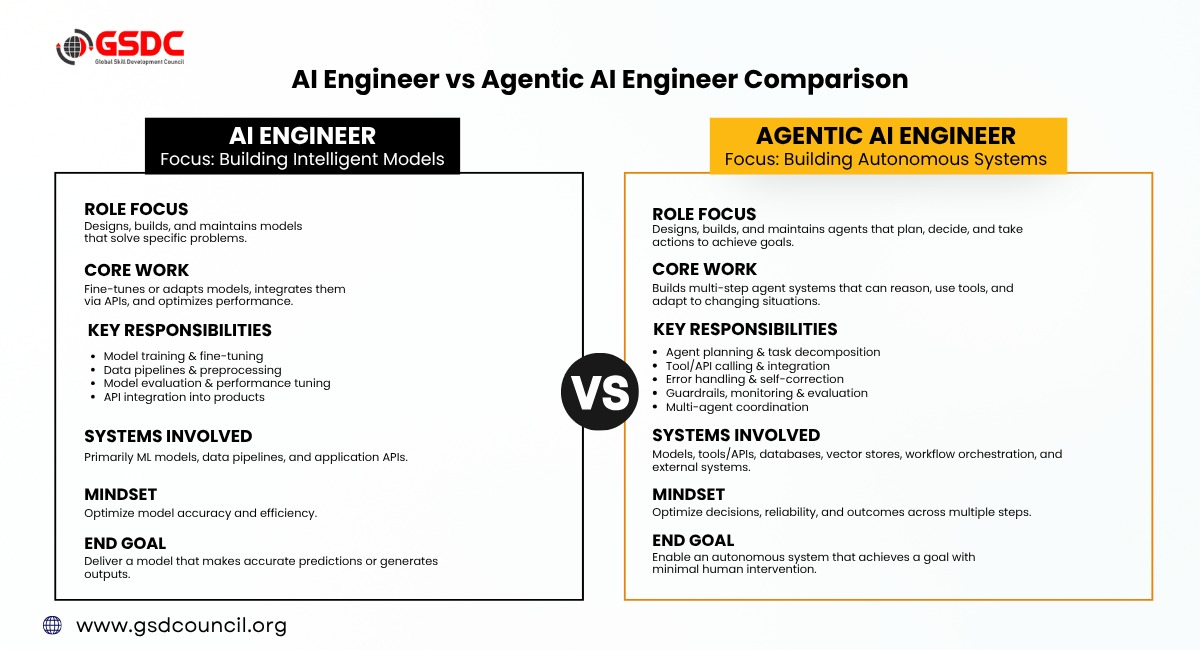
A general AI engineer designs, builds, and maintains systems that use machine learning or large language models to solve a business problem. The work usually looks like:
- Fine-tuning or adapting an existing model for a specific use case
- Wiring that model into a product through an API
- Handling data pipelines, evaluation, and performance tuning
An agentic AI engineer takes that a step further. Instead of a model that responds once and stops, you're building a system that has to think in steps:
- Retrieving information it needs before it can act
- Calling external tools or APIs on its own
- Checking its own output for errors
- Adjusting its plan when something doesn't go as expected
In practical terms, agentic AI roles sit somewhere between traditional software engineering, machine learning engineering, and systems/DevOps work. That's part of why demand has grown so fast it's not a niche add-on skill anymore; it's becoming its own discipline, one that's already starting to get its own dedicated training paths, like the Agentic AI Professional Certification, rather than being treated as an extension of general AI engineering.
What Does an Agentic AI Job Description Actually Look Like?
If you've searched for an "agentic AI job description" and found the listings a bit vague, you're not imagining it this is still a young field, and companies are still settling on standard titles. But underneath the different job titles (AI Agent Engineer, Agentic AI Developer, Autonomous Systems Engineer), the core responsibilities tend to repeat:
- Designing and building AI agents that can plan tasks and use external tools or APIs
- Working with agent frameworks to coordinate multiple agents on a shared goal
- Setting up guardrails, evaluation systems, and monitoring so agents behave safely and predictably
- Integrating agents into existing business systems (CRMs, internal databases, customer support platforms)
- Debugging and improving agent decision-making when it goes off track
- Collaborating with product and data teams to define what "success" looks like for an autonomous system
Compare that to a general AI engineer job description, which usually focuses more narrowly on model training, fine-tuning, and API integration. Agentic roles ask for a broader systems mindset. You're not just building a model; you're building something closer to a small digital employee.
Skills Required for an Agentic AI Engineer
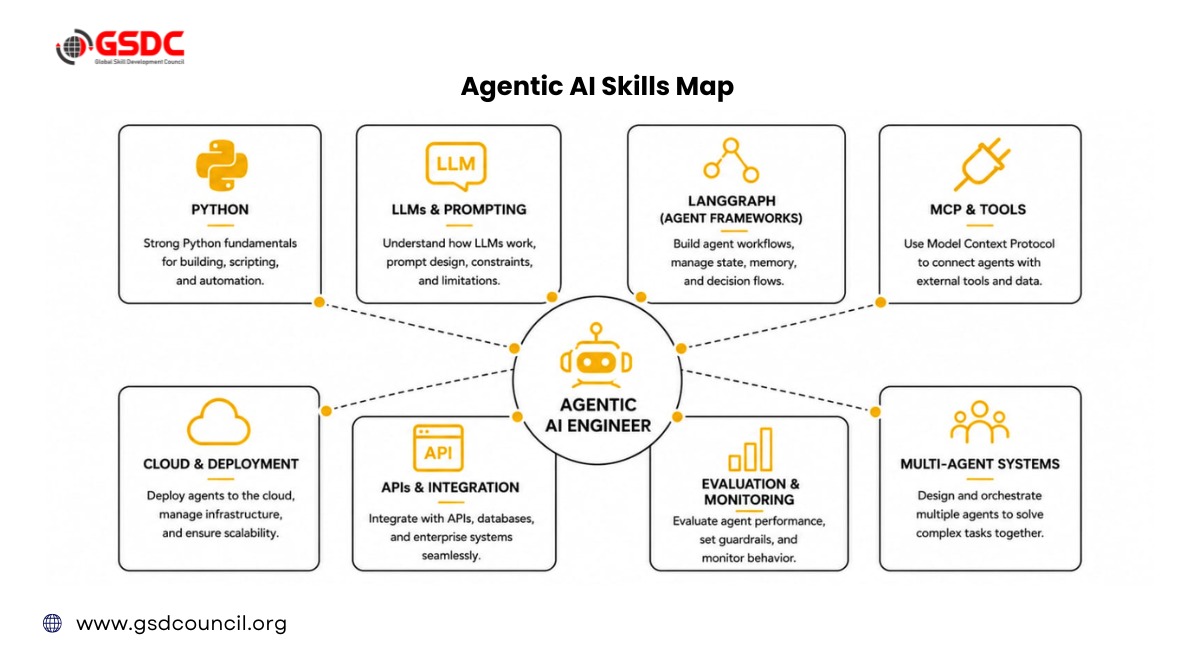
If you're mapping out what to learn, here's where to focus. The Stanford AI Index notes that AI hiring has shifted from "exploring the technology" toward "running it in production" - Python remains the single most requested technical skill across AI postings, with demand for it growing nearly 30% in the past year alone, increasingly paired with cloud deployment and workflow orchestration experience. Here are the agentic AI skills and AI engineer requirements showing up most consistently in job postings and hiring guides right now.
Core technical skills:
- Strong Python fundamentals (still the most in-demand language in AI hiring by a wide margin)
- Experience with agent frameworks such as LangChain, LangGraph, or similar orchestration tools
- Familiarity with the Model Context Protocol (MCP) and how agents connect to external tools
- Working knowledge of large language models and prompt design
- API integration and workflow automation
- Basic cloud deployment skills (AWS, Azure, or GCP)
Systems and reasoning skills:
- Multi-agent coordination - getting several agents to work together without stepping on each other
- Evaluation and testing methods for non-deterministic systems (agents don't always behave the same way twice)
- Debugging decision chains, not just code
Soft skills that quietly matter a lot:
- Breaking a fuzzy business problem into steps an agent can actually execute
- Communicating risk and limitations clearly to non-technical stakeholders
- Comfort with ambiguity, since best practices in this field are still being written
A useful way to think about it: a traditional software engineer optimizes code. An agentic AI engineer optimizes decisions. That's a different muscle, and it's part of why employers tend to favor candidates who've genuinely built and shipped agent-based systems, not just experimented with a demo. It's also why organizations like the Global Skill Development Council (GSDC) have started building structured programs around this exact skill set, rather than treating it as a footnote in a broader AI curriculum.
Agentic AI Engineer Salary: What the Market Is Actually Paying
This is one of the first things most people want to know, and the honest answer is: it depends heavily on level, employer, and location, but the overall picture looks well-paid.
According to Glassdoor's 2026 salary data, the average total pay reported for Agentic AI Engineer roles in the United States sits at roughly $147,000 to $193,000 per year, with a typical range between $115,000 and $247,000 depending on experience and employer, and senior engineers at top firms reaching well beyond that with equity factored in. That said, the title is barely a year or two old, and Glassdoor's figures are based on a small number of self-reported salaries. Take these numbers as an early, directional read rather than a settled benchmark.
Where the Jobs Are: Remote Roles, Developer Positions, and Global Demand
One encouraging thing about this hiring wave is that it isn't confined to Silicon Valley. Because agentic AI work is largely cloud-based and collaborative by nature, agentic AI jobs remote listings have become common across startups, mid-size SaaS companies, and enterprise AI teams alike.
You'll find the demand split roughly across a few categories:
- Agentic AI developer jobs - building and shipping the actual agent systems, often within product teams
- Agentic AI engineer jobs - a broader systems role covering architecture, deployment, and monitoring
- Agentic AI roles in specific industries - customer support automation, finance workflow agents, healthcare administrative agents, and internal IT/DevOps agents are among the fastest-growing use cases
Geographically, the Stanford AI Index data shows hiring concentrated in a handful of innovation hubs rather than spread evenly worldwide. Singapore currently has the highest share of AI job postings globally at 4.77%, with Hong Kong close behind. In the US, the highest concentration isn't in California or Texas; it's Washington, DC, where 4.46% of all postings call for AI skills, reflecting the region's dense mix of government, defense, and enterprise tech employers. Still, the underlying skill demand is genuinely global. Companies everywhere are trying to automate workflows, and agentic AI is becoming an increasingly common approach.
The Tools Shaping This Field
If you want a quick read on where the industry is heading, look at which agentic AI tools show up repeatedly across job postings and engineering teams:
- LangChain / LangGraph - for building and orchestrating multi-step agent workflows
- Model Context Protocol (MCP) - an emerging standard for connecting agents to external tools and data sources
- Vector databases (like Pinecone or Weaviate) - for giving agents memory and retrieval capability
- Cloud orchestration platforms - AWS, Azure, and GCP tooling for deploying agents at scale
- Evaluation and observability tools - for tracking how agents behave in production, since these systems don't act the same way every time
You don't need to master all of these at once. But familiarity with at least one agent framework and one deployment environment is quickly becoming a baseline expectation, not a bonus.
Building an Agentic AI Career: A Realistic Learning Path
If you're starting from a general software or data background, here's a grounded, step-by-step way to approach an agentic AI learning path without getting overwhelmed:
- Get genuinely comfortable with Python. Not just syntax, but how to build and structure real applications.
- Learn how large language models actually work, at least at a practical level: context windows, prompting, embeddings, and limitations.
- Build one small agent project end-to-end. A research assistant, a task automation bot, a data-lookup agent, something that plans, uses a tool, and produces a result.
- Learn one orchestration framework in depth rather than skimming five. LangGraph or a similar tool is a solid starting point.
- Study evaluation and safety practices. Employers care a lot about agents that fail predictably and safely, not just agents that work when everything goes right.
- Contribute to or shadow a real deployment, even a small one. This is where you learn what breaks in the real world versus a tutorial.
- Consider validating your skills through structured training or certification, especially if you're switching fields and don't yet have a portfolio to point to.
That last step is optional, but useful in a field this new. A portfolio of real projects is the strongest signal you can offer, and structured training can help you build one faster if you're starting from scratch.
How to Prove You Have These Skills
Because the agentic AI job market is expanding faster than formal training programs can keep up, there's often a gap between people who've read about agent frameworks and people who can actually demonstrate they've built one. A certification is one way to close that gap. It gives you a structured curriculum instead of piecing things together from scattered tutorials, and it gives candidates a clearer way to demonstrate foundational knowledge, particularly if you're transitioning into the field or don't yet have production experience to point to.
It's one option among several; a strong GitHub portfolio or a shipped side project can do similar work. But if you'd rather learn through a structured path than figure it out alone, this is exactly the gap the Global Skill Development Council (GSDC) built its Agentic AI Professional Certification to address. The program is designed around what employers are actually asking for in job postings right now: hands-on work with agent frameworks, real project builds, and practical grounding in deploying and monitoring autonomous systems responsibly, rather than certification-by-multiple-choice-quiz.

The Bottom Line
A 280% jump in agentic AI job postings in a single year isn't a fluke or a passing trend; it reflects a genuine shift in how companies want to use AI: not as a chatbot on the side, but as a system that gets real work done. For engineers, that opens a wide door. The field is new enough that there's still room to establish yourself as an expert, but structured enough that employers already know what skills they're looking for.
If you're weighing whether to invest time in this shift, the data makes a reasonably clear case: agentic AI hiring is accelerating fast, the early compensation data looks promising, and demand is spreading well beyond a handful of tech hubs. Engineers who start building real projects now and can back them up with credible, demonstrable skills are the ones best positioned to ride this wave rather than catch up to it later.

Related Certifications
Frequently Asked Questions
An AI engineer is someone who builds systems that use machine learning or language models to do something useful, recommend products, answer support questions, generate content, and so on. It's less about inventing new algorithms and more about taking existing AI models and turning them into something that actually works inside a real product or business process.
A standard AI engineering role usually focuses on a single task: training a model, fine-tuning it, or wiring it into an app through an API. Agentic AI roles go a step further: you're building systems that can plan several steps ahead, use outside tools on their own, and adjust when something doesn't go to plan. Think of it as the difference between building a smart feature and building something closer to a digital employee.
Python is still non-negotiable, along with a working knowledge of large language models and at least one agent framework like LangChain or LangGraph. Beyond the technical side, you need to be comfortable debugging a system that doesn't always behave the same way twice that reasoning skill matters as much as the code itself.
Based on current Glassdoor data, most agentic AI engineer roles in the US fall somewhere between $115,000 and $247,000 a year, with senior engineers at top firms earning more once equity is included. It's worth remembering the role is still new, so these numbers will likely shift as more companies post and fill positions.
If the hiring data is anything to go by, yes, GenAI postings grew over 280% in a single year, and demand is spreading well beyond a handful of tech hubs. The field is young enough that there's still real room to build a reputation, but structured enough that employers already have a clear idea of what skills they're looking for.
Stay up-to-date with the latest news, trends, and resources in GSDC
If you like this read then make sure to check out our previous blogs: Cracking Onboarding Challenges: Fresher Success Unveiled
Not sure which certification to pursue? Our advisors will help you decide!