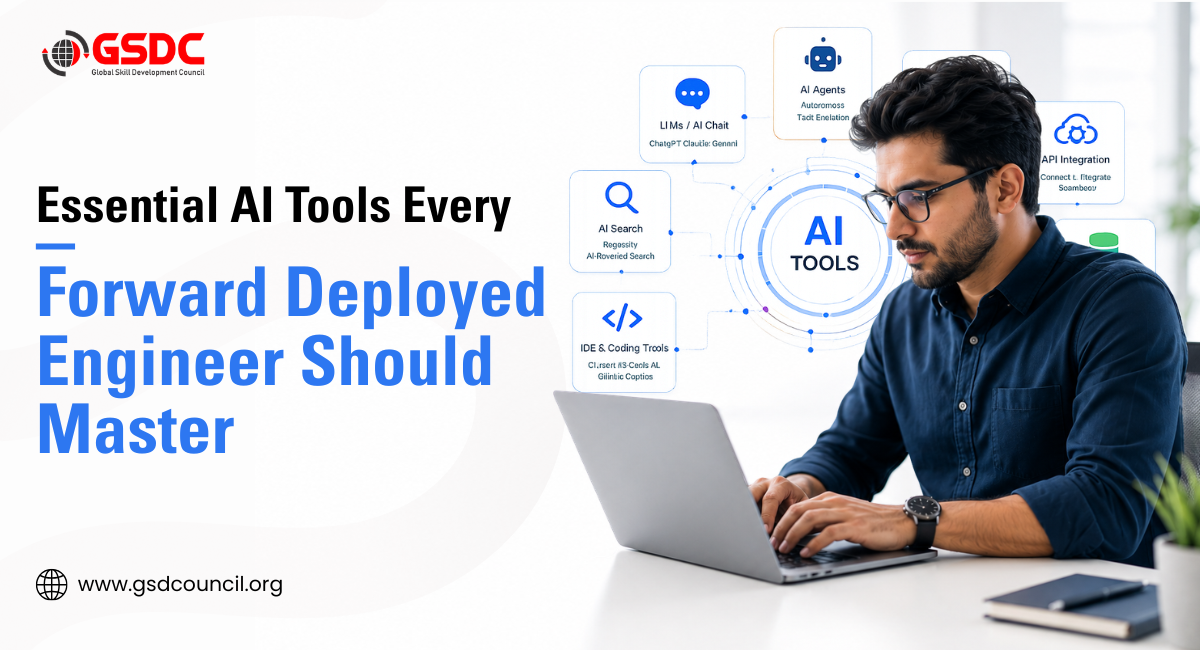
12 AI Security Jobs to Watch in 2026: Salaries, Skills & Career Roadmap
Written by Matthew Hale
- Why This Happened So Fast
- How Is AI Actually Being Used in Cybersecurity Right Now?
- The Benefits (and the Catch) of Bringing AI Into Security Work
- The 12 AI Security Jobs Reshaping the Industry
- What Employers Are Actually Screening For
- A Simple Cybersecurity Career Roadmap for 2026
- Certifications Worth Knowing About
- The Bottom Line
Two years ago, nobody was hiring an "AI Red Teamer." There was no such thing as a "Prompt Injection Analyst." If you'd walked into a corporate HR department in early 2024 and asked about an "LLM Security Engineer," you'd probably have gotten a blank stare.
Today, these are real job titles, with real budgets behind them, at real companies that are tired of finding out the hard way that a chatbot can be talked into leaking customer data.
That's the story of AI security jobs right now. The field grew up almost overnight, and it grew up messy - new titles, unclear pay bands, job descriptions written by people who were still figuring out what the role actually needed to do. If you're mapping out a career move or you're just trying to understand where cybersecurity is heading, this is the moment to pay attention.
This blog breaks down 12 AI security roles that have emerged in the last two years, what they actually pay, the skills behind them, and a simple roadmap for getting into one of these jobs - even if you're starting from a fairly ordinary IT or security background.
Why This Happened So Fast
Here's the short version: companies adopted generative AI faster than they built the guardrails to secure it.
Executive teams pushed hard on AI adoption because the upside was too big to ignore - faster product cycles, lower costs, new revenue lines. Security teams, meanwhile, were left playing catch-up. That mismatch between "how fast we're deploying AI" and "how well we're protecting it" is exactly why this new category of jobs exists.
Put a number on it, and the picture gets clearer: the global cybersecurity workforce is still short by roughly 4.8 million people it needs but doesn't have, according to the ISC2 Cybersecurity Workforce Study. That gap used to be mostly about headcount. Now it's increasingly about a specific kind of headcount - people who understand AI well enough to secure it, not just secure around it.
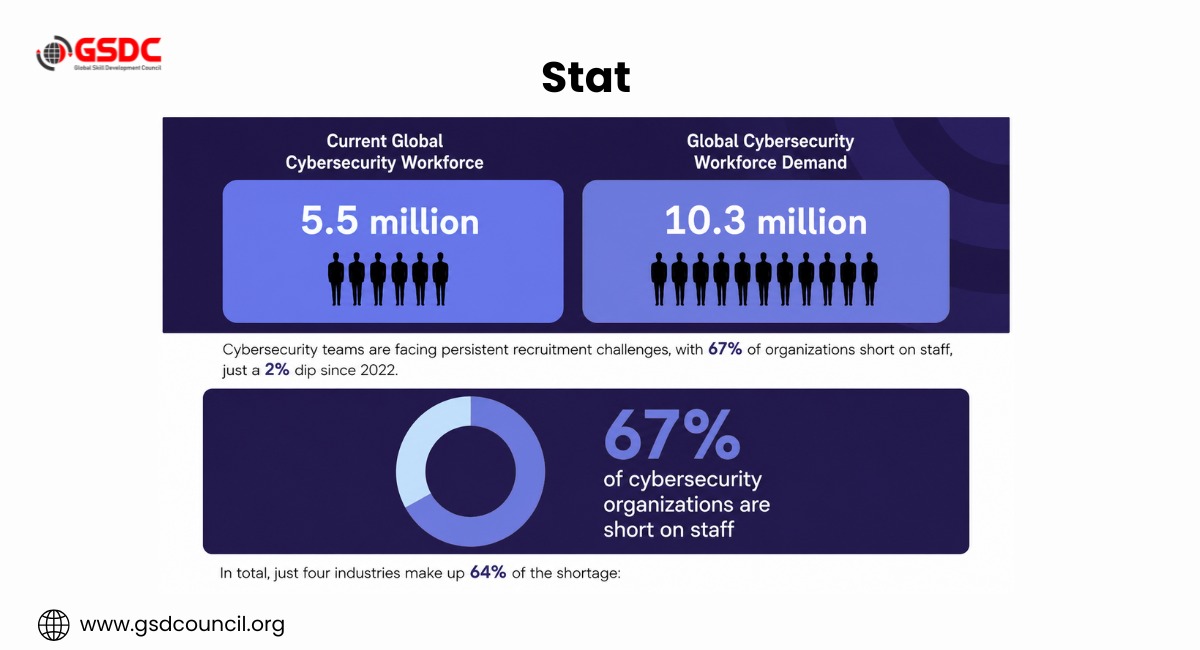
That's the shift driving the impact of AI on cybersecurity hiring in 2026. Traditional firewall-and-antivirus skills aren't enough anymore, and the job titles below are the industry's answer to that.
How Is AI Actually Being Used in Cybersecurity Right Now?
Before we get to the job titles, it helps to understand what these people are actually doing all day. The use of AI in cybersecurity isn't one thing - it splits into two very different jobs: using AI to defend, and defending the AI itself.
Using AI as a defensive tool.
This is the more familiar side. Security teams use machine learning models to spot unusual login patterns, flag phishing emails that a human would miss, and cut through the noise in a security operations center (SOC) that would otherwise drown an analyst in alerts.
Defending AI systems themselves.
This is the newer, faster-growing half. Once a company deploys a chatbot, a copilot, or an AI agent that can take actions on its own, that system becomes an attack surface. Someone has to test it, monitor it, and respond when it misbehaves.
A few concrete examples of AI in cyber security that show up in job postings today:
- Detecting AI-generated phishing that no longer has the spelling mistakes and awkward phrasing that used to give it away
- Spotting prompt injection attacks, where an attacker hides malicious instructions inside a document or webpage that an AI assistant later reads
- Catching data poisoning attempts, where bad actors quietly corrupt the training data feeding a model
- Flagging deepfake audio and video used in fraud, particularly the "urgent call from the CEO" scam that's now automated
- Automating incident triage, so a human analyst reviews the 20 alerts that actually matter instead of the 2,000 that don't
So when people ask how generative AI can be used in cybersecurity, the honest answer is: on both sides of the fight. It writes better phishing emails for attackers, and it writes better detection rules for defenders - which is precisely why this field needed a whole new set of job titles to keep up. It's also the exact split Global Skill Development Council builds its own AI security training around: not just teaching people to use AI tools, but teaching them to think like both the attacker and the defender at once.
The Benefits (and the Catch) of Bringing AI Into Security Work
The benefits of AI in cybersecurity are real. Catching an intrusion in hours instead of weeks changes everything about the damage it can do, and AI-assisted detection tools are genuinely faster at spotting the early signs. AI also handles the repetitive grunt work - log review, pattern matching, first-pass alert triage - that used to eat up an analyst's whole shift.
The catch is that none of this removes the need for people. It just changes what those people need to know. A SOC analyst who only knows how to read a dashboard is being replaced by tools. A SOC analyst who knows how to train, tune, and question those same tools is becoming more valuable, not less.
The 12 AI Security Jobs Reshaping the Industry
Pay ranges below are US-based estimates for 2026, pulled from salary-aggregator data (ZipRecruiter, Glassdoor) and adjacent Bureau of Labor Statistics figures for similar security roles. Actual pay varies a lot by city, company size, and experience - think of this as a starting compass, not a guarantee.
1. AI Security Engineer
Typical pay: $140,000–$210,000
Builds and hardens the infrastructure around AI systems - access controls, encryption, secure model deployment pipelines. This is the closest thing to a "traditional" security engineer role, just pointed at a new kind of system.
2. AI Red Teamer (Adversarial ML Tester)
Typical pay: $130,000–$200,000
Gets paid to break AI models on purpose. Tries to jailbreak chatbots, trick image classifiers, or manipulate a model's outputs before an actual attacker does it for real.
What that looks like day to day: mornings testing jailbreak prompts against a client's chatbot, afternoons simulating how an attacker might chain a small manipulation into a bigger exploit, and evenings writing up findings the engineering team can actually act on. It's less "hacker in a hoodie" and more structured, repeatable testing - closer to a pen tester's routine than people expect.
3. Prompt Injection / LLM Security Analyst
Typical pay: $110,000–$170,000
A job that genuinely did not exist before large language models went mainstream. Focused entirely on the ways attackers can smuggle malicious instructions into an AI system through everyday inputs - a resume, an email, a customer support ticket.
4. AI Governance & Compliance Lead
Typical pay: $125,000–$190,000
Translates AI regulation (the EU AI Act, US state-level AI laws, sector-specific rules) into actual company policy. Part lawyer, part technologist, part project manager.
A pattern worth noticing: the roles that touch regulation and infrastructure directly - governance leads, security engineers - tend to command the highest pay in this list. That tracks with what's actually driving hiring: organizations under pressure to comply with fast-moving AI regulation, while also racing to lock down production AI systems before something breaks publicly.
5. AI Incident Response Specialist
Typical pay: $115,000–$175,000
When an AI system does something it shouldn't - leaks data, gets manipulated into fraud, produces harmful output - this is the person who figures out what happened and how to contain it, fast.
6. MLSecOps Engineer
Typical pay: $130,000–$195,000
Embeds security checks directly into the machine learning development pipeline, the same way DevSecOps embedded security into software development. Catches problems before a model ever reaches production.
7. AI Threat Intelligence Analyst
Typical pay: $105,000–$160,000
Tracks how attackers are actually using AI in the wild - which criminal groups are automating phishing, which are using AI to write malware, which are targeting AI systems directly.
8. Deepfake & Synthetic Media Forensics Analyst
Typical pay: $95,000–$150,000
Verifies whether audio, video, or images are real. Increasingly critical for banks, insurers, and newsrooms dealing with AI-generated fraud and misinformation.
Another pattern: the roles further down this list tend to be more accessible entry points - less specialized, closer to existing SOC or analyst work, and a more realistic first move if you're breaking into AI security rather than already deep in it.
9. AI SOC Analyst
Typical pay: $85,000–$135,000
An evolved version of the traditional SOC analyst, working alongside AI-powered detection tools instead of just staring at raw logs. Often the most accessible entry point into this whole field.
10. AI Data Security Specialist
Typical pay: $110,000–$165,000
Protects the training data itself - the thing an AI model is built on. Guards against data poisoning, leakage of sensitive training data, and unauthorized data scraping.
11. Autonomous Agent Security Specialist
Typical pay: $130,000–$195,000
A brand-new role tied to AI agents that can take real actions - booking things, sending emails, executing code - without a human clicking "approve" every time. Someone has to make sure that autonomy doesn't turn into a liability.
12. AI Security Analyst (Enterprise / SOC-Adjacent)
Typical pay: $90,000–$145,000
A broader, less specialized version of several roles above, common at mid-sized companies that need AI security coverage but can't yet justify five separate specialist hires. It's fast becoming one of the more common AI security analyst jobs on the market simply because it's the easiest for a company to justify hiring first.
Notice how many of these roles - from prompt injection analysis to governance to red teaming - pull from the same core skill set rather than from twelve unrelated disciplines. That's exactly what Certification in Generative AI in Cybersecurity is built to cover in one place, instead of leaving candidates to piece it together from a dozen different sources.
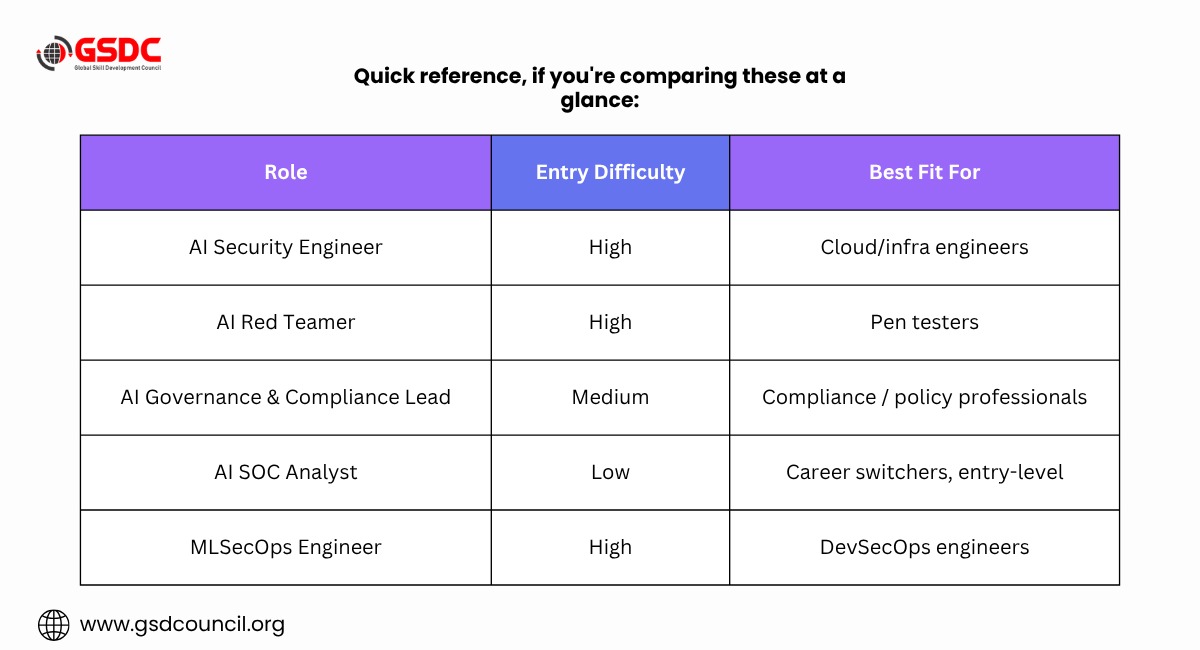
What Employers Are Actually Screening For
Job postings for these roles tend to circle back to the same core cybersecurity skills, layered with AI-specific knowledge:
- Fundamentals that never go away: networking, cloud security (AWS/Azure/GCP), identity and access management
- Machine learning literacy: you don't need to build models from scratch, but you need to understand how they're trained, what "fine-tuning" means, and where the weak points are
- Scripting: Python shows up constantly, mostly for automating tests and analyzing model behavior
- Familiarity with LLM tooling: how prompts work, what a system prompt is, how retrieval-augmented generation (RAG) pipelines are structured
- Communication: several of these roles (governance, incident response) live at the intersection of engineering and executive reporting, so being able to explain a technical risk in plain English is a genuine differentiator
None of this requires a PhD. It requires a security foundation plus a deliberate effort to learn how AI systems actually work under the hood.
If any of this is new territory, it's worth reading up separately on AI governance, prompt engineering, and AI risk management - three adjacent topics that show up constantly in these job descriptions, even when the title itself doesn't mention them. Frameworks like ISO 42001 (the AI management system standard) and the rise of agentic AI are also reshaping what "AI security" means month to month, so they're worth tracking even outside a job search.
A Simple Cybersecurity Career Roadmap for 2026
If you're starting from scratch - or pivoting from general IT or software work - here's a practical cybersecurity career roadmap that lines up with where the AI security jobs actually are:
Step 1: Get the fundamentals down.
Networking basics, operating systems, and a foundational certification like CompTIA Security+. Don't skip this step even if it feels slow - it's the floor everything else stands on.
Step 2: Pick a security lane and get hands-on.
SOC analyst work, cloud security, or application security are the most common entry points. Build a home lab. Practice on deliberately vulnerable systems. Hands-on experience beats another certificate at this stage.
Step 3: Layer in AI literacy.
Take a course on how machine learning models are built and trained. You don't need to become a data scientist - you need to understand the system well enough to know where it can be attacked.
Step 4: Specialize.
Pick one of the 12 roles above that fits your interests. Red teaming suits people who like breaking things. Governance suits people who like policy and structure. Incident response suits people who work well under pressure.
Step 5: Get certified and get visible.
Pursue a generative AI in cybersecurity certification alongside your core security credentials. Publish write-ups of projects, contribute to open-source security tools, or present findings at local meetups. In a field this new, demonstrated skill often outweighs years of formal experience.
This roadmap holds up whether you're a recent graduate or a security professional with a decade of traditional experience looking to move into AI-focused work.
Certifications Worth Knowing About
AI security is still new enough that employers can't screen for years of direct experience - nobody's had time to build a decade of it. What they can screen for is demonstrated knowledge, and certifications are one of the clearest ways to show it, especially paired with a real project you can talk through in an interview.
A solid foundation in core security and cloud security concepts still matters as a baseline. But the fastest-moving credential right now is in generative AI security specifically - prompt security, model risk assessment, AI governance. Global Skill Development Council's Certification in Generative AI in Cybersecurity is built around exactly those skills, mapped directly to the 12 roles above rather than treating AI as an add-on chapter to a general security course. For anyone serious about breaking into this field, it's the credential worth prioritizing.

The Bottom Line
Two years is not a long time. Yet in that window, AI security jobs went from nonexistent to some of the highest-demand, best-paying roles in the entire tech industry. The pattern is familiar if you've watched cybersecurity evolve before: a new technology arrives, organizations rush to adopt it, security gets left behind, and then a scramble follows to close the gap.
The difference this time is the size and speed of the opportunity. If you're building a career in this space, the smartest move isn't waiting for the field to settle down - it's getting in while it's still being defined.
AI security isn't replacing traditional cybersecurity - it's becoming one of its fastest-growing specializations. As organizations deploy AI across customer service, operations, and software development, securing those systems is turning from a nice-to-have into a business necessity. Professionals who combine solid cybersecurity fundamentals with real AI knowledge will be well positioned to ride this shift over the next several years, not just react to it.

Related Certifications
Frequently Asked Questions
AI plays two roles at once: a defensive tool that speeds up threat detection and reduces alert fatigue, and a new category of asset that itself needs protecting. Understanding both sides is what separates a generalist from someone qualified for these newer roles.
Even lean teams use AI-powered tools for email filtering, anomaly detection, and automated first-pass alert triage - it's often the most cost-effective way to extend a small security team's coverage.
No. Banks, healthcare providers, insurers, and government agencies are all hiring for AI security work, largely because they're the ones with the most regulatory exposure if an AI system goes wrong.
It helps, but it's not mandatory. A solid security background plus demonstrated AI literacy - through certifications, projects, or hands-on labs - carries real weight in a field this short on experienced candidates.
Stay up-to-date with the latest news, trends, and resources in GSDC
If you like this read then make sure to check out our previous blogs: Cracking Onboarding Challenges: Fresher Success Unveiled
Not sure which certification to pursue? Our advisors will help you decide!