Essential AI Tools Every Forward Deployed Engineer Should Master
Written by Emily Hilton
Artificial Intelligence has transformed from a research concept into a business necessity. Organizations across healthcare, finance, manufacturing, retail, cybersecurity, and government are investing heavily in AI solutions to automate workflows, improve decision-making, and create competitive advantages. However, building an AI model is only one part of the journey. Successfully deploying AI into real business environments requires professionals who understand both technology and business operations.
This is where Forward Deployed Engineers (FDEs) play a critical role.
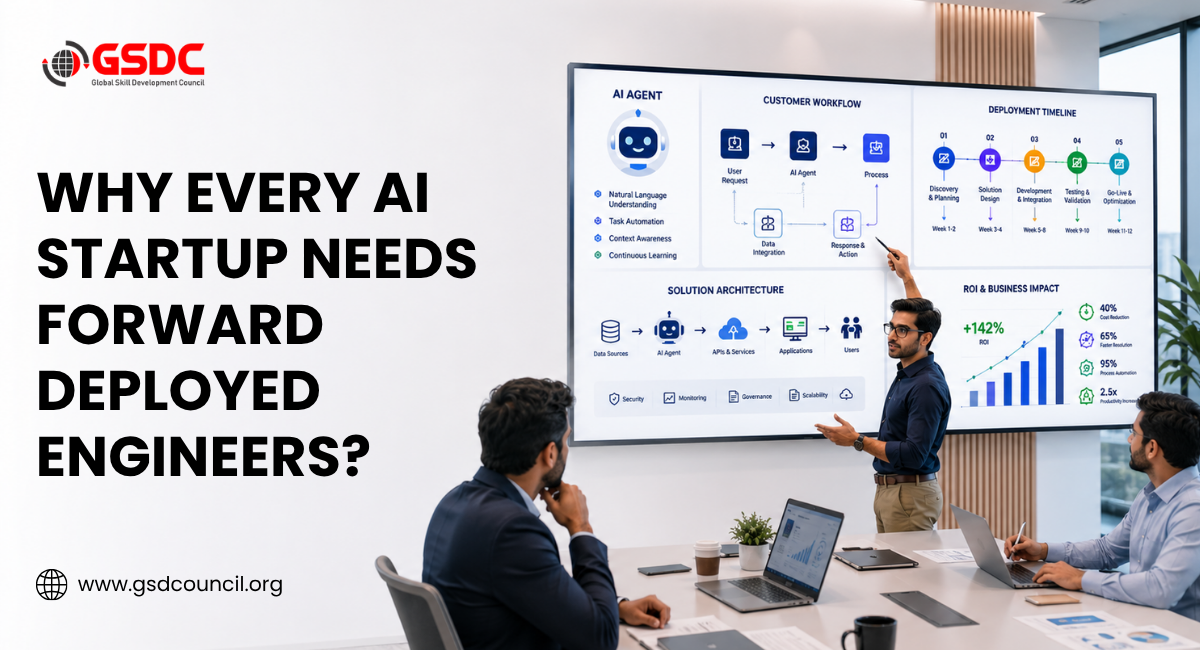
Unlike traditional software engineers, Forward Deployed Engineers work directly with customers, understand business challenges, customize AI solutions, integrate them into existing systems, and ensure successful deployment. A forward deployed engineer in AI acts as the bridge between advanced AI technologies and practical business implementation.
As enterprise AI adoption continues to grow, companies are seeking professionals who possess strong technical expertise along with problem-solving, communication, and deployment skills. Mastering the right AI tools has become one of the most significant differentiators for any forward-thinking AI engineer.
This guide explores the essential AI tools that every Forward Deployed Engineer should master, explains why these tools are crucial, and demonstrates how they contribute to delivering successful AI implementations across various industries.
What Does a Forward Deployed Software Engineer Mean?
Many professionals entering the AI industry ask, what does forward deployed software engineer mean?
A Forward Deployed Software Engineer is a customer-facing technical expert responsible for implementing software or AI solutions in real-world business environments. Instead of only writing code from a development office, they collaborate directly with clients to:
- Understand business requirements
- Design AI-powered workflows
- Integrate AI with enterprise systems
- Deploy machine learning applications
- Optimize performance
- Resolve deployment challenges
- Train customer teams
Their work extends beyond software development. They combine software engineering, AI engineering, consulting, cloud architecture, and solution design to ensure organizations achieve measurable business outcomes.
Why AI Tools Matter for Forward Deployed Engineers?
The phrase AI Tools matters for Forward Deployed Engineer reflects a fundamental reality of modern AI implementation. Today's projects involve much more than creating machine learning models. Engineers must manage data pipelines, integrate APIs, automate deployments, monitor model performance, and collaborate across teams.
The right AI tools help Forward Deployed Engineers:
- Build production-ready AI systems faster
- Reduce deployment time
- Improve collaboration with customers
- Automate repetitive engineering tasks
- Monitor AI performance continuously
- Scale AI across multiple environments
- Maintain security and compliance
Rather than replacing engineering expertise, these tools enhance productivity and allow engineers to focus on solving complex customer problems.
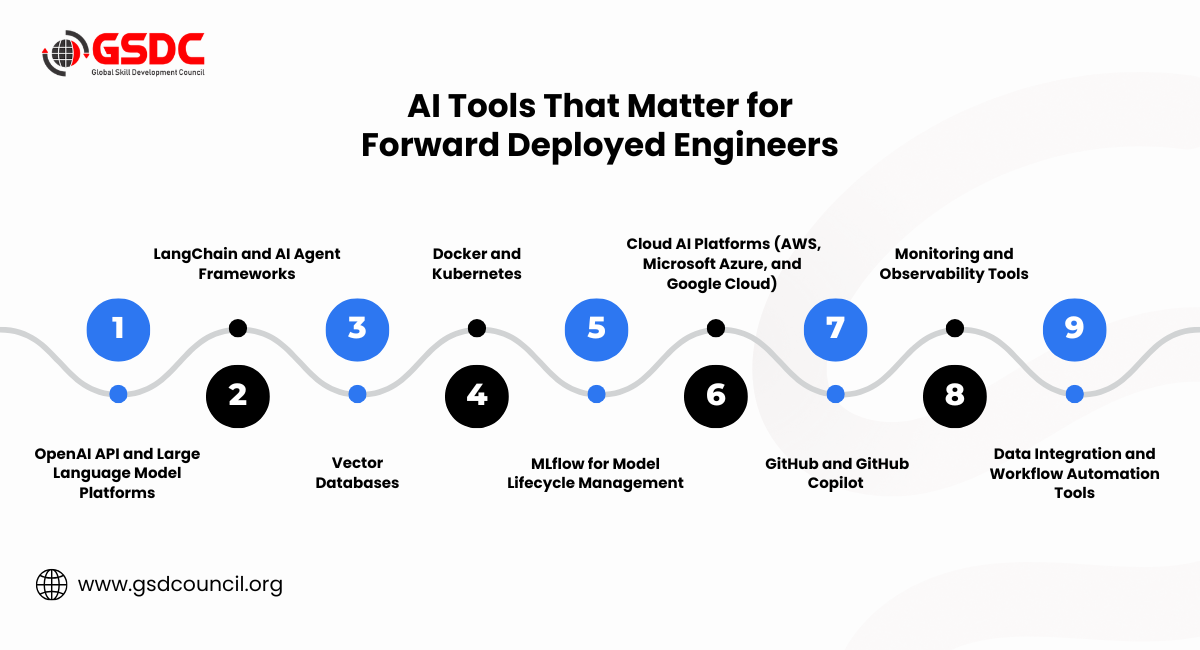
1. OpenAI API and Large Language Model Platforms
Large Language Models (LLMs) have become the foundation of enterprise AI applications.
Forward Deployed Engineers frequently develop solutions such as:
- AI chatbots
- Virtual assistants
- Knowledge management systems
- Document analysis tools
- Code generation assistants
- Customer support automation
Platforms like OpenAI provide APIs that make it easier to integrate powerful AI capabilities into enterprise applications without building models from scratch.
Important skills include:
- Prompt engineering
- API integration
- Function calling
- Retrieval-Augmented Generation (RAG)
- Fine-tuning strategies
- Security best practices
Understanding how to deploy and customize LLM-powered applications is becoming a core requirement for every forward deployed engineer in AI.
2. LangChain and AI Agent Frameworks
Modern enterprise AI solutions increasingly rely on AI agents capable of performing multiple tasks autonomously.
LangChain enables engineers to build applications that can:
- Access databases
- Search enterprise documents
- Use external APIs
- Execute workflows
- Maintain conversational memory
- Chain multiple AI tasks together
For customer deployments, Forward Deployed Engineers often create intelligent assistants that interact with internal business systems instead of simply answering questions.
Mastering AI orchestration frameworks significantly improves the quality of enterprise AI implementations.
3. Vector Databases
Enterprise AI rarely relies solely on pre-trained knowledge.
Organizations require AI systems that understand company-specific documents, policies, product catalogs, contracts, manuals, and internal knowledge bases.
Vector databases such as Pinecone, Weaviate, Milvus, and Chroma make Retrieval-Augmented Generation (RAG) possible.
Forward Deployed Engineers use them to:
- Build enterprise search
- Improve chatbot accuracy
- Reduce hallucinations
- Retrieve relevant business documents
- Enable semantic search
As more businesses adopt private AI systems, vector databases have become indispensable deployment tools.
4. Docker and Kubernetes
One of the biggest challenges in enterprise AI is moving applications from development to production.
Docker packages AI applications into portable containers that work consistently across different environments.
Kubernetes automates:
- Deployment
- Scaling
- Load balancing
- Resource management
- High availability
- Container orchestration
Without containerization, AI deployments often fail due to environment inconsistencies.
Forward Deployed Engineers working on enterprise-scale AI implementations should be comfortable deploying containerized AI applications across cloud infrastructures.
5. MLflow for Model Lifecycle Management
Deploying an AI model is only the beginning.
Organizations constantly retrain, evaluate, compare, and improve machine learning models.
MLflow simplifies:
- Experiment tracking
- Model versioning
- Performance comparison
- Model registry
- Deployment management
Instead of manually tracking different model versions, engineers maintain an organized workflow that improves collaboration and reproducibility.
For businesses managing multiple AI models across departments, MLflow provides centralized visibility into the entire model lifecycle.
6. Cloud AI Platforms (AWS, Microsoft Azure, and Google Cloud)
Cloud computing powers nearly every enterprise AI deployment today.
Forward Deployed Engineers regularly work with cloud-native AI services because customers require scalable, secure, and reliable deployments.
Popular cloud AI capabilities include:
Amazon Web Services (AWS)
- SageMaker
- Bedrock
- Lambda
- ECS
- EKS
Microsoft Azure
- Azure AI Studio
- Azure Machine Learning
- Azure OpenAI Service
- Cognitive Services
Google Cloud Platform
- Vertex AI
- BigQuery
- Cloud Run
- Kubernetes Engine
Cloud expertise enables engineers to deploy AI systems that can serve thousands or even millions of users efficiently.
7. GitHub and GitHub Copilot
Version control remains one of the most important engineering practices.
GitHub allows teams to:
- Collaborate efficiently
- Review code
- Track changes
- Manage releases
- Automate deployment pipelines
GitHub Copilot further enhances developer productivity by assisting with:
- Code generation
- Documentation
- Refactoring
- Unit testing
- Boilerplate creation
Rather than replacing engineers, AI coding assistants accelerate development and reduce repetitive work, allowing Forward Deployed Engineers to focus on customer-specific solutions.
8. Monitoring and Observability Tools
Successful AI deployment does not end after launch.
Forward Deployed Engineers continuously monitor deployed systems for:
- Latency
- Model accuracy
- Resource utilization
- API failures
- User feedback
- AI hallucinations
- Drift detection
Common monitoring solutions include:
- Prometheus
- Grafana
- Datadog
- Arize AI
- WhyLabs
Monitoring ensures AI systems remain reliable long after deployment.
9. Data Integration and Workflow Automation Tools
Enterprise AI depends heavily on clean, connected, and continuously updated data.
Forward Deployed Engineers frequently integrate AI with:
- CRM platforms
- ERP systems
- HR software
- Internal databases
- Business intelligence platforms
- Third-party APIs
Automation tools such as Apache Airflow, Prefect, Zapier, and Make simplify data movement and workflow orchestration.
These platforms reduce manual intervention while ensuring AI applications receive accurate and timely information.
Who Deploys AI Models?
A common question among aspiring professionals is who deploys AI models?
In enterprise environments, AI deployment is usually a collaborative effort involving:
- Machine Learning Engineers
- MLOps Engineers
- Cloud Engineers
- DevOps Engineers
- Data Engineers
- Solution Architects
- Forward Deployed Engineers
Among these roles, Forward Deployed Engineers stand out because they not only deploy AI models but also ensure the solution aligns with customer requirements, integrates seamlessly with existing systems, and delivers measurable business value.
They often act as the final link between AI development teams and end users, making sure AI performs effectively in production.
Why Companies Like Scale AI Value Forward Deployed Engineers
When professionals search for forward deployed engineer Scale AI, they often notice that the role demands much more than software development.
Organizations working on cutting-edge AI deployments value engineers who can:
- Solve customer problems independently
- Build production-ready AI solutions
- Work across multiple technology stacks
- Understand machine learning concepts
- Communicate with technical and non-technical stakeholders
- Deploy AI securely at scale
This combination of consulting, engineering, and AI expertise makes the role highly sought after across the technology industry.
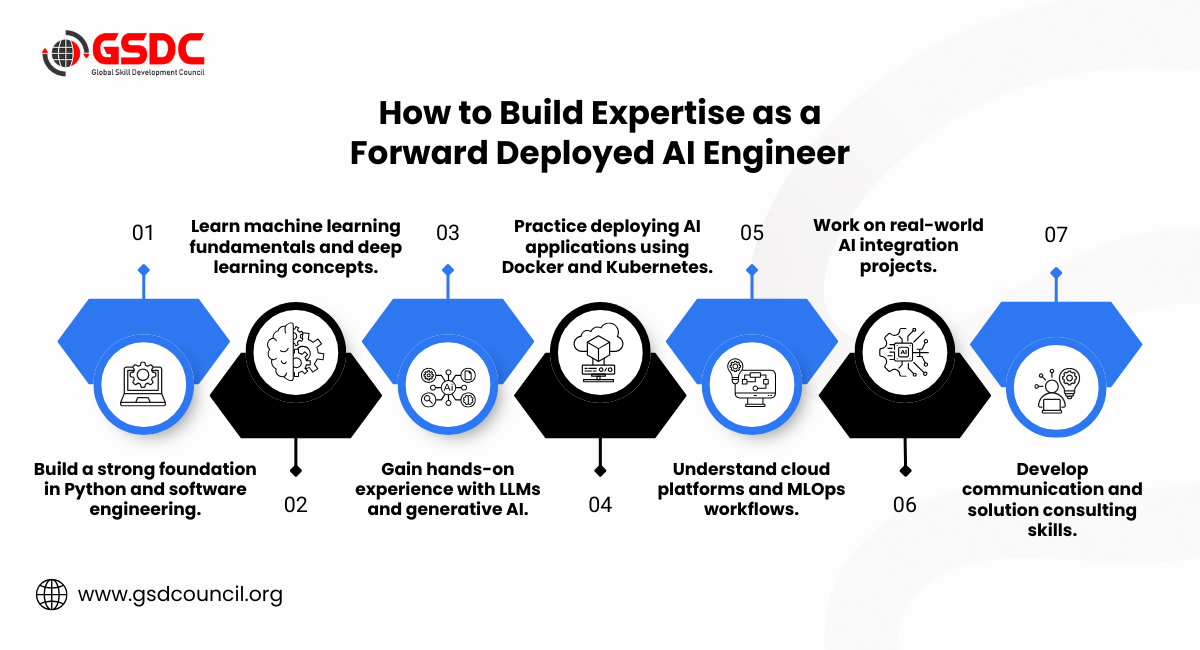
Strengthen Your Career with a Forward Deployed Engineer Certification
As organizations continue investing in enterprise AI, employers increasingly seek professionals with validated deployment expertise. Earning a Forward Deployed Engineer Certification demonstrates your ability to bridge AI development and business implementation.

A comprehensive certification from GSDC equips professionals with practical skills in AI deployment, cloud infrastructure, customer engagement, MLOps, integration strategies, and production-ready AI workflows. It also helps candidates stand out in a competitive job market by showcasing their readiness to manage real-world AI implementations rather than only theoretical concepts.
For aspiring AI professionals, software engineers, solution architects, and consultants, a recognized forward deployed engineer certification can accelerate career growth and improve credibility when working on enterprise AI projects.
Conclusion
The role of Forward Deployed Engineers has become indispensable in today's AI-driven business landscape. They are responsible for transforming AI innovations into practical, scalable, and reliable business solutions that deliver measurable value.
Mastering essential tools such as OpenAI APIs, LangChain, vector databases, Docker, Kubernetes, MLflow, cloud AI platforms, GitHub, monitoring solutions, and workflow automation technologies enables engineers to deploy AI systems with confidence and efficiency.
As AI adoption accelerates across industries, professionals who combine technical expertise with customer-focused problem-solving will be in high demand. By continuously learning modern AI tools and validating your skills through a Forward Deployed Engineer Certification, you can position yourself for a successful and future-ready career in enterprise AI deployment.

Related Certifications
Frequently Asked Questions
Key tools include OpenAI APIs, LangChain, vector databases, Docker, Kubernetes, MLflow, GitHub, cloud AI platforms, and AI monitoring tools.
A Forward Deployed Software Engineer works directly with customers to implement, customize, integrate, and deploy AI or software solutions in production environments.
AI models are typically deployed by Machine Learning Engineers, MLOps Engineers, DevOps Engineers, Cloud Engineers, Data Engineers, and Forward Deployed Engineers working collaboratively.
It validates practical skills in AI deployment, cloud infrastructure, MLOps, customer collaboration, and enterprise AI implementation, helping professionals advance their careers.
They should master AI tools, cloud platforms, programming, machine learning, MLOps, system integration, communication, and problem-solving to deliver successful enterprise AI solutions.
Stay up-to-date with the latest news, trends, and resources in GSDC
If you like this read then make sure to check out our previous blogs: Cracking Onboarding Challenges: Fresher Success Unveiled
Not sure which certification to pursue? Our advisors will help you decide!