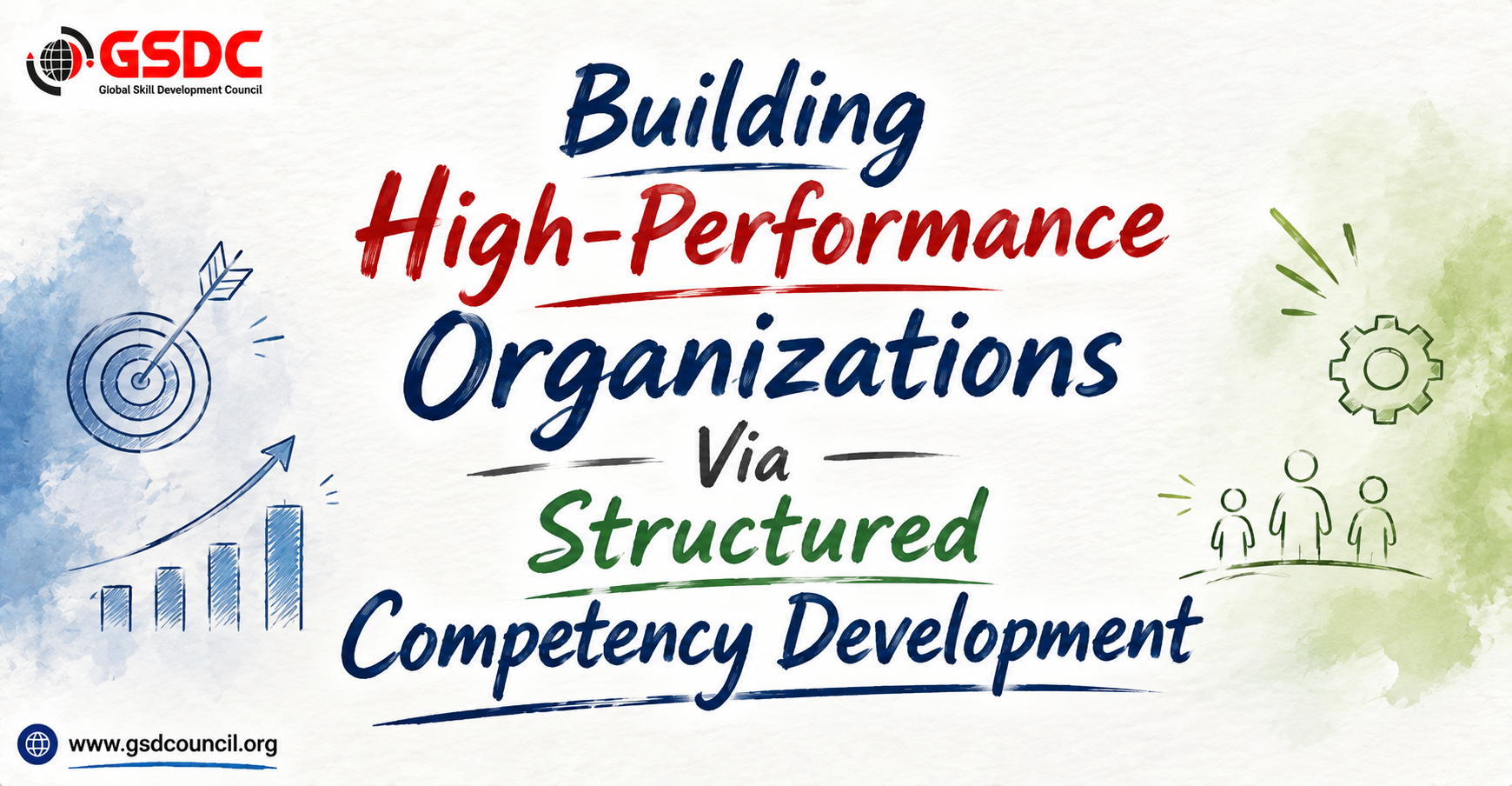
Building High-Performance Organizations Via Structured Competency Development
Written by Treasure Kalu
- Why High-Performance Organizations Stand Out
- Three Persistent Challenges That Prevent Organizational Growth
- Understanding Structured Competency Development
- The Four Pillars of Structured Competency Development
- Managing Weak Links to Strengthen Organizational Performance
- A Practical Example: Unilever's Competency Development Approach
- Build Leadership Competencies for Organizational Success
- Conclusion
Every organization aspires to become a high-performance organization, but achieving sustainable success requires far more than ambitious goals or innovative business strategies. While strategy provides direction, it is people, their skills, capabilities, and leadership, who determine whether that strategy succeeds. Organizations that consistently outperform their competitors invest in competency development, talent development, and employee development to build a workforce capable of delivering long-term business results.
As industries evolve through digital transformation, AI, and automation, organizations need more than occasional learning and development initiatives. A structured competency framework and competency management system help identify skill gaps, drive skills development, and align employee development with business objectives, enabling continuous organizational development.
This webinar explored how organizations can create a culture of continuous learning and performance through structured competency development. It highlighted why competency management should become a strategic business function rather than simply an HR initiative and shared practical approaches for building stronger teams, accelerating leadership development, and creating a sustainable high-performance organization.
Why High-Performance Organizations Stand Out
Many organizations believe that having a well-designed business strategy is enough to achieve exceptional results. However, strategy alone cannot guarantee success. The organizations that consistently deliver strong business outcomes have one thing in common: they develop people who are capable of executing that strategy effectively.
A high-performance organization is not defined by occasional success or short-term achievements. Instead, it is characterized by employees who understand their responsibilities, possess the necessary competencies to perform their roles, and consistently deliver results over time.
Three characteristics distinguish high-performance organizations:
- Employees clearly understand what they are expected to accomplish.
- They possess the knowledge, skills, and behaviors required to perform effectively.
- They consistently execute their responsibilities while maintaining quality and accountability.
Consistency is the defining factor. High-performing organizations do not rely on individual brilliance or isolated achievements. Instead, they create systems that enable reliable performance across teams, departments, and leadership levels.
Another important insight discussed during the webinar was that capacity is intentionally built rather than naturally acquired. Just as physical strength develops through continuous exercise, organizational capability grows through ongoing learning, coaching, practice, and performance improvement.
Three Persistent Challenges That Prevent Organizational Growth
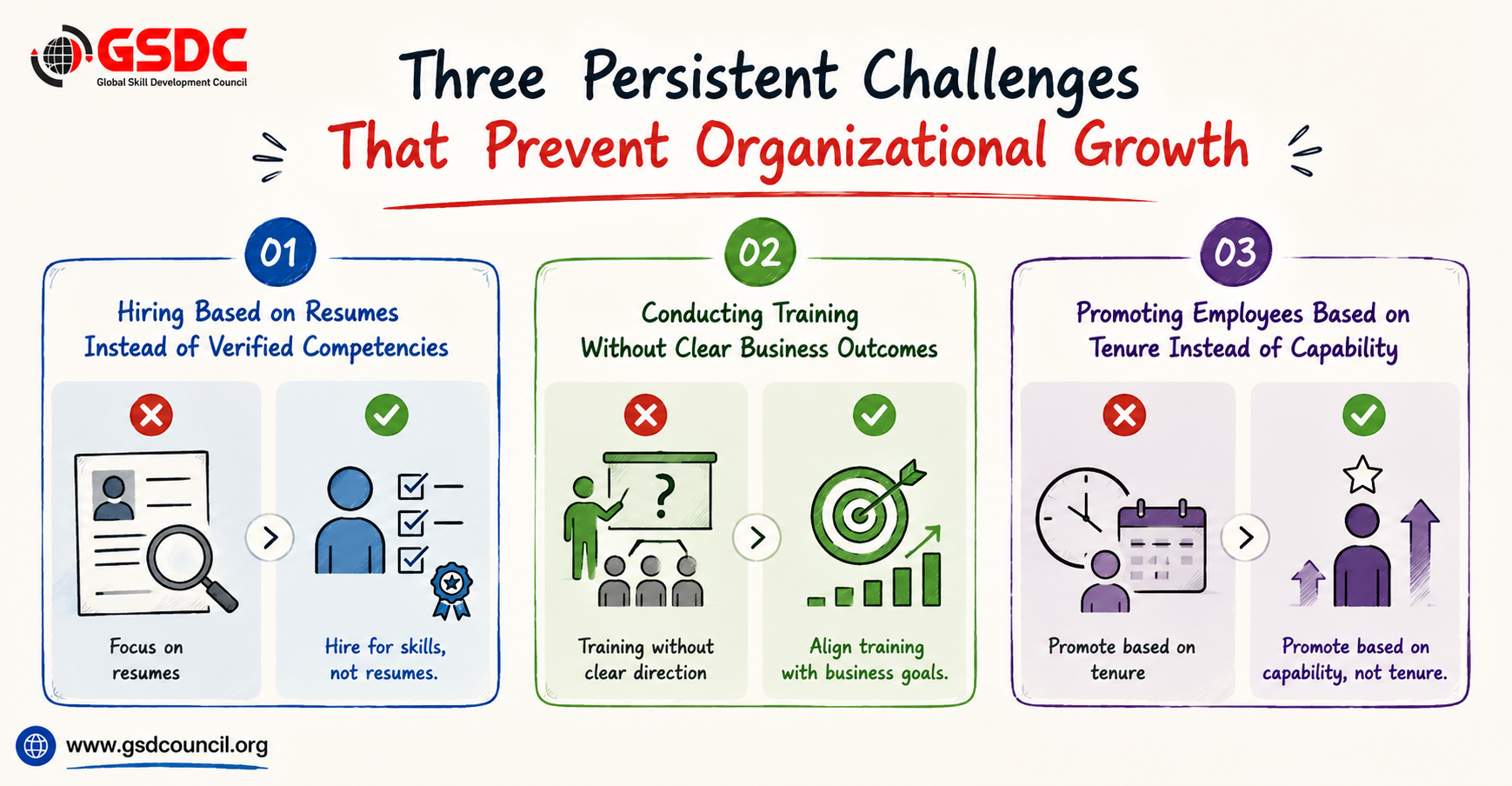
Despite investing significantly in hiring and employee development, many organizations continue to struggle with performance challenges. The webinar highlighted three common mistakes that often prevent organizations from reaching their full potential.
Hiring Based on Resumes Instead of Verified Competencies
Modern recruitment has become increasingly challenging. With AI-powered resume builders and professional networking platforms, candidates can easily create impressive resumes that appear highly qualified on paper.
However, a polished resume does not always reflect actual capability.
Organizations that rely primarily on resumes instead of validating practical competencies often discover performance issues after hiring. Employees may possess impressive credentials but struggle to deliver expected results in real-world situations.
Effective hiring requires organizations to evaluate practical skills, behavioral competencies, problem-solving ability, and role-specific expertise rather than focusing solely on educational qualifications or previous job titles.
Conducting Training Without Clear Business Outcomes
Many organizations allocate substantial budgets for employee learning and development. However, training frequently becomes an activity rather than a strategic investment.
Employees attend workshops, seminars, and certification programs without clearly defined learning objectives or measurable business outcomes.
Without identifying specific competency gaps beforehand, organizations cannot determine whether training has improved performance or contributed to organizational goals.
Successful competency development begins by answering important questions such as:
- What specific skills need improvement?
- Which business objectives will this training support?
- How will success be measured after training?
Learning initiatives become significantly more valuable when they are directly linked to organizational performance.
Promoting Employees Based on Tenure Instead of Capability
Experience certainly has value, but years of service should not become the primary criterion for leadership development and promotion. Many organizations continue promoting employees simply because they have spent a long time within the company. While loyalty deserves recognition, leadership responsibilities require demonstrated competencies, decision-making ability, emotional intelligence, and the capacity to guide teams effectively within a leadership competency framework.
Promoting individuals without evaluating leadership readiness often creates performance bottlenecks that affect entire departments. Organizations achieve stronger leadership pipelines when promotions are based on verified competence rather than tenure alone, supporting organizational development and building a high performance organization.
Understanding Structured Competency Development
To overcome these challenges, organizations need a structured competency framework that supports continuous organizational development. Competency development is a strategic process of identifying, assessing, developing, and improving the knowledge, skills, and behaviors employees need to succeed.
Rather than treating learning and development as a one-time event, this approach creates an ongoing cycle aligned with business objectives. It focuses on four key activities:
- Identifying competencies required for success.
- Assessing current employee capabilities.
- Developing targeted learning interventions.
- Measuring improvements and organizational impact.
Together, these activities strengthen talent development, employee development, and help organizations adapt to changing industry demands.
The Four Pillars of Structured Competency Development
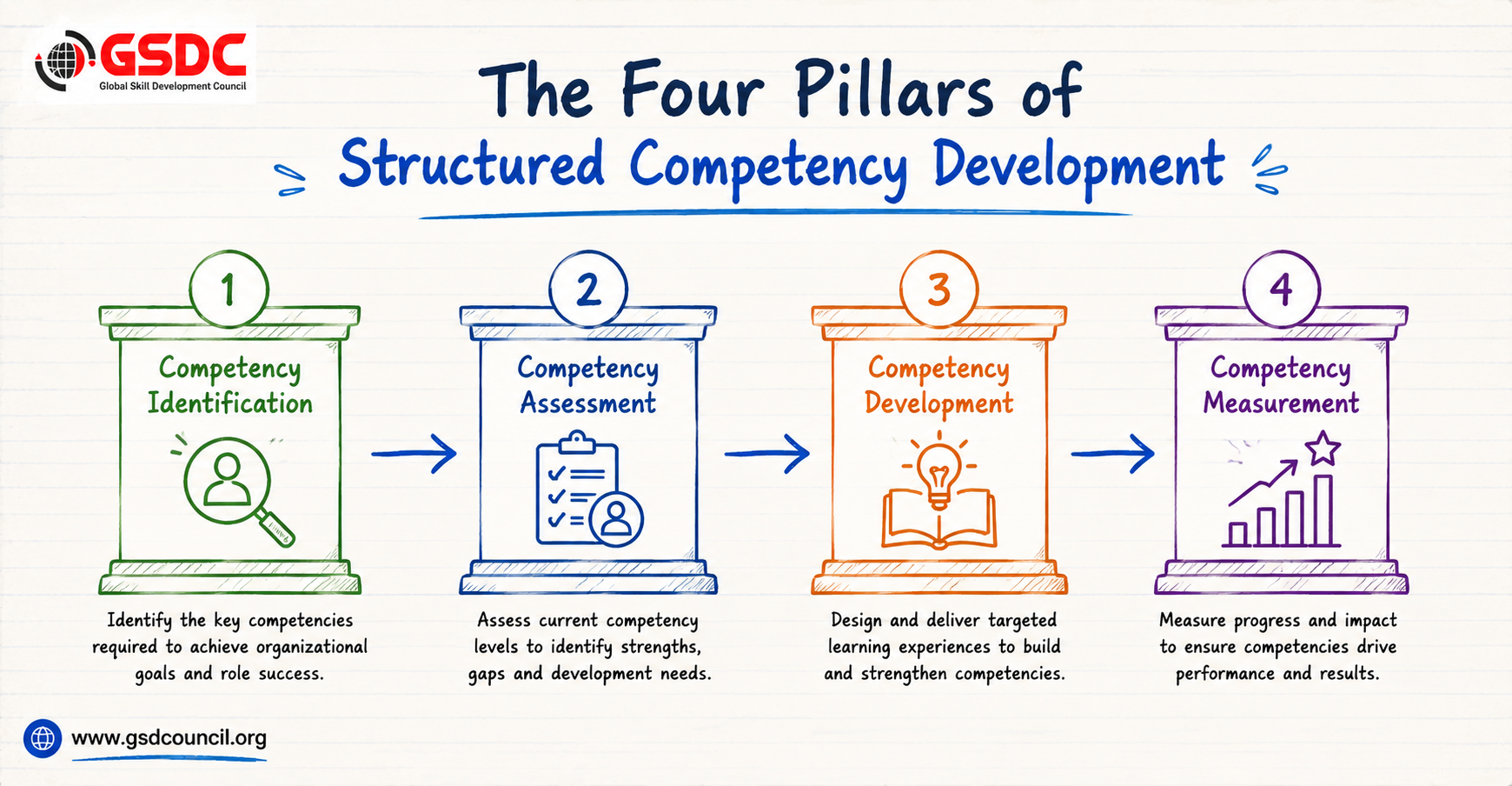
1. Competency Identification
Every successful competency framework begins by defining what excellence looks like for each role. Organizations must identify the technical skills, behavioral competencies, and professional capabilities employees need to succeed.
For example, a sales manager may require competencies in negotiation, customer relationship management, coaching, communication, and strategic planning. Clearly defined competencies support talent development, improve hiring, establish performance expectations, and strengthen employee development. Without competency identification, organizations risk role mismatches that reduce productivity and performance.
2. Competency Assessment
Once required competencies have been identified, organizations must evaluate where employees currently stand.
Competency assessment helps leaders understand existing strengths while identifying capability gaps that require attention.
Several methods can support this process, including:
- Performance evaluations
- Skills assessments
- 360-degree feedback
- Behavioral observations
- Role-specific performance metrics
Continuous assessment is especially important as industries evolve rapidly due to technological advancements and artificial intelligence.
Organizations that regularly evaluate workforce capabilities are better positioned to adapt to changing business requirements and future skill demands.
3. Competency Development
Competency development extends far beyond classroom training.
One of the webinar's key insights was that organizations often mistake training for development. While workshops and certifications play an important role, they represent only one component of an effective development strategy.
Different competency gaps require different development approaches.
Depending on the situation, organizations may benefit from:
- Coaching
- Mentoring
- On-the-job learning
- Simulations
- Strategy sessions
- Targeted skill-building programs
The most effective organizations customize development initiatives based on the specific competencies employees need to improve rather than applying the same learning solution across every department.
4. Competency Measurement
Development efforts should never end after training concludes. Organizations must continuously evaluate whether learning and development initiatives translate into measurable performance improvements.
Competency measurement enables leaders to answer important questions such as:
- Have employee capabilities improved?
- Are teams performing more effectively?
- Has business performance increased?
- Which skills development initiatives delivered the greatest value?
Without measurement, organizations rely on assumptions rather than evidence. Data-driven evaluation helps refine learning strategies, strengthen performance management, and ensure competency development remains aligned with organizational development goals.
Managing Weak Links to Strengthen Organizational Performance
Weak links can silently reduce productivity, disrupt collaboration, and prevent teams from reaching their full potential. Addressing them proactively through competency development and performance management helps organizations build a stronger, more accountable workforce while supporting long-term organizational development.
Key Points:
- Weak links are not limited to low performers; they can include employees with poor attitudes or leaders who resist growth.
- Even one underperforming individual can negatively impact team morale, productivity, and accountability across a high performance organization.
- Identifying the root cause, whether it is a skills gap, role mismatch, or behavioral issue, is essential before taking action using a structured competency framework.
- Coaching, mentoring, targeted learning and development, and role realignment can strengthen employee development and improve performance.
- Consistent performance reviews, competency assessments, and a competency management system help organizations monitor progress and support continuous improvement.
Organizations that address weak links through development rather than assumption create a culture of continuous improvement and accountability. By investing in talent development and providing the right support, employees can overcome performance challenges and contribute more effectively, while leaders maintain high standards across the organization.
A Practical Example: Unilever's Competency Development Approach
One of the examples highlighted during the webinar was Unilever, a global organization known for its strong talent development practices.
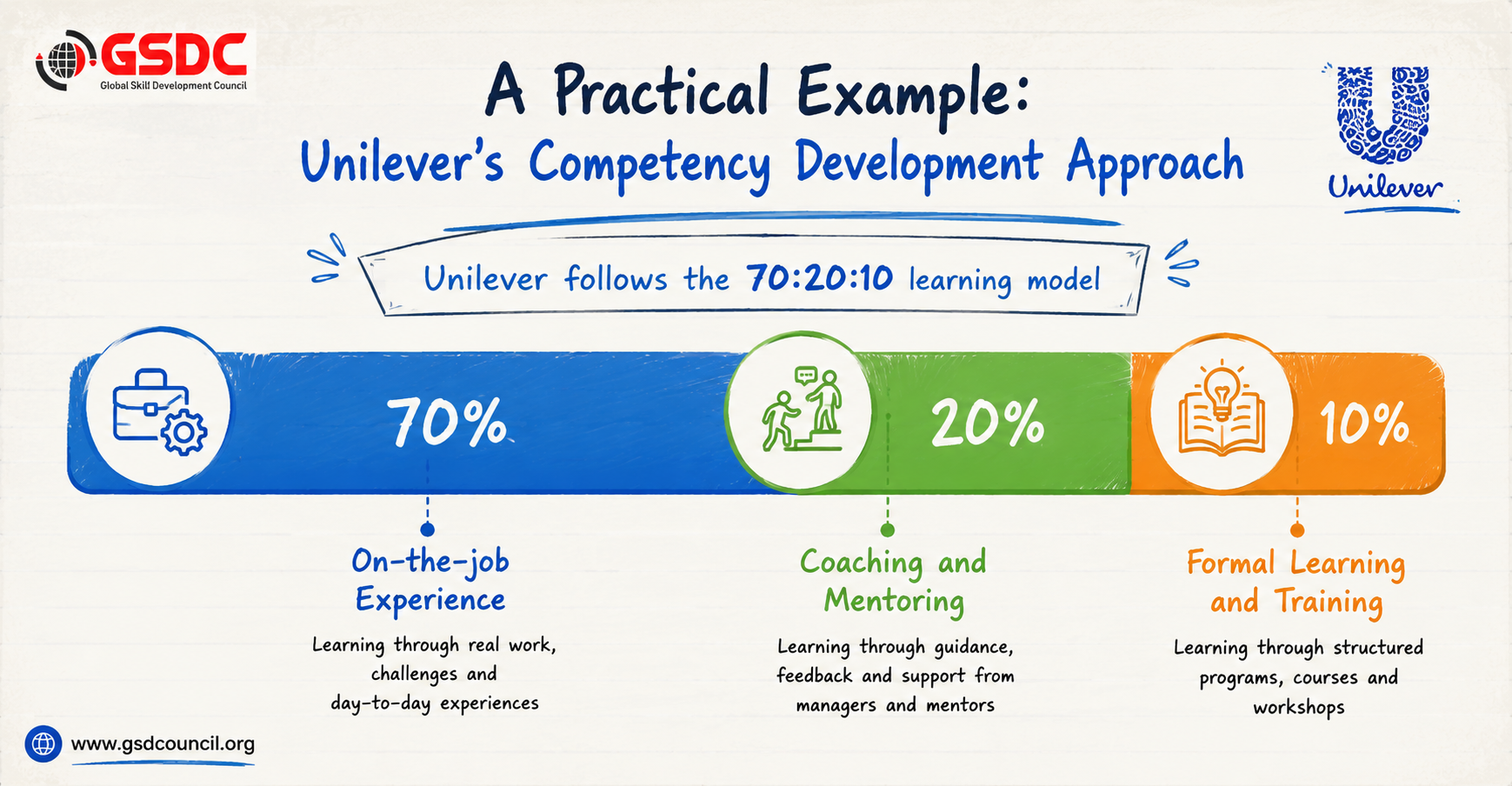
This balanced approach enables employees to apply new skills in real work environments while receiving continuous support from experienced leaders. The result is a stronger leadership pipeline, consistent performance across global teams, and a culture of continuous learning.
Although every organization has different needs, adopting a structured learning framework similar to this can help businesses build future-ready talent and improve long-term organizational performance.
Build Leadership Competencies for Organizational Success
GSDC's Certified Leadership Development Professional helps managers, HR, and L&D professionals build the leadership competencies needed to develop high-performing teams, improve employee engagement, and drive business success. The certification strengthens strategic leadership, coaching, and workforce development skills to support long-term organizational growth.
Benefits of the Certified Leadership Development Professional (CLDP):
- Develop Practical Leadership Skills to Lead High-Performing Teams with Confidence.
- Enhance Employee Engagement & Motivation through effective coaching and communication.
- Strengthen Strategic Decision-Making to align leadership with business objectives.
- Drive Workforce Development by building a culture of continuous learning and performance.
- Advance Your Leadership Career with an industry-recognized certification that validates your leadership competencies.
Conclusion
High-performing organizations are built intentionally, not by chance. While business strategies provide direction, it is the capabilities of people that determine whether those strategies succeed. By adopting structured competency development, organizations can move beyond reactive training and create a culture of continuous learning, accountability, and performance improvement.
As workplaces continue to evolve with emerging technologies and changing business demands, organizations that prioritize competency development today will be better positioned to lead tomorrow.

Related Certifications
Frequently Asked Questions
Structured competency development is the process of identifying, assessing, developing, and measuring employee skills using a competency framework to support organizational development and business goals.
It helps build a high performance organization by improving skills development, supporting leadership development, and aligning employee capabilities with business objectives.
Organizations can use a competency framework, performance reviews, skills assessments, 360-degree feedback, and a competency management system to identify development needs.
Leaders should identify whether issues relate to skills, behavior, or role fit, then use coaching, learning and development, employee development, or performance management to improve performance.
Unilever's 70:20:10 model highlights how talent development, practical learning, coaching, and a strong leadership competency framework build future-ready leaders and high-performing teams.
Stay up-to-date with the latest news, trends, and resources in GSDC
If you like this read then make sure to check out our previous blogs: Cracking Onboarding Challenges: Fresher Success Unveiled
Not sure which certification to pursue? Our advisors will help you decide!