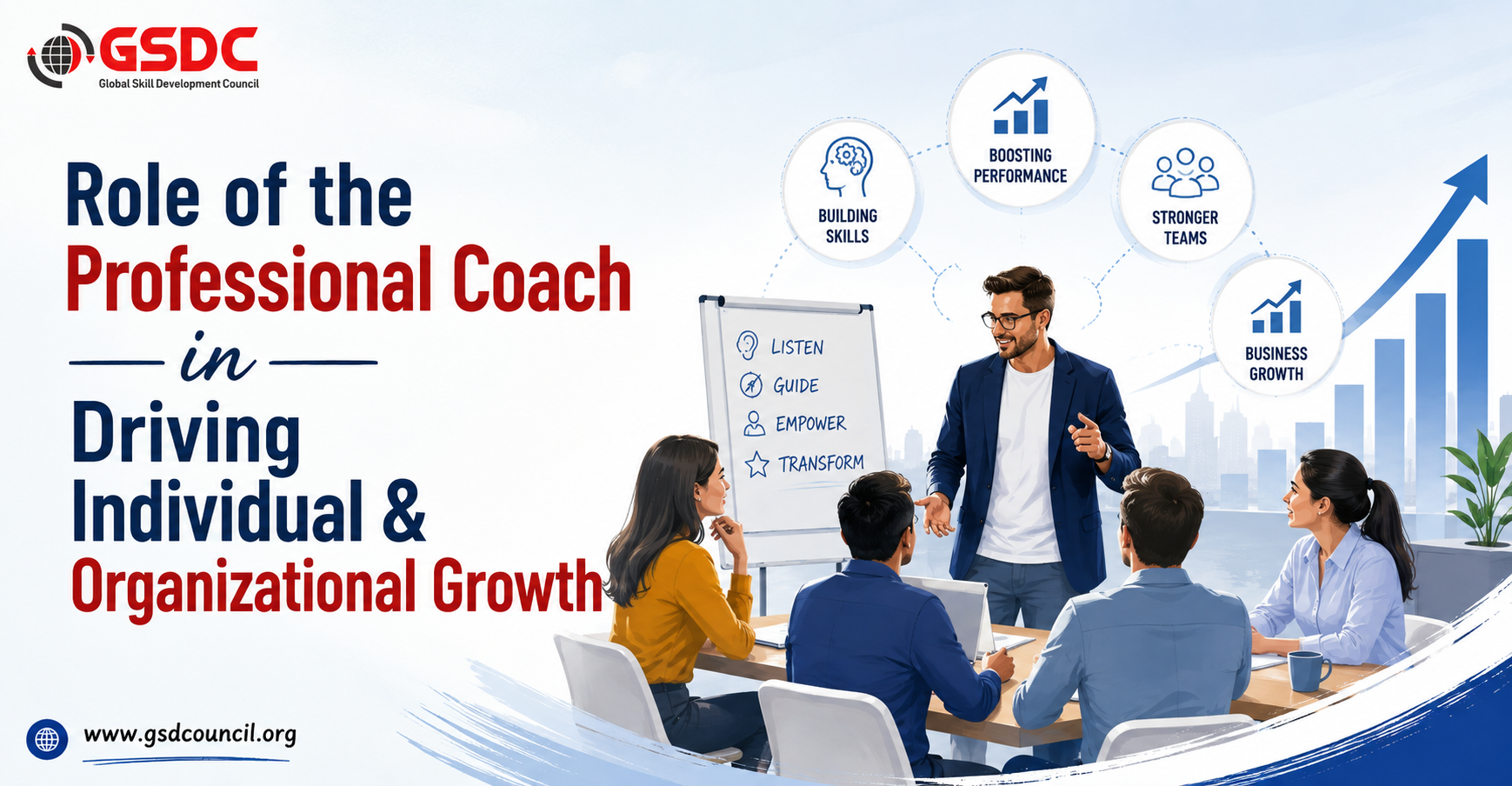
Role of the Professional Coach in Driving Individual & Organizational Growth
Written by Treasure Kalu
- Why Organizations Need More Coaches and Fewer Command-and-Control Managers
- What Professional Coaching Really Means
- Coaching, Mentoring, Training, and Management: Understanding the Difference
- The Three Levels of Impact Created by Professional Coaching
- Four Coaching Skills Every Leader Should Develop
- The GROW Framework: A Practical Coaching Tool for Leaders
- Building a Coaching Culture Across the Organization
- Develop Coaching-Oriented Leadership Skills with GSDC's Certified Leadership Development Professional
- What Organizations Can Learn from Microsoft
- Conclusion
Imagine two leaders managing teams with similar goals, resources, and opportunities. One leader spends every day solving problems and providing answers. The other takes a different approach, asking thoughtful questions, encouraging reflection, and helping employees find solutions on their own. Over time, the difference becomes clear. While one team remains dependent on its manager, the other grows more confident, capable, and independent.
This simple example highlights why professional coaching and leadership coaching are becoming essential leadership capabilities rather than just management techniques. In today's fast-changing business environment, organizations need leaders who can develop people, not just manage tasks. As workplaces evolve with digital transformation, AI, and shifting workforce expectations, coaching strengthens employee engagement, supports organizational development, and empowers employees to think critically, take ownership, and continuously improve.
This blog explores how professional coaching helps unlock individual potential, strengthen teams, accelerate organizational growth, and create a culture that drives long-term business success.
Why Organizations Need More Coaches and Fewer Command-and-Control Managers
The demands placed on today's workforce are very different from those of the past. Employees are expected to solve complex problems, adapt quickly, and make decisions independently. As a result, traditional management approaches are becoming less effective.
Traditional Manager | Coaching-Oriented Leader |
Provides answers | Asks questions |
Directs work | Develops capability |
Focuses on immediate results | Focuses on long-term growth |
Solves problems for employees | Helps employees solve problems themselves |
Creates dependency | Builds independence |
This shift reflects a broader organizational need. Modern businesses require employees who can think critically, take ownership, and adapt to changing circumstances. Coaching helps develop these capabilities by focusing on growth rather than instruction.
Organizations that embrace coaching often create teams that are more engaged, resilient, and prepared to navigate change.
What Professional Coaching Really Means
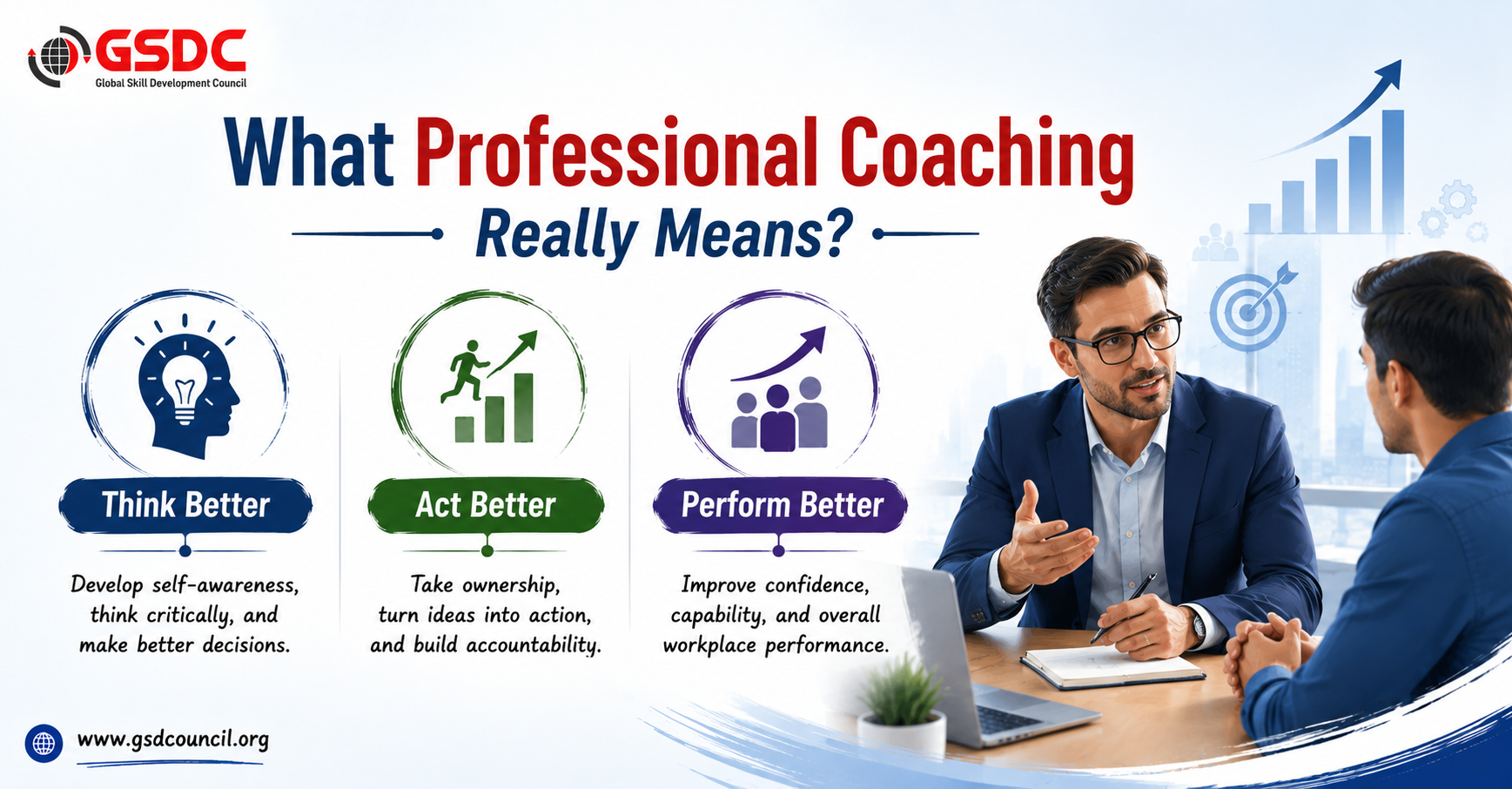
At its core, professional coaching helps people think better, act better, and perform better.
Think Better
Coaching encourages reflection, self-awareness, and critical thinking. Individuals learn to examine challenges from different perspectives and make more informed decisions.
Act Better
Through coaching, individuals identify practical actions, take ownership of commitments, and develop greater accountability.
Perform Better
As thinking and actions improve, performance often improves as well. Employees become more effective, confident, and capable in their roles.
Unlike mentoring, training, or management, coaching focuses less on providing answers and more on helping individuals discover their own solutions. The goal is to create sustainable growth and independence rather than reliance on external guidance.
Coaching, Mentoring, Training, and Management: Understanding the Difference
One reason coaching is often misunderstood is that it shares similarities with other leadership and development activities. While management, mentoring, training, and coaching all contribute to employee growth, they achieve it in different ways.
Role | Primary Focus |
Manager | Directs work, sets expectations, and monitors performance |
Mentor | Shares experience, guidance, and career advice |
Trainer | Builds knowledge and teaches specific skills |
Coach | Helps individuals think, learn, and develop their own solutions |
The key difference lies in how development occurs.
A manager provides direction to ensure work is completed effectively. A mentor shares personal experiences to guide someone’s growth, while a trainer builds specific skills and knowledge.
A professional coach, however, focuses on unlocking potential. Rather than providing answers, coaches help individuals explore challenges, identify opportunities, and develop their own solutions. This approach builds confidence, accountability, and long-term capability.
Understanding these distinctions helps organizations apply each approach effectively while recognizing the value of professional coaching and leadership development coaching in supporting leadership development, employee engagement, and organizational growth.
The Three Levels of Impact Created by Professional Coaching
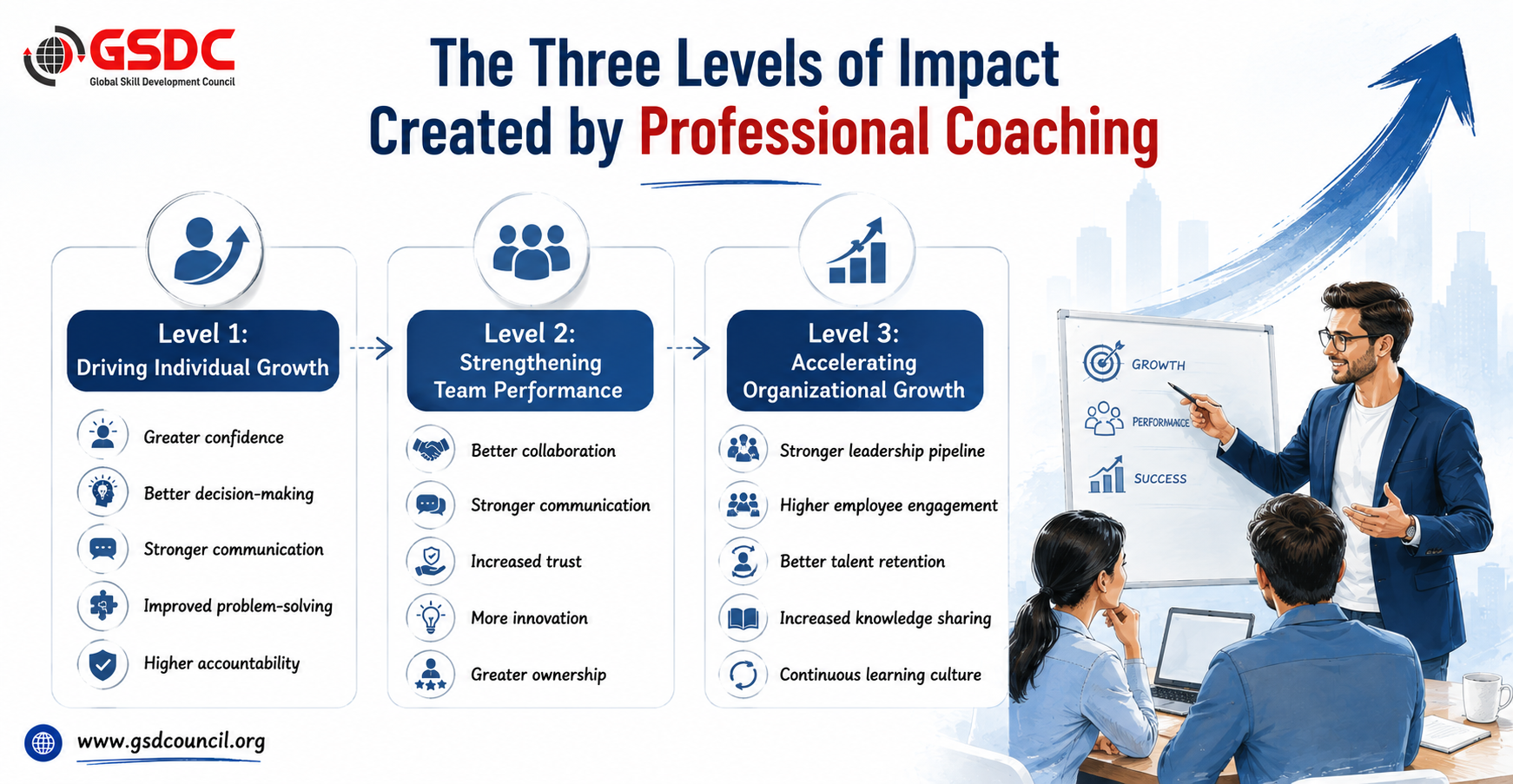
One of the most valuable aspects of professional coaching is that its impact extends far beyond individual development. While coaching often begins with a one-on-one conversation, its effects can influence teams, leadership pipelines, and even organizational development.
Level 1: Driving Individual Growth
The first and most visible impact of leadership coaching occurs at the individual level. Through structured reflection, guided questioning, and accountability, coaching helps individuals better understand their strengths, challenges, and opportunities for growth. As a result, employees often develop:
- Greater confidence
- Stronger decision-making abilities
- Improved communication skills
- Better problem-solving capabilities
- Increased ownership and accountability
These improvements help individuals perform more effectively in their current roles while preparing them for future responsibilities, career coaching, and leadership growth.
Level 2: Strengthening Team Performance
The impact of coaching becomes even more powerful when leaders apply coaching principles across their teams. Rather than creating dependency, coaching encourages employees to think independently, contribute ideas, and take greater ownership of outcomes. Teams led by coaching-oriented leaders often experience:
- Stronger collaboration
- More effective communication
- Higher levels of trust
- Greater initiative and innovation
- Reduced dependence on managers
As employees become more confident and capable, teams improve employee engagement, adapt to change, and achieve stronger performance.
Level 3: Accelerating Organizational Growth
When coaching becomes embedded within leadership practices, its influence extends beyond individuals and teams to the organization as a whole. Organizations that invest in leadership development coaching often benefit from:
- Stronger leadership pipelines
- Higher employee engagement
- Improved talent retention
- Greater knowledge sharing
- A culture of continuous learning
Over time, coaching creates an environment where people are encouraged to grow, develop, and contribute at a higher level. This strengthens workforce capability, supports performance management, and drives long-term organizational growth.
The true value of professional coaching lies in this ripple effect. What begins as an investment in individual development ultimately strengthens teams, leadership, and the entire organization.
Four Coaching Skills Every Leader Should Develop
While professional coaches undergo extensive training, leaders can significantly improve their coaching effectiveness by developing a few core skills. These skills help leaders move beyond directing work and toward developing people.
Powerful Questioning: Helping People Think for Themselves
Many leaders feel pressure to provide immediate answers whenever challenges arise. Coaches take a different approach.
Instead of solving problems for others, they ask questions that encourage deeper thinking and self-discovery. Questions such as:
- What options have you considered?
- What is preventing progress?
- What would success look like?
- What can you do differently?
help individuals explore possibilities, evaluate alternatives, and strengthen their decision-making capabilities. Over time, this creates more independent and confident employees.
Active Listening: Understanding Before Responding
Listening is one of the most overlooked leadership skills.
Many people listen with the intention of replying. Coaches listen with the intention of understanding. They focus on what is being said, what is not being said, and the underlying concerns or motivations behind the conversation.
Effective active listening involves:
- Giving full attention
- Asking clarifying questions
- Observing verbal and nonverbal cues
- Seeking to understand different perspectives
When people feel genuinely heard, coaching conversations become more productive, meaningful, and impactful.
Feedback That Builds Rather Than Breaks
Feedback is one of the most powerful tools available to a coach, but only when it is delivered effectively.
The goal of feedback is not criticism. The goal is growth.
Strong coaching feedback:
- Recognizes strengths
- Identifies development opportunities
- Encourages reflection
- Supports continuous improvement
When delivered constructively, feedback helps individuals build confidence while also improving performance.
Accountability: Turning Insight into Action
Insight alone rarely creates change.
Coaching becomes valuable when conversations lead to action, commitment, and measurable progress. Effective professional coaches help individuals define next steps, establish clear commitments, and take ownership of their development.
Without accountability, coaching can become an interesting discussion that never produces meaningful results. With accountability, leadership coaching becomes a catalyst for sustained growth, improved performance management, and continuous improvement.
Together, these four skills help leaders create coaching conversations that solve immediate challenges while strengthening long-term capability, employee engagement, and organizational growth.
The GROW Framework: A Practical Coaching Tool for Leaders
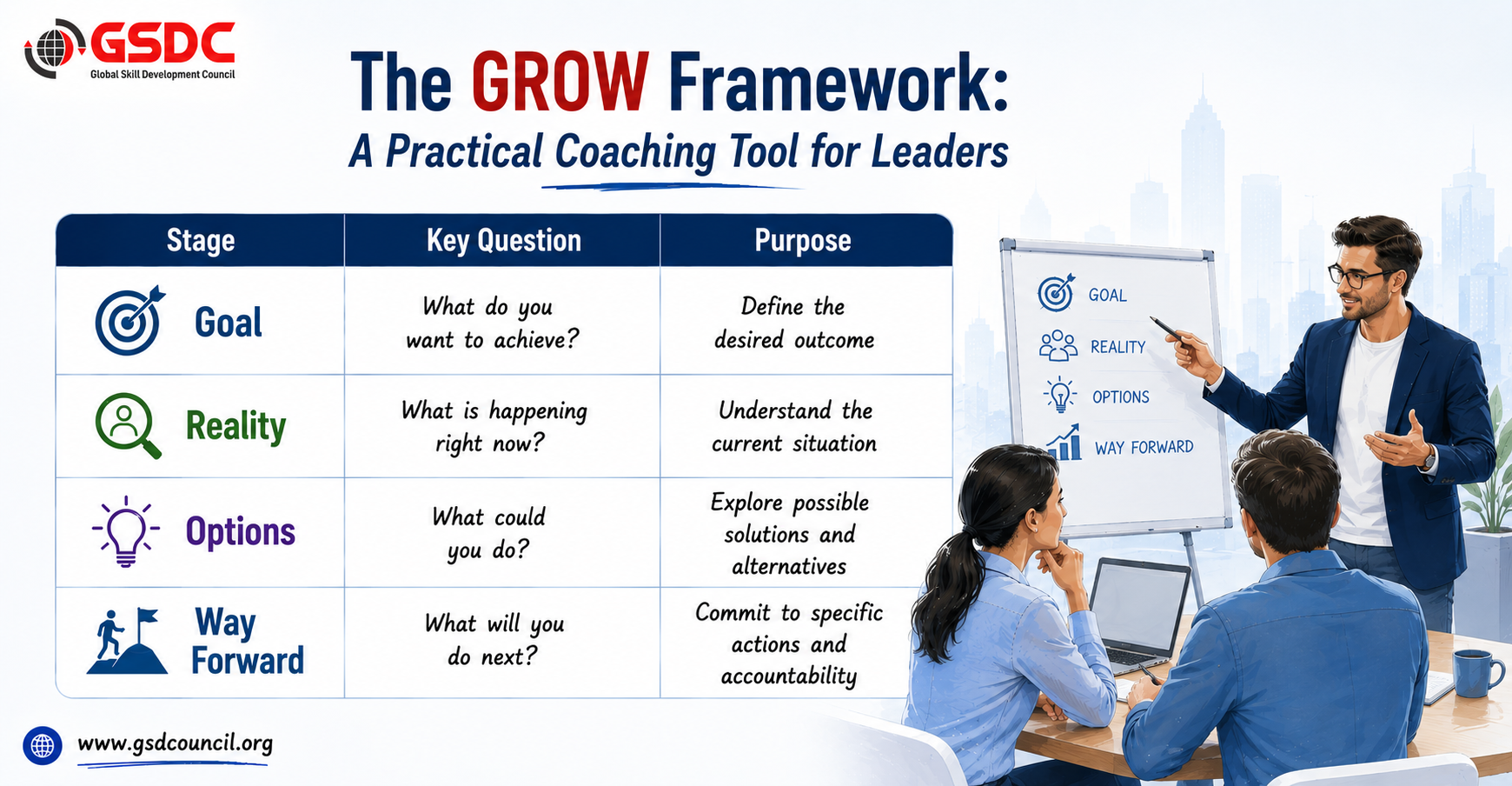
One of the most widely used coaching models is the GROW framework. Its strength lies in its simplicity. Rather than jumping directly to solutions, the framework helps leaders guide structured conversations that encourage reflection, ownership, and action. The framework is particularly effective because it encourages employees to think through challenges rather than relying on managers to provide immediate answers.
For example, imagine an employee who is consistently missing project deadlines.
Instead of immediately offering solutions, a coaching-oriented leader might guide the conversation using the GROW framework:
- Goal: What would successful project delivery look like?
- Reality: What factors are currently causing delays?
- Options: What different approaches could help improve timelines?
- Way Forward: Which actions will you commit to before our next discussion?
This approach helps employees develop problem-solving skills, take ownership of outcomes, and build confidence in their decision-making abilities.
The GROW framework demonstrates a fundamental principle of coaching: the objective is not to provide answers but to help individuals discover solutions for themselves.
Building a Coaching Culture Across the Organization
Individual coaching creates meaningful change, but organizations achieve lasting impact when coaching becomes part of the culture. This requires intentional leadership and consistent reinforcement.
Key Practices:
- Train Managers to Coach: Shift leaders from directing work to developing people.
- Integrate Coaching Daily: Make coaching part of regular one-on-ones and performance conversations.
- Reward Initiative: Recognize ownership, problem-solving, and independent thinking.
- Provide Continuous Feedback: Offer regular feedback to support ongoing learning and improvement.
When coaching is embedded into leadership practices, organizations build stronger individuals, higher-performing teams, and a more resilient workforce.
Develop Coaching-Oriented Leadership Skills with GSDC's Certified Leadership Development Professional
GSDC's Certified Leadership Development Professional equips managers, HR, and L&D professionals with the leadership and coaching skills needed to develop people, strengthen team performance, and foster a culture of continuous learning.
The Certified Leadership Development Professional certification prepares leaders to build high-performing teams, improve employee engagement, and drive sustainable organizational growth.
Learning Objectives
- Develop a coaching mindset to lead and empower high-performing teams.
- Strengthen communication, active listening, and powerful questioning skills.
- Apply coaching frameworks to improve employee performance and accountability.
- Build a culture of continuous learning, collaboration, and feedback.
Enhance leadership effectiveness to drive team and organizational success.
What Organizations Can Learn from Microsoft
Microsoft's transformation under Satya Nadella highlights the power of coaching-oriented leadership. By shifting from a "know-it-all" to a "learn-it-all" mindset, the company fostered curiosity, collaboration, and continuous learning.
Key Takeaways:
- Encourage curiosity over having all the answers.
- Use questions to promote learning and growth.
- Build a culture of collaboration and innovation.
- Embed coaching into everyday leadership.
Microsoft's journey shows that coaching is more than a leadership skill it is an organizational capability that drives long-term growth and adaptability.
Conclusion
The most effective leaders are not always the ones with the most answers. They are often the ones who help others discover answers for themselves.
Professional coaching plays a critical role in this process. By encouraging reflection, strengthening decision-making, building accountability, and developing confidence, leadership coaching helps individuals unlock their potential and achieve higher levels of performance.
The impact extends beyond individuals. Coaching strengthens teams, develops future leaders, improves employee engagement, supports organizational development, and contributes to long-term organizational growth.
As organizations face increasing complexity and change, the ability to coach may become one of the most valuable leadership capabilities they can cultivate. Leaders who embrace leadership development coaching are not simply improving performance today they are building the people and capabilities that will drive success in the future.

Related Certifications
Frequently Asked Questions
Professional coaching helps individuals improve performance, build self-awareness, and achieve goals through guided reflection.
Mentoring provides advice based on experience, while coaching helps individuals discover their own solutions.
Coaching builds ownership, improves communication, boosts employee engagement, and creates more confident, collaborative teams.
The GROW model guides professional coaching conversations through four stages: Goal, Reality, Options, and Way Forward.
Coaching strengthens leadership, improves performance management, boosts employee engagement, and fosters a culture of continuous learning that supports organizational growth.
Stay up-to-date with the latest news, trends, and resources in GSDC
If you like this read then make sure to check out our previous blogs: Cracking Onboarding Challenges: Fresher Success Unveiled
Not sure which certification to pursue? Our advisors will help you decide!