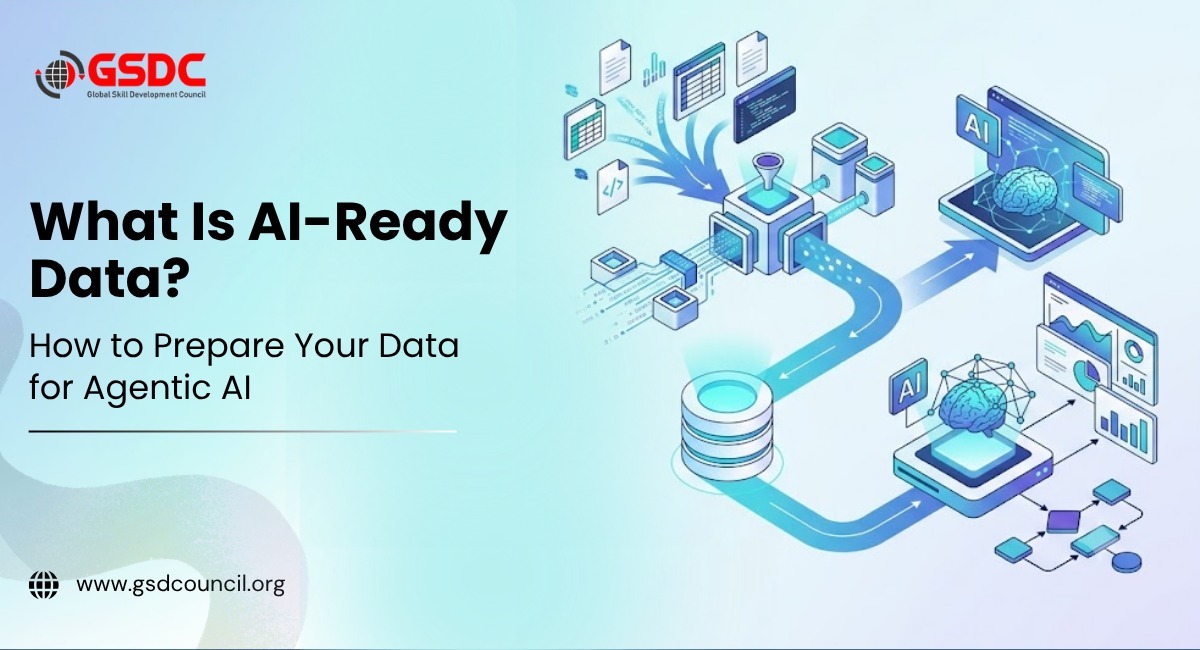
How to Use AI in GRC for Smarter Governance and Risk Management?
Written by Emily Hilton
- What Is AI in GRC?
- Why Use AI in Risk Management?
- AI Use Cases in Risk Management
- Using AI for Smarter Compliance
- AI Use Cases in Compliance
- What Is an AI GRC Platform?
- Choosing AI GRC Tools
- How to Implement AI in GRC
- Challenges of Using AI in GRC
- Measuring the Benefits of AI in GRC
- The Future of AI in GRC
- Conclusion
Governance, Risk, and Compliance (GRC) has traditionally depended on periodic assessments, manual evidence collection, spreadsheets, control testing, and compliance reviews. But organizations today operate in an environment where risks can emerge faster than traditional GRC processes can respond.
Cyber threats evolve continuously. Regulations change rapidly. Third-party ecosystems are becoming more complex. At the same time, organizations are deploying generative AI, AI agents, cloud platforms, and automated decision systems that introduce new categories of risk.
This is why AI in risk management is becoming an important part of modern GRC strategies.
Artificial intelligence can help GRC teams analyze large volumes of information, detect anomalies, identify emerging risks, automate repetitive compliance activities, and support faster decision-making. The objective is not simply to replace manual GRC processes with AI, but to create a more intelligent, continuous, and risk-aware operating model.
NIST's AI Risk Management Framework provides a useful foundation for organizations seeking to manage AI-related risks across the lifecycle, using the core functions Govern, Map, Measure, and Manage.
What Is AI in GRC?
AI in GRC refers to the use of artificial intelligence, machine learning, generative AI, natural language processing, predictive analytics, and AI-enabled automation across governance, risk, and compliance activities.
Traditional GRC typically focuses on documenting known risks and verifying whether controls are operating effectively.
AI-enabled GRC can go further by analyzing information continuously and identifying relationships or patterns that may indicate emerging risks.
For example, an AI system could analyze audit findings, security events, regulatory updates, vendor assessments, policies, and incident reports to identify potential connections between different risk areas.
This creates a shift from reactive GRC to intelligent risk management.
Why Use AI in Risk Management?
One of the most valuable applications of AI is helping organizations understand risk faster and at greater scale.
Traditional risk assessments can require teams to collect information from multiple departments, manually review documentation, assess risk scores, and update risk registers. This process can be time-consuming and may become outdated quickly.
With AI in risk management, organizations can automate or accelerate many of these activities.
AI can help:
- Identify potential risk signals
- Detect anomalies and unusual activity
- Analyze historical risk data
- Prioritize high-impact risks
- Identify relationships between risks
- Support predictive analysis
- Monitor risk indicators
- Generate risk summaries
- Recommend potential responses
- Continuously update risk information
This is particularly useful in AI in enterprise risk management, where organizations need to understand how technology, operational, financial, cyber, regulatory, and third-party risks interact.
AI Use Cases in Risk Management
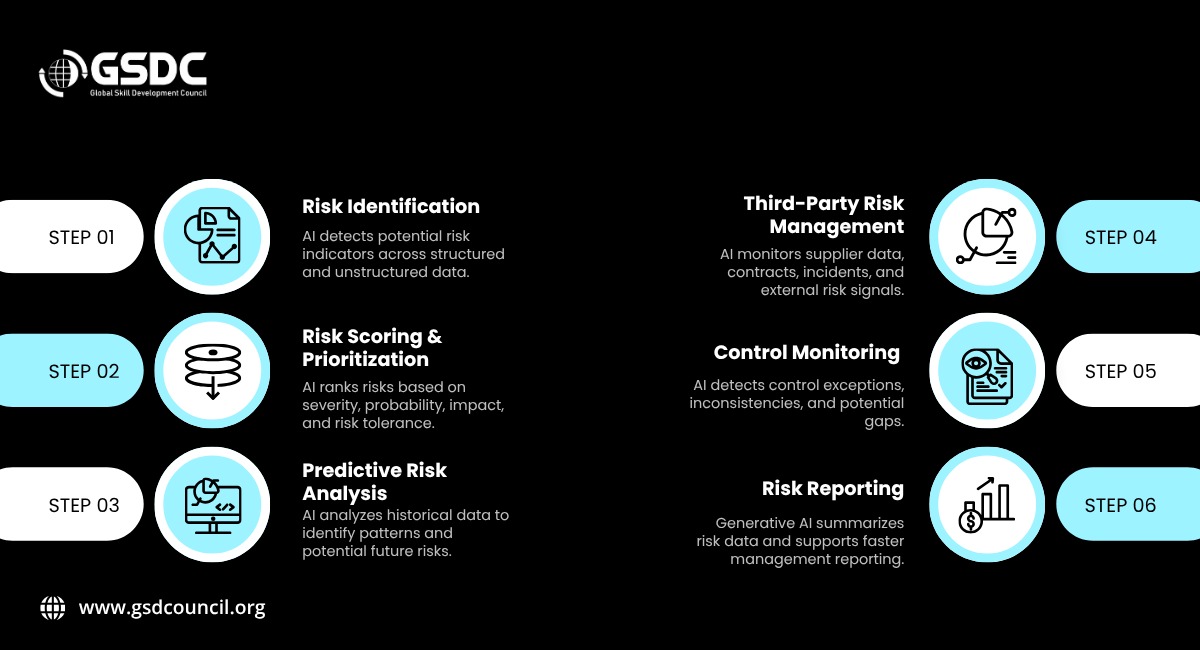
The AI use cases in risk management extend across multiple areas of enterprise GRC.
1. Risk Identification
AI can analyze structured and unstructured information to identify potential risk indicators that may not be immediately visible to risk teams.
2. Risk Scoring and Prioritization
AI can evaluate multiple risk factors and help organizations prioritize issues based on severity, probability, business impact, and risk tolerance.
3. Predictive Risk Analysis
Historical data can be analyzed to identify patterns that may indicate future incidents or risk events.
4. Third-Party Risk Management
AI can analyze supplier information, contracts, assessments, incidents, and external signals to support more continuous third-party risk monitoring.
5. Control Monitoring
AI can help identify control exceptions, inconsistencies, and potential gaps across large datasets.
6. Risk Reporting
Generative AI can summarize complex risk information and create management-level reports, allowing risk professionals to spend more time on analysis and decision-making.
NIST's guidance also emphasizes ongoing monitoring because AI system performance and trustworthiness can change after deployment, potentially creating new risks or degrading system value.
Using AI for Smarter Compliance
Compliance is another area where AI can significantly reduce repetitive work.
Compliance teams often need to monitor regulatory changes, interpret requirements, map them to controls, collect evidence, conduct assessments, and prepare for audits.
An AI compliance software solution can help automate parts of this workflow.
AI can analyze regulatory documents, identify relevant requirements, compare policies against obligations, and help compliance teams determine where updates may be necessary.
However, organizations should distinguish between AI-assisted compliance and fully automated compliance decisions. Regulatory interpretation and high-impact decisions may still require qualified human review.
AI Use Cases in Compliance
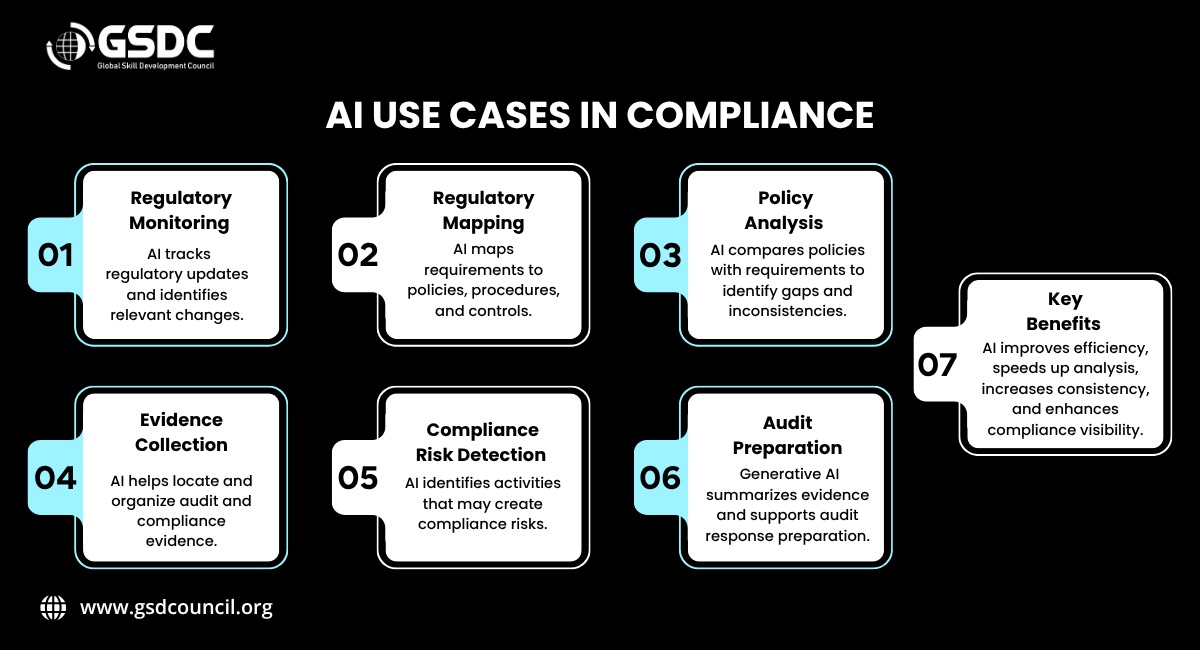
The AI use cases in compliance are increasingly diverse.
Regulatory Monitoring
AI can monitor large volumes of regulatory information and identify updates relevant to a specific organization or industry.
Regulatory Mapping
AI can help map regulatory requirements to policies, procedures, and controls.
Policy Analysis
Natural language processing can compare policies with requirements and identify potential inconsistencies or gaps.
Evidence Collection
AI-powered workflows can help locate and organize evidence needed for audits and assessments.
Compliance Risk Detection
AI can analyze operational information to identify activities that may create compliance exposure.
Audit Preparation
Generative AI can summarize evidence, organize documentation, and help teams prepare responses to audit requests.
These capabilities represent some of the key benefits of AI in compliance: improved efficiency, faster analysis, greater consistency, and better visibility into compliance gaps.
What Is an AI GRC Platform?
An AI GRC platform combines traditional GRC capabilities with AI-powered analysis and automation.
Instead of managing risk registers, controls, policies, audits, and compliance activities separately, an AI-enabled platform can connect these information sources.
A modern platform may include capabilities such as:
- Risk management
- Compliance management
- Policy management
- Audit management
- Control testing
- Third-party risk management
- Regulatory intelligence
- AI risk management
- Automated workflows
- Predictive analytics
- Generative AI assistants
The objective is to create a connected view of organizational risk rather than isolated GRC processes.
Choosing AI GRC Tools
Organizations evaluating AI GRC tools should avoid selecting technology based solely on the presence of an "AI-powered" label.
Important evaluation criteria include:
Data Integration
Can the platform connect with existing business, security, compliance, and risk systems?
Explainability
Can users understand how AI-generated recommendations or risk assessments were produced?
Governance
Does the platform provide appropriate controls for AI usage, access, accountability, and oversight?
Security and Privacy
How is organizational data protected? What information is processed by AI models, and where?
Human Oversight
Can professionals review, challenge, approve, or override AI-generated recommendations?
Scalability
Can the platform support the organization's evolving risk and compliance requirements?
Regulatory Alignment
Does it support relevant frameworks, standards, and regulatory requirements?
Organizations should also evaluate whether AI functionality is genuinely improving a GRC process rather than simply adding another technology layer.
How to Implement AI in GRC
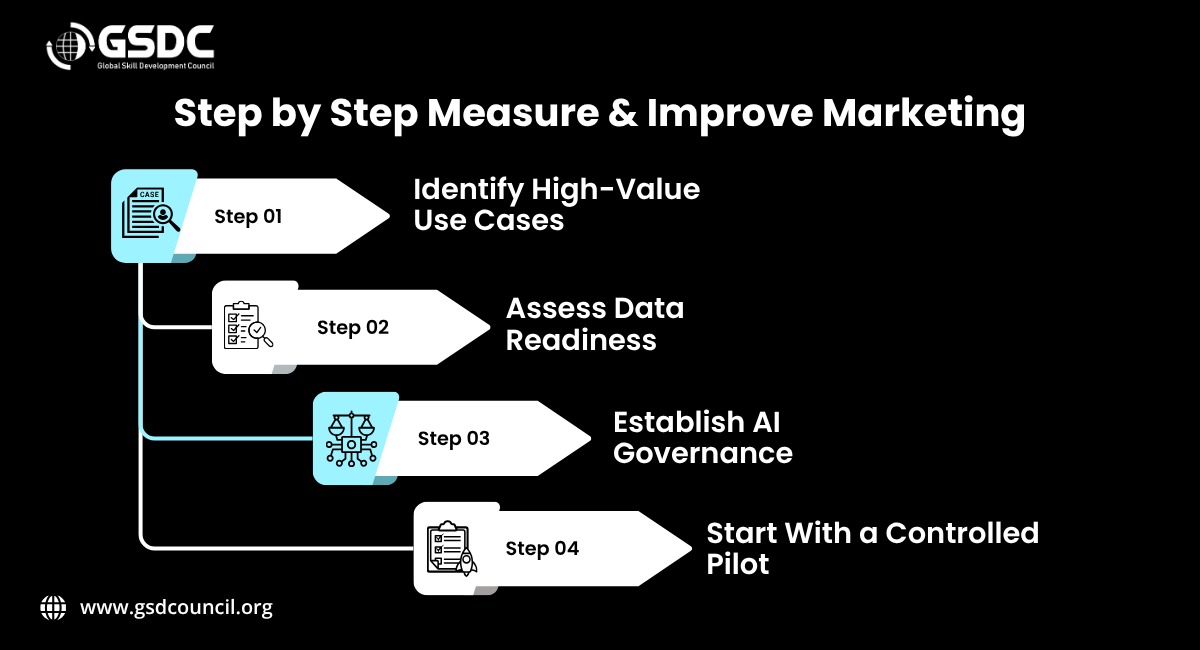
Successful implementation should begin with business and risk objectives rather than technology.
Step 1: Identify High-Value Use Cases
Start by identifying repetitive, data-intensive, or time-consuming GRC activities where AI can provide measurable value.
Examples include regulatory monitoring, risk classification, evidence collection, control testing, and reporting.
Step 2: Assess Data Readiness
AI depends heavily on the quality, accessibility, and governance of organizational data.
Review where risk and compliance information is stored, whether data is accurate, and whether systems can be integrated.
Step 3: Establish AI Governance
Define ownership, approval processes, acceptable AI usage, security requirements, data controls, monitoring procedures, and escalation mechanisms.
NIST's AI RMF is structured around Govern, Map, Measure, and Manage, providing organizations with a practical way to structure AI risk activities.
Step 4: Start With a Controlled Pilot
Rather than deploying AI across every GRC process immediately, select one or two high-value use cases.
Measure improvements in efficiency, accuracy, response time, risk visibility, and user experience.
Step 5: Maintain Human Oversight
AI should support GRC professionals rather than eliminate accountability.
Human review is particularly important for high-risk decisions involving regulatory interpretation, significant business impact, privacy, security, or ethical considerations.
Step 6: Monitor AI Performance
AI systems themselves need ongoing monitoring.
NIST recommends post-deployment monitoring and mechanisms for identifying performance degradation, unexpected behavior, attacks, near misses, and other impacts.
Challenges of Using AI in GRC
Although AI provides significant opportunities, implementation also introduces challenges.
Data Quality
Poor-quality or incomplete data can produce unreliable recommendations.
Explainability
Risk professionals need to understand why an AI system produced a particular recommendation.
AI Hallucinations
Generative AI may produce inaccurate information, making validation essential for compliance and risk workflows.
Privacy
Sensitive business, employee, customer, and regulatory information requires appropriate protection.
Model Risk
AI models can change, drift, or behave differently when conditions change.
Over-Automation
Organizations should avoid allowing AI to make high-impact decisions without appropriate human oversight.
NIST specifically notes that AI system performance and trustworthiness can change over time, reinforcing the importance of monitoring and risk controls throughout the system lifecycle.
Measuring the Benefits of AI in GRC
Organizations should define measurable outcomes before implementing AI.
Useful metrics can include:
- Time required for risk assessments
- Compliance monitoring time
- Number of automated workflows
- Control-testing efficiency
- Time required to collect audit evidence
- Number of detected risk anomalies
- False-positive rates
- Risk response time
- Compliance issue resolution time
- Cost per assessment
The goal should be measurable improvement rather than AI adoption for its own sake.
The Future of AI in GRC
AI is reshaping GRC by enabling continuous risk monitoring, predictive risk analysis, automated control testing, intelligent regulatory mapping, and AI-powered audit support. As organizations increasingly adopt autonomous and agentic AI systems, GRC teams will also need stronger capabilities to govern AI-driven decisions, risks, and compliance requirements.
This growing shift highlights the need for professionals who understand both AI and GRC. The GSDC Certified AI GRC Professional Certification helps professionals build practical knowledge across AI governance, AI risk management, compliance, responsible AI, and emerging AI-related risks. Certified AI GRC Professional Certification supports professionals in developing the skills needed to establish effective AI governance and align AI adoption with organizational objectives and regulatory expectations.
The future of AI in GRC is not about replacing GRC professionals. It is about combining human expertise with intelligent technology to make governance more proactive, risk management more predictive, and compliance more adaptive.
Conclusion
AI is transforming GRC from a largely periodic and documentation-focused function into a more continuous, data-driven, and intelligent discipline.
From AI in risk management and enterprise risk analysis to regulatory monitoring and AI compliance software, organizations can use artificial intelligence to identify risks earlier, automate repetitive activities, improve compliance visibility, and support better decisions.
However, successful AI adoption requires more than purchasing an AI GRC platform or implementing a collection of AI GRC tools. Organizations need strong data foundations, clear governance, human oversight, appropriate security controls, and continuous monitoring.
The organizations that approach AI strategically can use it not only to reduce GRC workloads but also to strengthen risk intelligence, improve resilience, and make governance a more proactive part of business decision-making.

Related Certifications
Frequently Asked Questions
AI is used to identify emerging risks, analyze historical data, detect anomalies, prioritize risks, monitor indicators, support predictive analysis, and generate risk insights for decision-makers
Key use cases include regulatory monitoring, regulatory mapping, policy analysis, compliance gap identification, evidence collection, control monitoring, and audit preparation.
AI compliance software uses artificial intelligence to support activities such as regulatory monitoring, compliance analysis, control mapping, evidence management, and identifying potential compliance gaps.
Organizations should evaluate data integration, security, privacy, explainability, AI governance, human oversight, scalability, regulatory support, and the platform's ability to integrate with existing GRC processes.
AI can automate repetitive and data-intensive GRC activities, but it should not eliminate human accountability. Professionals remain important for judgement, regulatory interpretation, risk decisions, escalation, governance, and oversight.
Stay up-to-date with the latest news, trends, and resources in GSDC
If you like this read then make sure to check out our previous blogs: Cracking Onboarding Challenges: Fresher Success Unveiled
Not sure which certification to pursue? Our advisors will help you decide!