GRC Framework: Key Components, Benefits and Best Practices
Written by Emily Hilton
- What Is a GRC Framework?
- Key Components of GRC
- GRC Framework Diagram
- GRC Frameworks List: Popular Frameworks and Standards
- How Does GRC Risk Assessment Work?
- GRC Implementation: How to Build a GRC Program
- GRC Technology: Why It Matters
- GRC Roles and Responsibilities
- Benefits of a GRC Framework
- GRC Certification and Career Opportunities
- How to Become a GRC Analyst
- Choosing the Right GRC Framework
- The Future of GRC
- Conclusion
Organizations today must manage more than day-to-day business operations. Cybersecurity threats, regulatory requirements, data privacy concerns, third-party risks, and technology changes can all affect business performance. Without a structured approach, governance, risk, and compliance activities can become disconnected across departments.
This is where a GRC framework can help.
A GRC framework provides a structured approach for aligning governance, risk management, and compliance with business objectives. It helps organizations define responsibilities, identify risks, implement controls, monitor compliance, and make informed decisions.
This guide explains the GRC framework components, common GRC frameworks, implementation steps, benefits, technology, roles, and career opportunities.
What Is a GRC Framework?
A GRC framework is a structured approach that helps an organization manage governance, risk, and compliance activities in an integrated way.
The three GRC pillars work together:
- Governance establishes policies, responsibilities, and decision-making.
- Risk management identifies, assesses, and manages organizational risks.
- Compliance ensures adherence to applicable laws, regulations, standards, and policies.
GRC is not limited to cybersecurity. It can cover financial risk, privacy, IT, third-party risk, operational risk, business continuity, and regulatory requirements.
The goal is to create a consistent approach where business objectives, risks, controls, and compliance obligations are connected.
Key Components of GRC
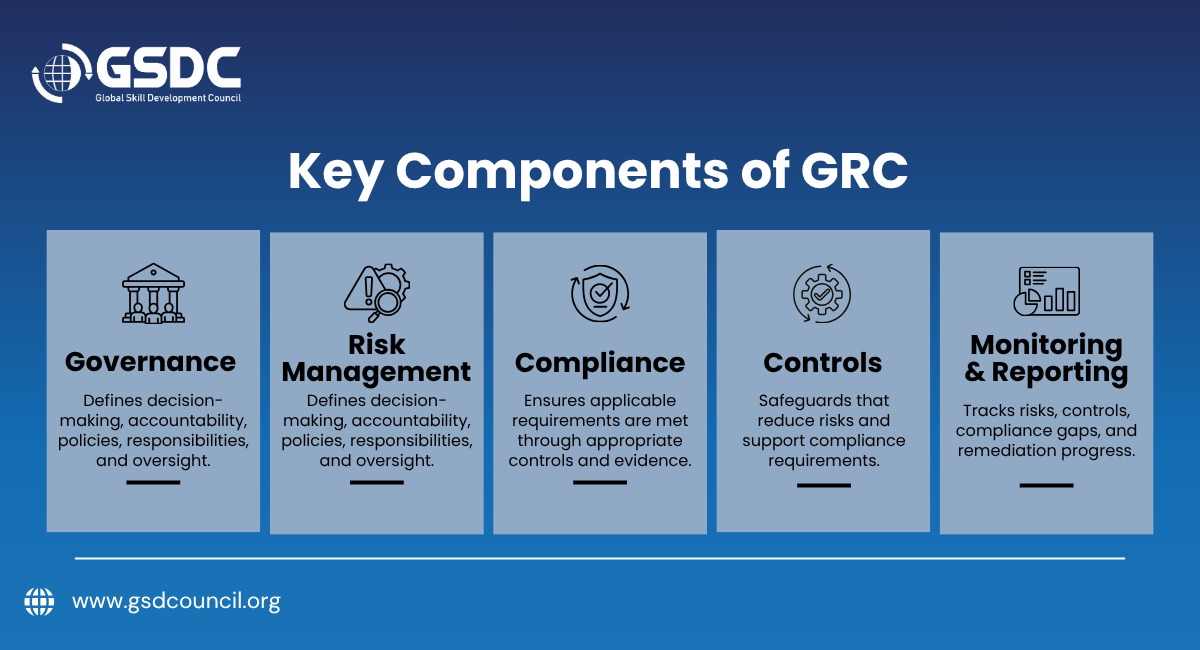
The Key Components of GRC can vary depending on an organization's industry and objectives, but most GRC programs include several common elements.
1. Governance
Governance defines how decisions are made and who is accountable for them. It includes policies, procedures, organizational responsibilities, oversight, and risk appetite.
2. Risk Management
Risk management involves identifying potential threats, evaluating their likelihood and impact, prioritizing them, and determining appropriate responses.
3. Compliance
Compliance involves identifying applicable requirements and ensuring that the organization has appropriate controls and evidence to demonstrate adherence.
4. Controls
Controls are safeguards designed to reduce risks or meet specific requirements. They can include technical controls, policies, procedures, approvals, monitoring, and audits.
5. Monitoring and Reporting
Organizations need ongoing visibility into risks, controls, compliance gaps, and remediation activities. Reporting helps management understand the organization's current risk position.
GRC Framework Diagram
A simple GRC framework diagram can be represented as:
Business Objectives → Governance → Risk Assessment → Controls → Compliance → Monitoring → Continuous Improvement
This illustrates that GRC is not a one-time exercise. Organizations continuously assess risks, review controls, monitor requirements, and improve their processes.
NIST similarly emphasizes continuous monitoring and structured risk management as important elements of managing security and privacy risk.
GRC Frameworks List: Popular Frameworks and Standards
There is no single universal GRC framework that every organization must follow. Organizations often use multiple frameworks and standards based on their industry, risk profile, and regulatory requirements.
A GRC frameworks list may include:
- NIST Cybersecurity Framework (CSF) — Helps organizations manage cybersecurity risk.
- COBIT — Focuses on governance and management of enterprise IT.
- ISO/IEC 27001 — Provides requirements for an information security management system.
- COSO — Provides a framework for internal control and enterprise risk management.
- NIST Risk Management Framework (RMF) — Provides a structured approach to managing security and privacy risks.
NIST's Cybersecurity Framework provides a common language for managing cybersecurity risk and can be tailored to an organization's needs.
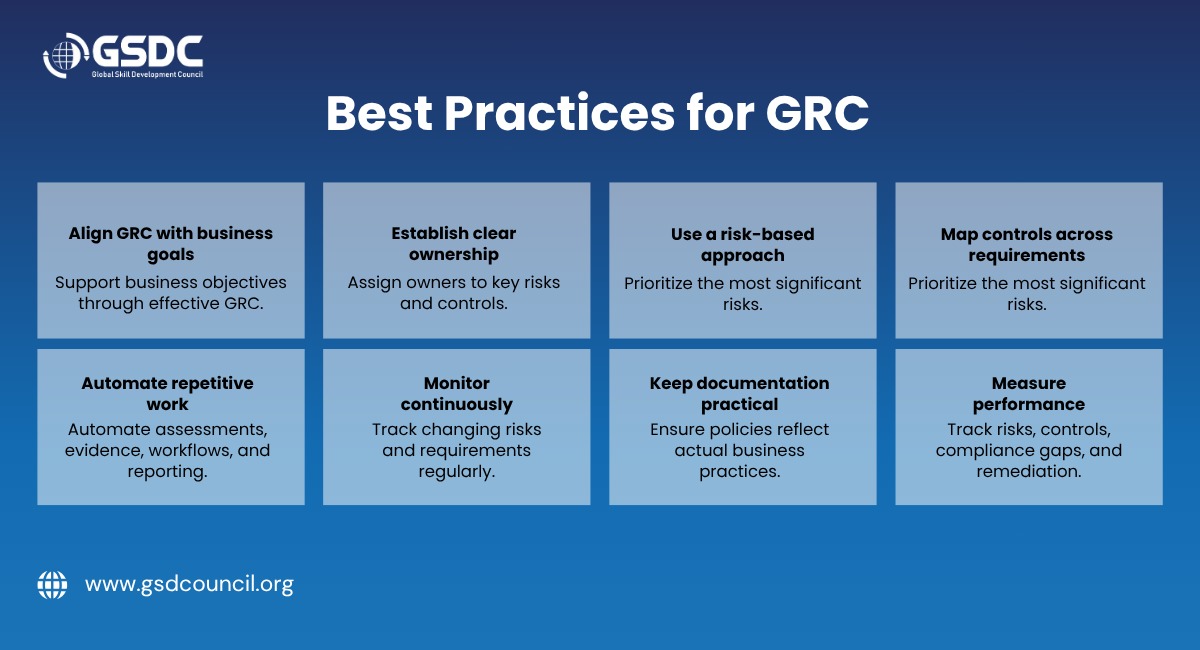
Organizations may map controls across multiple frameworks instead of managing each requirement independently. This can reduce duplication and create a more consistent control environment.
How Does GRC Risk Assessment Work?
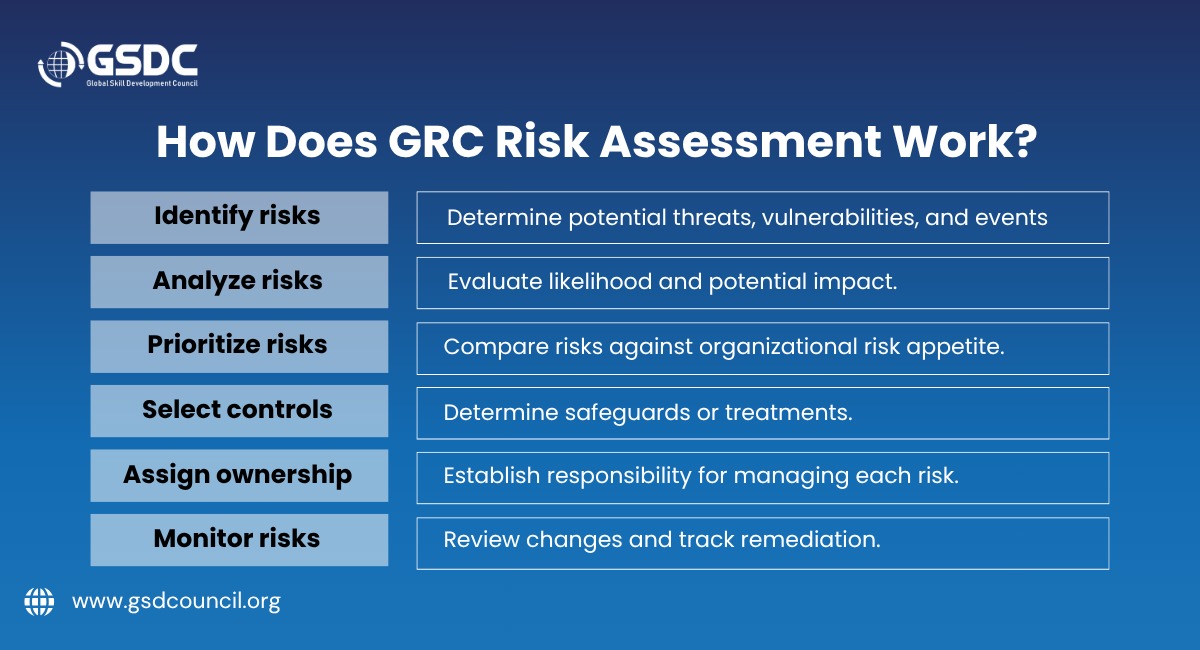
A GRC risk assessment helps organizations understand which risks could affect business objectives and how those risks should be managed.
For example, an organization introducing a cloud application may identify risks involving unauthorized access, data exposure, vendor dependency, and regulatory compliance.
The assessment helps determine which controls are needed and where additional action may be required.
NIST's Risk Management Framework uses a structured process involving categorization, control selection, implementation, assessment, authorization, and continuous monitoring.
GRC Implementation: How to Build a GRC Program
Successful GRC implementation requires more than purchasing software or creating policies. It requires clear objectives, ownership, processes, and ongoing monitoring.
Step 1: Define Business Objectives
Start by understanding what the organization wants the GRC program to achieve. Objectives might include improving regulatory compliance, reducing cybersecurity risk, strengthening audit readiness, or improving third-party risk management.
Step 2: Identify Requirements
Document relevant laws, regulations, contracts, standards, and internal policies. Determine which requirements apply to different business units and systems.
Step 3: Assess Current Risks
Perform a baseline assessment to understand existing risks, controls, gaps, and vulnerabilities.
Step 4: Define Controls
Map risks and compliance requirements to appropriate controls. Avoid creating unnecessary controls that add complexity without reducing meaningful risk.
Step 5: Assign Roles and Responsibilities
Every major risk, control, policy, and remediation activity should have clear ownership.
Step 6: Implement Technology
Organizations can use GRC technology to centralize risks, controls, policies, assessments, evidence, and reporting.
Step 7: Monitor and Improve
GRC should be continuously reviewed. Changes in regulations, technology, threats, vendors, and business processes can create new risks.
NIST notes that framework profiles and implementation planning can help organizations identify gaps and prioritize improvement activities.
GRC Technology: Why It Matters
As organizations grow, managing GRC activities through spreadsheets, emails, and disconnected documents becomes increasingly difficult.
GRC technology provides centralized tools for managing governance, risk, and compliance activities.
A GRC platform may provide capabilities such as:
- Risk registers
- Policy management
- Compliance tracking
- Control management
- Audit management
- Third-party risk management
- Issue and remediation tracking
- Evidence collection
- Regulatory monitoring
- Dashboards and reporting
The value of GRC technology is not simply automation. It can improve visibility by connecting risks, controls, requirements, owners, and evidence.
For example, if a regulation changes, a centralized GRC system can help identify which policies and controls may need to be reviewed.
Modern GRC programs are also moving toward more continuous approaches. ISACA notes that cloud-native environments and continuous deployment are creating pressure to move beyond static documentation and periodic governance processes.
GRC Roles and Responsibilities
Clearly defined GRC roles and responsibilities are essential for program effectiveness.
Common responsibilities include:
- Board and Executives: Set organizational direction, risk appetite, and oversight expectations.
- GRC Manager: Leads the GRC program, coordinates teams, and reports risk and compliance information to leadership.
- GRC Analyst: Performs assessments, manages controls, supports audits, tracks compliance requirements, and documents risks.
- Risk Manager: Identifies and evaluates organizational risks and coordinates risk treatment.
- Compliance Team: Monitors regulatory requirements and supports compliance assessments.
- Internal Audit: Independently evaluates controls and organizational processes.
- IT and Security Teams: Implement and maintain technical controls that address identified risks.
ISACA identifies governance, risk management, auditing, cybersecurity, communication, and risk analysis among the skills commonly associated with GRC roles.
Benefits of a GRC Framework
A well-designed GRC program can provide several GRC Benefits:
Better Risk Visibility
Organizations gain a clearer view of important risks and their potential business impact.
Stronger Accountability
Defined ownership ensures that risks, controls, and remediation activities do not fall between teams.
Improved Compliance
Organizations can systematically track requirements and demonstrate compliance.
Greater Audit Readiness
Centralized evidence and control documentation can make audits more efficient.
Better Decision-Making
Leadership can make decisions using consistent information about risks and controls.
Reduced Duplication
Mapping multiple requirements to common controls can reduce repetitive compliance work.
Improved Business Resilience
Organizations can better prepare for cybersecurity incidents, operational disruptions, regulatory changes, and third-party risks.
GRC Certification and Career Opportunities
As organizations invest more in governance, cybersecurity, risk, and compliance, professionals with GRC skills can pursue a range of career opportunities.
Common roles include:
- GRC Analyst
- GRC Consultant
- GRC Manager
- Risk Analyst
- Compliance Analyst
- IT Auditor
- Security Governance Specialist
- Third-Party Risk Analyst
A GRC certification can help professionals demonstrate knowledge in areas such as risk management, governance, auditing, cybersecurity, and compliance.
However, certification should be combined with practical knowledge. Professionals should understand frameworks, controls, risk assessment, documentation, communication, and business processes.
How to Become a GRC Analyst
If you are wondering how to become a GRC analyst, start by developing knowledge in cybersecurity, risk management, compliance, auditing, and governance.
Useful skills include:
- Risk assessment
- Control testing
- Policy management
- Regulatory research
- Audit support
- Cybersecurity fundamentals
- Documentation
- Communication
- Data analysis
A technical degree can be useful, but GRC careers are also accessible to professionals from audit, compliance, business analysis, IT, privacy, and risk backgrounds.
ISACA's GRC career guidance identifies risk analysis, governance, auditing, cybersecurity, communication, and management among relevant skills for the field.
Choosing the Right GRC Framework
The right framework depends on the organization's objectives, industry, risk profile, regulatory environment, and existing processes.
Before selecting a framework, consider:
- What risks does the organization need to manage?
- Which regulations and standards apply?
- What business objectives should GRC support?
- What controls already exist?
- What gaps need to be addressed?
- What level of automation is required?
- Who will own the program?
- How will effectiveness be measured?
Organizations do not necessarily need to choose one framework exclusively. A practical approach may involve using COBIT for IT governance, ISO/IEC 27001 for information security, NIST CSF for cybersecurity risk, and COSO for internal controls, depending on organizational needs.
NIST's framework guidance emphasizes flexibility and tailoring rather than prescribing one approach for every organization.
The Future of GRC
GRC is evolving as organizations adopt cloud computing, artificial intelligence, automation, and increasingly complex digital environments.
Traditional GRC programs often depend on periodic assessments and manually maintained documentation. Modern approaches increasingly focus on continuous monitoring, integrated data, automated workflows, and real-time risk visibility.
The GSDC AI in GRC Certification helps professionals understand how Artificial Intelligence can strengthen Governance, Risk, and Compliance processes. It covers practical approaches to using AI for risk identification, compliance monitoring, control assessment, policy management, data analysis, and governance decision-making. The certification is designed to help professionals connect AI capabilities with GRC frameworks, improve risk visibility, automate repetitive compliance activities, and support more effective, responsible, and data-driven organizational governance.
At the same time, organizations face overlapping regulatory requirements. ISACA recently highlighted how organizations may need to manage multiple frameworks and regulations with significant areas of overlap, increasing the need for integrated compliance approaches.
This makes GRC technology, effective frameworks, and skilled professionals increasingly important.
Conclusion
A GRC framework provides organizations with a structured way to connect governance, risk management, and compliance with business objectives.
From conducting a GRC risk assessment to defining controls, assigning GRC roles and responsibilities, implementing GRC technology, and continuously monitoring performance, every part of the program contributes to stronger organizational resilience.
There is no one-size-fits-all approach. The most effective GRC programs are aligned with business priorities, use appropriate frameworks, clearly define ownership, and continuously adapt to changing risks and requirements.
For professionals, understanding GRC frameworks can also open opportunities in risk, compliance, cybersecurity, auditing, and governance. Whether you are considering a GRC certification, exploring GRC jobs, or planning your career in this field, developing practical GRC knowledge can provide a strong foundation for long-term growth.

Related Certifications
Stay up-to-date with the latest news, trends, and resources in GSDC
If you like this read then make sure to check out our previous blogs: Cracking Onboarding Challenges: Fresher Success Unveiled
Not sure which certification to pursue? Our advisors will help you decide!