AI in GRC: The Shift Toward Intelligent Risk and Compliance
Written by Emily Hilton
- What Is AI in GRC?
- From Traditional GRC to Intelligent Risk Management
- Key Components of GRC in the AI Era
- The Rise of AI Risk Management
- AI Maturity Model: Measuring GRC Readiness
- How AI Improves GRC Benefits?
- AI and the Future of Compliance
- AI Governance Is Becoming a Core GRC Discipline
- Continuous Compliance and Risk Intelligence
- The Future of GRC and Risk Management
- Building GRC Capabilities for the AI Era
- Conclusion
Governance, Risk, and Compliance (GRC) is undergoing a major transformation. Traditional GRC programs often depend on periodic assessments, manual evidence collection, spreadsheets, static risk registers, and compliance reviews. But as organizations face faster-moving cyber threats, regulatory changes, third-party dependencies, and widespread AI adoption, these approaches are increasingly difficult to scale.
This is where AI in GRC is becoming strategically important.
Artificial intelligence can help GRC teams identify emerging risks, analyze large volumes of information, automate controls, monitor compliance, prioritize issues, and generate actionable insights. The goal is not simply to automate existing GRC activities, but to create a more connected and intelligent approach to enterprise risk.
The latest GRC trends point toward continuous oversight, AI governance, risk quantification, connected controls, and greater integration between compliance and business operations.
What Is AI in GRC?
AI in GRC refers to the application of artificial intelligence, machine learning, generative AI, analytics, and increasingly AI agents to governance, risk management, and compliance processes.
Traditional GRC generally asks:
What risks do we currently know about, and are our controls working?
AI-enabled GRC can go further by asking:
What risks are emerging, what signals indicate that they may materialize, and what action should we take now?
This shift creates opportunities for organizations to move from reactive compliance toward risk intelligence.
AI can analyze information from policies, contracts, audit findings, regulatory updates, security systems, third-party assessments, incidents, and operational data. It can then identify relationships and patterns that may be difficult to detect manually.
The result is a GRC function that is more predictive, connected, and continuous.
From Traditional GRC to Intelligent Risk Management
Historically, risk management has often been periodic. Organizations conduct assessments at scheduled intervals, review controls, prepare audit evidence, and update risk registers.
However, risks can change much faster than annual or quarterly review cycles.
A cyber vulnerability can emerge within hours. A new regulation can affect a business process within weeks. A third-party provider can introduce a new technology risk without the organization's risk register immediately reflecting it.
AI can help address this gap by continuously analyzing risk signals.
This is the foundation of modern risk intelligence.
Risk intelligence combines internal and external information to help organizations understand not only existing risks but also potential future exposures. AI can strengthen this capability through pattern recognition, anomaly detection, predictive analytics, natural-language processing, and automated correlation.
For example, an AI-enabled GRC platform could connect a supplier's cybersecurity incident with the business processes, assets, regulatory requirements, and controls associated with that supplier.
Instead of treating these as separate GRC records, the organization gets a connected view of the potential business impact.
Key Components of GRC in the AI Era
The Key Components of GRC remain governance, risk management, and compliance, but each is becoming more technology-driven.
1. Governance
Governance establishes accountability, policies, decision rights, and oversight.
With AI adoption, governance must increasingly address:
- AI accountability
- Model oversight
- Responsible AI
- Data governance
- Human oversight
- AI usage policies
- Third-party AI
- Agentic AI controls
2. Risk Management
AI can strengthen risk identification, assessment, prioritization, monitoring, and response.
Organizations can use AI to identify patterns across operational, cyber, financial, regulatory, third-party, and AI-related risks.
3. Compliance
AI can help organizations monitor regulatory changes, map requirements to controls, identify compliance gaps, automate evidence collection, and support audits.
These three areas are becoming increasingly interconnected rather than operating as separate departments.
The Rise of AI Risk Management
AI itself introduces a new category of enterprise risk.
Organizations deploying generative AI, AI agents, predictive models, or automated decision systems must consider risks including:
- Hallucinations and inaccurate outputs
- Bias and discrimination
- Data privacy
- Intellectual property exposure
- Cybersecurity vulnerabilities
- Model manipulation
- Lack of transparency
- Third-party AI dependencies
- Unauthorized AI usage
- Regulatory non-compliance
- Excessive autonomy in AI agents
Frameworks such as the NIST AI Risk Management Framework provide organizations with a structured approach to managing AI-related risks.
Meanwhile, ISO/IEC 42001 provides a management-system approach for AI governance, while the EU AI Act introduces legally binding requirements based on the risk classification of AI systems. These approaches can complement one another rather than being treated as competing frameworks.
This convergence is one of the most important risk management trends shaping modern GRC.
AI Maturity Model: Measuring GRC Readiness
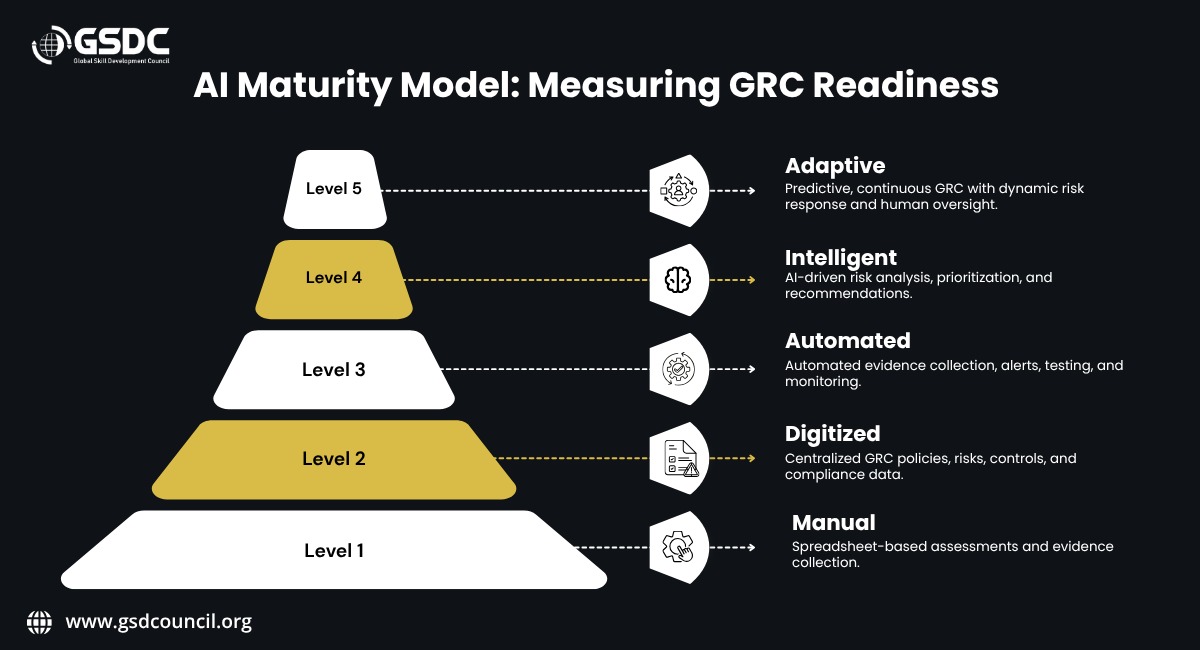
Organizations should not assume that purchasing an AI-powered GRC platform automatically makes them AI mature.
An AI maturity model can help organizations understand their current capabilities and identify the next stage of development.
A practical maturity progression could include:
Level 1: Manual
GRC processes are primarily spreadsheet-based and dependent on manual assessments and evidence collection.
Level 2: Digitized
Organizations use GRC platforms to centralize policies, risks, controls, assessments, and compliance information.
Level 3: Automated
Routine activities such as evidence collection, notifications, control testing, and regulatory monitoring become increasingly automated.
Level 4: Intelligent
AI analyzes data, identifies patterns, prioritizes risks, recommends actions, and supports decision-making.
Level 5: Adaptive
GRC becomes continuously monitored and increasingly predictive, with AI helping organizations respond dynamically to emerging risks while maintaining appropriate human oversight.
This type of AI maturity model is particularly relevant as organizations move from AI experimentation toward enterprise-wide implementation.
Recent research illustrates the gap between AI investment and governance maturity. In India, for example, enterprise AI investment increased substantially, but only a minority of organizations reported established AI governance processes such as testing, auditing, and risk assessment.
How AI Improves GRC Benefits?
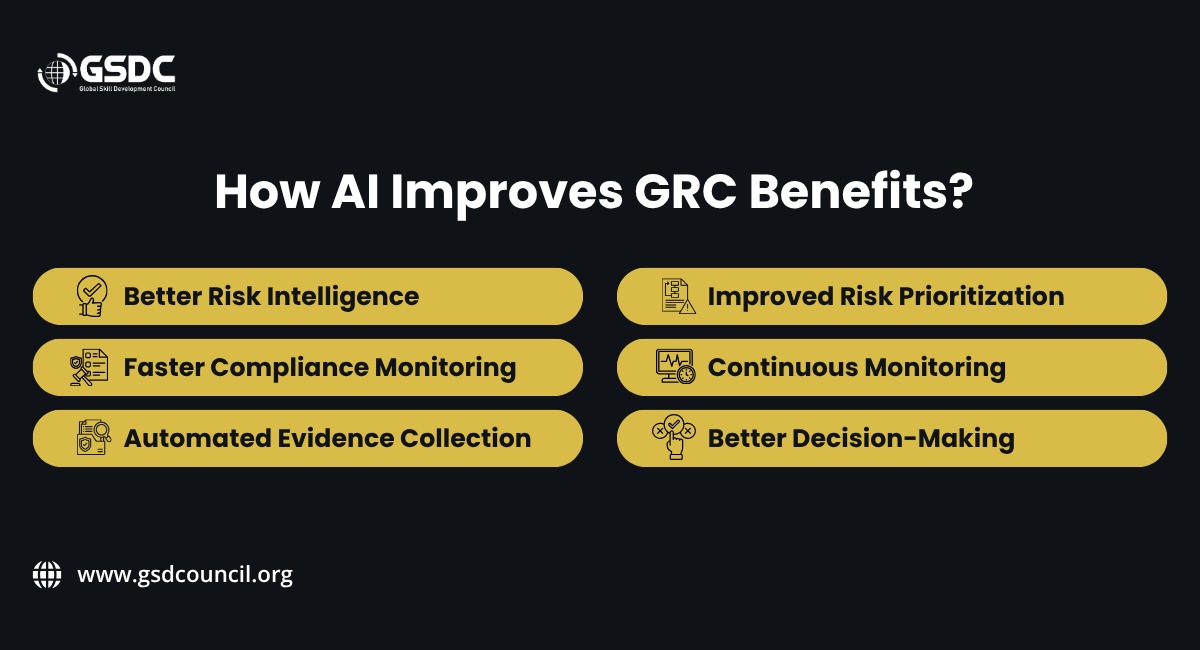
The GRC Benefits of AI extend beyond cost reduction.
Better Risk Intelligence
AI can process large datasets and identify relationships that may otherwise remain hidden, improving enterprise risk intelligence.
Faster Compliance Monitoring
AI can monitor regulatory information and help identify changes that may affect policies, controls, and processes.
Automated Evidence Collection
Instead of manually gathering documentation for every audit, AI-enabled workflows can help identify and organize relevant evidence.
Improved Risk Prioritization
AI can help distinguish high-impact risks from lower-priority issues, allowing GRC teams to focus resources where they matter most.
Continuous Monitoring
Organizations can move from periodic assessments toward more continuous risk and control monitoring.
Better Decision-Making
AI can provide executives and boards with more contextual information about risk exposure, potential impact, and emerging threats.
AI and the Future of Compliance
The future of compliance will increasingly involve continuous monitoring rather than periodic checking.
Regulatory environments are becoming more complex, while businesses operate across multiple jurisdictions and technology ecosystems. AI can help compliance teams interpret large volumes of regulatory information and connect requirements to internal controls.
However, AI should support compliance professionals rather than replace accountability.
Human review remains essential for high-impact decisions, particularly where legal interpretation, ethical judgement, or significant business consequences are involved.
The EU AI Act is an important example of the changing compliance environment. Organizations operating within its scope need to consider risk classification and corresponding obligations, making structured AI governance increasingly important.
AI Governance Is Becoming a Core GRC Discipline
One of the clearest GRC trends in 2026 is the movement of AI governance from an IT concern toward an enterprise and board-level responsibility.
Organizations increasingly need visibility into:
- Which AI systems are being used
- Who owns each AI system
- What data they access
- What decisions they influence
- Which regulations apply
- What controls are in place
- How performance is monitored
- What happens when an AI system fails
This becomes even more important with agentic AI.
AI agents can potentially interact with systems, retrieve information, make recommendations, and execute tasks. Greater autonomy creates greater governance requirements. Recent industry analysis identifies AI governance and oversight of autonomous agents as a major GRC priority.
Continuous Compliance and Risk Intelligence
Another major shift is the movement from static GRC toward continuous GRC.
Instead of waiting for a scheduled audit, organizations can continuously monitor:
- Control effectiveness
- Security events
- Regulatory changes
- Third-party risks
- Policy violations
- AI system behavior
- Operational anomalies
This creates a feedback loop:
Monitor → Detect → Analyze → Prioritize → Respond → Learn
AI can make this cycle faster and more scalable.
The GRC technology market is also moving in this direction, with market research pointing toward demand for integrated platforms, continuous controls monitoring, and real-time risk and compliance workflows.
The Future of GRC and Risk Management
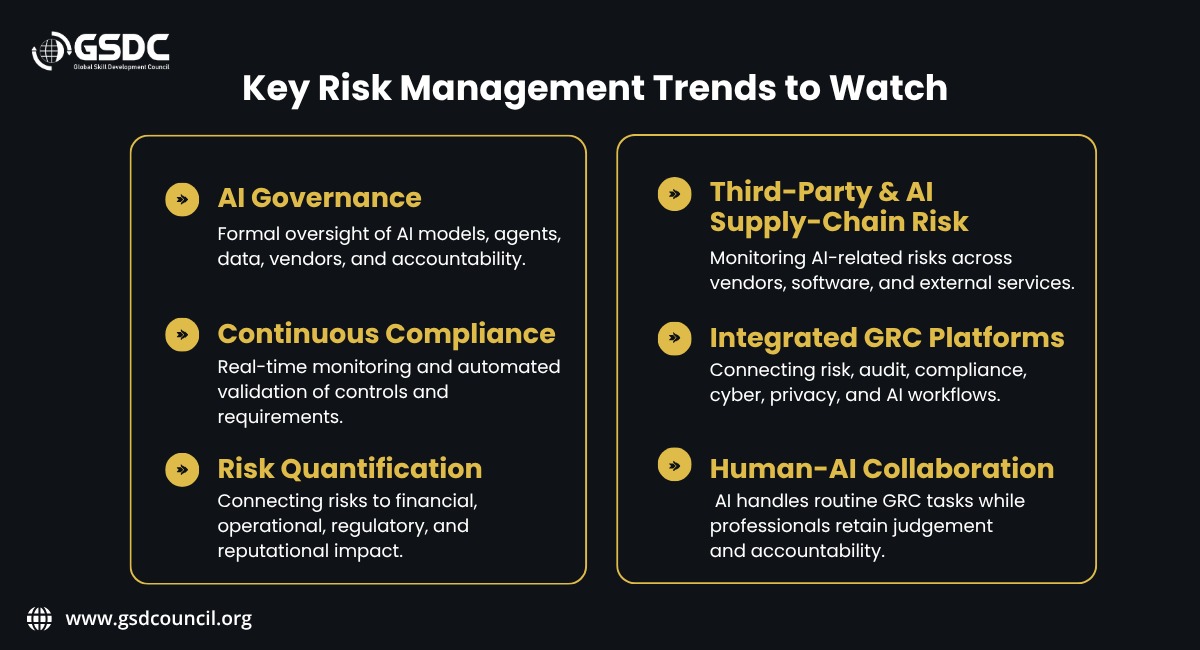
The future of GRC will likely be more connected, predictive, and embedded into everyday business operations.
Rather than having GRC operate as a separate administrative function, risk and compliance controls will increasingly become part of business workflows.
The future of risk management will similarly move toward earlier detection and better quantification of potential business impact.
For example, instead of simply recording that a vendor represents "high risk," organizations may increasingly want to understand:
- What could happen?
- How likely is it?
- What business processes could be affected?
- What would the financial impact be?
- Which controls reduce the exposure?
- What action should happen next?
This is where risk intelligence becomes more valuable than static risk reporting.
Building GRC Capabilities for the AI Era
Organizations looking to implement AI in GRC should avoid starting with technology alone.
A stronger approach is to begin with business objectives and risk priorities.
First, identify the organization's most important risks and compliance obligations. Next, evaluate current processes and data quality. An AI maturity model can then help determine whether the organization is ready for automation, intelligent analysis, or more advanced predictive capabilities.
Organizations should also establish clear AI governance, define ownership, select appropriate frameworks, and create human oversight mechanisms.
Training is equally important. GRC professionals increasingly need knowledge of AI, data, cybersecurity, privacy, regulatory requirements, and responsible AI.
For professionals looking to develop these capabilities, a relevant AI GRC certification can provide structured knowledge across governance, risk, compliance, AI governance, and emerging technology risks.
Developing Future-Ready GRC Expertise
GSDC’s AI GRC Certificate helps professionals develop future-ready capabilities for the evolving GRC landscape. Covering AI governance, risk management, compliance, AI maturity, responsible AI, and risk intelligence, the certificate supports professionals in understanding how AI can enable continuous monitoring, stronger risk prioritization, smarter compliance, and more informed GRC decision-making.
Conclusion
AI in GRC represents a fundamental shift in how organizations approach governance, risk, and compliance.
The objective is not simply to automate manual GRC activities. The bigger opportunity is to create intelligent systems that continuously understand risk, connect information, identify emerging threats, improve compliance visibility, and help decision-makers act earlier.
As organizations adopt generative and agentic AI, the boundaries between technology risk, operational risk, cybersecurity, privacy, compliance, and enterprise risk will continue to converge.
The organizations best positioned for the future of GRC will be those that combine AI capabilities with strong governance, reliable data, clear accountability, continuous monitoring, and human judgement.
In this environment, risk intelligence will become increasingly important—and GRC professionals who understand how to combine AI with governance, risk management, and compliance will be well positioned to lead the next generation of enterprise risk management.

Related Certifications
Frequently Asked Questions
AI in GRC refers to using artificial intelligence, machine learning, generative AI, analytics, and AI agents to improve governance, risk management, compliance monitoring, control testing, risk identification, and decision-making.
AI can analyze large volumes of structured and unstructured information, detect patterns, identify anomalies, prioritize risks, support predictive analysis, and provide organizations with stronger risk intelligence.
An AI maturity model helps an organization assess how developed its AI capabilities are. It can evaluate areas such as AI governance, data, technology, processes, skills, risk management, and responsible AI practices.
AI governance helps organizations establish accountability, policies, controls, risk assessments, monitoring, and oversight for AI systems. It is increasingly important as organizations deploy generative AI and more autonomous AI agents.
Yes. A relevant GRC certification can help professionals develop structured knowledge of governance, risk, compliance, AI risk, controls, and emerging regulatory requirements. However, certification is most valuable when combined with practical experience and knowledge of current AI governance frameworks.
Stay up-to-date with the latest news, trends, and resources in GSDC
If you like this read then make sure to check out our previous blogs: Cracking Onboarding Challenges: Fresher Success Unveiled
Not sure which certification to pursue? Our advisors will help you decide!