Certified AI GRC Professional: GSDC Certification Guide
Written by Emily Hilton
- What Is the GSDC Certified AI GRC Professional Certification?
- Why Is AI GRC Certification Important?
- Understanding the GRC Full Form in the AI Context
- What Will You Learn Through the GSDC AI GRC Certification?
- AI GRC Frameworks Covered in the Certification
- Who Should Pursue the Certified AI GRC Professional Certification?
- GRC Jobs: Where Can an AI GRC Certification Lead?
- How to Become a GRC Analyst and Move Into AI GRC
- How Does an AI GRC Career Path Look?
- GRC Platform Knowledge vs AI GRC Expertise
- Why Choose the GSDC Certified AI GRC Professional Certification?
- Conclusion
Artificial intelligence is rapidly becoming a strategic priority for organizations across industries. Businesses are adopting generative AI, machine learning, large language models, and increasingly autonomous AI systems to improve productivity, automate processes, and support decision-making.
But greater AI adoption also brings greater responsibility.
Organizations need professionals who can ensure that AI systems are governed effectively, risks are identified and managed, regulatory requirements are addressed, and responsible AI practices are followed. This growing need has created a new specialization at the intersection of AI and Governance, Risk, and Compliance (GRC).
For professionals looking to build expertise in this emerging field, the GSDC Certified AI GRC Professional Certification provides a focused learning pathway covering AI governance, risk management, compliance, responsible AI, security, auditing, and regulatory requirements.
But what exactly does the certification cover? Who should pursue it? What skills can professionals develop? And how can an AI GRC certification support your career?
Let's take a closer look.
What Is the GSDC Certified AI GRC Professional Certification?
The GSDC Certified AI GRC Professional Certification is a professional certification designed for individuals who want to develop specialized knowledge in managing the governance, risk, and compliance requirements associated with artificial intelligence.
The certification moves beyond the basic understanding of AI and focuses on how organizations can adopt and manage AI responsibly.
It covers important areas such as:
- AI governance
- AI risk management
- AI compliance
- Responsible AI
- AI security
- AI auditing
- Generative AI risks
- Agentic AI risks
- AI lifecycle governance
- AI regulations
- AI governance frameworks
- Enterprise AI GRC
The program is particularly relevant as organizations move from experimenting with AI to deploying it across business-critical processes.
Why Is AI GRC Certification Important?
Traditional GRC already plays an important role in managing organizational risk and compliance. However, AI introduces a different set of challenges.
AI systems can process large volumes of sensitive data, generate decisions or recommendations, interact with customers, and sometimes operate with limited human intervention.
This creates questions around accountability, transparency, privacy, security, bias, reliability, and regulatory compliance.
An AI GRC professional helps organizations answer these questions.
An AI GRC certification can help professionals understand how established GRC principles can be applied to AI systems throughout their lifecycle—from planning and development to deployment, monitoring, and retirement.
It can also help bridge the gap between technical AI teams and business functions such as risk, compliance, audit, legal, cybersecurity, and governance.
Understanding the GRC Full Form in the AI Context
The GRC full form is Governance, Risk, and Compliance.
Understanding these three areas is fundamental to becoming an effective AI GRC professional.
Governance establishes policies, accountability, decision-making structures, and oversight for AI.
Risk management identifies and evaluates potential AI risks and determines how those risks should be controlled or mitigated.
Compliance ensures that AI activities align with applicable laws, regulations, standards, contractual requirements, and organizational policies.
The GSDC certification brings these three areas together with AI-specific considerations, giving professionals a broader perspective on responsible AI adoption.
What Will You Learn Through the GSDC AI GRC Certification?
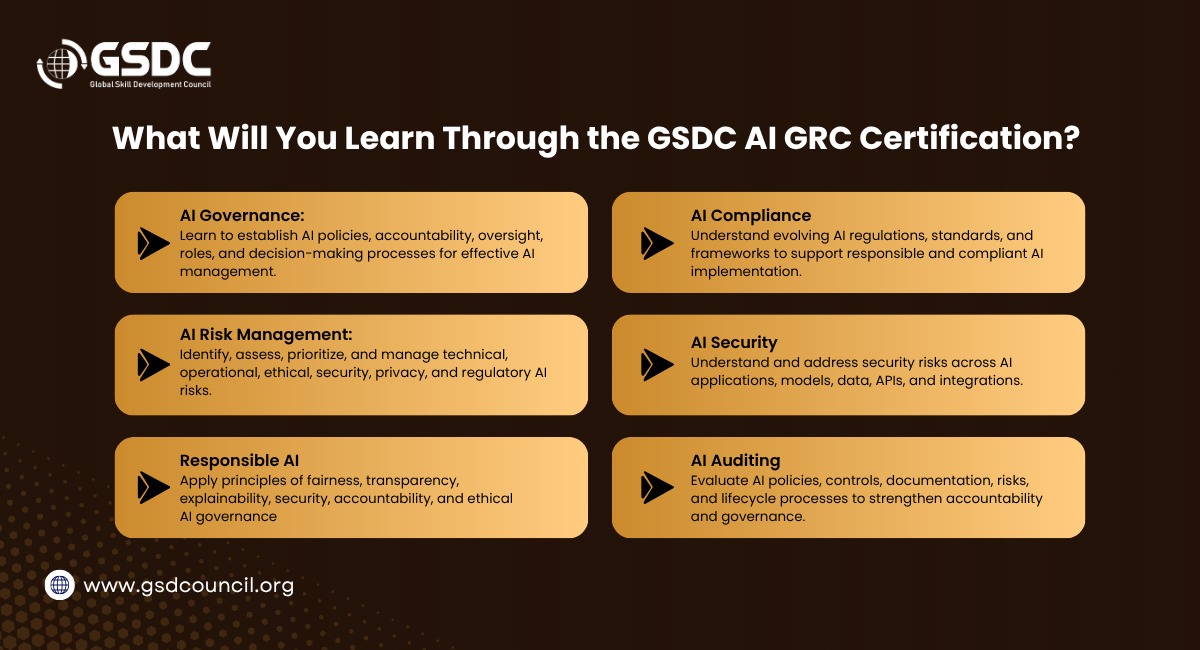
One of the key advantages of pursuing a specialized certification is having a structured learning path.
The GSDC Certified AI GRC Professional Certification covers several areas that are becoming increasingly important for organizations.
AI Governance
AI governance focuses on establishing the policies, processes, roles, and responsibilities required to manage AI effectively.
Through AI governance concepts, professionals can understand areas such as AI accountability, ownership, oversight, governance structures, and decision-making.
This knowledge can help organizations create processes for approving AI use cases and determining appropriate levels of oversight.
AI Risk Management
AI systems can create technical, operational, ethical, security, and regulatory risks.
The certification addresses AI risks across the lifecycle and helps professionals understand how to identify, assess, prioritize, and manage them.
Potential risks include:
- Data privacy risks
- Security vulnerabilities
- Algorithmic bias
- Incorrect AI outputs
- Model risks
- Lack of transparency
- Third-party AI risks
- Regulatory risks
- Intellectual property concerns
Understanding these risks is essential for professionals working in AI governance and risk management.
AI Compliance
AI regulations and standards are evolving rapidly around the world.
AI GRC professionals need to understand how organizations can interpret and respond to these requirements.
The certification covers areas including AI regulations, compliance considerations, and recognized frameworks and principles that support responsible AI implementation.
Responsible AI
Responsible AI is another important part of AI governance.
Organizations need to consider whether their AI systems are fair, transparent, explainable, secure, accountable, and aligned with organizational values and applicable requirements.
The certification helps professionals understand how responsible AI principles can be incorporated into organizational governance and risk processes.
AI Security
AI systems introduce new security considerations that traditional security controls may not completely address.
Professionals need to understand how AI applications, models, data, APIs, and integrations can introduce security risks.
AI security controls therefore form an important component of a comprehensive AI GRC program.
AI Auditing
Organizations need mechanisms to evaluate whether AI governance processes and controls are working effectively.
AI auditing can involve reviewing policies, controls, documentation, risk assessments, compliance requirements, and AI lifecycle processes.
Understanding AI audit principles can help professionals support organizations in demonstrating accountability and governance.
AI GRC Frameworks Covered in the Certification
A strong understanding of the GRC framework landscape is valuable for professionals working in AI governance.
The GSDC certification introduces learners to important AI governance frameworks, standards, and principles, including the NIST AI Risk Management Framework (AI RMF), ISO/IEC 42001, and OECD AI Principles.
Learning these frameworks can help professionals understand how organizations can structure their AI governance programs and approach AI risk systematically.
Rather than viewing compliance as a one-time activity, AI GRC encourages organizations to establish continuous governance, monitoring, assessment, and improvement processes.
Who Should Pursue the Certified AI GRC Professional Certification?
The certification can be relevant to professionals from several backgrounds.
It is particularly suited to individuals working in:
- Governance, Risk, and Compliance
- Cybersecurity
- Information Security
- Internal Audit
- Compliance
- Risk Management
- IT Governance
- Data Governance
- AI Governance
- Responsible AI
- Technology Risk
- Legal and Regulatory Functions
- Digital Transformation
Professionals already working in GRC can use the certification to add AI expertise to their existing knowledge.
Similarly, cybersecurity, audit, compliance, and technology professionals can use AI GRC knowledge to expand into emerging AI governance roles.
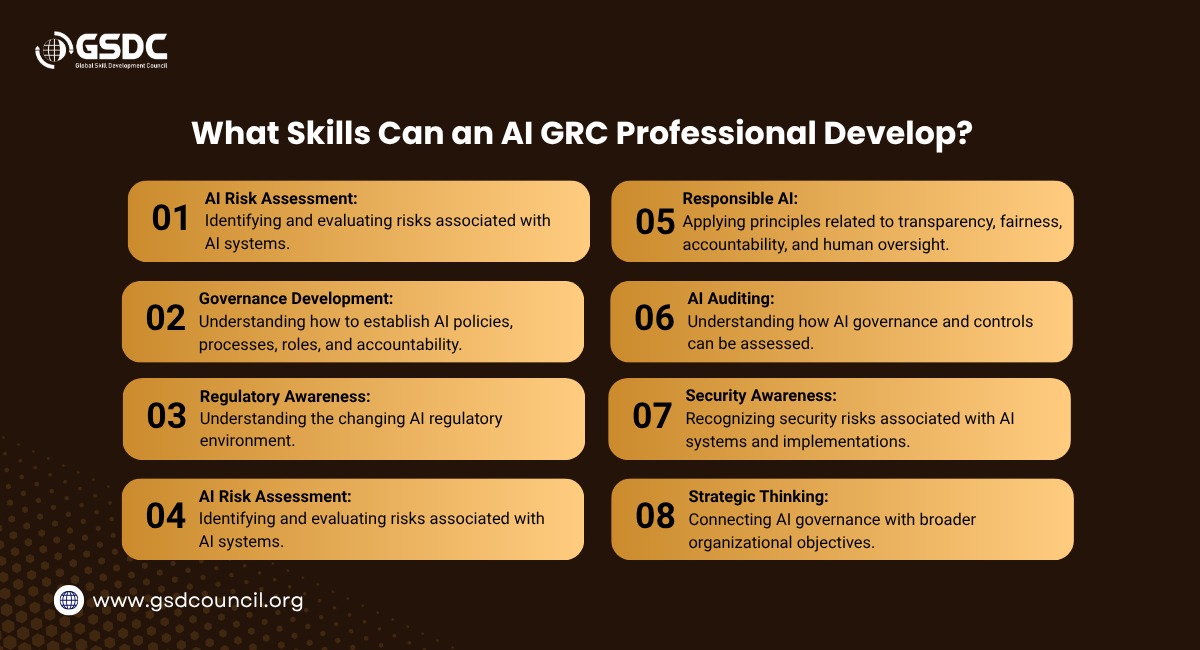
GRC Jobs: Where Can an AI GRC Certification Lead?
The expansion of AI governance is creating new opportunities within the broader GRC ecosystem.
Professionals may explore roles such as:
- AI GRC Analyst
- AI Governance Specialist
- AI Risk Analyst
- AI Compliance Specialist
- AI Governance Manager
- AI Risk Manager
- Responsible AI Specialist
- AI Auditor
- Technology Risk Consultant
- GRC Consultant
- AI Compliance Officer
- AI Governance Lead
Job titles can vary between organizations, but the demand is increasingly centered around professionals who understand how to manage AI-related risks while enabling responsible innovation.
An AI-focused certification can therefore complement existing GRC, cybersecurity, audit, compliance, and technology experience.
How to Become a GRC Analyst and Move Into AI GRC
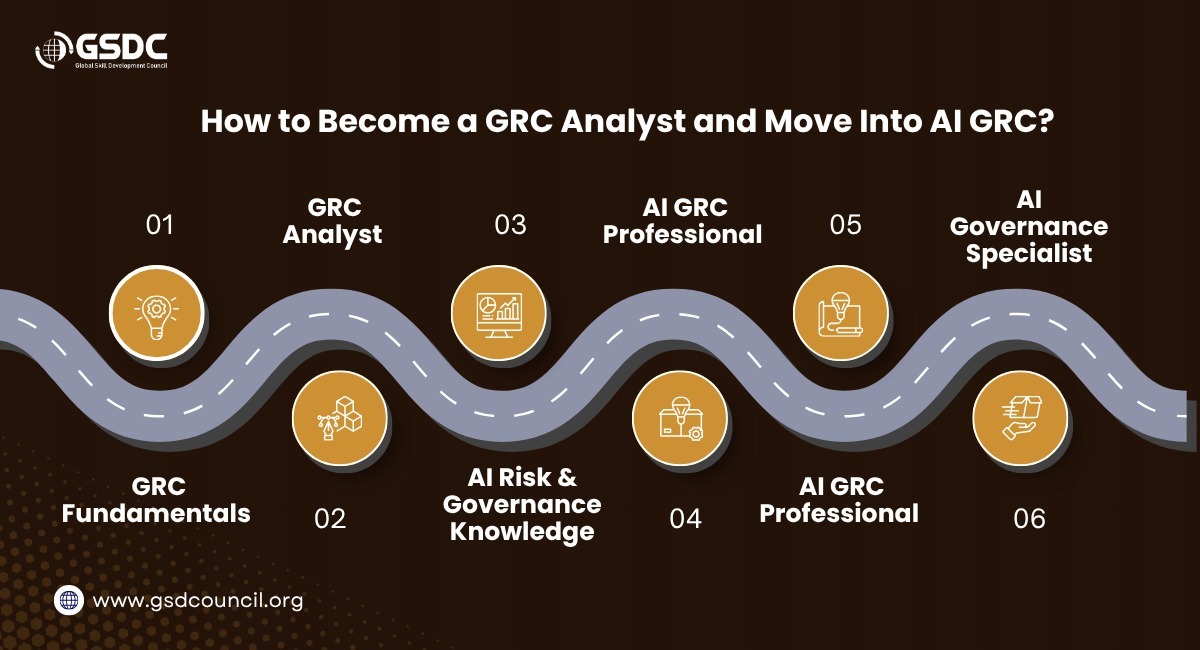
If you are researching how to become a GRC analyst, a background in risk management, compliance, cybersecurity, information technology, or auditing can provide a strong foundation.
The next step is developing knowledge of AI and its associated risks.
A potential career progression could look like:
GRC Fundamentals → GRC Analyst → AI Risk & Governance Knowledge → AI GRC Professional → AI Governance Specialist
Professionals can strengthen this pathway by learning AI fundamentals, studying AI governance frameworks, developing risk assessment skills, understanding regulations, and pursuing a relevant GRC certification.
The GSDC Certified AI GRC Professional Certification can serve as a specialization for professionals who want to move from traditional GRC toward AI-focused governance and risk management.
How Does an AI GRC Career Path Look?
The GRC career path is flexible because professionals can enter the field from multiple disciplines.
For example:
Cybersecurity → Technology Risk → GRC → AI GRC
or
Compliance → Regulatory Risk → AI Compliance → AI Governance
or
Internal Audit → Technology Audit → AI Audit → AI GRC
This flexibility makes AI GRC relevant to both experienced professionals and individuals looking to specialize in a growing area of governance.
As organizations establish dedicated AI governance programs, professionals with combined AI and GRC knowledge can position themselves for emerging responsibilities.
GRC Platform Knowledge vs AI GRC Expertise
A GRC platform can help organizations automate and centralize activities such as risk registers, policies, controls, assessments, audits, and compliance reporting.
However, knowing how to operate a GRC platform is different from understanding AI GRC.
A platform provides the technology to manage governance processes. An AI GRC professional provides the knowledge needed to determine:
- What risks should be assessed?
- Which controls are required?
- Who should be accountable?
- Which regulations apply?
- What level of human oversight is appropriate?
- How should AI systems be monitored?
This distinction makes AI GRC expertise valuable even as organizations adopt increasingly sophisticated GRC technologies.
Why Choose the GSDC Certified AI GRC Professional Certification?
Professionals pursuing an AI GRC certification should look for a program that combines AI knowledge with practical governance, risk, and compliance concepts.
The GSDC Certified AI GRC Professional Certification is focused specifically on this intersection.
The program addresses modern AI governance challenges, including generative AI and agentic AI risks, while introducing learners to governance frameworks, responsible AI, AI security, regulatory considerations, and AI auditing.
This makes it relevant for professionals who want to understand not only what AI is, but also how organizations can govern and manage it responsibly.
The Future of AI GRC
AI governance is becoming an essential organizational capability.
As businesses deploy AI across customer service, finance, HR, cybersecurity, healthcare, operations, and other functions, organizations will need stronger mechanisms for managing AI-related risks and demonstrating accountability.
This is likely to create continued demand for professionals who understand both AI and GRC.
The future AI GRC professional will need to look beyond basic compliance. They will need to understand how governance, risk, security, responsible AI, and regulatory requirements work together across the AI lifecycle.
Conclusion
The rise of artificial intelligence is creating a new need for professionals who can balance innovation with governance, risk management, and compliance.
The GSDC Certified AI GRC Professional Certification provides a focused pathway for professionals who want to develop expertise in this emerging field. From AI governance and risk management to responsible AI, security, auditing, frameworks, and regulations, the certification addresses key capabilities required for modern AI oversight.
As organizations continue to scale AI adoption, the ability to govern AI responsibly, manage its risks, and support regulatory compliance will become increasingly valuable.
For professionals planning their next GRC career path, becoming a Certified AI GRC Professional can be a strategic step toward building expertise at the intersection of AI, governance, risk, and compliance.

Related Certifications
Stay up-to-date with the latest news, trends, and resources in GSDC
If you like this read then make sure to check out our previous blogs: Cracking Onboarding Challenges: Fresher Success Unveiled
Not sure which certification to pursue? Our advisors will help you decide!