Think Like a Forward Deployed Engineer: 5 Real-World Scenarios

Written by Matthew Hale
- Scenario 1: The AI Assistant Gives the Wrong Answers
- Scenario 2: The Customer Wants to Automate a Broken Process
- Scenario 3: The Prototype Works, but Production Does Not
- Scenario 4: The Customer Wants a Feature That Does Not Exist
- Scenario 5: The AI Agent Works, but the Business Does Not Trust It
- Take Your FDE Skills Further With GSDC
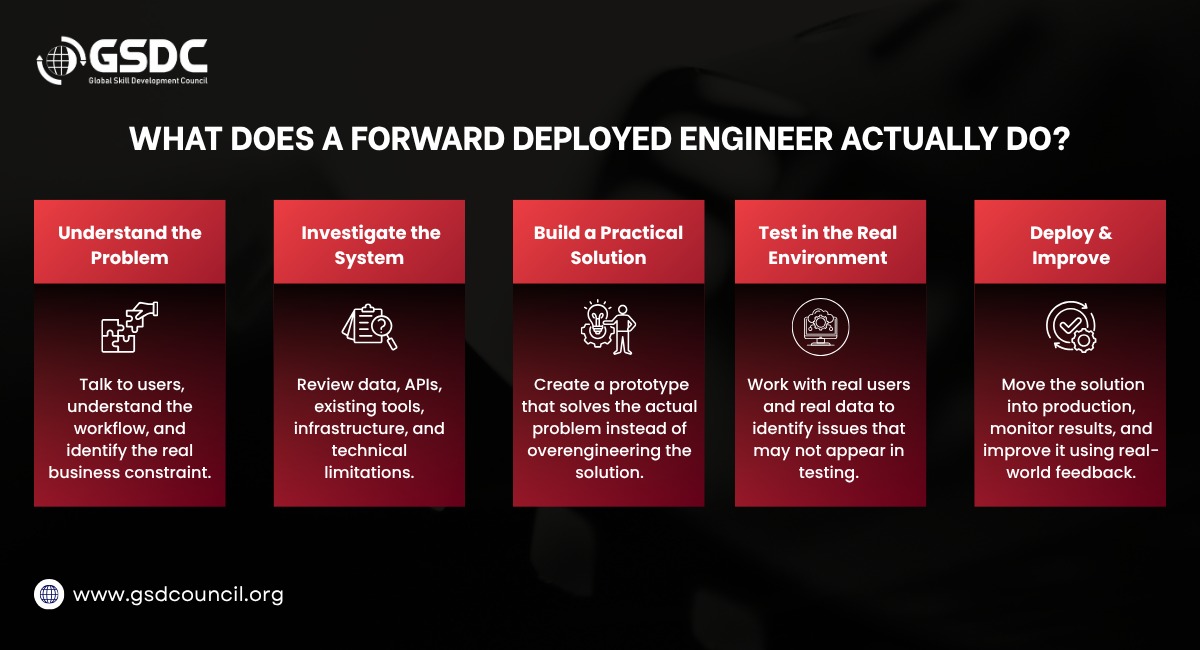
A Forward Deployed Engineer works on problems that are rarely fully defined. The customer may know what is not working, but they may not know what needs to be built to fix it. The FDE has to understand the business process, investigate the technical problem, build a practical solution, and make sure it works in the customer's environment.
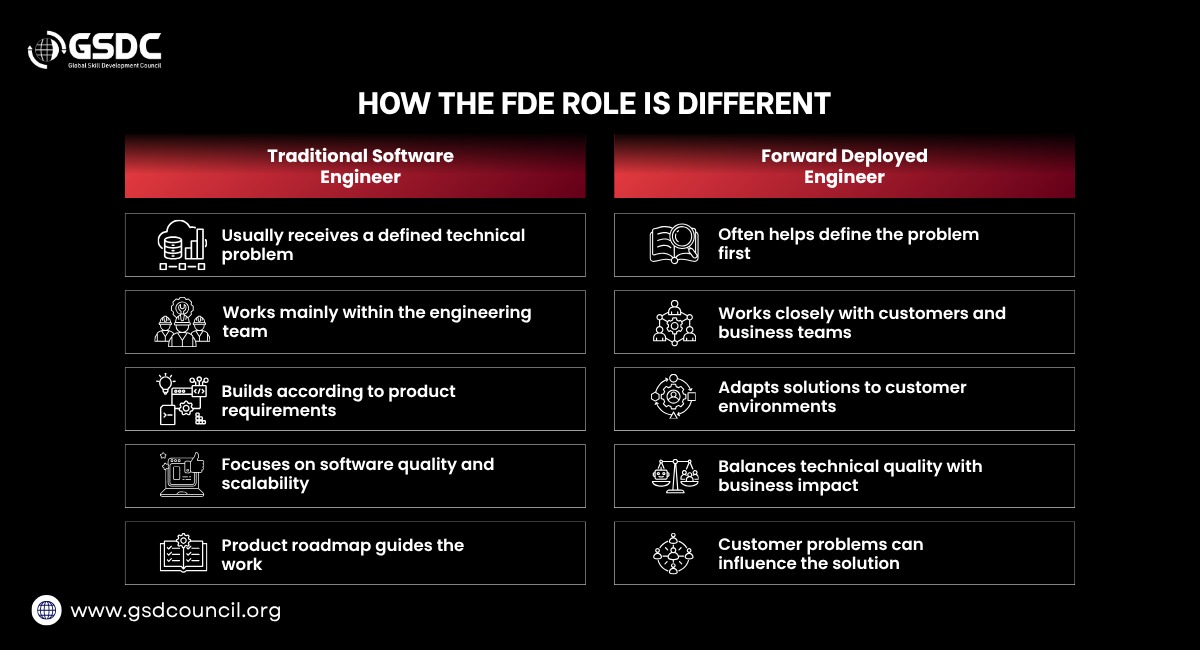
This is why the FDE role is different from traditional software engineering. The work is not limited to writing code. An FDE has to move between customer conversations, technical investigation, prototyping, integrations, testing, and deployment.
The best way to understand what does a Forward Deployed Engineer do is to look at real situations where the answer is not obvious.
Scenario 1: The AI Assistant Gives the Wrong Answers
Problem
A company has built an internal AI assistant for employees. It can search company policies, HR documents, product information, and internal guides. The system works well during testing, but employees start reporting incorrect answers after deployment.
The problem is not that the AI is completely wrong. In many cases, the answer sounds correct but is based on an old policy or information from the wrong department. The system is retrieving too much information, and the model is struggling to identify which source should be trusted.
A basic response would be to use a larger model or add more documents. A Forward Deployed Engineer would first investigate why the wrong information is reaching the model.
Solution
The FDE looks at the complete flow from the employee's question to the final answer. They check what documents are being retrieved, why those documents were selected, whether they are current, and whether different documents contain conflicting information.
The solution is to improve the retrieval process. Documents are organized using useful metadata such as department, document owner, version, and effective date. The retrieval system then ranks information based on relevance and freshness instead of treating every document equally.
The FDE also reduces the amount of information sent to the model. Instead of passing every related document, the system provides the model with the strongest sources that directly support the answer.
Key Takeaways
- A poor AI answer does not always mean the model is the problem.
- Adding more documents can make retrieval worse instead of better.
- An FDE looks at the complete system before deciding what needs to change.
- Data quality, retrieval, context, and system design can have a bigger impact than simply changing the model.
Scenario 2: The Customer Wants to Automate a Broken Process
Problem
A financial company wants to automate customer onboarding. The initial request is simple: use AI to collect information, check documents, and approve customers faster.
After speaking with the operations team, the FDE discovers that the onboarding process is different across departments. Some teams use spreadsheets, some rely on email, and some perform additional manual checks that are not documented anywhere.
If the FDE simply automates the existing process, they will make an inefficient process run faster without actually fixing it.
Solution
The FDE first maps how onboarding really works. They identify which steps are repetitive, which decisions follow clear rules, which steps require human judgment, and where employees have to move information between different systems.
The final solution does not try to make AI responsible for everything. AI handles tasks such as document classification and information extraction. Business rules handle decisions that can be defined clearly, while unusual cases are sent to employees for review.
This creates a workflow where automation is used where it makes sense, instead of forcing AI into every part of the process.
Key Takeaways
- The customer's requested solution may not be the actual problem.
- An FDE studies the existing workflow before building the solution.
- Not every decision needs to be handled by AI.
- Human review is useful when a situation falls outside clearly defined rules.
Good deployment starts with understanding how people actually work.
Scenario 3: The Prototype Works, but Production Does Not
Problem
A company develops an AI system that reads support tickets and sends them to the right department. During testing, the system achieves strong accuracy and the customer is ready to deploy it.
Once real tickets start coming in, performance drops.
The production data contains incomplete descriptions, screenshots, spelling mistakes, internal product names, multiple problems in one ticket, and cases that were not present in the original test data.
The problem is not simply that the model became worse. The test environment did not represent the real operating environment.
Solution
The FDE studies the failed cases instead of looking only at the overall accuracy score. They group the failures and find that most problems come from a few areas: unclear tickets, new product terminology, multiple issues in one request, and missing information.
The workflow is then changed so that straightforward tickets are automatically routed, while uncertain cases go through another check or are sent to a human reviewer. The system also records corrections made by employees so that recurring problems can be identified and addressed.
The goal is not to force the AI to handle every ticket. The goal is to create a system that knows when it can act and when it needs help.
Key Takeaways
- A successful prototype does not guarantee a successful deployment.
- Real customer data is usually more complicated than test data.
- An FDE studies failure patterns to find the real cause of the problem.
- Confidence checks and human review can make automation safer.
Production feedback should be used to improve the system continuously.
Scenario 4: The Customer Wants a Feature That Does Not Exist
Problem
An enterprise customer wants a new capability that the existing product does not support. The sales team has already committed to solving the customer's problem, but the product team cannot add the feature immediately.
The obvious options are to wait for the product roadmap or build a completely custom solution. Both can create problems. Waiting may delay the customer's deployment, while a custom solution may become difficult to maintain.
The FDE needs to find another way.
Solution
The first step is to understand what the customer actually needs instead of taking the feature request literally.
For example, the customer may ask for a custom dashboard. After speaking with the users, the FDE may discover that the real problem is that employees have to check several systems manually to identify exceptions.
That changes the solution.
Instead of building an entirely new product feature, the FDE creates a lightweight integration that brings the required information together and presents it in the existing workflow. The solution solves the immediate problem while also giving the product team information about a capability that may be useful for other customers.
Key Takeaways
- Customers often describe the feature they want instead of the problem they need to solve.
- An FDE connects the business requirement with a practical technical solution.
- A quick custom solution should not create unnecessary long-term technical debt.
- Customer deployments can reveal product improvements that apply beyond one customer.
- The best solution is not always the largest feature.
Scenario 5: The AI Agent Works, but the Business Does Not Trust It
Problem
A company has built an AI agent that can search information, use internal tools, create reports, and perform operational tasks. Technically, the agent works well.
The problem is that employees do not trust it enough to let it operate independently. They want to check every action because they cannot easily understand why the agent made a decision or what information it used.
This means the company has built a capable AI system, but it is not getting the expected business value.
Solution
The FDE looks at the problem from an operational perspective rather than trying to make the agent more autonomous.
The agent's actions are divided according to their risk. Low-risk actions can be completed automatically. Actions that could have a bigger business impact require validation or human approval.
The system also records important actions and the information used to make decisions. When something goes wrong, the team can see what the agent did and where the problem occurred.
This gives the business more control without removing the benefits of automation.
Key Takeaways
- A technically capable AI system can still fail if people do not trust it.
- AI autonomy should depend on the risk of the action.
- Human approval is useful for decisions with higher business impact.
- Teams need visibility into important agent actions and decisions.
An FDE considers adoption and operational risk along with technical performance.
Take Your FDE Skills Further With GSDC
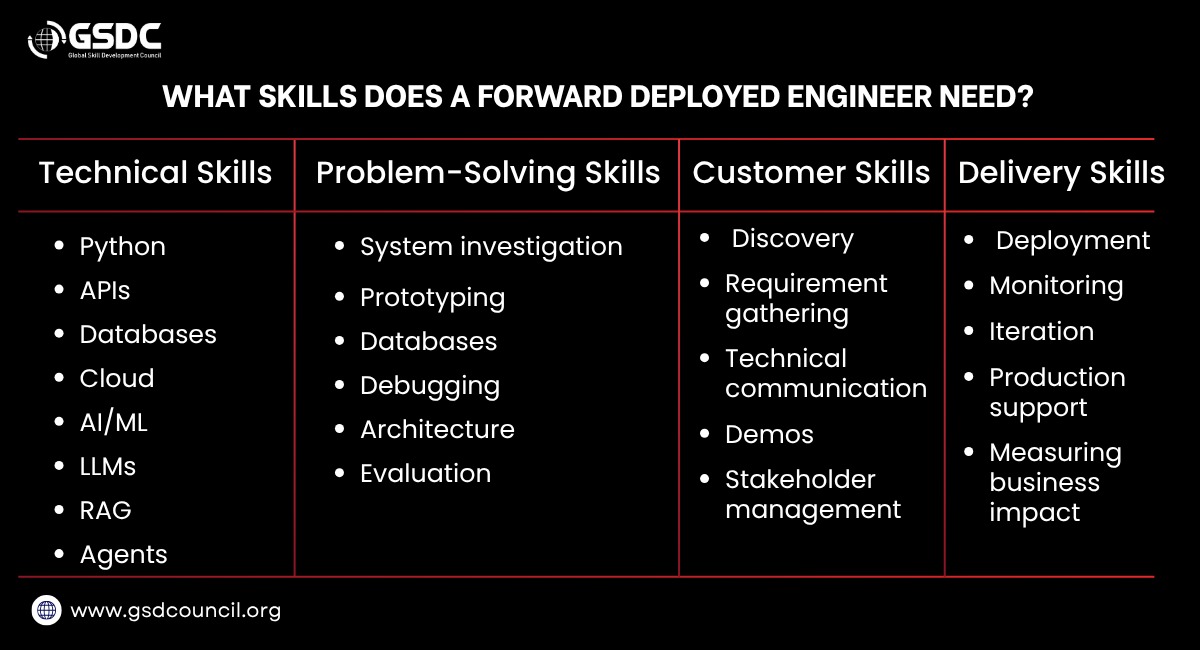
The five scenarios show that a Forward Deployed Engineer needs more than coding skills. The role requires the ability to understand business problems, work with AI and software systems, build practical solutions, work directly with clients, and take solutions from proof of concept to production. GSDC’s Certified Forward Deployed Engineer program is designed around these skills, covering production-ready Python, backend and API development, ML and LLM workflows, RAG, agentic systems, cloud deployment, client engagement, and technical delivery.
The program also follows a hands-on approach through Learn by Doing, live expert-led sessions, SME Connect sessions, a capstone project, practice exams, and job support. This makes it useful for professionals who want to build both the technical and client-facing skills expected in the FDE role.

Explore the GSDC Certified Forward Deployed Engineer Certification
What you will learn includes:
- FDE Mindset & Problem Structuring: Learn how to break down unclear business problems and translate them into practical technical solutions.
- Production Engineering: Build skills in Python, backend development, APIs, databases, and data pipelines.
- AI & LLM Systems: Work with machine learning, LLMs, prompt engineering, RAG, and AI evaluation.
- Agentic AI & Deployment: Understand agent workflows, orchestration, cloud deployment, MLOps, monitoring, and production security.
- Client Engagement: Learn how to run discovery sessions, scope solutions, present technical demos, and move projects from PoC to production.
This is particularly relevant if you want to move beyond traditional software development and work at the intersection of engineering, AI, consulting, and enterprise problem-solving.

Related Certifications
Stay up-to-date with the latest news, trends, and resources in GSDC
If you like this read then make sure to check out our previous blogs: Cracking Onboarding Challenges: Fresher Success Unveiled
Not sure which certification to pursue? Our advisors will help you decide!