Accelerating AI Adoption in L&D: People, Agents & Automation
Written by Niyati K Prajapati
- Why AI Adoption in L&D Is Entering a New Era?
- Building a Workforce Ecosystem: People, AI Agents, and Intelligent Automation
- Redefining the Role of Learning and Development
- Understanding the AI Architecture Behind Modern Learning
- Responsible AI and Governance: Building Trust in Enterprise AI
- Creating a Skill-Based Workforce Ecosystem for the AI Era
- Strengthen AI Adoption Through L&D Expertise
- Conclusion
What if every employee had an AI-powered coach that could recommend the right skills, personalize learning, and help them grow throughout their career? That vision is quickly becoming a reality. As Artificial Intelligence reshapes the workplace, Learning and Development (L&D) is evolving from a traditional training function into a strategic engine for workforce transformation and AI workforce development.
The webinar, Accelerating AI Adoption in L&D: Building a Workforce Ecosystem of People, Agents, and Intelligent Automation, explored how organizations can prepare for this shift by developing an AI adoption strategy, rethinking learning strategies, building AI skills development, and integrating intelligent automation and AI agent automation into everyday work. Rather than replacing people, AI is emerging as a powerful partner that enhances human capabilities, delivers personalized learning experiences, and helps organizations become more agile and future-ready.
A key message throughout the session was that AI adoption is no longer just a technology initiative, it's a workforce strategy. Organizations that invest in AI literacy, responsible governance, continuous learning, AI for learning and development, and human-AI collaboration will be better equipped to drive innovation, adapt to change, and build resilient teams for the future.
Why AI Adoption in L&D Is Entering a New Era?
Learning and Development is no longer limited to delivering training programs or managing learning platforms. As AI becomes part of everyday business, L&D is evolving into a strategic function that prepares employees to work alongside intelligent technologies and adapt to continuous change through the future of learning and development.
The webinar highlighted several ways AI is reshaping Learning and Development:
- From Training to Workforce Transformation: L&D now focuses on building future-ready skills, AI workforce transformation, and AI workforce development, not just delivering courses.
- Growing AI Maturity: Organizations are moving from experimenting with generative AI to embedding AI into learning, workforce planning, and decision-making as part of their AI adoption strategy.
- Adaptive Learning Ecosystems: AI enables personalized, flexible learning experiences that evolve with changing business and skill requirements through AI for learning and development.
- Proactive Skill Development: Intelligent systems identify AI skills gap, recommend learning paths, and predict future workforce needs before they become challenges, supporting AI skills development.
- Strategic Business Impact: Modern L&D supports innovation, workforce resilience, and long-term organizational growth by aligning learning with business goals through Intelligent Automation and AI workflow automation.
The webinar emphasized that organizations embracing this shift will be better equipped to develop agile, AI-ready workforces and stay competitive in an increasingly intelligent business landscape.
Building a Workforce Ecosystem: People, AI Agents, and Intelligent Automation
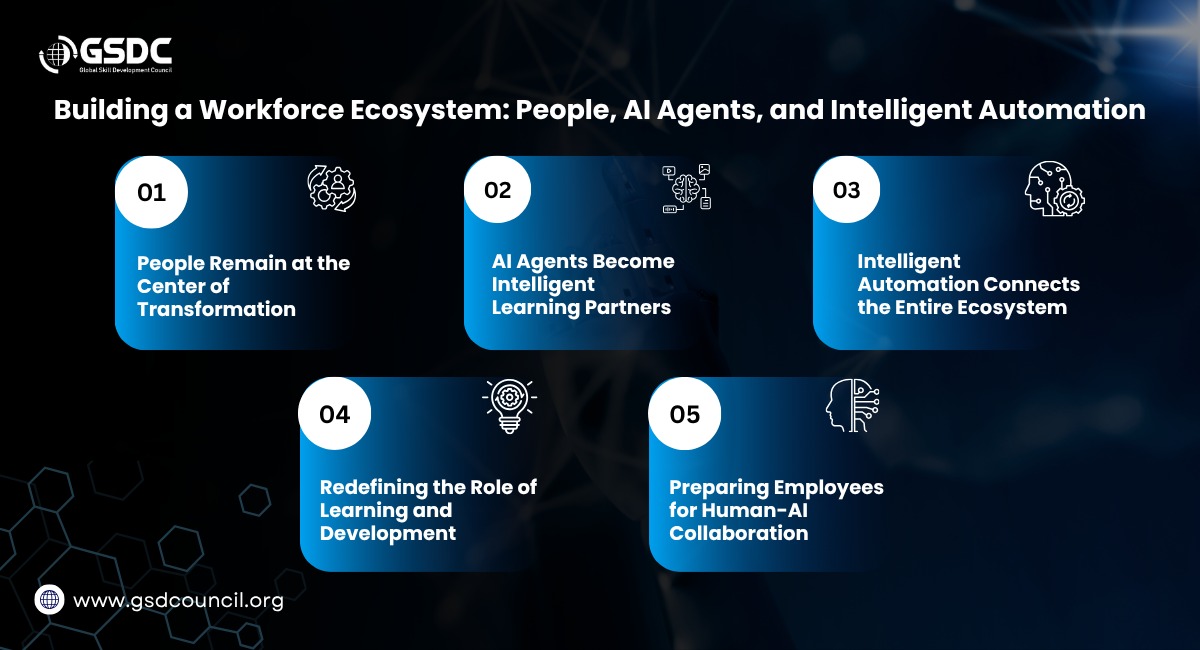
One of the webinar's central themes was the concept of a workforce ecosystem an environment where people, AI agents, and intelligent automation work together to achieve business objectives. This model recognizes that the future workplace is not defined solely by human employees or AI technologies but by the collaboration between both.
People Remain at the Center of Transformation
Despite rapid advances in AI, the webinar reinforced that people remain the foundation of every successful organization. Human creativity, empathy, ethical judgment, strategic thinking, and leadership continue to be irreplaceable.
Rather than replacing employees, AI should enable them to focus on higher-value work by reducing time spent on repetitive and administrative tasks. This allows professionals to devote more attention to innovation, collaboration, customer engagement, and complex problem-solving.
For Learning and Development teams, this means preparing employees to confidently work alongside AI by developing technical knowledge, critical thinking skills, and an adaptable mindset.
AI Agents Become Intelligent Learning Partners
A major focus of the webinar was the growing role of AI agents in enterprise learning.
Unlike traditional AI tools that respond only when prompted, AI agents can perform tasks autonomously, interact with multiple systems, retrieve information, execute workflows, and continuously support employees throughout their work.
Within Learning and Development, AI agents can act as intelligent learning assistants by recommending relevant training, answering employee questions, generating learning content, tracking progress, and providing personalized coaching based on individual skill levels.
As organizations mature, multiple AI agents can work together across different business functions. Some agents may specialize in knowledge retrieval, while others focus on competency assessments, content generation, learner engagement, or workforce analytics.
This multi-agent approach enables organizations to deliver more scalable and personalized learning experiences while reducing administrative workload for L&D professionals.
Intelligent Automation Connects the Entire Ecosystem
The third pillar of the workforce ecosystem is intelligent automation.
While AI agents focus on reasoning and decision support, intelligent automation orchestrates repetitive processes across enterprise systems. It connects learning platforms, HR systems, knowledge repositories, collaboration tools, and business applications into a unified workflow.
For example, when an employee transitions into a new role, intelligent automation can automatically identify required competencies, assign personalized learning paths, schedule assessments, recommend mentors, and update skill profiles without requiring manual intervention.
Similarly, learning data can be integrated with workforce planning systems to provide leaders with real-time visibility into organizational capabilities and emerging skill gaps.
The webinar highlighted that intelligent automation is not simply about increasing efficiency. Its true value lies in creating seamless employee experiences while enabling Learning and Development teams to focus on strategic initiatives instead of administrative tasks.
Redefining the Role of Learning and Development
The webinar highlighted that Learning and Development is evolving from a training function into a strategic driver of workforce transformation. Rather than focusing only on course completion, L&D leaders must align learning with business goals, future skills, and emerging technologies.
Key priorities include:
- Align learning with business strategy and workforce needs.
- Deliver personalized learning using AI-driven recommendations.
- Foster a culture of continuous learning to keep pace with evolving technologies.
By focusing on these areas, L&D can build agile, future-ready workforces that support long-term business growth.
Preparing Employees for Human-AI Collaboration
The webinar emphasized that AI is designed to augment human capabilities, not replace them. Employees don't need to become AI experts, but they should know how to use AI responsibly, evaluate AI-generated outputs, and apply critical thinking.
Organizations can prepare employees by:
- Providing hands-on experience with AI tools.
- Encouraging responsible AI use and human oversight.
- Building adaptability through continuous learning.
This approach fosters a confident and resilient workforce that is ready to collaborate effectively with AI.
Understanding the AI Architecture Behind Modern Learning
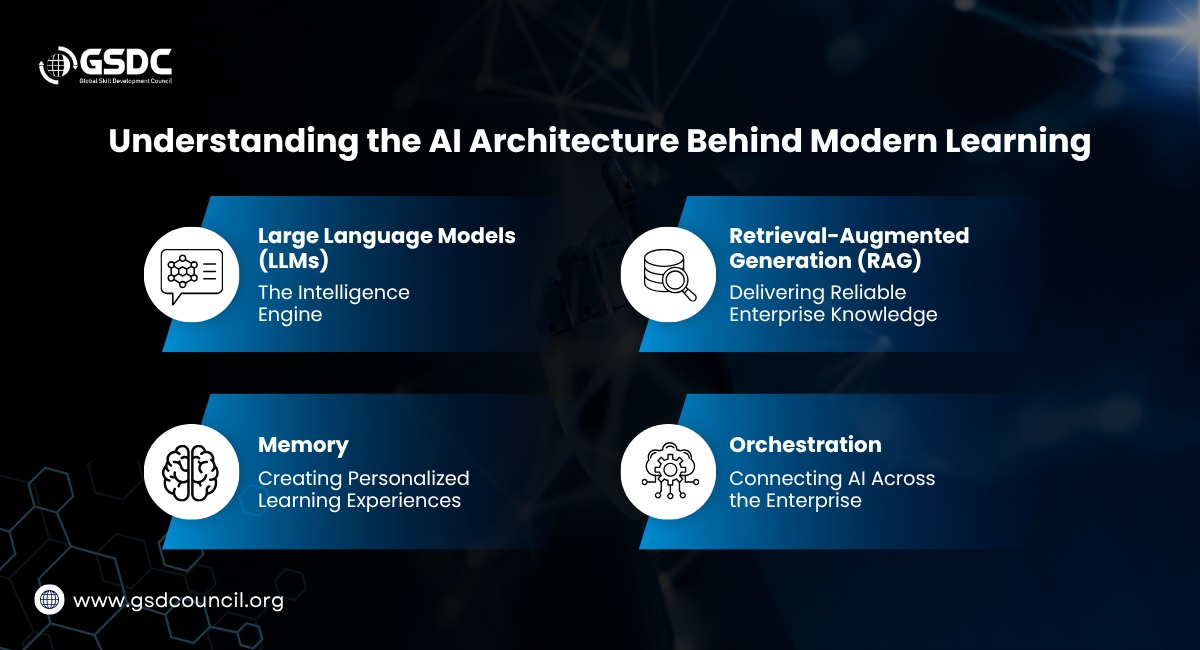
One of the most insightful discussions during the webinar focused on the architecture that powers enterprise AI solutions. While employees often interact with chatbots or AI assistants, the technology operating behind the scenes is significantly more sophisticated.
The speaker explained that effective AI systems combine multiple components, each serving a distinct purpose within the learning ecosystem.
Large Language Models (LLMs): The Intelligence Engine
At the center of modern AI systems are Large Language Models (LLMs). These models understand natural language, generate content, answer questions, summarize information, and assist users with complex tasks.
Within Learning and Development, LLMs can support instructional design, generate learning materials, create assessments, simplify technical documentation, and answer learner queries in real time.
However, the webinar highlighted an important limitation: LLMs alone are not enough. Since they rely primarily on pre-trained knowledge, they may generate outdated or inaccurate responses if they cannot access an organization's latest information.
To overcome this limitation, organizations need additional architectural components.
Retrieval-Augmented Generation (RAG): Delivering Reliable Enterprise Knowledge
One of the webinar's key topics was Retrieval-Augmented Generation (RAG), a technique that significantly improves the quality and reliability of AI responses.
Instead of relying solely on information learned during training, RAG enables AI systems to retrieve relevant documents, policies, knowledge bases, and organizational resources before generating an answer.
For Learning and Development, this means employees receive responses based on current company documentation rather than generic internet knowledge.
For example, instead of providing a general explanation of an HR policy, an AI assistant using RAG can retrieve the organization's latest policy documents and generate answers that are accurate, context-aware, and aligned with internal guidelines.
The webinar emphasized that this capability is particularly valuable for compliance training, onboarding, enterprise knowledge management, and role-specific learning.
Memory: Creating Personalized Learning Experiences
Another important concept discussed during the webinar was AI memory.
Traditional AI interactions often treat every conversation as independent. In contrast, AI systems equipped with memory can remember previous interactions, learner preferences, completed courses, skill levels, and ongoing development goals.
This enables Learning and Development teams to deliver highly personalized learning experiences.
Rather than recommending the same content to every employee, AI can understand individual progress and suggest the next most relevant learning activity based on previous performance and career aspirations.
The webinar described memory as one of the foundational capabilities required for intelligent, adaptive learning systems because it allows AI to build meaningful long-term relationships with learners instead of responding to isolated requests.
Orchestration: Connecting AI Across the Enterprise
While individual AI tools can automate specific tasks, organizations require orchestration to coordinate multiple AI systems and business processes.
The webinar explained that orchestration enables AI agents, enterprise applications, HR systems, learning platforms, and knowledge repositories to work together as a unified ecosystem.
For example, onboarding a new employee might involve several interconnected activities. Rather than manually assigning training, scheduling assessments, updating HR records, and notifying managers, an orchestrated AI system can automatically coordinate each step across multiple platforms.
This creates smoother employee experiences while significantly reducing administrative effort.
More importantly, orchestration allows organizations to scale AI adoption without creating disconnected workflows or fragmented learning experiences.
Responsible AI and Governance: Building Trust in Enterprise AI
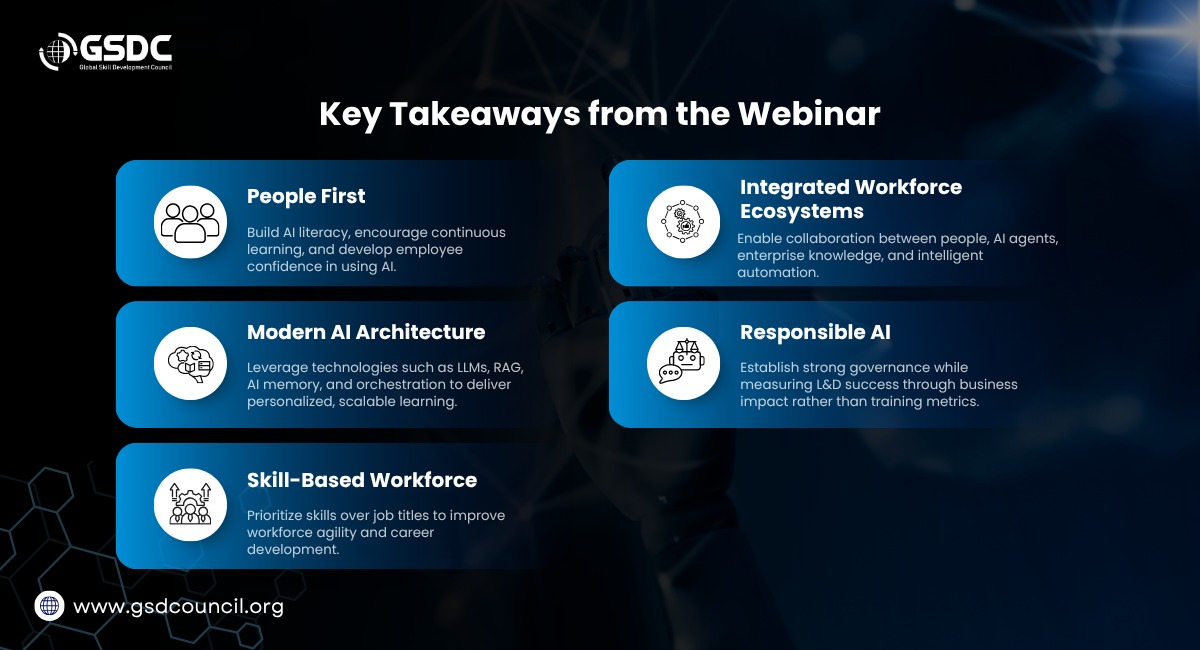
Throughout the webinar, the speaker reinforced that successful AI adoption requires strong governance and a clear AI adoption strategy.
Employees are far more likely to embrace AI when they understand how it operates, how their data is protected, and how decisions are made. This understanding is essential for AI workforce transformation and building confidence in AI for learning and development.
Organizations should therefore establish clear governance frameworks that prioritize transparency, accountability, fairness, privacy, security, and human oversight. These practices support responsible AI adoption and help organizations manage AI agent automation effectively.
Responsible AI also requires continuous monitoring to identify bias, validate AI-generated outputs, and ensure compliance with organizational policies and regulatory requirements. This is particularly important when implementing Intelligent Automation and AI workflow automation across business processes.
For Learning and Development teams, governance extends beyond technology. It also involves helping employees understand ethical AI practices, strengthening AI skills development, and encouraging responsible use of intelligent systems across the organization.
Building trust ultimately becomes the foundation upon which successful AI adoption is achieved, supporting AI workforce development and the future of learning and development.
Creating a Skill-Based Workforce Ecosystem for the AI Era
The webinar highlighted that organizations are shifting from job-based structures to skill-based workforce ecosystems. Instead of defining employees by job titles, businesses are focusing on the skills they possess and continuously develop, creating a more agile and adaptable workforce.
Key elements of a skill-based ecosystem include:
- Skills Over Job Titles: Employees are recognized for their capabilities rather than fixed roles.
- AI-Driven Skill Mapping: AI identifies existing skills, uncovers gaps, and recommends personalized learning paths.
- Dynamic Skill Portfolios: Employees build continuously updated profiles that reflect their evolving competencies.
- Verified Skills: Certifications, assessments, and practical experience validate job-ready capabilities.
- AI-Powered Talent Mobility: Intelligent talent marketplaces match employees to projects and opportunities based on skills instead of hierarchy.
By adopting this approach, organizations gain greater workforce flexibility, while employees benefit from continuous learning, career mobility, and clearer growth opportunities in an AI-driven workplace.
Strengthen AI Adoption Through L&D Expertise
The GSDC Certified Learning and Development Certification helps L&D professionals build the capabilities needed to support AI adoption and workforce transformation.
Aligned with the focus on AI literacy, AI skills development, skill-gap identification, personalized learning, intelligent automation, AI agents, responsible AI, and human-AI collaboration, the certification equips professionals to develop AI-ready talent and build adaptive learning ecosystems.
It also emphasizes practical approaches to integrating AI into L&D strategies, supporting continuous learning, strengthening workforce capabilities, and preparing organizations for the future of learning and development.
Conclusion
AI adoption is transforming how organizations learn, develop talent, and work. The webinar emphasized that successful AI transformation requires more than technology; it depends on AI literacy, continuous learning, responsible governance, human-AI collaboration, AI skills development, and a strong AI adoption strategy. Organizations that invest in these capabilities can build agile, future-ready workforces, support AI workforce transformation, and drive long-term business growth.

Related Certifications
Frequently Asked Questions
L&D builds AI literacy, closes AI skills gap, and prepares employees to use AI confidently while supporting business goals and AI workforce development.
It combines human expertise, ai agent automation, and Intelligent Automation to improve productivity, collaboration, decision-making, and AI workflow automation.
RAG provides AI with up-to-date organizational knowledge, while AI memory personalizes learning based on user preferences and past interactions, supporting AI for learning and development.
Measure outcomes through AI skills development, productivity, employee performance, innovation, engagement, and business impact as part of the future of learning and development.
The biggest challenge is preparing people for change through continuous learning, responsible AI practices, strong leadership, and effective AI workforce transformation.
Stay up-to-date with the latest news, trends, and resources in GSDC
If you like this read then make sure to check out our previous blogs: Cracking Onboarding Challenges: Fresher Success Unveiled
Not sure which certification to pursue? Our advisors will help you decide!