How Forward Deployed Engineers Turn Messy Business Data into Working AI Solutions
Written by Emily Hilton
- Why Do AI Projects Fail When Business Data Is Messy?
- What Does Data Readiness for AI Actually Mean?
- How Forward Deployed Engineers Prepare Messy Data for AI
- What Tools Can Forward Deployed Engineers Use for AI Data Preparation?
- How Better Data Preparation Supports Enterprise AI Adoption
- Want to Become a Forward Deployed Engineer? Start Here
- Final Thoughts
Businesses are investing in artificial intelligence to automate processes, improve decision-making, and solve complex problems. However, building an AI model is only one part of the process. For AI to deliver useful results, it needs access to reliable data, relevant business context, and the systems where employees already work.
This is where many organizations face challenges. Business data may be scattered across spreadsheets, customer relationship management (CRM) platforms, databases, internal documents, and enterprise applications. Some records may be incomplete, outdated, or inconsistent. When AI systems rely on this information without proper preparation, their outputs can become inaccurate or unreliable.
A Forward Deployed Engineer helps bridge this gap between business data and working AI solutions. By understanding business requirements, identifying data problems, connecting systems, and testing AI applications in real-world conditions, these engineers help organizations move from promising prototypes to solutions that support everyday work.
In this blog, we will explore how Forward Deployed Engineers prepare messy business data for AI, improve data readiness, connect disconnected systems, and help businesses implement AI solutions that address practical challenges.
Why Do AI Projects Fail When Business Data Is Messy?
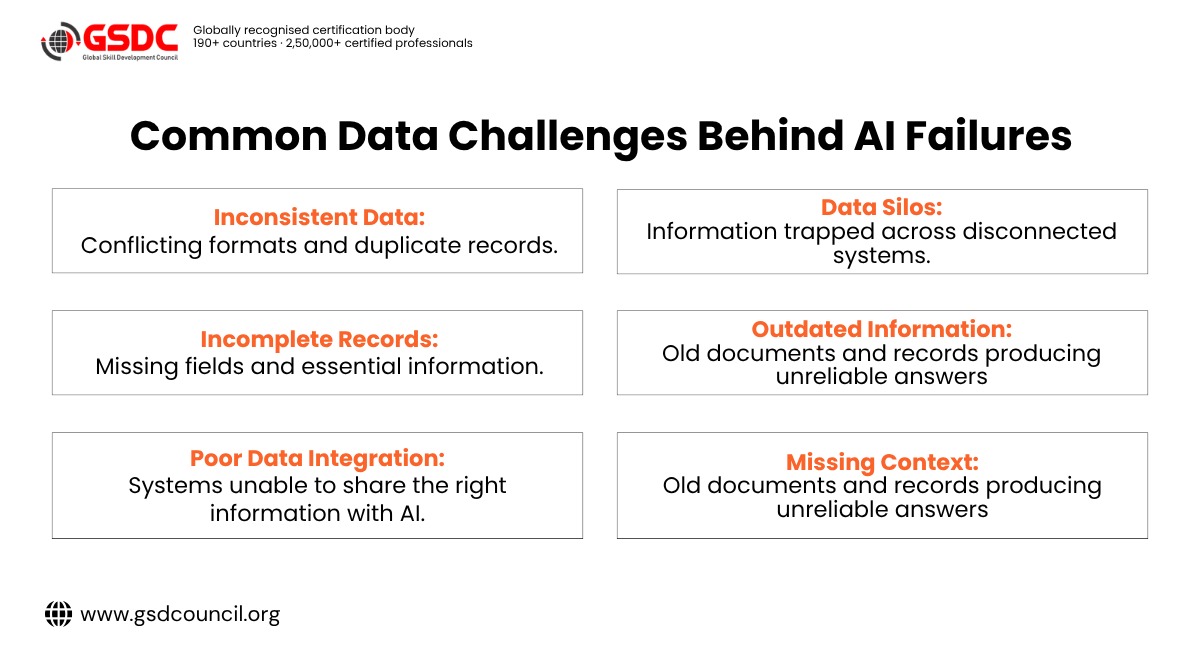
AI projects often struggle because business data is incomplete, inconsistent, outdated, or disconnected. Even a capable AI model can produce unreliable results without accurate information and relevant context.
Understanding why AI projects fail requires looking beyond the model. Data quality, system integration, and business requirements all influence AI performance.
1. Inconsistent and Incomplete Data
Different teams may use different formats, duplicate records, or leave important fields missing. These inconsistencies make it harder for AI systems to interpret information accurately.
2. Data Silos Across Business Systems
Organizations store information across CRM platforms, databases, spreadsheets, and internal applications. These data silos make it difficult to connect information from different sources.
3. Outdated Information
Old policies, product details, and records can lead to inaccurate AI-generated answers. Engineers must identify reliable sources and keep information updated.
4. Missing Business Context
Data without details such as reporting periods, customer segments, or business meaning can be misinterpreted, affecting the relevance of AI outputs.
5. Poor System Integration
An AI application may work in a demo but fail when connected to business systems due to API errors, access restrictions, or retrieval issues.
Forward Deployed Engineers address these challenges by improving data quality, connecting systems, and testing AI solutions against real business requirements. This helps organizations move beyond prototypes toward practical AI applications.
What Does Data Readiness for AI Actually Mean?
Data readiness for AI refers to the process of ensuring that data is suitable for a specific AI application. It involves checking whether the information is accessible, accurate, relevant, consistent, and managed appropriately.
Data readiness does not mean that every dataset must be perfect before an organization can begin using AI. Instead, teams need to understand what information the application requires, identify existing limitations, and resolve the issues that could affect its performance.
For example, a business developing an AI assistant to answer employee questions may not need to prepare every database in the organization. It may need to focus on approved policies, internal documentation, access permissions, and the process for keeping those documents current.
Several factors help determine whether data is ready for AI.
- Accessibility: Can the application retrieve the information it needs?
- Accuracy: Does the data reflect the actual business situation?
- Consistency: Are formats, labels, and definitions aligned across sources?
- Relevance: Does the information provide enough context for the intended task?
- Completeness: Are important fields, records, and documents available?
- Security and governance: Are permissions, privacy requirements, and data ownership clearly defined?
These factors provide a starting point for assessing data readiness. The specific requirements depend on the AI use case, the type of data involved, and the risks associated with incorrect results.
How Forward Deployed Engineers Prepare Messy Data for AI
Forward Deployed Engineers approach data preparation as part of a broader implementation process. They do not simply clean datasets and pass them to an AI model. They first understand the business problem, determine what information is required, and build a practical approach to making that information usable.
Here is how the process typically works.
Step 1: Understand the Business Problem Before Touching the Data
The first step is to define the problem the organization wants AI to solve.
Suppose a customer support team spends too much time searching internal documents to answer technical questions. The business wants an AI assistant that can retrieve relevant information and help support agents respond faster.
Before choosing tools or cleaning data, the Forward Deployed Engineer needs to understand:
- Which questions take the most time to resolve?
- Who will use the AI application?
- What information is required to answer those questions?
- Where is that information currently stored?
- What would a successful outcome look like?
This discovery process prevents teams from preparing large amounts of data that may not be relevant to the actual problem.
It also helps establish measurable goals, such as improving answer relevance, reducing information retrieval time, or lowering the number of questions that require manual investigation.
Step 2: Map Data Sources and Identify Data Silos
Once the business requirements are clear, the engineer identifies the systems that contain the necessary information.
These sources may include:
- CRM and customer support platforms
- Enterprise databases and data warehouses
- Internal documents and knowledge bases
- Product manuals and technical documentation
- Spreadsheets and shared folders
- APIs and third-party applications
The engineer then examines how these sources relate to one another. Some systems may contain duplicate information, while others may use different identifiers for the same customer, product, or transaction.
The goal is to determine which sources are relevant, how information can be accessed, and whether the systems can exchange data reliably.
Not every source needs to be connected. A good implementation focuses on the information required for the use case while respecting security and access restrictions.
Step 3: Audit Data Quality for AI
After mapping the sources, the engineer evaluates their suitability for the intended application. Data quality for AI is not just about making information look clean. It is about ensuring that the data supports reliable outputs for a specific task.
Common checks include:
- Missing information: Identify incomplete records and essential fields that have not been populated.
- Duplicate records: Find repeated entries that could distort results or create confusion.
- Inconsistent formats: Standardize dates, units, labels, and other fields where necessary.
- Outdated content: Identify documents and records that no longer reflect current business processes.
- Conflicting information: Determine which source should be treated as authoritative when records disagree.
- Access restrictions: Confirm that the AI application will not expose information to unauthorized users.
The engineer prioritizes issues based on their potential impact. For example, outdated policy documents may be a serious problem for an internal AI assistant, while a minor formatting inconsistency may have little effect on the result.
This targeted approach helps teams focus their effort on the data problems that matter most.
Step 4: Perform AI Data Preparation
Once the main quality issues have been identified, the engineer prepares the information for the chosen AI approach.
AI data preparation varies depending on whether the solution uses document retrieval, a large language model, predictive machine learning, or another technique.
For an AI assistant that answers questions using internal documents, preparation may involve:
- Extracting text from PDFs, Word documents, and other file formats.
- Removing duplicate or outdated content.
- Dividing long documents into smaller, meaningful sections.
- Preserving metadata such as document type, date, department, and source.
- Generating embeddings when required for semantic retrieval.
- Indexing approved content so the application can retrieve relevant information.
This process is commonly used in retrieval-augmented generation (RAG) systems. The application retrieves relevant information from an approved knowledge source and supplies that context to the language model when generating an answer.
For predictive AI applications, preparation may involve a different set of tasks, including handling missing values, standardizing numerical fields, checking labels, and preparing suitable training and evaluation datasets.
The important principle is that data preparation must match the AI task. A document-based assistant and a forecasting model have different data requirements, so they should not follow an identical preparation process.
Step 5: Connect Prepared Data to the AI Application
Prepared data becomes useful when the AI application can access it in the right context.
A Forward Deployed Engineer may connect the data through APIs, databases, search systems, retrieval pipelines, or other integration methods. The appropriate approach depends on the organization's existing infrastructure and the requirements of the use case.
During integration, the engineer considers several practical questions:
- Can the application retrieve the correct information?
- Are permissions enforced when users request data?
- How will the system handle unavailable records or failed requests?
- How frequently should the data be updated?
- Can changes in the source system be reflected in the AI application?
- What should happen when the required information cannot be found?
These details are important because AI applications often operate within larger business workflows. A solution that retrieves information correctly in isolation may still fail if it cannot interact reliably with the systems employees use every day.
Step 6: Test the Solution With Real Business Scenarios
Before deployment, the engineer tests the application using realistic questions, records, and business situations.
Testing should go beyond a few successful demonstrations. It should examine how the application behaves when the information is incomplete, ambiguous, outdated, or unavailable.
For an AI assistant, the evaluation might include:
- Whether it retrieves the most relevant documents.
- Whether its answers match the available source information.
- Whether it recognizes when the data is insufficient.
- Whether it handles conflicting sources appropriately.
- Whether it respects user permissions.
- Whether it responds within acceptable time and cost limits.
The engineer can compare outputs against expected answers, review failure cases, and adjust the data preparation or retrieval process.
For example, if an assistant repeatedly retrieves an outdated product manual instead of the latest version, the problem may require changes to document metadata, source prioritization, or content update procedures rather than a different AI model.
Step 7: Deploy, Monitor, and Improve
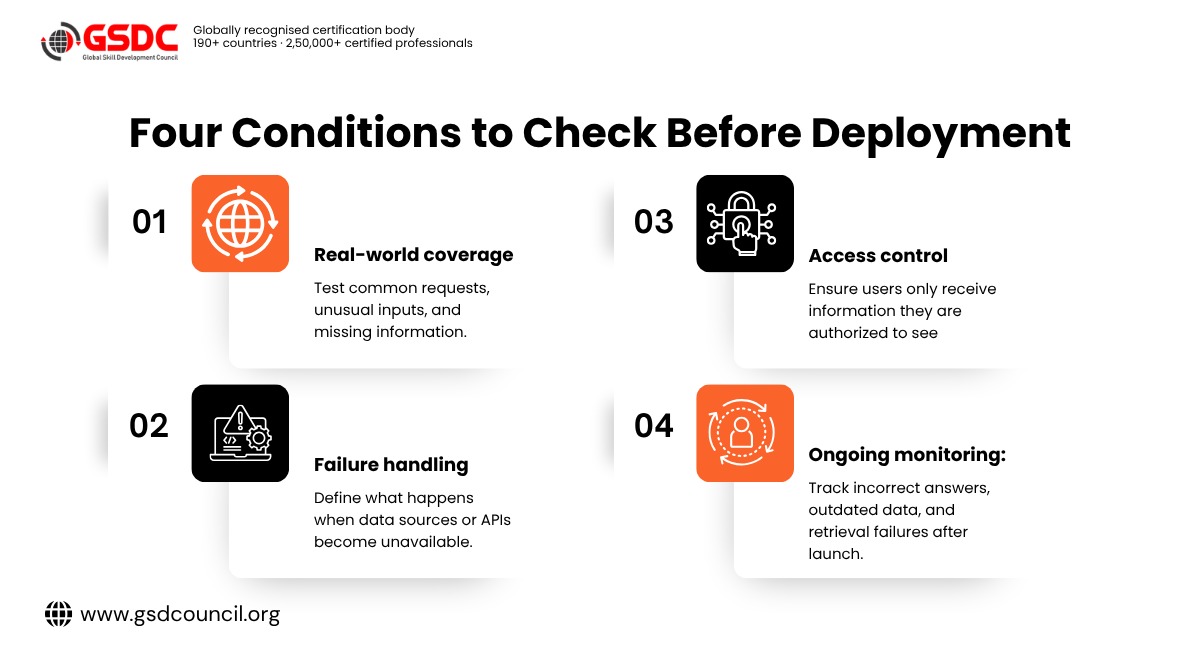
Deploying the AI application is not the final step. Business information changes, new documents are added, and existing records become outdated.
A Forward Deployed Engineer helps establish a process for monitoring the application and identifying issues after launch.
Depending on the use case, the team may monitor:
- Retrieval relevance and answer accuracy
- Failed requests and application errors
- Data freshness and synchronization problems
- Response time and cost per task
- Human corrections or escalations
- User adoption and task completion
These signals help the team identify whether the problem lies in the data, the integration, the AI model, or the workflow itself.
Continuous improvement ensures that the solution can adapt as business requirements and data sources evolve.
What Tools Can Forward Deployed Engineers Use for AI Data Preparation?
The tools used by a Forward Deployed Engineer depend on the data sources, AI application, technical environment, and security requirements. Rather than choosing tools first, engineers should identify the problem that needs to be solved and then select suitable technologies.
Task | Tool categories | How they help |
| Data inspection | SQL, Python, data profiling tools | Identify missing, inconsistent, or duplicate data. |
| Data integration | APIs, ETL/ELT platforms | Move and synchronize information across systems. |
| Document processing | Document parsers, OCR, text extraction tools | Convert business documents into usable content. |
| Data transformation | SQL, Python, transformation frameworks | Standardize and organize data for the intended use. |
| AI retrieval | Search systems, embedding models, vector databases | Make relevant information available to AI applications. |
| Evaluation | Test datasets, retrieval evaluation tools, monitoring platforms | Assess quality and identify failures. |
| Deployment and monitoring | Cloud platforms, logging, observability tools | Run applications and monitor their behavior in production. |
For example, SQL and Python may help inspect and transform structured data, while document-processing tools can prepare information from PDFs and other files. Search systems and vector databases may support retrieval-based AI applications.
No single toolset is suitable for every project. A Forward Deployed Engineer must understand the use case and work within the organization's existing technology stack wherever practical.
How Better Data Preparation Supports Enterprise AI Adoption
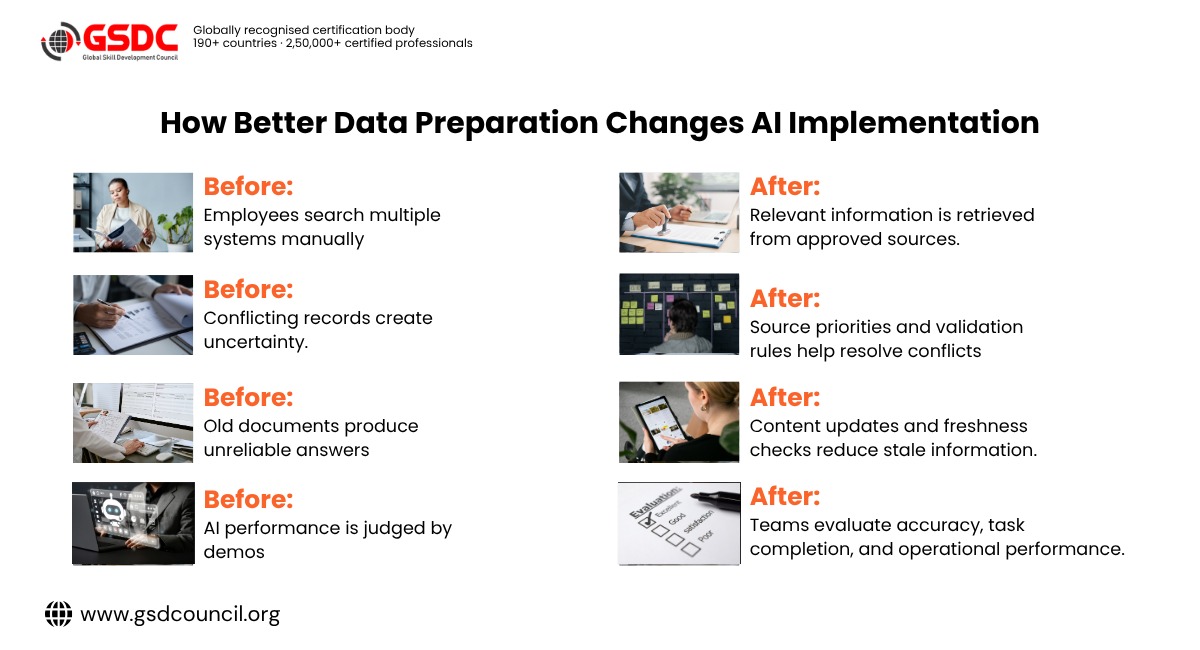
Organizations often need more than a successful prototype before they can use AI across business operations. They need solutions that work with existing systems, handle real-world data, and deliver outcomes that can be evaluated.
Better data preparation can support enterprise AI adoption in several ways.
1. More Relevant AI Outputs
When information is accurate, current, and relevant, AI applications have a stronger foundation for generating useful answers. Data preparation does not eliminate model errors, but it can reduce problems caused by poor source information.
2. Better Use of Existing Business Information
Organizations often have valuable information spread across multiple systems. Connecting appropriate sources can help employees find information without manually searching each application.
3. More Reliable Business Workflows
AI applications must work within real processes. Reliable integrations, clear data ownership, and appropriate access controls help reduce implementation problems and support consistent operation.
4. Easier Evaluation of Business Value
When a project has clear goals and measurable indicators, teams can assess whether the application is helping. Depending on the use case, these indicators might include task completion, time spent finding information, answer relevance, or the number of cases requiring manual intervention.
5. Stronger Foundations for Ongoing Improvement
Data quality and business requirements change over time. Monitoring data freshness, application performance, and user feedback helps organizations identify issues and improve their solutions after deployment.
However, data preparation alone does not guarantee successful enterprise AI adoption. The results also depend on the AI approach, application design, governance, security, user training, and ongoing maintenance.
Want to Become a Forward Deployed Engineer? Start Here
Professionals interested in this career path can explore structured learning that connects engineering concepts with practical AI implementation.
The GSDC Certified Forward Deployed Engineer Certification is an option for learners who want to build their understanding of the Forward Deployed Engineer role, customer-focused engineering, AI applications, and technical implementation.
A certification can provide structure for learning, while practical projects help learners apply concepts to real implementation challenges. Before enrolling, review the curriculum to understand how it aligns with your current skills and development goals.
What Can You Gain From the Certification?
- Understand the FDE Role: Learn how Forward Deployed Engineers connect business requirements with technical solutions.
- Explore AI Applications: Understand how AI can address real-world business challenges.
- Strengthen Technical Knowledge: Build familiarity with software systems, APIs, integrations, and AI workflows.
- Connect Business and Technology: Learn to approach technical problems with business needs in mind.
- Prepare for Practical Challenges: Develop a foundation for understanding real-world AI implementation.
Explore the GSDC Certified Forward Deployed Engineer Certification to learn more.

Final Thoughts
Messy business data can prevent AI projects from delivering reliable results. Inconsistent records, disconnected systems, outdated documents, and missing context can affect how an AI application retrieves information and responds to real business needs.
Forward Deployed Engineers help address these challenges by connecting business requirements with data preparation, system integration, AI implementation, testing, and continuous improvement. Their work focuses not only on making an AI application function, but also on making it useful within the environment where it will be used.
For organizations, this approach can help create a stronger foundation for practical AI implementation. For professionals, learning how data, AI, software systems, and business problem-solving work together can be a useful step toward exploring Forward Deployed Engineering.

Related Certifications
Frequently Asked Questions
Data preparation helps ensure that information is accurate, relevant, consistent, and suitable for the intended AI application. Poorly prepared data can affect retrieval quality, predictions, and generated answers.
Data readiness for AI is the process of assessing whether data is accessible, reliable, relevant, and appropriately governed for a specific AI use case. It also involves identifying and addressing limitations that could affect the solution.
They identify the business problem, map relevant data sources, assess data quality, prepare the information for the selected AI approach, integrate it with the application, and test the solution using realistic scenarios.
Yes. AI applications can use information from multiple systems when suitable integrations, data pipelines, or retrieval mechanisms are implemented. The approach must also account for data permissions, consistency, and update frequency.
Data cleaning focuses on identifying and correcting issues such as duplicates, missing values, and inconsistent formats. AI data preparation is broader: it includes cleaning as well as transforming, organizing, enriching, and making information suitable for a particular AI task.
Useful skills include software development, data preparation, APIs, databases, AI implementation, testing, troubleshooting, business analysis, and stakeholder communication. The exact requirements vary by employer and use case.
A Forward Deployed Engineer Certification can provide a structured way to learn about the role and related implementation concepts. Learners should also build practical projects and develop the technical skills required for their intended roles.
Stay up-to-date with the latest news, trends, and resources in GSDC
If you like this read then make sure to check out our previous blogs: Cracking Onboarding Challenges: Fresher Success Unveiled
Not sure which certification to pursue? Our advisors will help you decide!