Aligning L&D Strategy with Business Goals for Organizational Growth AI
Written by David Vance
Have you ever wondered why some learning programs in organizations seem to make a real difference, while others just tick a box? The answer usually comes down to a strong learning and development strategy. In our recent webinar, “Aligning Learning & Development Strategy with Business Goals: Achieving Organizational Success Through Strategic Learning Initiatives,” we explored what is L&D in business and how it can move beyond traditional training programs to drive measurable results.
Instead of creating courses first and then trying to link them to business goals, strategic learning and development flips the script it starts with the goals themselves. By understanding what the organization needs to achieve in a fiscal year, L&D can design programs that not only enhance skills but also contribute directly to top-line objectives like increasing sales, reducing injuries, or improving productivity.
Through this blog, let’s dive into the key insights shared in the webinar, showing how you can plan, measure, and execute learning initiatives that truly matter.
Why Strategic Learning Matters
A common mistake in many organizations is backward mapping. This occurs when courses are developed first, and later leaders try to assign them to business goals in an effort to justify the learning. While it may appear that L&D is aligned with corporate priorities, this approach fails to create true alignment with strategy and rarely produces measurable business impact.
A strong learning and development strategy framework takes a different approach. Instead of reacting, it ensures aligning learning with business strategy from the very beginning. Strategic learning, in contrast, is goal-based, proactive, and measurable:
- Starts with organizational goals: L&D identifies the top business priorities for the coming fiscal year—such as reducing safety incidents, increasing sales, improving customer satisfaction, or enhancing operational efficiency.
- Performs a targeted needs analysis: Programs are designed based on what is specifically needed to achieve these goals, rather than relying on generic skill development.
- Sets measurable targets: Each program has defined success metrics, including completion rates, knowledge application, and its projected contribution to business outcomes.
This approach ensures that learning is not just activity-based but becomes a strategic lever for achieving real business objectives.
Planning Strategic Learning Programs
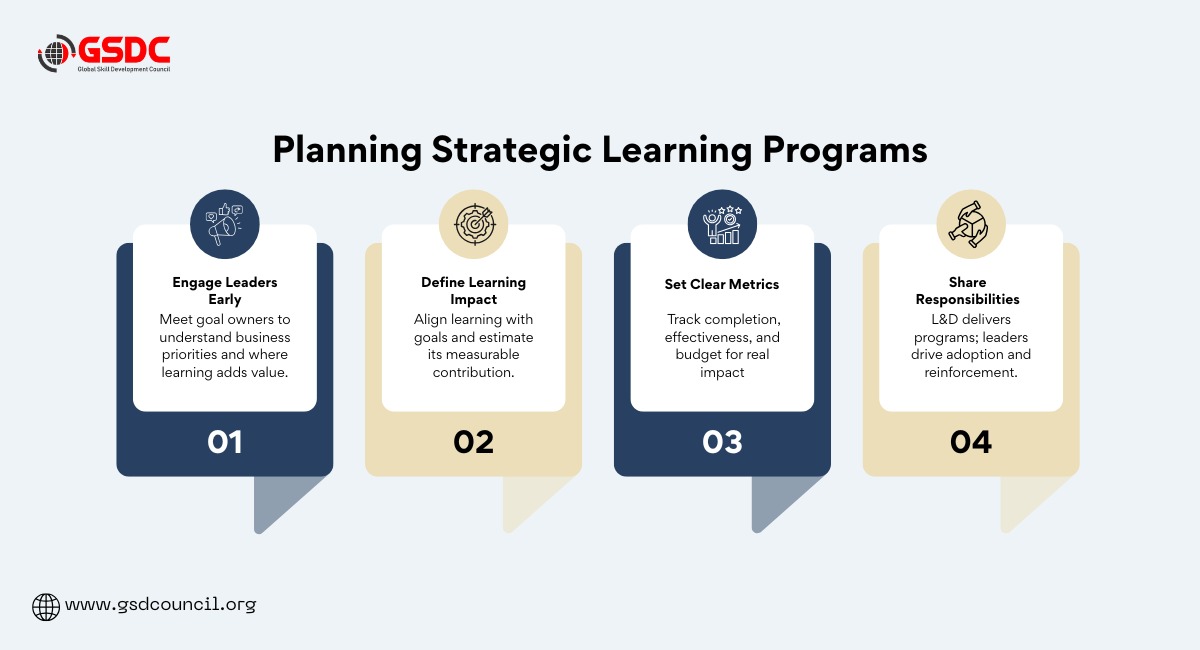
Effective Strategic Learning begins with careful planning and collaboration between L&D professionals and business leaders. At its core, what is strategic alignment comes down to ensuring that learning initiatives directly support business priorities. The webinar outlined a systematic learning and development strategy framework that enables true alignment with strategy and ensures accountability while aligning learning with business strategy.
1. Engage Goal Owners Early
Start by meeting with senior leaders and goal owners before the fiscal year begins. Understand their top priorities and what success looks like. This step defines what is strategic learning in practice focusing on business outcomes first, not training delivery.
For example, if the sales department’s goal is a 10% increase in revenue, the L&D team collaborates with the VP of Sales to understand all contributing factors. Learning becomes one component among others, such as market growth, product launches, incentives, and staffing.
2. Define the Learning Contribution
Once contributing factors are identified, work with the goal owner to quantify the projected impact of learning. This ensures stronger alignment with strategy by assigning a measurable value to learning.
If sales are expected to grow by 10%, learning might contribute 20% of that growth resulting in a 2% increase directly tied to learning programs. This transforms learning into a measurable driver rather than a supportive activity.
3. Set Success Metrics
A strong learning and development strategy framework requires metrics beyond course completion to support aligning learning with business strategy:
- Completion rates and deadlines: Deliver programs early to maximize impact
- Effectiveness measures: Track intent to apply learning and real-world application
- Budget and resource adherence: Ensure efficient use of internal and external resources
These metrics provide a clear picture of how learning contributes to business success.
4. Jointly Manage Roles & Responsibilities
Successful Strategic Learning depends on shared ownership and clear accountability:
- L&D responsibilities: Design, deliver, and reinforce learning while guiding managers
- Goal owner responsibilities: Communicate importance, drive participation, and ensure reinforcement
This structured collaboration strengthens alignment with strategy and ensures that learning initiatives deliver meaningful, measurable outcomes.
Measuring the Impact of Learning
Without measurement, strategic learning and development is just a theory. A strong learning and development strategy must include clear evaluation methods to prove real impact. The webinar highlighted several approaches within a robust learning and development strategy framework that support aligning learning with business strategy and demonstrate what is L&D in business as a value-driving function:
- Planned vs. actual impact: Compare the projected contribution of learning against real outcomes throughout the fiscal year to ensure true business alignment.
- Monthly reporting: Track year-to-date results and forecast end-of-year performance, enabling early corrective action if progress lags.
- Phillips ROI methodology: Evaluate the isolated impact of learning using control groups, statistical analysis, or participant estimation to scientifically quantify results.
These methods help organizations move beyond assumptions and clearly show how a well-executed learning and development strategy contributes to business outcomes. They also empower L&D leaders to demonstrate value to the CEO and senior leadership, positioning learning programs as strategic investments rather than operational costs.
Strategic Learning vs. Skills-Based Learning
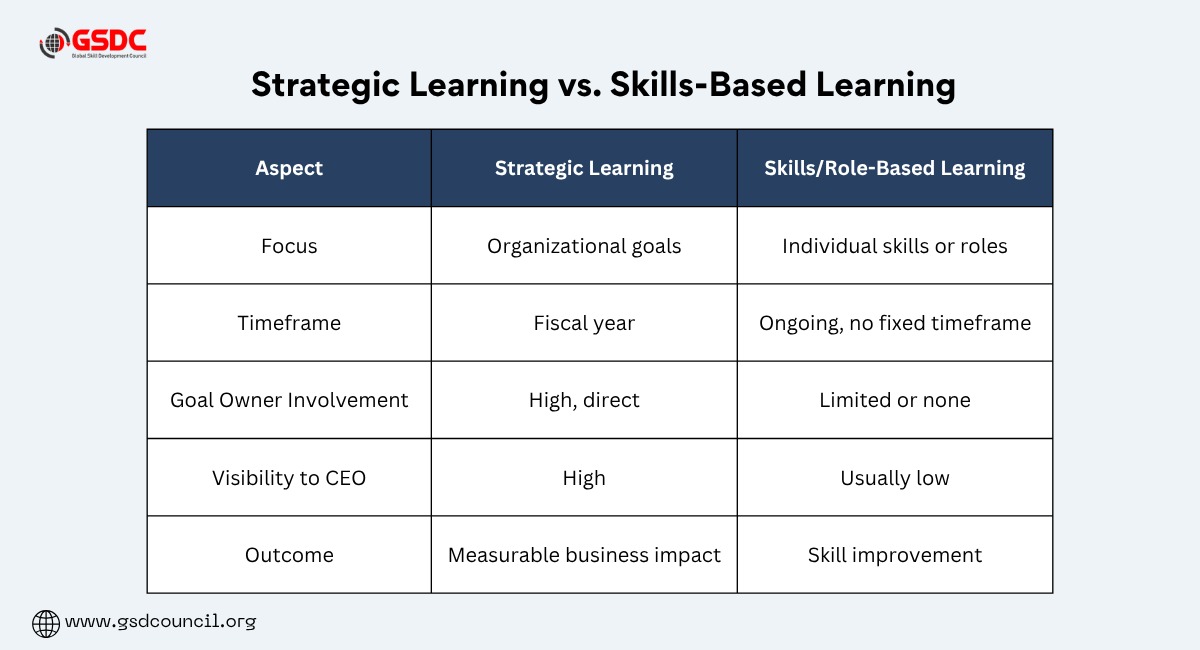
It is essential to differentiate goal-based strategic learning from skills or role-based learning. Both are valuable but serve different purposes.
While skills-based learning helps employees develop competencies, it does not guarantee a measurable contribution to organizational goals. Strategic learning, on the other hand, is designed and executed specifically to achieve organizational objectives, making it visible and valuable at the executive level.
Implementing Strategic Learning: Best Practices
To make Strategic Learning effective in practice, organizations need a structured and actionable approach one that starts by equipping their L&D professionals with the right credentials. If you want to understand how to become an instructional designer who can lead these strategic initiatives, GSDC's 90-day certification pathway covers the complete skill set from ADDIE 2.0 to Kirkpatrick L3/L4 measurement. These best practices reflect what is L&D in business today moving beyond training delivery to driving measurable outcomes through a strong learning and development strategy framework and ensuring true alignment with strategy.
- Start small: Focus on one or two top-priority goals initially, then scale gradually. This is a practical way of applying what is strategic learning without overwhelming resources.
- Ensure early-year completion: Deliver high-priority programs in the first half of the fiscal year to maximize impact and support aligning learning with business strategy.
- Include application measures: Define how learning will be applied on the job. This reinforces what is strategic alignment by linking learning directly to performance outcomes.
- Maintain flexibility: Reserve 10–20% of resources for unplanned learning requests to stay adaptable while maintaining alignment with strategy.
- Use proactive reporting: Implement monthly reports comparing planned, actual, and forecasted results to track progress and strengthen accountability.
- Pilot programs for credibility: Start with focused initiatives—success in one area builds trust and expands opportunities for broader Strategic Learning adoption.
- Reinforce learning: Collaborate with supervisors and managers to ensure training is consistently applied in the workplace.
By following these practices, organizations ensure that learning is not only aligned with business priorities but also measurable, scalable, and impactful.
GSDC Certified Learning & Development Professional (CLDP): Driving Strategic Learning
GSDC’s Certified Learning & Development Professional equips L&D professionals to align learning with business goals and deliver measurable impact. The program focuses on learner-centric design, digital learning strategies, and effective virtual delivery.
With expertise in instructional design and modern learning practices, a Certified Learning & Development Professional enables professionals to create targeted programs that enhance performance, support real business outcomes, and strengthen a strategy-driven learning function.
Conclusion
Strategic learning transforms L&D from an administrative function into a driver of organizational success. This is the hallmark of a learning architects a professional who moves beyond slide-deck delivery to design learning systems that directly influence business KPIs, productivity, and talent retention. By starting with business goals, performing a targeted needs analysis, defining measurable contributions, and managing programs proactively, learning initiatives can deliver real, quantifiable results.
Organizations that embrace this approach not only improve key metrics such as sales, safety, and productivity but also elevate the credibility of L&D within the leadership team. While skills-based learning remains important for individual growth, strategic learning is the vehicle that links learning directly to measurable business outcomes, ensuring that L&D contributes meaningfully to organizational success.
By adopting this strategic, business-focused approach, organizations can maximize the ROI of learning investments and position L&D as a critical partner in achieving top-level goals.

Related Certifications
Stay up-to-date with the latest news, trends, and resources in GSDC
If you like this read then make sure to check out our previous blogs: Cracking Onboarding Challenges: Fresher Success Unveiled
Not sure which certification to pursue? Our advisors will help you decide!