Designing Inclusive Learning for Neurodiverse Learners
Written by Hayley Brackley
Average does not exist.
We can calculate an average height because height sits on a single linear scale. We can plot the average weight. But when we start talking about how brains work, there is no single axis, no meaningful centre point, and no such thing as an average learner. Designing as though there is one means designing for a statistical anomaly, leaving everyone else to quietly manage the gap on their own.
This webinar explored what it looks like to stop designing for the average and start designing for the actual range of people in the room, with a focus on neuro-inclusion, neurodivergent learners, and the need to create inclusive learning environments. It also highlighted practical inclusive learning strategies and approaches to workplace design that better support diverse ways of thinking, learning, and participating.
The problem with waiting for disclosure
What is neurodiversity? It is the recognition that every brain thinks, processes, and experiences the world differently. In that sense, neurodiversity covers all of us. Neurodivergence refers to those whose brains differ significantly from the majority, including autistic people, people with ADHD, dyslexic people, and many others. Each brings distinct patterns of thinking, communicating, learning, and engaging with the world. Understanding this distinction is an important part of what inclusive learning really means in practice.
For trainers and facilitators, the goal is not to become experts in every condition. The real task is to build learning experiences that work better for a wider range of neurodiverse learners from the very beginning. This is where neuroinclusive design becomes essential. Instead of waiting for individuals to ask for support, it focuses on creating learning environments where more people can participate, contribute, and succeed from the start.
Many organisations still rely on the idea that people will simply disclose their needs in advance. On the surface, that sounds reasonable. In practice, it often fails. Diagnosis pathways vary around the world; many people do not have a formal diagnosis, and some may not yet have the language to describe their own experiences. On top of that, stigma still shapes what people feel safe sharing. By the time disclosure happens, the programme is often already designed and the session is about to begin.
What this approach often reveals is a deeper neuro-normative bias: the quiet assumption that everyone processes information at a similar speed, responds to pressure in similar ways, and finds standard participation formats equally accessible. That assumption influences almost every design decision. To truly answer what is inclusive learning, organisations must move beyond disclosure-based support and instead create learning systems that are flexible, thoughtful, and inclusive by design.
The Seven Lenses
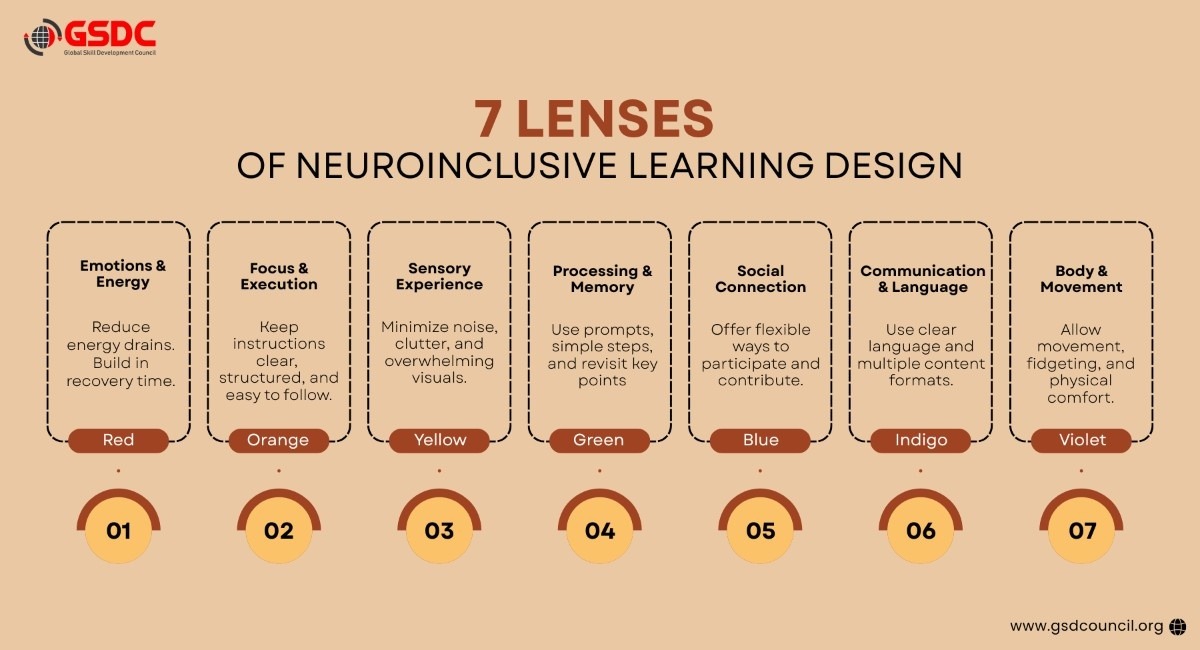
To give facilitators and leaders something practical to work with, the session introduced the Seven Lenses model. Each lens is an invitation to look at the environments they design through a different aspect of human experience, without needing anyone to disclose anything. It also offers a practical way to understand what is inclusive design in real learning and workplace settings, especially when building more effective inclusive learning environments for neurodivergent learners and recognising the different types of neurodivergent experiences people may bring.
The lenses run in rainbow order.
The Red lens
The red lens looks at emotions and energy. Neurodivergent learners can experience greater variation in both emotional intensity and energy levels, and the things that drain energy are not the same for everyone. Being put on the spot in front of a group, doing intense quiet work, or sitting through a long icebreaker can all have a significant impact. The question to ask is: where are the energy drains in what has been designed, and where has space to recover been built in?
The Orange lens
The orange lens looks at execution and focus. Executive function sits at the front of the brain and covers planning, prioritising, concentrating, and just getting started. When instructions are scattered across fifteen emails, when exercises are not clearly sequenced, and when there is no obvious hook to bring attention back in, the design is working against people rather than with them. Small changes here make a significant difference and are often some of the most effective inclusive learning strategies.
The Yellow lens
The yellow lens looks at sensory experience. Noise, visual clutter, poor sound quality, and overwhelming slides all affect how people absorb information. This applies in physical rooms and online equally. Permitting people to turn their camera off, to fidget, to take a sensory break, and designing genuinely clear materials rather than just comprehensive all help create a stronger inclusive learning environment.
The Green lens
The green lens looks at processing and memory. Memory demands create unnecessary barriers. If someone is expected to remember seven lenses with no written prompt, some people will manage, and many will not. That is not a failure of the learner. It is a failure of the design. Clear written and visual prompts, broken-down instructions, and opportunities to revisit material reduce the reliance on memory and make the content more usable for everyone in inclusive learning environments.
The Blue lens
The blue lens looks at social connection. Many standard participation formats assume a level of social ease that not everyone has. Icebreakers that require small talk, bingo networking activities, and large group discussions where the expectation is that everyone will contribute freely can quietly exclude the people who have the most to offer. Offering one-to-one time, individual reflection, and genuine choice in how people contribute are important inclusive learning strategies.
The Indigo lens
The indigo lens looks at communication and language. Some people process spoken information more slowly. Some find reading difficult. Assuming that putting instructions on a slide means everyone has received them is a significant design risk. Pace, clarity, and format all matter, and offering more than one route into the content is one of the most straightforward ways to improve inclusive learning environments.
The Violet lens
The violet lens looks at the body and movement. This is the lens that gets forgotten most often. For some neurodivergent people, movement is not a distraction. It is how they regulate. Being able to fidget, stretch, or shift position allows them to stay grounded enough to take in new information. Designing spaces that allow for movement without judgment, and that do not assume everyone can perform physical tasks easily, is a core part of what is inclusive design.
From Individual Adjustments To System Design
The shift the session was pointing toward is this: stop waiting for individuals to flag their needs, and start designing systems that work for more people from the beginning.
This is not about lowering standards or making sessions easier. A well-designed system, one that accounts for how people actually think, feel, process, and engage, is a more effective system. When the design reduces misunderstanding, fatigue, and unnecessary friction, it works better for everyone in the room, not just those who might otherwise struggle.
A practical tool to support this thinking is the Fit, Adaptation, Constraint, Workaround model. Identify which lens is most relevant to a situation. Find one small adaptation you could make. Name the constraint that makes it difficult. Then work out the best improvement possible within those limits. It is iterative, low-effort to start, and builds over time.
Leadership's Role
Leaders decide what participation looks like. They set communication norms, own workload design, control pace and deadlines, and shape the physical and digital environments people work in every day. Neuroinclusion is therefore a leadership and infrastructure priority. It cannot be delegated to individuals to sort out for themselves.
The evidence is clear that inclusive environments improve performance, wellbeing and outcomes for everyone. When systems are designed with human variation in mind, the benefits are not limited to any one group.
Strengthen Inclusive Learning with the GSDC Certified Learning and Development Professional (CLDP)

For professionals looking to turn inclusive learning ideas into practical workplace impact, the GSDC Certified Learning and Development Professional (CLDP) certification offers a strong next step. This program helps L&D professionals, trainers, facilitators, and HR leaders build the strategic and practical skills needed to design effective learning experiences for diverse teams.
GSDC’s credential covers key areas such as learning strategy, workforce capability development, training effectiveness, performance alignment, and modern workplace learning practices. For organisations committed to building more inclusive, accessible, and high-impact learning cultures, the Certified Learning and Development Professional certification supports professionals in creating learning systems that are thoughtful, measurable, and designed for real business outcomes.
One thing to take forward
At the close of the session, participants were invited to identify one thing they would take into their own practice. Not a full redesign, just one lens, one adaptation, one place to start.
That is the point of the model. You do not have to solve everything at once. You just have to be willing to look.
Subscribe to Our Newsletter
Stay up-to-date with the latest news, trends, and resources in GSDC
Related Certifications
Stay up-to-date with the latest news, trends, and resources in GSDC
If you like this read then make sure to check out our previous blogs: Cracking Onboarding Challenges: Fresher Success Unveiled
Not sure which certification to pursue? Our advisors will help you decide!