Best Agentic AI Certifications in 2026: Which One Should You Choose?
Written by Matthew Hale
- How Does Agentic AI Work? (The Short, Non-Technical Version)
- Where Agentic AI Is Already Working, Not Just Being Piloted
- Why This Kind of Workflow Looks So Different From Traditional Automation
- The Skills Employers Are Actually Screening For
- Where the Job Demand Is Actually Concentrated
- Agentic AI and AI Certification Options, by Career Goal
- Inside the GSDC Agentic AI Professional Certification
- So, Which One Should You Choose?
Eighteen months ago, "agentic AI" was a term you'd only hear in research papers. Today, it's a line item many CIOs are fighting to get into next year's budget - and a skill a growing number of recruiters are quietly hunting for on LinkedIn.
Here's a number worth sitting with: according to a Gartner press release from August 2025, task-specific AI agents are expected to be built into 40% of enterprise applications by the end of 2026, up from less than 5% in 2025. That's roughly an 8x jump in twelve months.
If you're trying to decide whether to invest your time and money in a certification, you're asking the right question at the right moment. But "which certification" is really two questions in disguise: what is agentic AI actually good for, and which program will genuinely strengthen your prospects in that world? This guide walks through both.
How Does Agentic AI Work? (The Short, Non-Technical Version)
Most people's mental model of AI is still "I type a prompt, I get an answer." That's generative AI. Agentic AI is a different animal entirely.
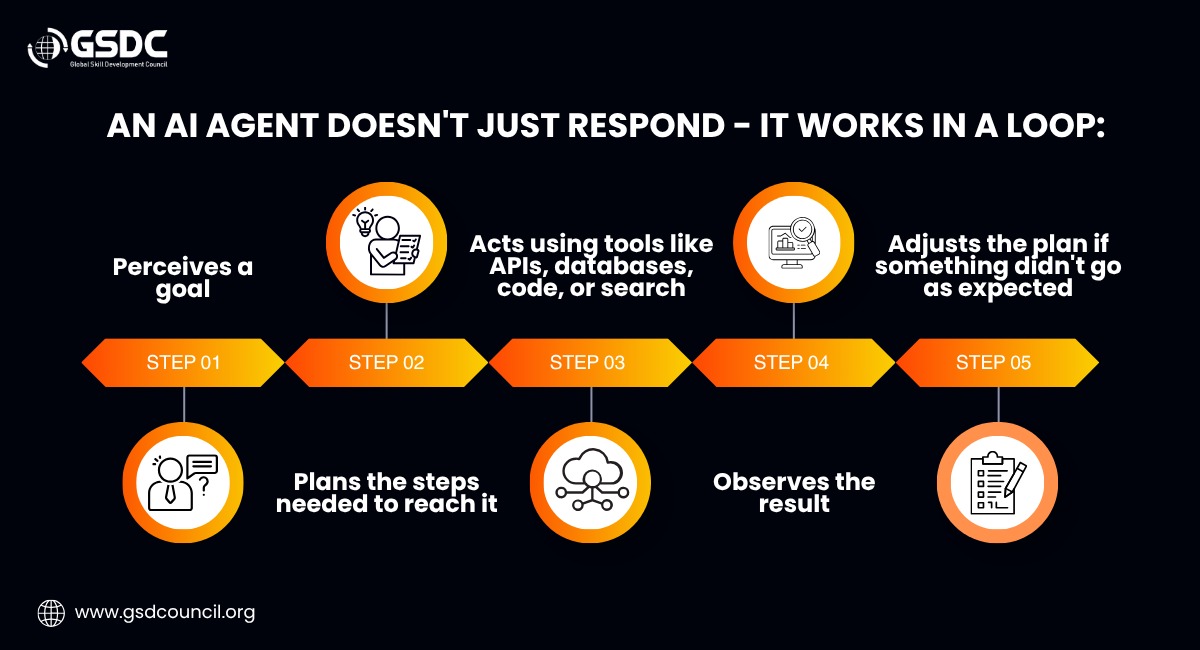
An AI agent doesn't just respond - it works in a loop:
It repeats this loop until the goal is done, with very little human hand-holding.
Think of the difference this way:
- A generative AI chatbot can draft a customer refund email when you ask it to.
- An agentic AI system can notice the refund request, check the order database, verify the return policy, process the refund, and send the confirmation email - on its own, end to end.
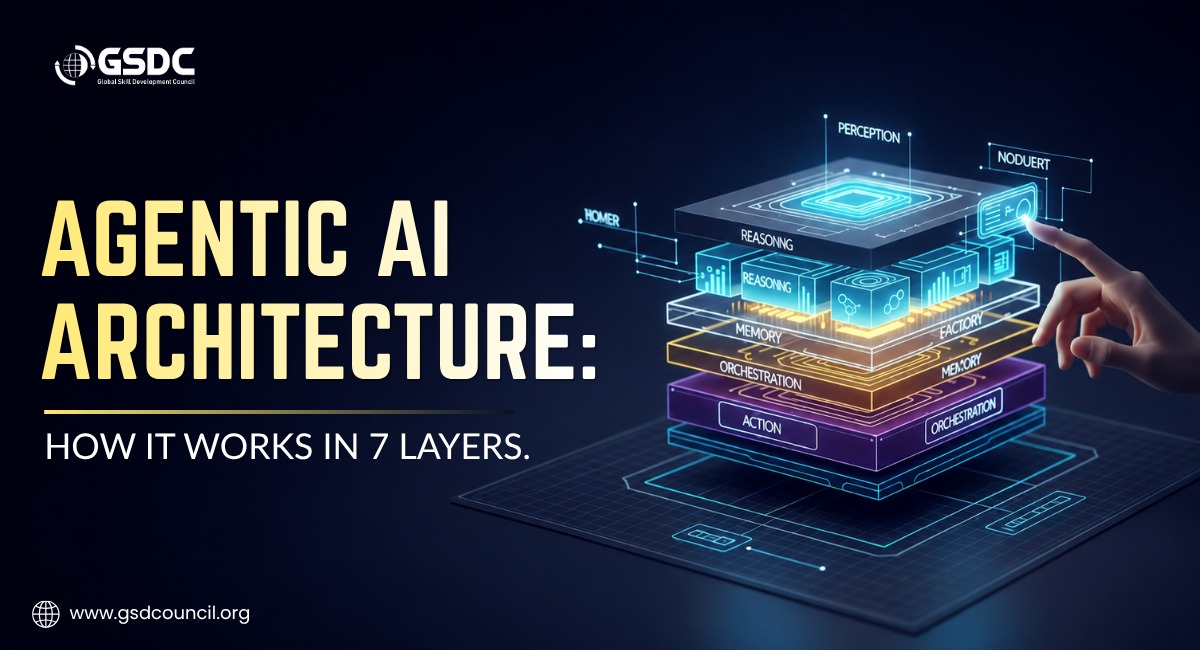
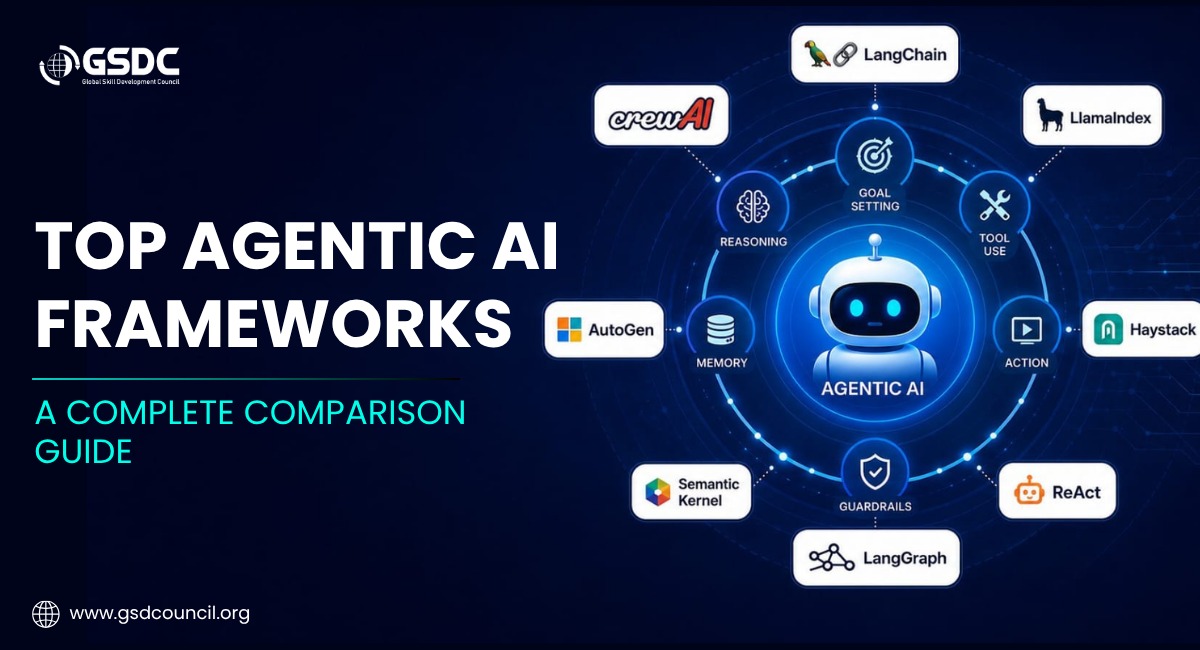
That loop of reasoning, tool use, and self-correction is the architecture people are referring to when they talk about how an agent framework works - usually a large language model paired with memory, planning modules, and the ability to call outside tools. It's what lets an agent behave less like a chatbot and more like a junior employee.
Where Agentic AI Is Already Working, Not Just Being Piloted
Talking in the abstract about "autonomous decision-making" doesn't land until you see it in practice. Here's what's already running in production, not in some lab:
- IT operations agents that scan logs and network traffic in real time and initiate an incident response before a human even opens a ticket.
- Coding agents embedded in developer tools that read a bug report, trace it through a codebase, write a fix, and open a pull request.
- Financial services agents used by banks for fraud detection, credit checks, and personalised customer service - often running quietly in the background of an app you already use.
- Customer support agents that resolve a ticket completely - refunds, order tracking, cancellations - without ever routing to a human queue.
- Supply chain and procurement agents that reorder stock, renegotiate vendor terms within set limits, and flag exceptions.
None of these are science fiction. They're also why roles like "AI agent orchestration" and "agentic workflow design" are starting to show up in job postings that didn't exist two years ago - and why training bodies like the Global Skill Development Council (GSDC) have built entire certification tracks around exactly these use cases, rather than around AI theory alone.
Why This Kind of Workflow Looks So Different From Traditional Automation
People often confuse agentic AI with the robotic process automation (RPA) they've seen for a decade. The difference comes down to rigidity. An RPA bot follows a fixed script - if step 4 fails, the whole process breaks. An agent-driven workflow is adaptive instead: it replans when it hits a wall, pulls in a different tool, or escalates to a human only when it genuinely needs to.
That adaptability is exactly why enterprises are moving so fast on this. But it's not all smooth sailing - a lot of "agentic AI" projects are really just chatbots with a new label, and many stumble on unclear ROI or weak governance. That's exactly why trained professionals who understand real agent architecture, not just the marketing pitch, are becoming so valuable.
The Skills Employers Are Actually Screening For
If you're mapping out what to learn before - or instead of - picking a course, these are the skills showing up most often in job descriptions and certification syllabi right now:
- Prompt and instruction design for autonomous, multi-step tasks (not just single-turn prompting)
- Agent orchestration - coordinating multiple agents with different specialisations on one task
- Tool and API integration so agents can act on real systems, not just talk about them
- Evaluation and guardrails - testing an agent's decisions before it's trusted with production data
- Ethical and compliance awareness - knowing when autonomy needs a human checkpoint
- Change management - helping non-technical teams adopt agent-based workflows without resistance
Notice how few of these are pure coding skills. That's deliberate - most certification programs in this space are designed to develop this mix of technical, strategic, and governance skills for engineers, product managers, and business leaders, not just developers. It's the same reasoning behind the structure of programs like the Agentic AI Professional Certification, which builds all six of these skill areas into one syllabus rather than treating them as separate specialisations.
Where the Job Demand Is Actually Concentrated
"AI is creating jobs" gets thrown around a lot. Let's look at where that's actually true.
According to Gartner's 2026 Hype Cycle for Agentic AI report, which draws on Gartner's 2026 CIO and Technology Executive Survey, only 17% of organisations had deployed AI agents by early 2026 - but more than 60% expect to do so within two years, which Gartner describes as the most aggressive adoption curve among all emerging technologies it measured. That gap between deployment and planned adoption is likely to increase demand for professionals who can build, govern, and manage agent-based systems.
Here's how emerging agentic AI roles are beginning to split across technical, operational, governance, product, and strategy functions:
Role Type | What It Involves | Typical Background |
Agentic AI / Automation Engineer | Building and deploying autonomous agents | Software engineering, ML |
AI Workflow Designer | Mapping business processes into agent-ready workflows | Business analysis, ops |
AI Governance Lead | Setting guardrails, audit trails, compliance for agents | Risk, compliance, legal |
AI Product Manager (Agentic) | Owning agent-based product features | Product management |
AI Strategy Consultant | Advising leadership on where to deploy agents first | Consulting, strategy |
Beyond the well-known technical roles, careers in this space are opening up in project management, HR, marketing operations, and finance - anywhere a repetitive, multi-step process exists. That's why demand is spiking well beyond software teams; a procurement manager is just as likely to need this on their resume in 2026 as a backend developer is.
Agentic AI and AI Certification Options, by Career Goal
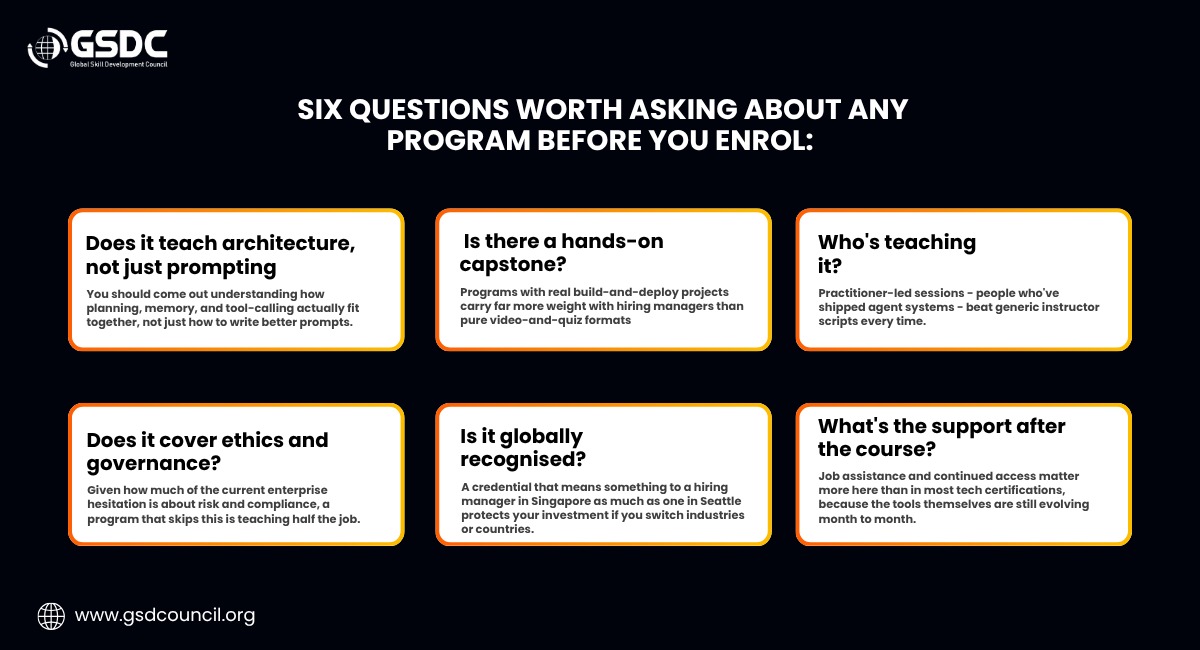
Search "agentic ai course" or "agentic ai certification" today and you'll get a wall of nearly identical-sounding landing pages. Here's a more useful filter than reading marketing copy - six questions worth asking about any program before you enrol:
It's worth being clear-eyed here: not every well-known AI certification is actually about agentic AI specifically. Several widely searched programs focus on generative AI, AI leadership, or business AI strategy more broadly, and only partly overlap with agent-building skills. Here's roughly how the landscape splits by what you're actually trying to achieve:
If your goal is... | Look for a program that... | Example |
Building and deploying agents hands-on | Has a coding-friendly, technical curriculum with a capstone build | Agentic AI Professional Certification (GSDC) |
Leading agentic AI adoption across a team or org | Combines strategy, governance, and no-code implementation | Agentic AI Professional Certification (GSDC) |
Broader generative AI leadership, not agent-specific | Focuses on prompting, use-case identification, rollout strategy | Google's Generative AI Leader |
Business-side AI strategy without technical depth | Covers AI decision-making and deployment planning for non-engineers | Microsoft's AI Business Professional |
Applying AI within HR/L&D workflows | Focuses on generative AI use cases for training and people functions | LinkedIn Learning's Generative AI for L&D |
The first two rows are genuinely about agentic AI. The rest are adjacent - useful if your role touches AI strategy broadly, but not a substitute if agent-building or agent governance is the actual job requirement.
Inside the GSDC Agentic AI Professional Certification
Measured against the six criteria above, here's where GSDC's own Agentic AI Professional Certification stands out, and where you should verify details yourself before enrolling.
- On architecture and hands-on build: the syllabus runs 36+ hours across ten modules - agent foundations, core LLM and framework technologies, sector-specific use cases, and a dedicated no-code module for building agents - built around a learn-by-doing structure rather than lecture-only content.
- On practitioner-led teaching: sessions run through GSDC Studio with AI practitioners and agentic systems experts, plus 1-on-1 SME connect sessions for feedback on your own use case.
- On ethics and governance: a full module is dedicated to ethical considerations, risk, and safeguards - not treated as an afterthought.
- On post-course support: the program includes a capstone project and job support, along with a 100% money-back guarantee.
As with any certification, treat pricing, current promotional offers, review scores, and enrolment numbers as things to confirm on the official page at the time you're reading this, since these details change over time. GSDC's Agentic AI Certification page has the current syllabus, pricing, and enrollment details.
So, Which One Should You Choose?
There isn't a single "best agentic ai certification" for everyone - the right pick depends on the role you're aiming at, not the marketing on the landing page. As a rough guide:
- Choose a builder-focused certification if you want a technical implementation role - agent engineering, automation development, or a hands-on move into AI product work. Look for coding-friendly curricula with a real capstone build.
- Choose a strategy-focused program if you're leading adoption for a team or business unit rather than building agents yourself. Prioritise programs that cover deployment planning and change management over deep technical content.
- Choose a governance-focused program if you sit in risk, compliance, or legal, and your job is making sure agents don't operate outside their guardrails. Look for a syllabus that treats ethics and oversight as a core module, not a footnote.
- Choose a hybrid program if you want to design agent workflows and lead their rollout - the more common ask for mid-career professionals moving into this space. This is where a program combining technical foundations with strategy and governance, like GSDC's, tends to fit best.
Given how fast this field moves, and how many "agentic AI" projects are expected to stall out on unclear ROI or weak governance, the professionals who'll be trusted to lead the next wave are the ones who understood both the opportunity and the risk from the start.

Related Certifications
Frequently Asked Questions
Generative AI and agentic AI overlap, but they're not really the same skill set. Most generative AI certifications barely touch agent orchestration, autonomous decision-making, or multi-step tool use - and that's exactly where agentic AI courses pick up. If your current knowledge stops at prompting a chatbot, there's a real gap left to fill.
Not necessarily. A number of programs now include no-code modules for building AI agents, aimed squarely at business and operations people who need to direct agent systems without writing a single line of code. If you're coming from a technical background, though, look for a course that goes deeper into the underlying agent framework rather than staying surface-level.
Most self-paced agentic AI certification courses run somewhere around 36+ hours of core content. Learners usually spread that across 4–8 weeks alongside a full-time job, rather than cramming it into one sitting - which, honestly, is the more sustainable way to actually retain any of it.
Common next steps include AI workflow designer, automation or agentic AI engineer, AI governance lead, AI product manager, and AI strategy consultant. These are some of the ai job roles growing fastest right now, simply because enterprises are moving from piloting agents to actually scaling them across teams.
An AI agent takes a goal, breaks it into steps, uses tools like APIs or databases to act on those steps, checks whether it worked, and adjusts if it didn't. That loop - plan, act, observe, adjust - is really the whole idea. It's a lot closer to how a person would tackle an open-ended task than to how a chatbot answers a single question.
Think of a framework as the scaffolding an agent runs on: memory, planning logic, and the ability to call external tools, usually built on top of a large language model. A certification that only teaches prompting won't touch this at all. If you want to actually build or manage agents rather than just use them, the course needs to get into this layer.
There isn't one universal answer, but the strongest fit for non-technical professionals tends to be a program that pairs no-code implementation with strategy and governance content - so you can direct agent projects credibly without needing to write the underlying code yourself. Skip anything that's 90% coding exercises; it won't serve what you actually need day to day.
Good programs go well beyond slideware. Expect hands-on work like designing a customer-support agent workflow, building a simple multi-step automation using an agent framework, or working through a capstone project tied to a real business use case - not just multiple-choice quizzes on definitions.
Not at all. Plenty of the demand is showing up in project management, HR, operations, and compliance - anywhere a repetitive, multi-step process exists that an agent could take over. Some of the fastest-growing agentic AI jobs right now are actually on the business and governance side, not purely in engineering.
A generic AI course usually stops at "how to use AI tools" - better prompts, basic use cases, maybe some ethics. An agentic AI certification course goes further into autonomy: how an agent plans, acts on real systems, and gets managed once it's making decisions without someone approving every step. If your goal is understanding or building autonomous systems specifically, that's the difference that actually matters.
Stay up-to-date with the latest news, trends, and resources in GSDC
If you like this read then make sure to check out our previous blogs: Cracking Onboarding Challenges: Fresher Success Unveiled
Not sure which certification to pursue? Our advisors will help you decide!