Generative AI in Business: 7 Real Use Cases Transforming Industries
Written by Matthew Hale
Generative AI has moved from hype to reality very quickly. In just a couple of years, it has gone from being a “cool demo” to a very serious part of how companies serve customers, make decisions, and run operations.
Across industries, leaders are asking the same question
- Where does this actually fit in my business?
- What problems can it solve today, not five years from now?
- How do we move beyond pilots and experiments?
Today, we finally have clear answers. Advanced chatbots, digital assistants, coding copilots, and content engines are no longer trials-they’re running in production at scale.
As we look at generative AI applications in industries such as retail, finance, aviation, and manufacturing, one trend stands out: generative AI is becoming a major driver of business transformation, prompting leaders to rethink their broader AI strategy as adoption accelerates.
This blog highlights seven practical, high-impact use cases to help you see where generative AI can create real value in your organization.
What Is Generative AI?
Generative AI is a type of technology that can create new content-like answers, summaries, ideas, images, or code based on what it has learned.
You give it a prompt, and it produces a clear, human-like response in seconds.
This ability to generate useful outputs so quickly is why it’s becoming essential in modern workplaces-and why many professionals now start their learning journey with a Generative AI Foundation Certification to understand the basics before applying it in real projects.
|
Technology |
What It Does |
Limitations |
How Generative AI Is Different |
|
Traditional Automation |
Follow fixed rules to complete routine tasks. |
Cannot understand context or handle new situations. |
GenAI interprets intent and creates new responses or content. |
|
Traditional Machine Learning |
Uses historical data to predict outcomes. |
Cannot generate new ideas, content, or solutions. |
GenAI produces original text, summaries, ideas, images, or code. |
|
Generative AI |
Creates human-like content, insights, and solutions. |
Requires good prompts and responsible use. |
Combines intelligence + creativity to automate, analyze, and generate. |
Why Companies Prefer Generative AI Today
- Speed: Creates responses, summaries, or ideas instantly.
- Personalization: Tailors output to each user or situation.
- Creativity: Helps teams brainstorm, write, design, or solve problems.
- Operational efficiency: Reduces repetitive work and supports faster decision-making.
In simple terms:
Traditional automation follows rules, traditional ML predicts, and generative AI creates-making it one of the most versatile technologies in business today.
This difference becomes even clearer when we look at real business use cases.
Use Case 1: AI-Powered Customer Support
Generative AI is creating a major shift in customer experience. Modern AI systems can understand queries, fetch information instantly, and provide accurate answers-often faster than traditional workflows.
They not only resolve common questions but also identify sentiment, prioritize urgent queries, and keep tone consistent across teams. For organizations managing large customer volumes, this leads to smoother operations and higher customer satisfaction.
Example:Coca-Cola introduced GenAI assistants to help customer service teams respond more quickly and consistently across regions, reducing wait times and improving accuracy.
Use Case 2: Digital Assistants for Employees
AI assistants are becoming everyday productivity partners. They help employees with emails, meeting summaries, follow-ups, reports, documentation, and basic research-freeing up hours of administrative work.
Beyond saving time, these assistants also help reduce cognitive overload. Employees don’t have to switch endlessly between tools or search through long documents - AI delivers the information right when needed.
Example: Microsoft Copilot is now widely used across Fortune 500 companies to automate documentation, summarize meetings, and support decision-making across teams.
Use Case 3: Coding Assistance & Software Development
For software teams, generative AI works like a coding companion-writing code, suggesting improvements, identifying bugs, and generating documentation. It removes the repetitive elements of development, allowing engineers to focus more on architecture, problem-solving, and innovation.
This speeds up development cycles while improving quality and consistency across codebases.
Example: GitHub Copilot Enterprise, used by companies like IKEA, helps developers accelerate coding tasks and reduce backlog, making development cycles faster and more efficient.
As generative AI becomes part of daily work, many professionals are strengthening their skills through a Generative AI in Business Certification.
The Certification in Generative AI in Business provides a simple, structured way to understand practical applications and responsible use.
Use Case 4: Marketing & Sales Content Creation
Marketing teams use AI to produce content at scale, from ad copy and product descriptions to personalized customer messages. This shift has positioned generative AI for marketing as one of the most widely adopted business use cases today.
AI also helps teams adapt content for regional markets, languages, and formats-something that once required large creative teams.
Example: Unilever uses generative AI to create campaign ideas, marketing copy, and creative assets across global brands-improving consistency and time-to-market.
Use Case 5: Business Process Automation
Generative AI is transforming manual, document-heavy tasks like reporting, compliance, underwriting, and approvals. These improvements mark a new era of AI-enabled automation, where processes once dependent on manual review are now faster and more accurate.
Example:Zurich Insurance uses AI to draft insurance policies and customer communication, significantly reducing manual writing time and improving accuracy.
Use Case 6: Data Analysis & Insight Generation
Generative AI turns huge volumes of unstructured data-emails, feedback, documents, transcripts-into clear, decision-ready insights.
This helps leaders shift from reactive decisions to proactive strategy. In sectors like finance, generative AI in finance is already being used to summarize reports, assess risks, and support analysis.
Example: Amazon uses generative AI to summarize millions of product reviews and extract customer sentiment trends, helping teams respond faster to market signals.
Use Case 7: Cybersecurity & Threat Detection
Cybersecurity teams face increasingly complex threats, and generative AI acts as an extra layer of intelligence. It can detect unusual behavior, prioritize alerts, and explain incidents in plain language, making investigations faster and more accurate.
As threats grow more sophisticated, AI becomes essential for scaling security operations without overwhelming teams.
Example:IBM Security launched a GenAI assistant that accelerates threat investigation and automates incident reporting-helping analysts handle increasing volumes of alerts.
As generative AI becomes part of more business processes-from customer support to cybersecurity that many organizations look to global bodies like The Global Skill Development Council (GSDC) for guidance and standards that support responsible and effective adoption.
Download the checklist for the following benefits:
📘 This free toolkit breaks it down step-by-step.
👇 Download and use it anytime—it’s yours!
Why These Generative AI Applications Matter for Businesses
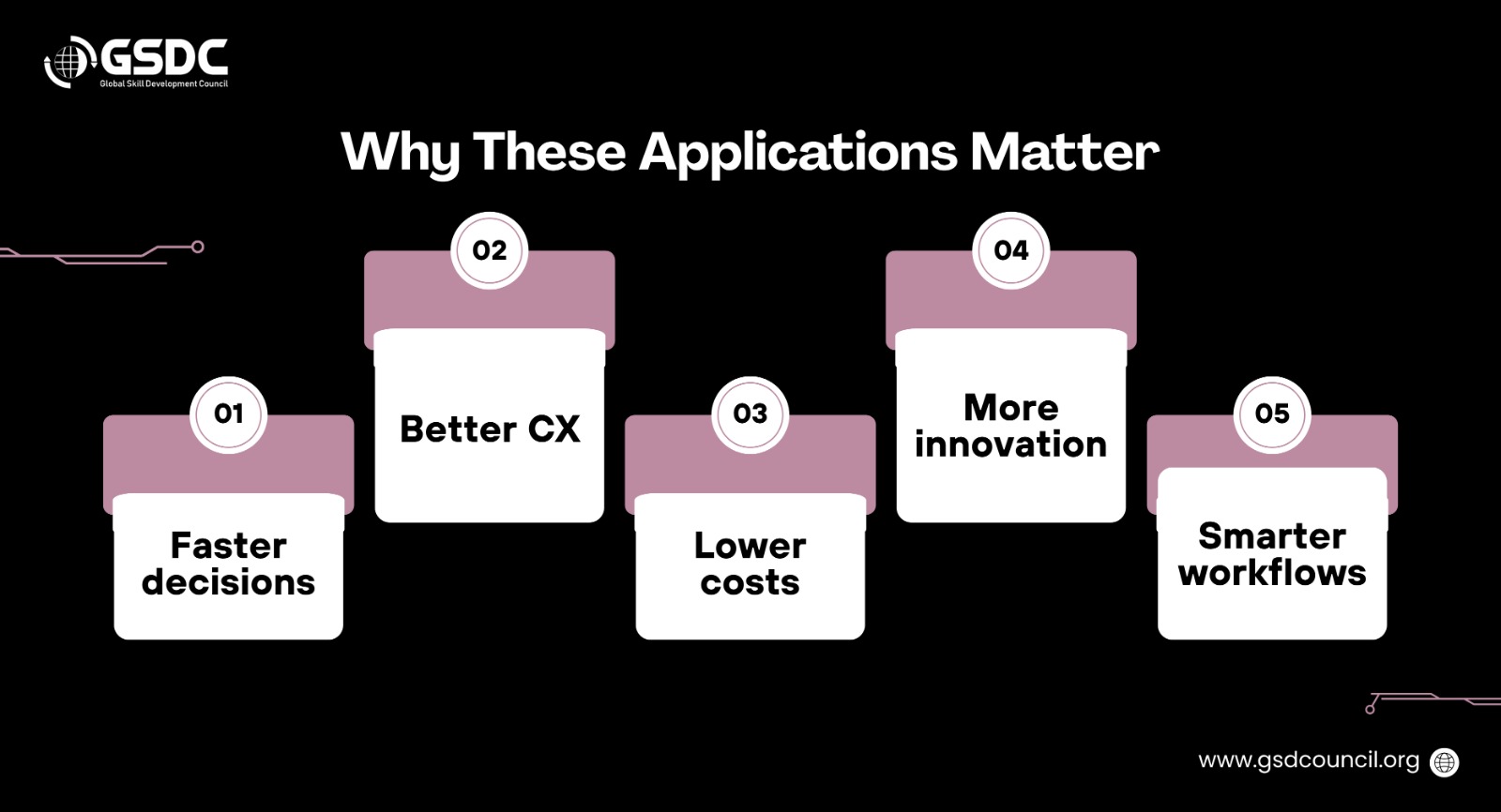
Generative AI is really making a difference because it helps companies by:
- Making faster, clearer decisions by scanning an enormous amount of data and picking out what is really important.
- Improve customer experience with faster and more personalised support.
- Lower operational costs by cutting down on the manual parts of the job that are repetitive.
- Accelerate innovation by helping teams generate ideas, content, and solutions quickly.
- Build smarter workflows that are able to adapt to company changes as per business needs.
Such use cases-along with the recent instances-demonstrate that generative AI is beyond a mere experimental phase. It is a viable, scalable solution that is, in fact, delivering tangible, quantifiable results to organizations of diverse magnitudes.
Build the Skills to Lead Generative AI in Business
As generative AI becomes central to business operations, companies need professionals who can apply AI thoughtfully, not just using the tools, but also guide adoption responsibly.
The Certification in Generative AI in Business helps individuals build this practical skillset for real-world workflows and decision-making.
Organizations also look to GSDC for globally recognized standards that support responsible, credible AI adoption across departments.
Together, they help professionals and companies move forward with clarity.
Conclusion
Generative AI is reshaping how businesses operate, innovate, and serve customers. The seven use cases above show how leading organizations are already using AI to streamline processes, strengthen decision-making, and improve customer experiences.
As AI continues to evolve, the real advantage will belong to professionals who understand how to apply it with purpose and responsibility. Building this capability is the first step toward leading AI-driven transformation in any organization.

Related Certifications
Stay up-to-date with the latest news, trends, and resources in GSDC
If you like this read then make sure to check out our previous blogs: Cracking Onboarding Challenges: Fresher Success Unveiled
Not sure which certification to pursue? Our advisors will help you decide!