How to Build Agentic Workflows That Don’t Fall Apart in Production
Written by Matthew Hale
- What Is an Agentic Workflow?
- Where Adoption Is Heading
- Why Prototypes Break in Production
- How to Build Agentic AI: 7 Practical Steps
- 9 Best Practices for Production-Grade Agentic AI Workflows
- How to Choose an Agentic AI Framework
- Common Mistakes to Avoid
- Build the Skills Behind the Systems
- Final Thoughts
Agentic workflows are quickly moving from experiments to real business systems. But the road to production is rough. Gartner predicts that over 40% of agentic AI projects will be canceled by the end of 2027, mainly because of escalating costs, unclear business value, or weak risk controls.
That number isn't a reason to avoid the technology. It's a reason to build it the right way. Most failed projects don't fail because the AI model is bad. They fail because nobody planned how the system would be designed, tested, governed, and deployed.
This agentic AI guide walks you through the process in plain language. You'll learn what an agentic workflow is, how to build agentic AI step by step, which mistakes to avoid, and how to choose the right agentic AI framework.
What Is an Agentic Workflow?
An agentic workflow is a process where one or more AI agents plan, decide, and take action to finish a task, with little human input at each step.
An AI agent is a software program that uses a large language model (LLM) along with tools, APIs, and outside data to get work done. When several agents work together, each with its own role, you get agentic AI workflows. These systems can reason, plan, act, check their results, retry, and improve as they go.
Think of it like a small team. One agent searches for information. Another filters it. A third writes. A fourth checks the facts. Each does one job well, and together they finish something a single prompt could never handle.
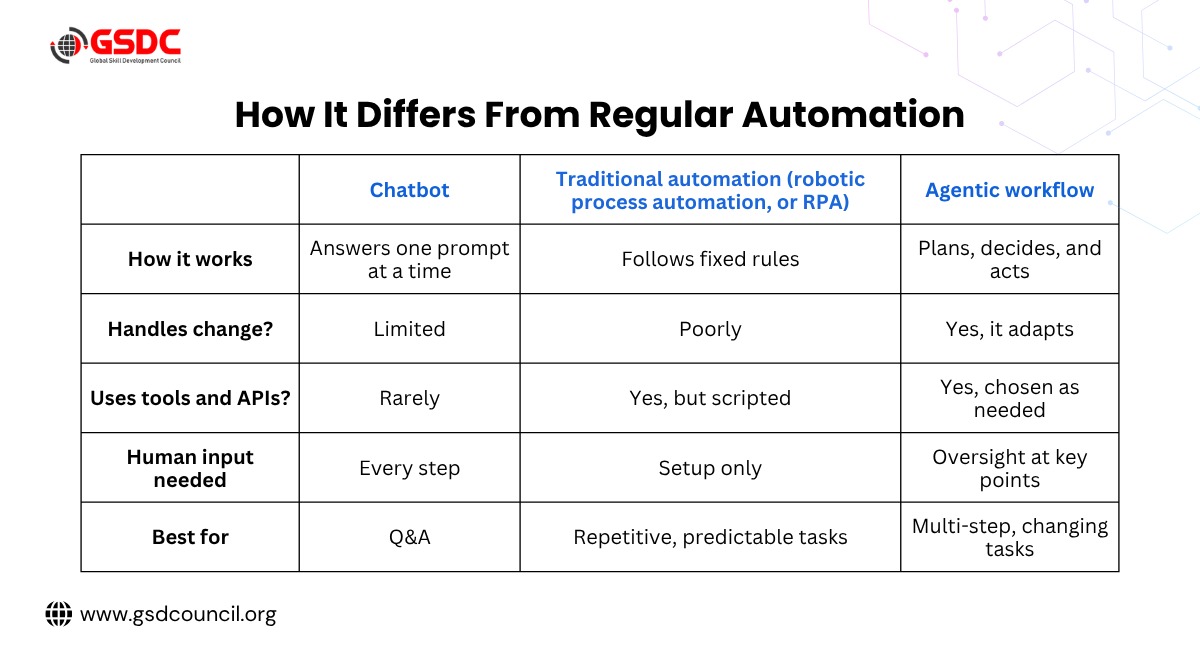
This is why agentic automation is getting so much attention. Agentic process automation takes the reliability of older automation and adds the reasoning of modern AI. That lets it handle messy tasks that rigid rules can't.
Where Adoption Is Heading
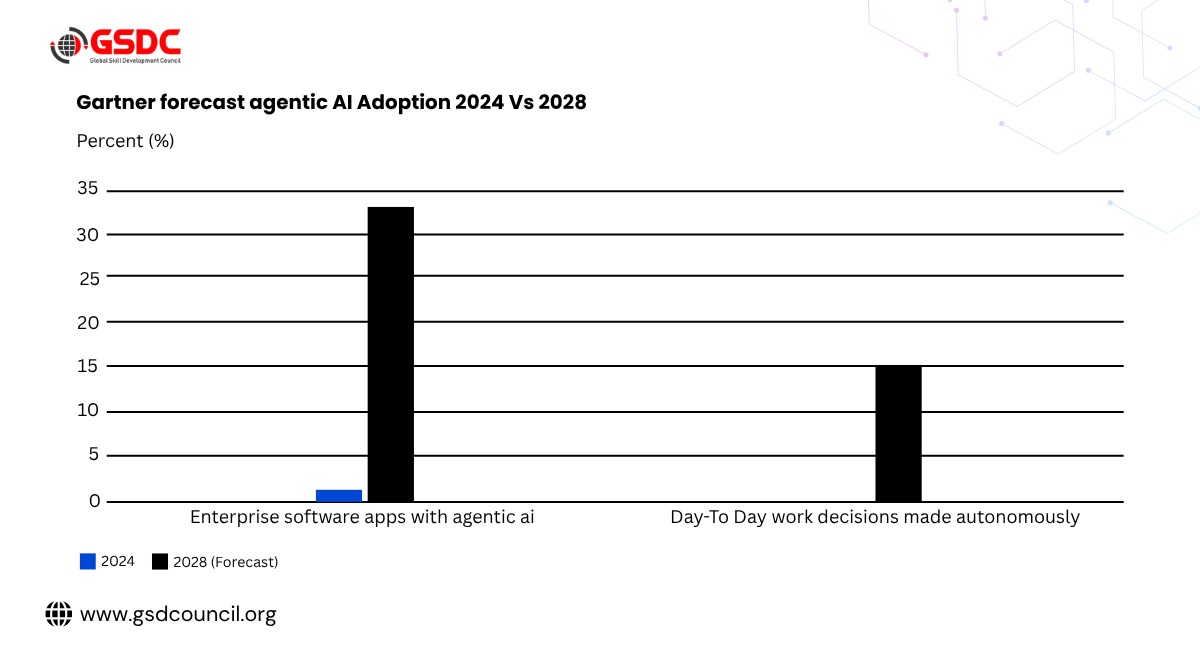
The long-term outlook is strong, even with the short-term risks. Gartner's forecast shows how quickly this space is expected to grow:
Why Prototypes Break in Production
This practical guide for designing agentic AI workflows starts with a hard truth: building a demo is easy. A short script and a good prompt can look impressive in an afternoon. Turning that demo into a reliable system is a different story.
Most production problems fall into four areas:
- Design: deciding how to split the work across agents and when to use tools
- Implementation: managing how agents talk to each other, keeping prompts organized, and mixing different models
- Operations: handling failures, retries, logging, costs, and security
- Deployment: packaging the system, managing versions, and pushing updates safely
Skip these, and the result is usually a brittle system that gives inconsistent answers and costs a lot to maintain.
None of this is hard to grasp once someone lays it out, but many teams only learn it after a project stalls. That's why foundational training, such as the Agentic AI Foundation Certification, is worth a look for anyone new to the field. It covers these basics up front, so you spot the weak points before they cost you time and budget.
How to Build Agentic AI: 7 Practical Steps
If you're wondering how to build AI agents that hold up in the real world, follow this order.
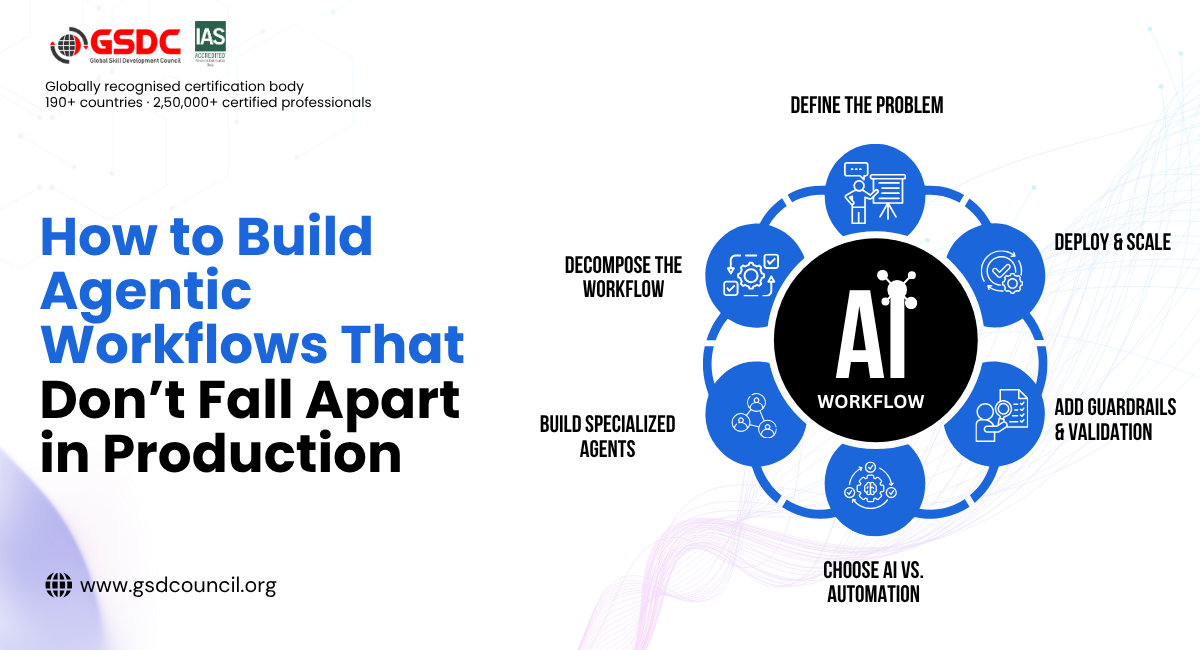
1. Start with one clear problem
Pick a task that is repetitive, has clear inputs and outputs, and has measurable value. "Summarize daily industry news and prepare a draft brief" is a good start. "Run our whole marketing team" is not.
2. Break the task into small steps
Write out every step a human would take. Each step becomes a candidate for an agent or a plain function. This is the core of designing agentic AI workflows, and it's often called workflow decomposition.
3. Build specialized AI agents
Give each agent one job. A search agent, a filtering agent, a writing agent, and a review agent will beat one giant agent that tries to do everything. Narrow roles are easier to prompt, test, and fix.
4. Decide what needs AI and what doesn't
This one saves a lot of money. If a step doesn't need language reasoning, such as saving a file, posting to an API, or writing to a database, don't send it through an LLM. Use a normal function. It's faster, cheaper, and predictable.
5. Add checks and guardrails
Use more than one model when accuracy matters. A common setup has several LLMs each write a draft, then a separate reasoning agent compares them, removes shaky claims, and produces one final version. This reduces hallucinations and single-model bias.
6. Package and deploy it properly
Use containers such as Docker, and a platform like Kubernetes if you need to scale. This keeps the system behaving the same in testing and in production, and it makes updates and rollbacks safer.
7. Monitor, measure, and improve
Track costs, failures, response quality, and agent behavior. Treat your workflow like a living product, not a one-time project.
Reading about these steps is one thing, and applying them on a real project is another. If you'd like a structured path, the Global Skill Development Council (GSDC) offers agentic AI programs that walk through this same lifecycle, from designing workflows to deploying them.
9 Best Practices for Production-Grade Agentic AI Workflows
Teams that ship real systems tend to land on the same lessons. Here are nine, in simple terms:
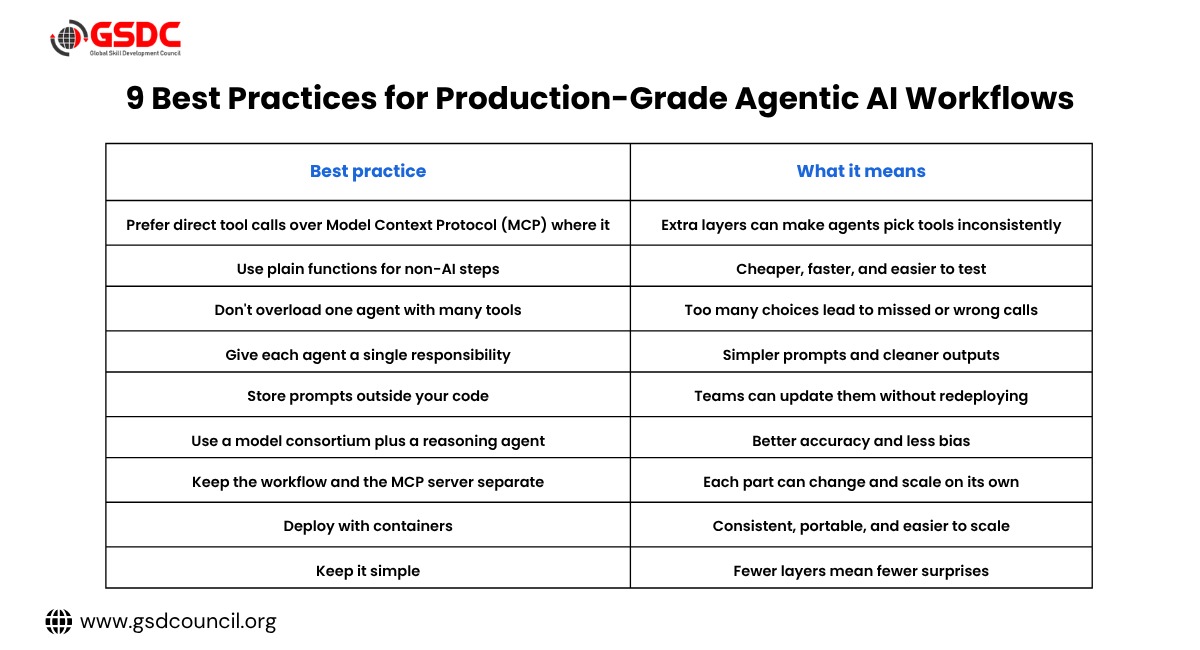
Here's a quick real-world example. One team built a single agent that both wrote a video prompt and generated the video. It sometimes returned broken JSON and even made up file paths. They split the job in two. An agent now writes only the prompt, and regular code calls the video service. The failures stopped.
The lesson is simple. Let AI do the thinking, and let ordinary code do the doing.
A Real Workflow in Action
A good way to see how the pieces fit is an automated news-to-podcast pipeline:
- A search agent finds recent news on a topic.
- A filtering agent keeps only the relevant articles.
- A scraping agent turns each page into clean text.
- Three agents, each on a different LLM, write podcast scripts.
- A reasoning agent merges the drafts into one trusted script.
- Other agents create audio and video instructions.
- The final files are published automatically for review.
Nothing here is magic. It's a chain of small, focused steps, and that's exactly why it works.
How to Choose an Agentic AI Framework
Picking an agentic AI framework can feel overwhelming because there are so many. Popular options include LangGraph, CrewAI, Microsoft AutoGen, and the OpenAI Agents SDK.
Instead of chasing the most popular one, check these points:
- Fit for your use case: Does it support the type of workflow you need?
- Control: Can you keep the flow predictable and easy to debug?
- Model flexibility: Can you switch or combine LLMs later?
- Observability: Can you see logs, traces, and errors?
- Community and support: Is it actively maintained?
- Simplicity: Can your team learn it quickly?
Whatever agentic AI frameworks you compare, remember this: the framework matters less than good design. A simple, well-structured workflow on an average framework beats a messy one on the best.
Common Mistakes to Avoid
- Trying to automate a huge process on day one
- Using an agent when a simple function would do
- Giving one agent too many tools or too many jobs
- Hiding prompts inside code where non-technical teams can't reach them
- Skipping testing, monitoring, and cost tracking
- Trusting one model's output without any check
- Buying into "agent washing," where a basic chatbot or old automation tool is simply rebranded as agentic
Build the Skills Behind the Systems
Tools change fast, but the fundamentals stay steady: workflow design, agent roles, tool use, safety, and deployment. Building those skills gives you an edge, whether you're an engineer, a product manager, or a business leader guiding an AI team.
That's where structured learning helps. The Agentic AI Foundation Certification from the Global Skill Development Council (GSDC) is a good starting point if you're new to the field and want a clear grounding in how agentic systems work. If you're ready to go deeper into building and managing them, the Agentic AI Certification helps you move from theory to practice with confidence. A recognized credential also shows employers and clients that your skills are current and verified.

Final Thoughts
Agentic workflows are powerful, but only when they're built with care. Start small, give every agent one clear job, use plain code where AI isn't needed, add checks, and deploy with discipline. Do that, and you'll be on the right side of the odds.

Related Certifications
Frequently Asked Questions
They mean the same thing in practice. Both describe a process where AI agents plan and act to complete multi-step tasks.
Pick one small task, split it into steps, build one focused agent per step, and add simple checks. Grow from there.
No. Sometimes one agent plus a few regular functions is enough. Add more agents only when a clear need appears.
It's the use of AI agents to run business processes that need judgment and adaptation, going beyond fixed rules.
Stay up-to-date with the latest news, trends, and resources in GSDC
If you like this read then make sure to check out our previous blogs: Cracking Onboarding Challenges: Fresher Success Unveiled
Not sure which certification to pursue? Our advisors will help you decide!