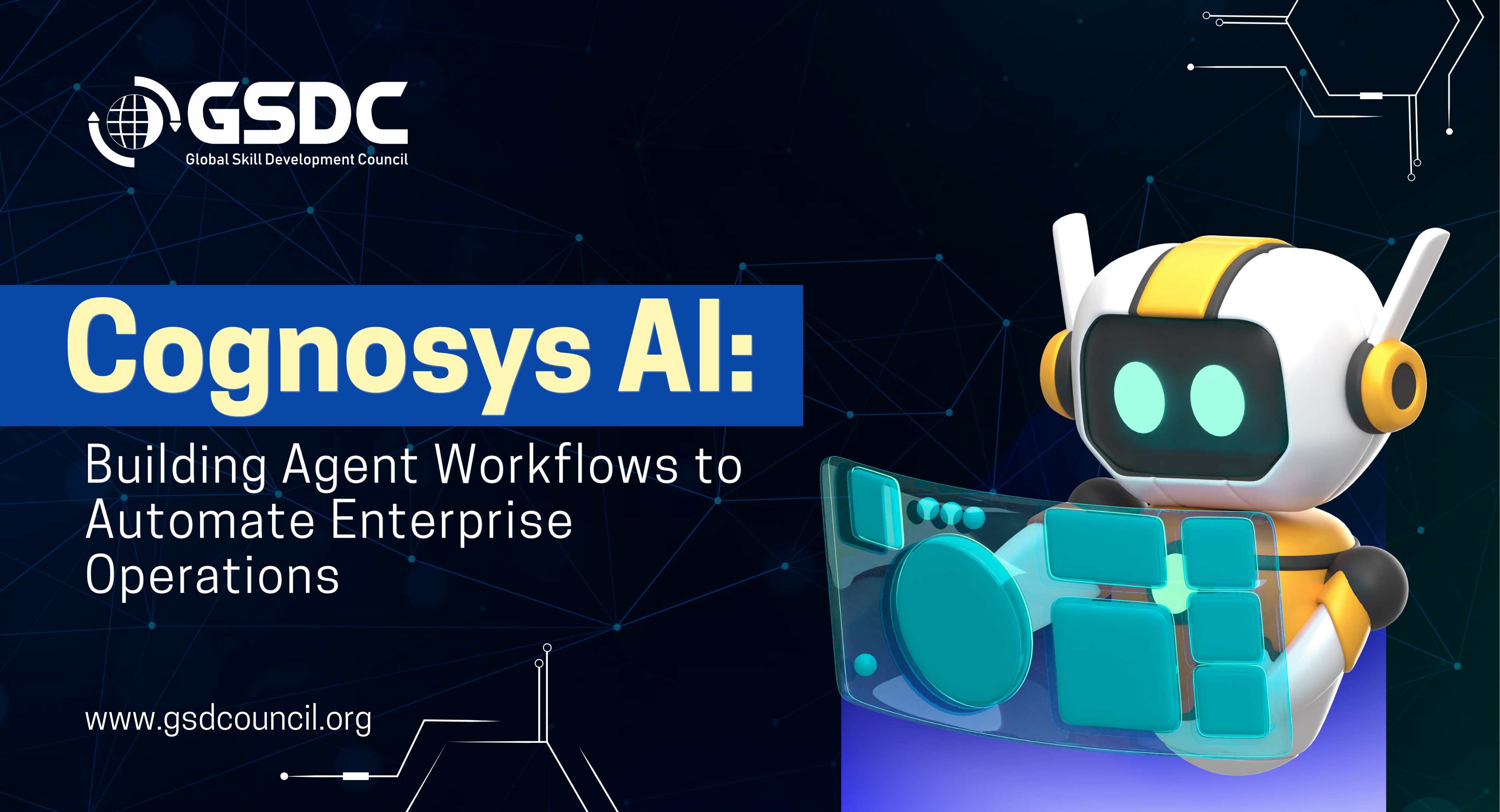
Cognosys AI: Building Agent Workflows to Automate Enterprise Operations
Written by Matthew Hale
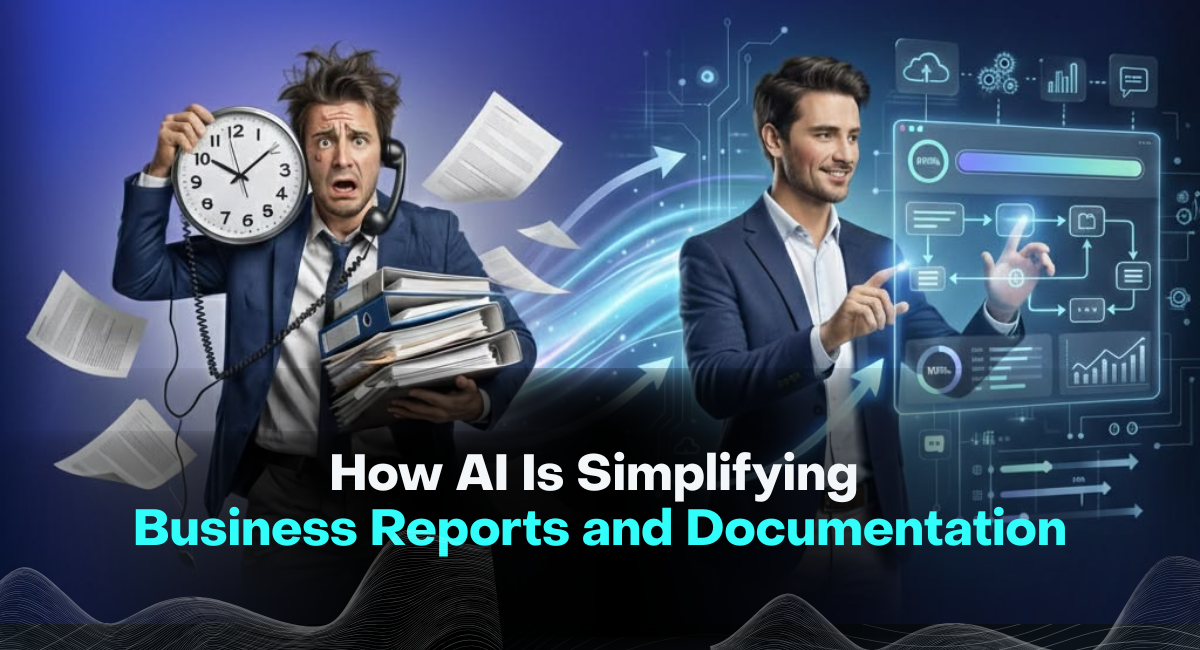
As enterprises scale, routine tasks, multiple approvals, and cross-system updates quickly become bottlenecks. While dashboards offer visibility, but execution still depends heavily on manual effort.
This leads to a very important question: what is artificial intelligence, and how does AI work when applied to real business operations, rather than just dashboards or chatbots?
Most of the time, the answer is agent workflow automation, where AI systems decide to move beyond the analysis and actually take the intervention.
This was explored during the GSDC Studio: AI Implementation Series, where Cognosys AI was highlighted as a practical, enterprise-ready solution for building workflow agents that automate repetitive, multi-step processes while maintaining accuracy, governance, and human oversight.
Why Agentic AI Matters Now
- Organizations face higher workload volumes with limited resources.
- There’s growing pressure to deliver faster, more accurate results.
- AI capabilities have advanced modern systems that can understand context, reason, and act across systems.
- Agentic AI allows enterprises to build structured agent workflows, enabling automation of operations beyond simple tasks.
More than 60% of business leaders stated in a 2025 survey that they are willing to raise their investment in AI-driven operational automation within the next 12 months.
What Is Cognosys AI?
Cognosys AI is an agentic AI platform that aims to assist organizations in automating their regular business workflows from start to finish. Instead of using fixed automation scripts or a single bot, Cognosys AI allows for the use of intelligent agent workflows that can adjust to changes in the real world.
As a Cognosys AI agent platform, it enables workflow agents that can:
- Observe events across enterprise systems
- Gather and understand the business context
- Apply business rules combined with AI reasoning
- Execute actions across multiple enterprise tools
Such agents behave as digital teammates by undertaking the heavy execution part of the work that is usually done by human teams, and thereby, human teams can concentrate on supervision, making decisions, and planning.
This is essentially one of the main features of Cognosys agentic AI automation, which not only recognizes the cause but also the next action.
How Cognosys AI Workflow Agents Work
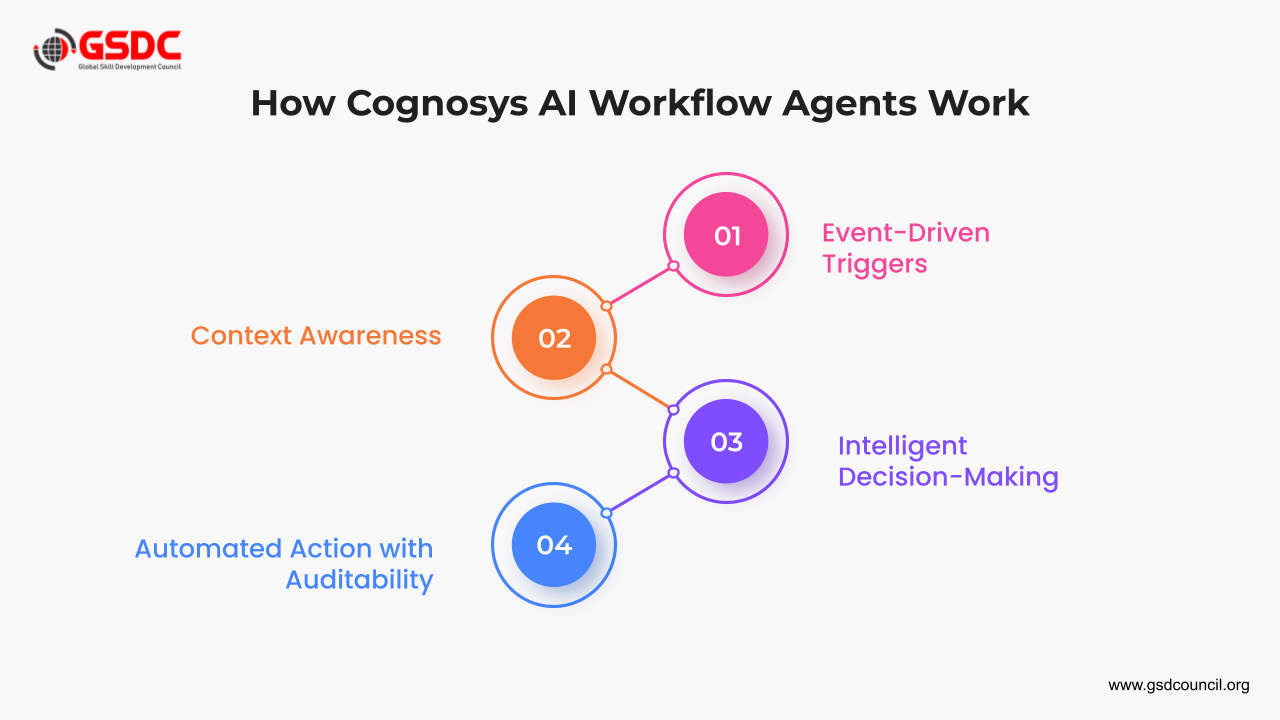
Each agent workflow built using Cognosys AI follows a structured yet flexible architecture that ensures reliability at enterprise scale.
- Event-Driven Triggers: Workflow agents change their working mode automatically when a certain event is registered in the system, e.g., invoice arrival, ticket creation, system update, document upload, and so on. Consequently, the manual checking is not required.
- Context Awareness: To avoid the situation where agents act in isolation, they collect data from various systems such as HR platforms, CRMs, finance tools, databases, and knowledge bases. Hence, a full operational context is delivered to every agent workflow.
- Intelligent Decision-Making: By using the preset business rules together with AI (LLM) reasoning, the agent goes beyond simple if/else logic to validate inputs, apply policies, and figure out the next steps.
- Automated Action with Auditability: After the decision-making process, agents perform tasks like updating records, sending notifications, getting approvals, or starting another workflow. Thus, the traceability and governance are ensured by logging all actions.
This framework is a guarantee of every agent workflow being reproducible, reviewable, and growthable.
Agent Workflow in Practice: Real Enterprise Examples
Enterprises are essentially automating their agent workflows for a plethora of everyday business processes through the use of Cognosys AI. Some of the common workflow process examples are:
- Invoice ingestion, validation, and routing across finance systems
- HR onboarding and employee lifecycle workflows, including approvals and record updates
- Customer support ticket triage and escalation based on priority and context
- Multi-level approval workflows for compliance and governance
- Data enrichment and structured reporting across internal tools
These new examples of workflow processes employ the same fundamental agent workflow model of trigger, context, decision, and action, while they differ in specific business rules, systems, and compliance requirements.
How Cognosys AI Differs from Traditional Automation and RPA
Fixed, UI-based tasks are where traditional automation and RPA tools perform best; however, they have difficulties if the workflows require judgment, flexibility, or cross-system intelligence.
Cognosys AI workflow agents provide a superior technological solution:
- They are context-driven rather than screen-driven, as they operate on system data instead of UI clicks
- Rules combined with AI reasoning allow for the flexibility of the solution; thus, it does not require constant re-engineering
- Multi-step, cross-system orchestration, extending enterprise platforms
- Human-in-the-loop concept is there from the very beginning; thus, it provides safe escalation and review
- Enterprise-ready governance, with integrated audit trails and controls
Cognosys AI, thus, is a technology that is better capable of handling the complexity of real-world enterprise operations where workflows are not only structured but also not perfectly predictable.
Why Cognition Is Important in Agentic AI
At the core of agent-based automation is cognition, the ability to understand context, evaluate conditions, and decide the next step.
This explains why cognition is important in enterprise AI systems:
- Enables AI agents to understand business context, not just follow rules
- Allows agents to adapt to changing conditions without breaking workflows
- Reduces fragile, hard-coded automations that fail when inputs vary
- Supports better decision-making while respecting business policies
- Ensures AI operates within governance, compliance, and control boundaries
Without cognition, automation remains rigid. With cognition, agentic AI becomes reliable, flexible, and enterprise-ready.
Key Benefits of Cognosys AI
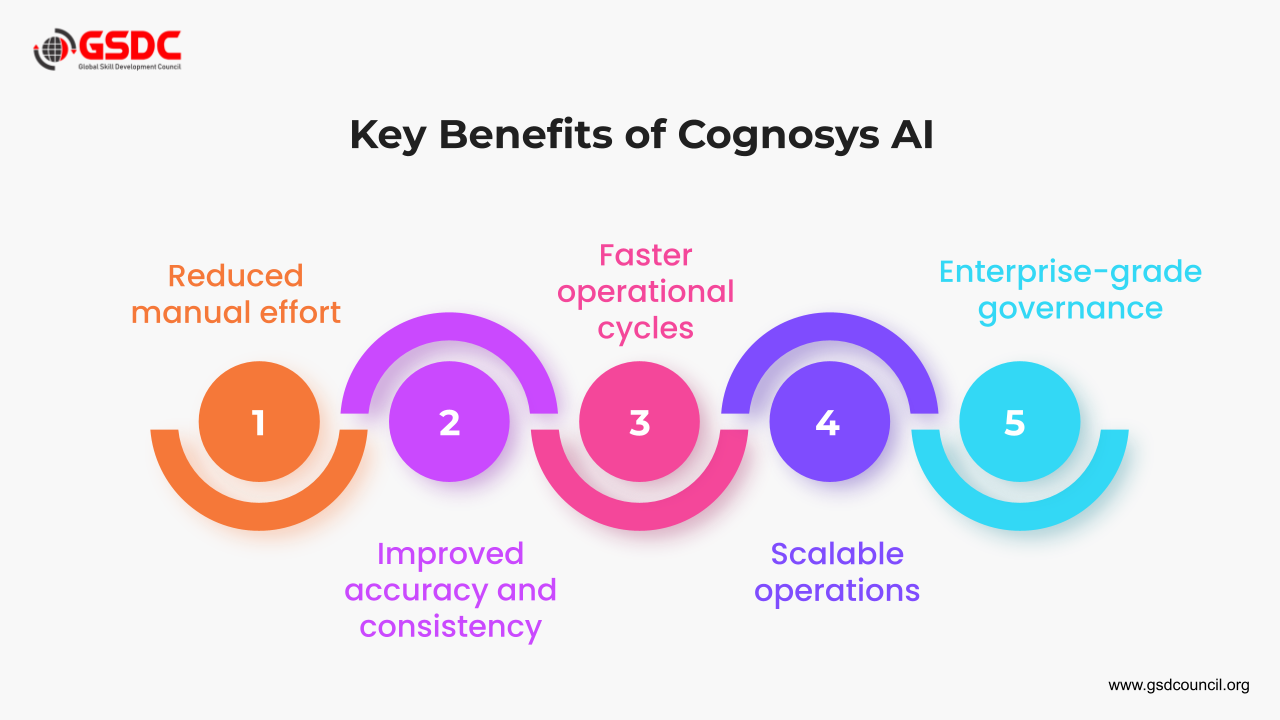 Cognosys AI delivers measurable operational value by enabling intelligent, agent-driven automation.
- Reduced manual effort by automating repetitive, rule-based tasks
- Improved accuracy and consistency through AI-powered validation
- Faster operational cycles without constant human intervention
- Scalable operations without proportional increases in headcount
- Enterprise-grade governance with logs, approvals, and controls
In real-world implementations, Cognosys AI–powered agent workflows have reduced manual effort by up to 80%, especially in finance and operations teams.
Who Can Use Cognosys AI?
Cognosys AI is designed for cross-functional adoption across enterprises.
- Business & Operations Teams managing high-volume workflows
- Product, Program, and Process Owners focused on efficiency and scale
- Non-Technical Teams creating workflows using logic and natural language
- Technical Teams extending automation through APIs and integrations
This collaborative model also aligns with the growing demand for AI-related roles and skills, reflected in increasing interest around Cognos jobs and agent-based automation expertise.
Human-in-the-Loop: AI That Supports, Not Replaces
Cognosys AI is designed around a human-in-the-loop approach. Workflow agents manage routine execution on their own, while humans step in only when judgment, escalation, or review is needed.
This approach:
- Makes the operations less tiring by taking out the repetitive, manual tasks of the operations
- Maintains accountability by having humans as the ones responsible for the final decisions
- Enhances trust in AI-assisted workflows as there are clear review and escalation paths.
Automation with Cognosys AI takes away the copy-paste work but not the ownership, which means that teams are allowed to focus on the work that really needs human expertise.
The Future of Cognosys AI
Cognosys AI is an example of a larger change in the way enterprises work that is agent-driven. In this scenario, AI moves from merely generating insights to actually taking business actions directly.
The key changes leading to this future are:
- Decision-to-action automation that allows AI systems to detect a problem and fix it without human intervention
- Significantly more context-aware, adaptive agents that can interpret the variability of the real world and business and respond accordingly
- More profound integrations throughout the enterprise systems, e.g., finance, HR, operations, and customer platforms
- Improved observability and governance that provide transparency, auditability, and responsible AI use
With the development of these features, workflow agents are turning into the main layer of operations for contemporary enterprises; that is, they are not only a productivity enhancement, but a foundation for Scalable execution.
Getting Started and Evaluating ROI
Organizations exploring adoption often ask about Cognosys AI pricing. In practice, most enterprises evaluate ROI based on time saved, error reduction, and scalability rather than license costs alone.
A practical starting approach includes:
- Identifying one high-volume, rule-based workflow
- Mapping triggers, context, and decisions
- Starting with human-in-the-loop controls
- Measuring impact before scaling
Professional Impact and Enterprise Alignment
By enabling useful, enterprise-ready AI automation that produces quantifiable operational impact, Cognosys AI closely aligns with the goals of the Global Skill Development Council (GSDC).
Cognosys AI provides practical exposure to real-world agent workflows that connect AI theory with workplace execution for professionals pursuing the Certified AI Tool Expert credential.
Final Thoughts
Cognosys AI is a move away from mere task automation to smart, enterprise-worthy agent workflow systems. Instead of automating the isolated steps, the system facilitates workflows that grasp the context, use the logic, and carry out the operations in different systems while being secure, auditable, and governed.
By integrating AI reasoning, cognition, and well-defined governance, Cognosys AI is instrumental in achieving the following: cutting down on manual labor, increasing the accuracy, and scaling the operations in a responsible manner. To enterprises and professionals who want to go beyond dashboards and see AI working in the real world, Cognosys AI is a viable and future-ready platform.
Frequently Asked Questions
1. How different is Cognosys AI from traditional automation or RPA?
Apart from traditional RPA, which depends on fixed scripts and UI interactions, Cognosys AI is based on context-aware agent workflows. It merges business rules with AI reasoning to decide, perform operations on multiple systems, and handle exceptions in a more friendly way.
2. What kind of workflows can deliver the fastest impact with Cognosys AI?
The workflows that are repetitive, high-volume, and rule-based practices have been found to give the highest return on investment. There are many instances of each, e.g. invoice processing, HR onboarding, approval workflows, ticket routing, and compliance-related tasks.
3. Are non-technical teams able to build workflow agents without coding?
Yes, non-technical users can put together the flow of work by using the logic of steps, rules, and natural language. If needed, the tech teams can later extend these workflows using APIs and integrations.
4. What are the main challenges when shifting from manual workflows to AI agents?
The major challenge is change management rather than technology. The team members should be involved in the initial stages and be aware that the workflow agents are just there to free them from repetitive tasks, not to take away their jobs or decision-making rights.
5. In what way does Cognosys AI guarantee safety, governance, and accuracy?
To ensure security, traceability, and compliance, Cognosys AI has several features such as validation layers, audit logs, role-based access controls, human-in-the-loop escalation, and fallback mechanisms.

Related Certifications
Stay up-to-date with the latest news, trends, and resources in GSDC
If you like this read then make sure to check out our previous blogs: Cracking Onboarding Challenges: Fresher Success Unveiled
Not sure which certification to pursue? Our advisors will help you decide!