How FDEs Can Help Banks Investigate Suspicious Transactions With AI
Written by Emily Hilton
- 1. What Is a Forward Deployed Engineer?
- 2. How AI Transaction Monitoring Works
- How Forward Deployed Engineers Help Banks Investigate Suspicious Transactions
- Practical Example: Investigating a Suspicious Transaction Network
- Technical Challenges Banks Must Consider Before Implementing AI
- Build Your Forward Deployed Engineering Knowledge With GSDC
- Final Thoughts
Today, banks face increasing challenges in identifying suspicious transactions. Fraudsters use multiple accounts, payment channels, and complex transaction patterns to move money without attracting attention. Traditional transaction monitoring systems may struggle to identify these patterns, resulting in missed suspicious activity and a high volume of false-positive alerts.
Investigating such activity also becomes difficult when customer records, transaction histories, and payment information are spread across different banking systems. Investigation teams need to connect these records, understand transaction relationships, and identify unusual behaviour without spending excessive time reviewing unrelated alerts.
In this blog, we will explore how AI transaction monitoring works, how FDEs help banks investigate suspicious transactions, how graph analytics and anomaly detection can identify hidden transaction patterns, and how banks can improve alert prioritisation, investigation workflows, and ongoing monitoring.
1. What Is a Forward Deployed Engineer?
A Forward Deployed Engineer (FDE) works directly with customers and business teams to understand technical requirements and implement solutions in real-world environments. In banking, an FDE helps connect AI capabilities with transaction monitoring systems, customer data, payment infrastructure, and fraud investigation workflows.
The role involves understanding operational challenges, working with engineering and data teams, and adapting technical solutions to meet banking requirements. Rather than focusing only on building AI models, Forward Deployed Engineers help ensure that these models work within actual business processes.
2. How AI Transaction Monitoring Works
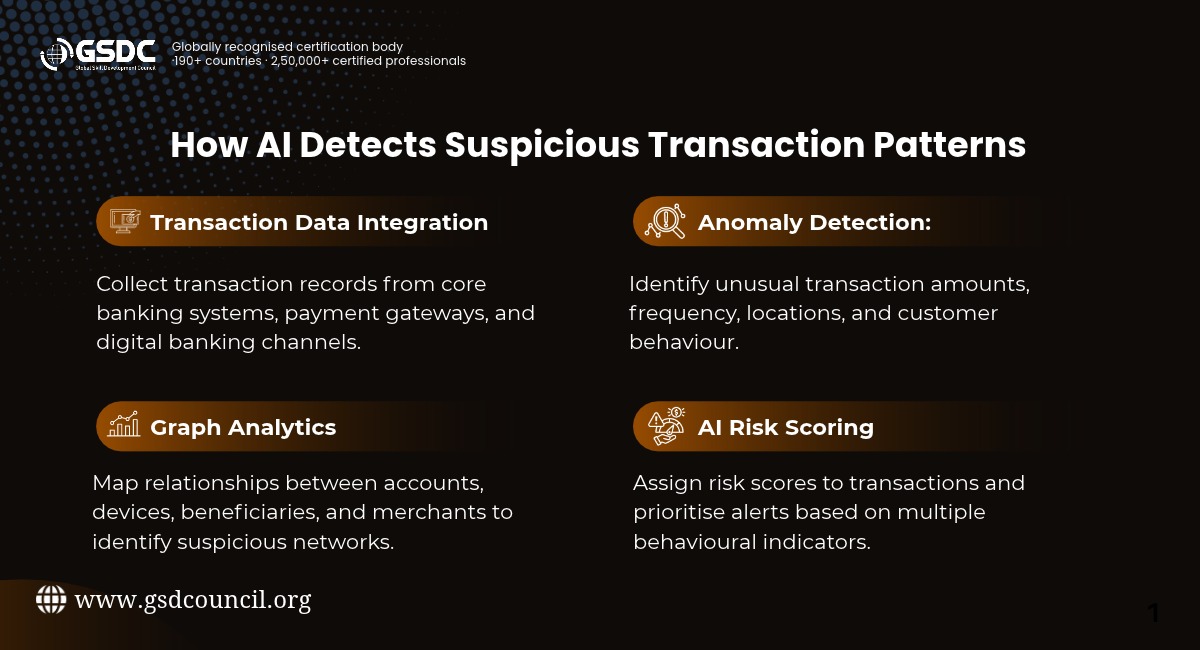
AI transaction monitoring uses machine learning, behavioural analysis, and data analytics to identify unusual transaction activity. It can analyse large volumes of transaction records and identify patterns that traditional rule-based systems may not easily detect.
The process generally involves four stages:
- Data Integration: Transaction information is collected from core banking platforms, payment gateways, card processing systems, and digital banking channels. APIs and event pipelines help bring this information together for analysis.
- Anomaly Detection: Machine learning models analyse transaction amounts, frequency, timing, locations, and customer behaviour. They identify activities that differ from established patterns, such as unusual transfers or sudden changes in account activity.
- Graph Analytics: Graph-based analysis connects customers, accounts, devices, merchants, and beneficiaries. This helps investigators identify relationships between accounts and detect potentially suspicious transaction networks.
- Risk Scoring: AI models assign risk scores based on transaction patterns, customer profiles, account behaviour, and other relevant indicators. Higher-risk alerts can be prioritised for further investigation.
AI-generated alerts indicate potential risks, not confirmed financial crime. Human investigators must review the available evidence before making decisions.
How Forward Deployed Engineers Help Banks Investigate Suspicious Transactions
Implementing AI transaction monitoring requires more than selecting a machine learning model. Banks need to connect analytical capabilities with existing payment infrastructure, customer records, security controls, and investigation workflows.
A Forward Deployed Engineer works with banking stakeholders and engineering teams to translate these requirements into practical technical solutions.
Here are five ways FDEs can contribute.
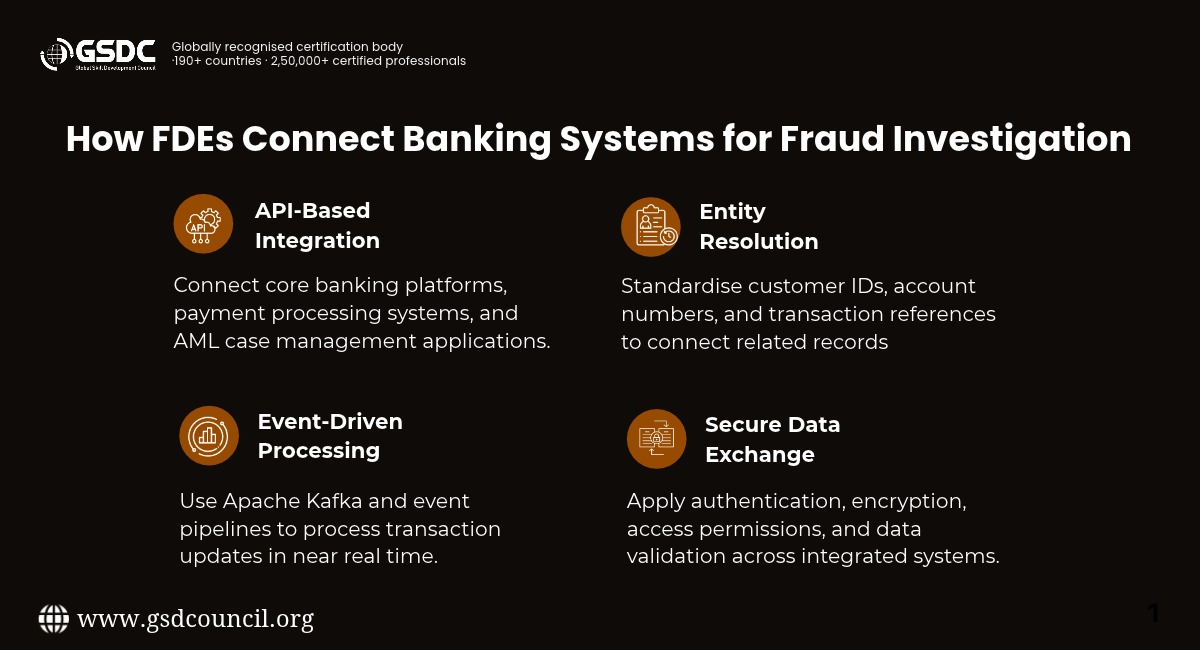
1. Connect Disconnected Banking Systems
A suspicious transaction investigation may require information from several platforms.
For example, transaction details may be available in a payment processing system, customer information in a core banking platform, device data in a digital banking application, and previous alerts in an AML case management system.
If these platforms are disconnected, investigators may need to collect information manually.
An FDE can help design integrations that bring these data sources together.
This may involve:
- Building API integrations between banking applications.
- Using event-driven pipelines to process transaction updates.
- Standardising customer, account, and transaction identifiers.
- Implementing data validation and reconciliation processes.
- Managing authentication, permissions, and secure data transfers.
For real-time fraud detection, technologies such as Apache Kafka can support event-driven transaction processing.
The architecture should also account for duplicate events, delayed messages, failed integrations, and inconsistent data formats.
The objective is to make relevant transaction information available to monitoring and investigation systems without creating another disconnected application.
2. Build Context-Aware Suspicious Transaction Monitoring
An AI model may flag an unusual transaction, but investigators need to understand the activity surrounding it.
An FDE can work with AML analysts and data scientists to build monitoring workflows that combine transaction behaviour with customer and account context.
For example, consider an account that suddenly receives multiple transfers from new beneficiaries.
The system could examine:
- Whether the transfers differ from the customer's historical activity.
- Whether the sending accounts have other unusual transaction relationships.
- Whether funds are transferred to another beneficiary shortly after receipt.
- Whether the activity matches previously identified suspicious patterns.
- Whether the transactions are consistent with the customer's expected account activity.
This requires more than a basic anomaly detection model. It may involve feature engineering, graph analysis, customer risk attributes, and transaction sequence analysis.
The FDE helps translate investigation requirements into technical features and ensures the monitoring solution evaluates the signals that matter to the bank.
3. Reduce False Positives Without Weakening Detection
False positives are a major challenge in AML transaction monitoring. Legitimate transactions may trigger alerts because the system does not have sufficient information about the customer, transaction purpose, or expected behaviour.
However, reducing alert volumes should not come at the cost of missing genuinely suspicious activity.
An FDE can work with data scientists and investigation teams to improve how alerts are generated and prioritised.
This may include:
- Reviewing historical alert outcomes and investigation labels.
- Identifying features that distinguish legitimate activity from suspicious patterns.
- Evaluating model precision, recall, and false-positive rates.
- Calibrating risk thresholds for different customer segments.
- Testing model performance across transaction types.
- Reviewing whether changes in alert volumes affect the detection of known suspicious cases.
For example, a business customer may regularly make high-value transfers as part of normal operations. Adding relevant customer and transaction context may help reduce unnecessary alerts without applying a higher detection threshold to every customer.
Banks should also remember that an alert closed without further action is not necessarily proof that the underlying transaction was legitimate. Model evaluation requires carefully reviewed outcomes and reliable investigation labels.
4. Support Investigation Workflows and Suspicious Activity Reports
Identifying suspicious activity is only the beginning of the investigation process.
Analysts may need to review transaction histories, connected accounts, customer profiles, previous alerts, supporting documents, and other records before deciding what action is appropriate.
An FDE can help integrate AI-generated insights into the bank's existing case management workflow.
An investigation interface could present:
- The transaction or activity that triggered the alert.
- Relevant customer and account information.
- A timeline of related transactions.
- Connected accounts and beneficiaries.
- The factors contributing to the risk score.
- Previous alerts and investigation notes.
- Links to supporting records and evidence.
AI can also assist with summarising transaction patterns and organising relevant case information.
For example, a system could generate a structured summary explaining that an account received several transfers from new beneficiaries before moving the funds to a common destination within a short period.
However, every important detail in the summary should be traceable to source records. Investigators must be able to verify the information rather than relying entirely on AI-generated explanations.
Where the investigation meets applicable reporting criteria, authorised personnel can use the documented findings to support the preparation of a Suspicious Activity Report (SAR), or the equivalent report required in their jurisdiction.
AI can assist with organising information and preparing summaries, but reporting decisions must follow the bank's compliance procedures and applicable legal requirements.
5. Monitor AI Performance After Deployment
AI transaction monitoring is not a one-time implementation. Customer behaviour changes, payment methods evolve, and fraud techniques become more sophisticated. These changes can affect model performance.
An FDE can work with engineering and risk teams to establish ongoing monitoring.
Important areas include:
- Data drift: Identifying changes in transaction data or customer behaviour compared with the model's training data.
- Model drift: Monitoring changes in model performance as transaction patterns evolve.
- Detection performance: Tracking precision, recall, false-positive rates, and alert volumes.
- System reliability: Monitoring processing delays, failed events, API errors, and data pipeline interruptions.
- Investigation outcomes: Using reviewed cases and confirmed findings to evaluate whether the system supports investigators effectively.
Banks should also establish controlled model update processes. Changes should be validated against historical data and relevant testing scenarios before being introduced into production.
This helps maintain reliable monitoring as the bank's operational and risk environment changes.
Practical Example: Investigating a Suspicious Transaction Network
Consider a bank that notices an increase in transfers involving several customer accounts. Individual transactions do not always exceed the bank's existing monitoring thresholds. However, the accounts show unusual patterns when their activity is examined together.
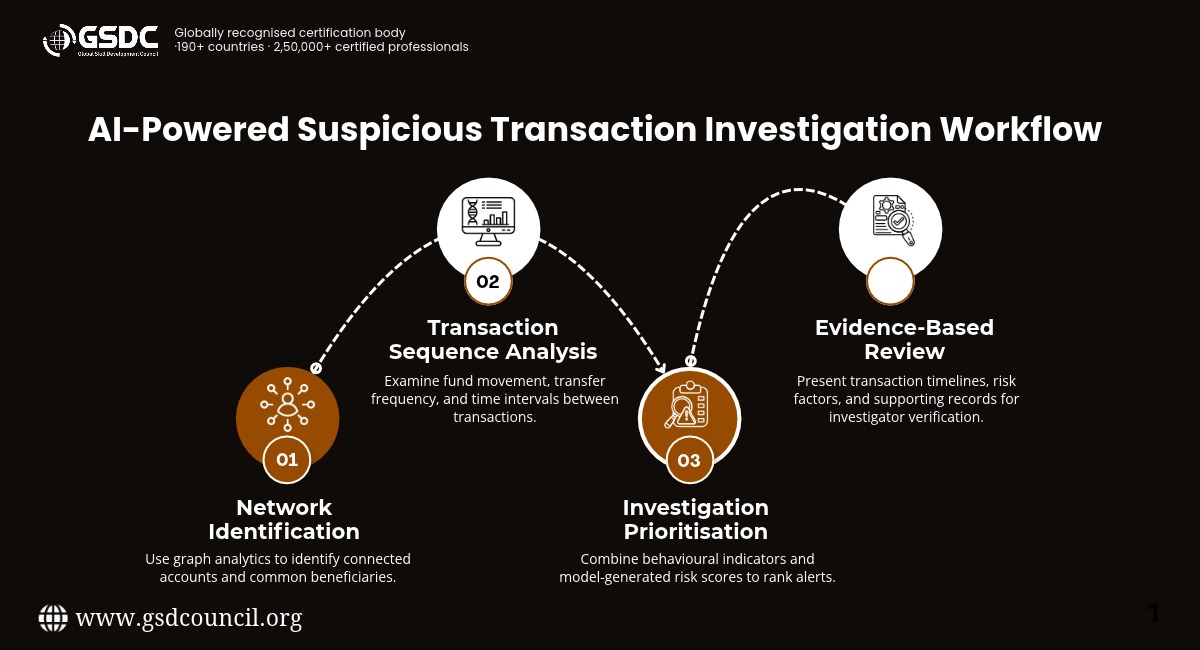
An AI-powered monitoring system can help investigate this activity through the following stages.
Stage 1: Detect unusual activity
The monitoring system identifies changes in transaction frequency, beneficiary patterns, and account behaviour.
Stage 2: Connect related records
Entity resolution and graph analytics identify accounts sharing relevant beneficiaries, devices, or transaction relationships.
Stage 3: Analyse transaction sequences
The system examines how funds move between accounts, including the time between incoming and outgoing transfers.
Stage 4: Generate a prioritised alert
A risk-scoring model combines behavioural, transactional, and relationship-based indicators to prioritise the case for review.
Stage 5: Support investigator review
The case management system presents the transaction timeline, connected accounts, relevant risk indicators, and supporting records.
Stage 6: Record the investigation outcome
The authorised investigation team reviews the evidence, documents its findings, and determines whether further action or regulatory reporting is required.
Throughout this process, the FDE helps connect data pipelines, analytical models, banking applications, and investigation workflows.
The important point is that AI is not simply identifying an unusual payment. It is helping investigators understand the wider activity surrounding that payment.
Technical Challenges Banks Must Consider Before Implementing AI
Building an AI-powered transaction monitoring system involves several engineering and operational challenges.
Technical challenge | Why it matters | How an FDE can contribute |
| Data fragmentation | Transaction and customer information may be spread across multiple platforms. | Design secure integrations and consistent data models. |
| Real-time processing | Delayed transaction events can affect timely detection. | Build and test event-driven processing pipelines. |
| Entity resolution | Inconsistent identifiers can hide relationships between accounts. | Implement identity matching and data reconciliation logic. |
| Model explainability | Investigators need to understand why an alert was generated. | Integrate feature-level explanations and traceable evidence. |
| False positives | Excessive alerts increase investigation workload. | Support model evaluation, feature refinement, and threshold testing. |
| Data privacy and access | Monitoring systems handle sensitive financial information. | Work with security teams on permissions, encryption, and data controls. |
| Model drift | Changing behaviour can reduce detection performance. | Establish monitoring, validation, and controlled model updates. |
Banks should also consider model governance, audit trails, data retention, operational resilience, and jurisdiction-specific compliance requirements.
These considerations should be included in the solution architecture rather than addressed only after deployment.
Build Your Forward Deployed Engineering Knowledge With GSDC
AI adoption in banking requires professionals who can understand technical systems while working closely with business and customer requirements. Forward Deployed Engineers help connect these areas by translating operational challenges into engineering solutions that can be tested and implemented in real environments.
The GSDC Certified Forward Deployed Engineer Certification is designed for professionals who want to understand the FDE role and develop relevant knowledge in customer-focused engineering and technical implementation.
What Can You Explore Through the GSDC FDE Certification?
- Understand the FDE Role: Learn how Forward Deployed Engineers connect business requirements with technical implementation.
- Explore AI Implementation: Develop an understanding of how AI technologies can address practical business challenges.
- Strengthen Technical Knowledge: Explore relevant engineering concepts, tools, APIs, and system integration.
- Bridge Business and Engineering: Understand how technical solutions support organisational goals and existing workflows.
- Explore the FDE Career Path: Learn about the responsibilities and skills associated with Forward Deployed Engineer opportunities.
The certification is worth exploring for software developers, AI and machine learning professionals, solutions engineers, technical consultants, and technology professionals interested in applying engineering to real-world business problems.
Explore the certification: GSDC Certified Forward Deployed Engineer Certification

Final Thoughts
Investigating suspicious transactions requires banks to understand more than individual payment records. They need to identify unusual behaviour, connect related accounts, analyse transaction patterns, and provide investigators with reliable evidence.
AI transaction monitoring can support this process through anomaly detection, behavioural analysis, graph analytics, and risk scoring. However, its effectiveness depends on how well these capabilities connect with existing banking systems and investigation workflows.
Forward Deployed Engineers help bridge this implementation gap. By working with banking teams, data specialists, and engineers, they can help turn AI capabilities into practical monitoring and investigation solutions.
For banks, the goal is not simply to generate more alerts. It is to help investigators identify relevant activity, understand why it matters, and make better-informed decisions using reliable information.

Related Certifications
Stay up-to-date with the latest news, trends, and resources in GSDC
If you like this read then make sure to check out our previous blogs: Cracking Onboarding Challenges: Fresher Success Unveiled
Not sure which certification to pursue? Our advisors will help you decide!