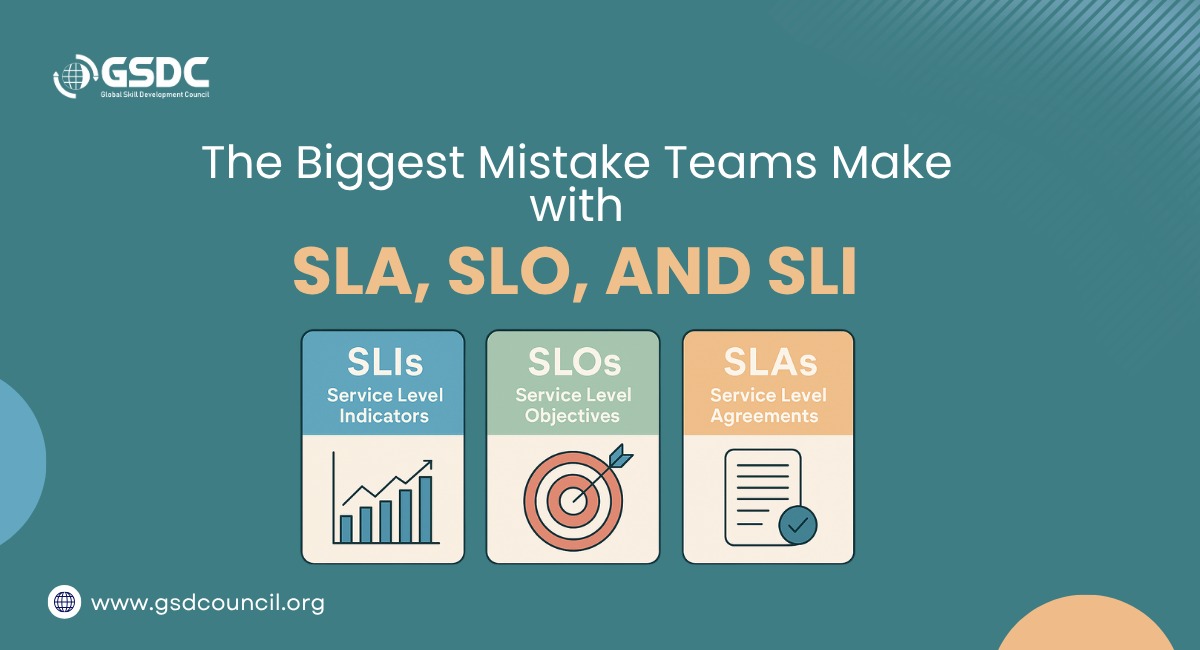
The Biggest Mistake Teams Make with SLA, SLO, and SLI
Written by Matthew Hale
Many organizations invest in monitoring tools, dashboards, and observability platforms to improve service reliability. Yet, they still face outages, performance issues, and customer complaints.
The problem isn't that they lack data. The problem is that they don't use SLA, SLO, and SLI correctly.
One of the most common mistakes is treating these three terms as if they mean the same thing. In reality, each has a different purpose, and confusing them can lead to poor reliability decisions.
Some common outcomes include:
- Teams focus only on meeting the SLA instead of improving the overall customer experience.
- SLOs are set to match the SLA instead of serving as internal reliability targets.
- SLIs are chosen because they're easy to measure, not because they reflect what customers actually experience.
- Monitoring is used to report problems after they occur instead of identifying them early.
- Teams take action only when an SLA is close to being breached.
As a result, an organization may still meet its SLA while customers experience slow response times, failed transactions, or inconsistent service performance.
The goal isn't simply to avoid an SLA breach. The real goal is to identify and resolve reliability issues before they affect customers.
Why Teams Make This Mistake
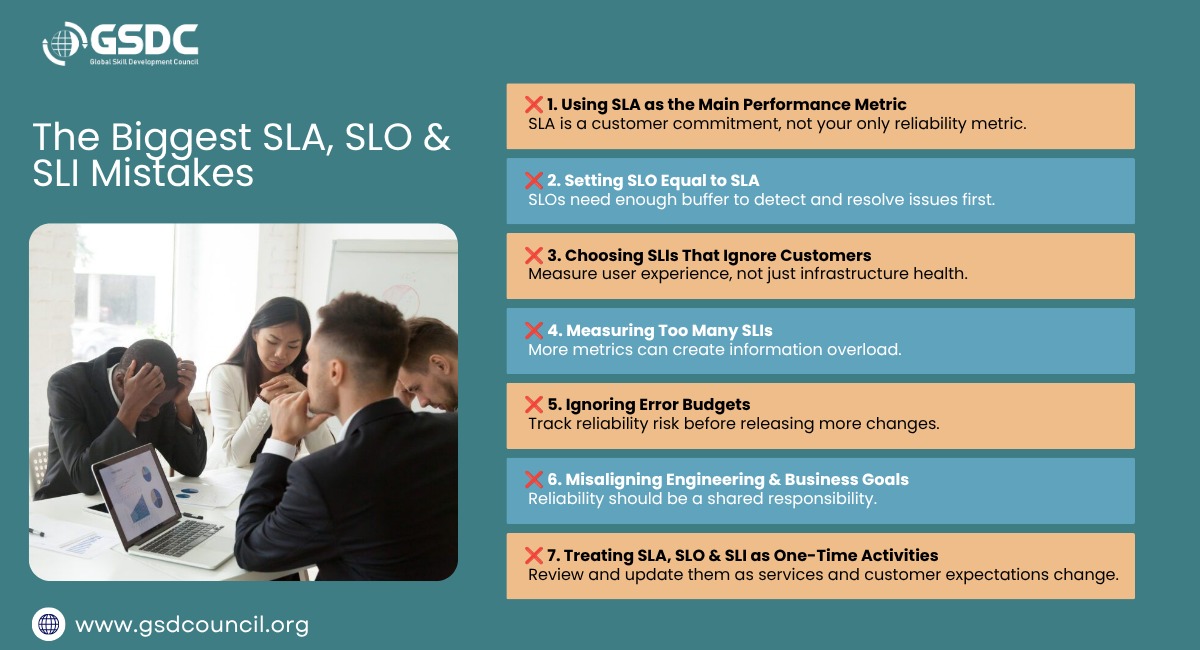
1. Using the SLA as the Main Performance Metric
An SLA is a commitment your organization makes to its customers. It defines the minimum level of service you agree to provide and usually outlines what happens if those commitments aren't met.
The mistake many teams make is using the SLA as their primary metric for measuring service reliability. By the time an SLA is at risk, customers have already experienced issues, and the engineering team is reacting instead of preventing problems.
SLOs and SLIs are designed to provide that early warning. They help teams identify performance issues before they impact customers or lead to an SLA breach.
Better approach
- Monitor SLIs continuously to understand service health.
- Use SLOs to trigger alerts before customer commitments are affected.
- Treat the SLA as a customer-facing commitment, not an internal engineering target.
2. Setting SLOs Equal to the SLA
Another common mistake is setting the same target for both the SLA and the SLO.
For example:
- SLA: 99.9% monthly availability
- SLO: 99.9% monthly availability
At first glance, this may seem reasonable, but it leaves no room for unexpected incidents. Even a small outage can immediately put the SLA at risk.
Instead, SLOs should give engineering teams enough buffer to detect, investigate, and resolve issues before they affect customer commitments.
Better approach
- Set SLOs that support your SLA instead of simply copying it.
- Review SLOs regularly as customer expectations and system performance change.
- Use error budgets to balance reliability with feature development.
3. Choosing SLIs That Don't Reflect Customer Experience
Not every metric is a useful Service Level Indicator.
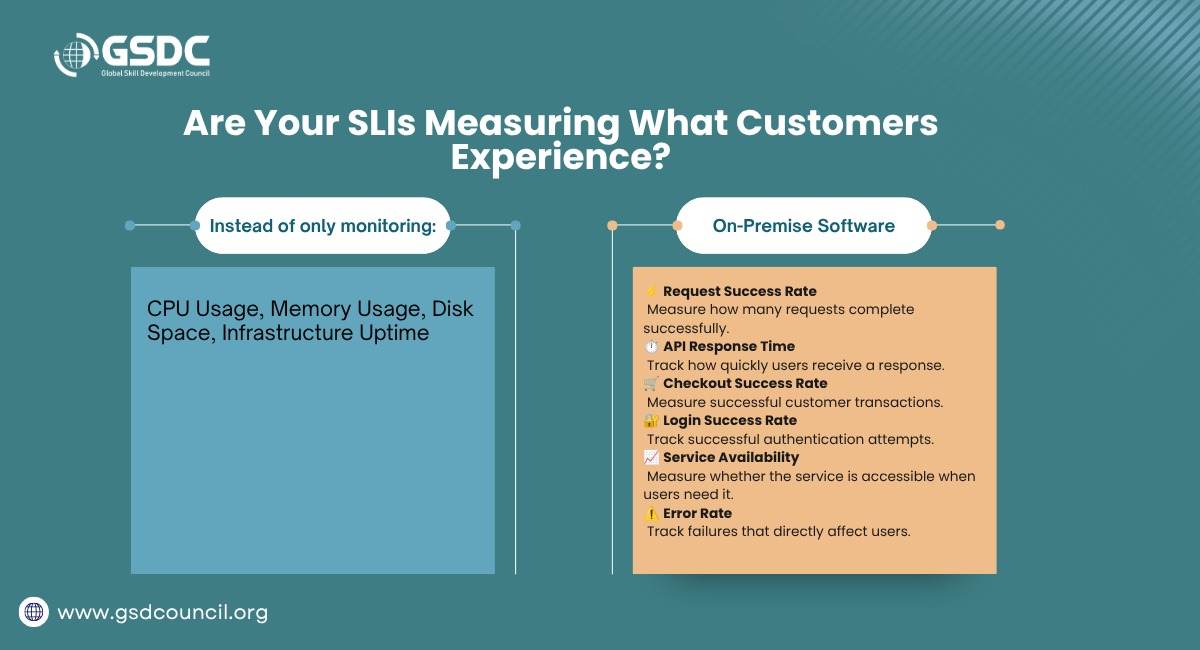
Infrastructure metrics like CPU usage, memory utilization, and disk space are important for monitoring system health, but they don't always show what your users are experiencing.
A service can have healthy infrastructure while customers still face slow response times or failed transactions.
Choose SLIs that measure the experience of the end user, such as:
- Request success rate
- API response time
- Checkout success rate
- Login success rate
- Service availability
- Error rate
These metrics provide a much clearer picture of how well your service is performing from the customer's perspective, allowing teams to detect issues before they become larger reliability problems.
4. Measuring Too Many SLIs
Modern monitoring tools can collect thousands of metrics, but more data doesn't always lead to better decisions.
Many teams build dashboards packed with infrastructure, application, and network metrics without identifying which ones actually measure service reliability. The result is information overload. Engineers spend time reviewing dashboards instead of focusing on issues that affect users.
A smaller set of meaningful SLIs is often far more valuable than tracking hundreds of metrics that rarely influence operational decisions.
Better approach
- Choose SLIs that directly support your SLOs.
- Prioritize customer-facing metrics over infrastructure metrics.
- Review SLIs regularly and remove those that don't provide actionable insights.
- Build dashboards around service health instead of system activity.
5. Ignoring Error Budgets
Defining an SLO is only part of the reliability strategy. Teams also need to manage the error budget that comes with it.
For example, if your service has an SLO of 99.9% availability, the remaining 0.1% is the error budget. It represents the acceptable amount of downtime or service degradation within the reporting period.
Many organizations define SLOs but never monitor their error budgets. As a result, teams continue releasing new features or making infrastructure changes without knowing how much reliability risk they are taking.
Error budgets help teams make informed decisions about when to prioritize innovation and when to focus on improving stability.
Better approach
- Define an error budget for every critical SLO.
- Track error budget consumption continuously.
- Slow down feature releases when the error budget is nearly exhausted.
- Use error budgets to guide release planning and reliability improvements.
6. Engineering and Business Teams Work Toward Different Goals
Service reliability isn't just an engineering responsibility. Product managers, customer support teams, operations, and business leaders all play a role in delivering a reliable service.
The challenge is that every team often measures success differently.
For example:
- Engineering focuses on system availability and performance.
- Product teams prioritize delivering new features.
- Customer support tracks support tickets and customer issues.
- Business leaders monitor SLA compliance and customer satisfaction.
When these teams work toward different objectives, reliability efforts become fragmented and customer experience suffers.
Better approach
- Align SLIs with what customers actually experience.
- Define SLOs collaboratively across engineering and business teams.
- Review reliability metrics during cross-functional planning meetings.
- Treat SLA performance as one of several indicators of service health, not the only one.
7. Treating SLA, SLO, and SLI as One-Time Activities
Service reliability isn't something you define once and forget.
As applications evolve, customer expectations change, and new features are introduced, your reliability goals should evolve as well.
Many organizations define their SLAs, SLOs, and SLIs during implementation and rarely review them again. Over time, these objectives may no longer reflect how the service is used or what customers expect.
Regular reviews help ensure that your reliability strategy continues to support both business goals and user experience.
Better approach
- Review SLIs and SLOs regularly, especially after major releases or architectural changes.
- Update objectives based on production data and customer feedback.
- Use incident reviews to identify gaps in your existing metrics.
- Continuously refine reliability targets as your services grow.
Real-World Example: Meeting the SLA but Failing the Customer
An online payment platform promises 99.9% monthly availability in its SLA. To support this commitment, the engineering team also sets an SLO of 99.9% availability and monitors only infrastructure uptime as its primary SLI. During peak shopping hours, the application remains online, but payment requests take 10–15 seconds to complete. Some transactions fail because customers abandon the checkout process before payment is processed.
From an operational perspective:
- The servers remain available.
- Infrastructure monitoring reports normal status.
- The SLA is not violated.
From the customer's perspective:
- Payments are slow.
- Checkout fails frequently.
- Confidence in the platform decreases.
The issue is not availability, it's choosing the wrong service indicators.
A stronger monitoring strategy could include:
- Payment success rate
- Checkout completion rate
- API response latency
- Transaction processing time
- Error rate during peak traffic
These SLIs provide earlier visibility into customer-impacting issues and allow teams to respond before reliability problems become business problems.
How High-Performing Teams Use SLA, SLO, and SLI Together
Organizations with mature reliability practices do not treat SLA, SLO, and SLI as independent metrics. Each serves a specific purpose within the service reliability lifecycle.
A typical workflow looks like this:
Customer Expectations
▼
Service Level Agreement (SLA)
▼
Service Level Objective (SLO)
▼
Service Level Indicators (SLIs)
▼
Monitoring & Alerting
▼
Continuous Improvement
Here's how each component contributes to reliability:
1. Start with Customer Expectations
Reliability goals should reflect what customers expect from the service.
Questions to consider include:
- How much downtime is acceptable?
- What response time do users expect?
- Which business transactions are most critical?
- What level of service supports business objectives?
These expectations become the foundation for the SLA.
2. Define Realistic SLAs
An SLA establishes the service commitment made to customers. It should be clear, measurable, and achievable.
A well-designed SLA typically defines:
- Service availability
- Performance commitments
- Support response times
- Resolution targets
- Service credits or penalties for non-compliance
The SLA should represent the minimum level of service customers can rely on and not the engineering team's daily operating target.
3. Create Internal SLOs That Support the SLA
SLOs translate business commitments into engineering objectives.
Instead of matching the SLA exactly, SLOs should provide enough operational margin to identify and resolve issues before customer commitments are affected.
When defining SLOs:
- Base objectives on historical performance data.
- Balance reliability with development velocity.
- Review objectives as services evolve.
- Use error budgets to guide release decisions.
4. Measure the Right SLIs
SLIs determine whether SLOs are being achieved.
The most effective SLIs measure customer-facing outcomes rather than infrastructure activity.
Examples include:
Service | Recommended SLI |
| Web Application | Page load time |
| API Platform | Successful request rate |
| E-commerce | Checkout completion rate |
| Banking Application | Transaction success rate |
| SaaS Platform | Service availability |
| Authentication Service | Login success rate |
Selecting meaningful SLIs allows teams to identify issues before they become customer complaints.
5. Automate Monitoring and Alerting
Monitoring should provide early warning signs rather than simply documenting incidents.
Effective monitoring includes:
- Real-time dashboards
- Automated threshold alerts
- SLO burn-rate alerts
- Error budget tracking
- Incident escalation workflows
Automation reduces response time and helps engineering teams focus on resolving issues instead of manually reviewing dashboards.
6. Continuously Review Reliability Metrics
Reliability objectives should evolve alongside the service.
Regular reviews help teams:
- Identify outdated SLIs.
- Adjust SLOs based on customer expectations.
- Improve monitoring coverage.
- Reduce alert fatigue.
- Strengthen incident response processes.
Continuous improvement ensures that SLA, SLO, and SLI remain aligned with business goals and system performance.
Best Practices for Managing SLA, SLO, and SLI
Organizations with strong reliability practices consistently follow a few key principles.
1. Focus on Customer-Centric SLIs
Measure metrics that represent the user experience rather than only infrastructure health.
Examples include:
- Request latency
- Successful transactions
- Service availability
- Error rate
- User session success rate
2. Keep SLOs Realistic
Aggressive reliability targets are difficult to maintain and often reduce engineering flexibility.
Set objectives based on:
- Historical performance
- Business priorities
- Customer expectations
- Team capacity
3. Use Error Budgets Effectively
Error budgets help balance innovation and reliability.
Monitor budget consumption regularly and use it to guide release planning, infrastructure improvements, and operational priorities.
4. Review Objectives Regularly
Business priorities change, customer expectations evolve, and services become more complex.
Review SLAs, SLOs, and SLIs after:
- Major product releases
- Infrastructure changes
- Significant incidents
- Quarterly reliability reviews
5. Align Engineering and Business Teams
Reliability is a shared responsibility. Ensure product managers, engineering teams, operations, and business stakeholders use the same reliability objectives when making decisions.
6. Build Dashboards That Drive Action
A dashboard should help engineers answer one question:
"What needs attention right now?"
Avoid dashboards that collect every available metric. Focus on indicators that support operational decisions and customer outcomes.
Take Your SLA, SLO & SLI Knowledge to the Next Level with SRE Certification
Understanding SLA, SLO, and SLI is an important part of Site Reliability Engineering. But effective SRE also requires practical knowledge of monitoring, incident management, error budgets, automation, and building reliable systems.
The GSDC Site Reliability Engineering (SRE) Foundation Certification helps professionals develop these skills and understand how SRE practices can be applied in real-world IT environments. The program covers SLOs, SLIs, error budgets, monitoring, incident management, toil, automation, anti-fragility, and the organizational impact of SRE.
What You Will Learn
- SLA, SLO & SLI Management: Learn how to define and manage service reliability objectives and indicators.
- Monitoring & Observability: Understand how to monitor service health and identify reliability issues early.
- Incident Management: Learn practical approaches for incident detection, response, escalation, and post-incident reviews.
- Error Budgets & Reliability: Use error budgets to balance system reliability with development and release activities.
- SRE Tools & Automation: Understand how automation can reduce operational toil and improve reliability.
- Reliable & Scalable Systems: Learn SRE practices for building and managing resilient systems.
Final Thoughts
SLA, SLO, and SLI are not competing concepts but they are complementary components of an effective reliability strategy. Confusing their roles often leads to reactive operations, ineffective monitoring, and reliability targets that fail to reflect the customer experience.
The strongest reliability practices begin with clear customer commitments, translate those commitments into measurable engineering objectives, and continuously track meaningful service indicators. This approach enables teams to identify issues early, make informed operational decisions, and improve service quality before customers are affected.
Rather than asking whether your organization has defined SLAs, SLOs, and SLIs, ask a more important question:
Are they working together to improve reliability, or are they simply metrics on a dashboard?

Related Certifications
Stay up-to-date with the latest news, trends, and resources in GSDC
If you like this read then make sure to check out our previous blogs: Cracking Onboarding Challenges: Fresher Success Unveiled
Not sure which certification to pursue? Our advisors will help you decide!