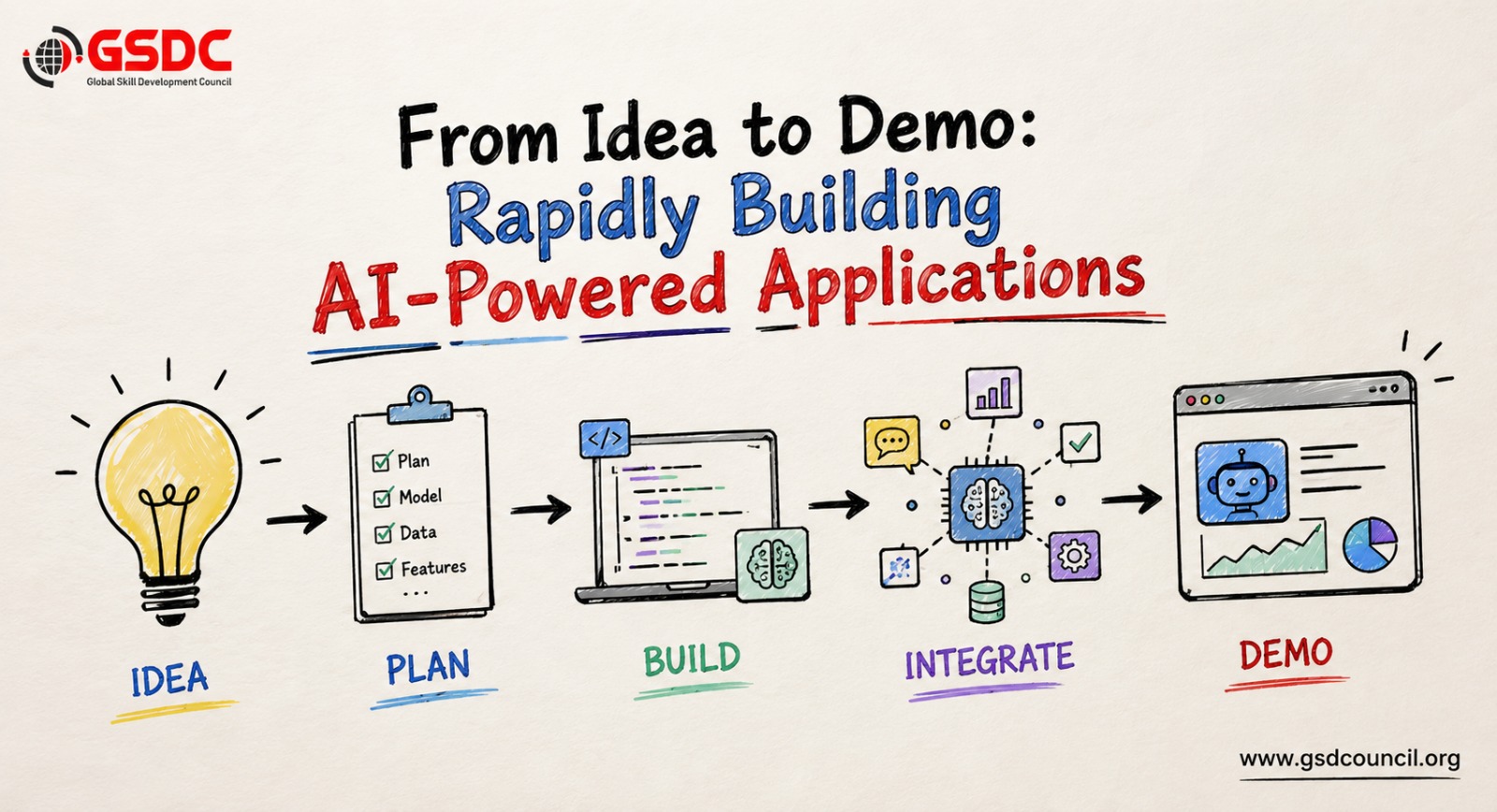
From Idea to Demo: Rapidly Building AI-Powered Applications
Written by Thanmaye Poojari
- AI Has Changed the Way Applications Are Built
- Start Small: The Power of Rapid Prototyping
- Every AI Application Begins with Quality Data
- Understanding Retrieval-Augmented Generation (RAG)
- Building a Modern AI Application Architecture
- Why Managed Cloud Services Accelerate Development
- Rapid Prototyping Principles That Speed Up AI Development
- Building AI Applications That Users Trust
- Intelligent Routing Makes AI Assistants More Powerful
- Follow-Up Conversations Create a Natural User Experience
- Cost Optimization Is Easier Than Ever
- The Role of Forward Deployed Engineering in AI
- From Prototype to Production
- Build the Skills to Lead AI Solutions from Prototype to Production
- Conclusion
Artificial intelligence is transforming software development faster than ever before. What once required months of planning, coding, testing, and infrastructure setup can now be accomplished in a matter of days or even hours. Thanks to advances in large language models (LLMs), cloud-based AI services, AI development tools, and modern frameworks, building AI applications has become more accessible to developers, startups, and enterprises alike.
However, creating AI-powered applications isn't just about integrating a chatbot or connecting to an API. Successful AI application development requires a thoughtful combination of high-quality data, the right architecture, intuitive user experience, and efficient cloud services.
Whether it's a recommendation engine, a customer support assistant, or an enterprise knowledge platform, the journey from a simple idea to a working prototype follows a structured process. Understanding this process enables organizations to validate concepts quickly, reduce development costs, and accelerate innovation.
This article explores the key principles behind rapid application development for AI, highlighting the technologies, design strategies, AI tools, and development practices that make modern AI prototyping both practical and scalable.
AI Has Changed the Way Applications Are Built
Traditional software development typically followed a long lifecycle. Teams spent weeks gathering requirements, designing architecture, building infrastructure, writing backend logic, developing interfaces, and testing features before users could interact with even a basic version of the product.
Generative AI has fundamentally changed this approach.
Today, developers can focus less on writing every line of logic manually and more on solving real business problems. AI can generate code, explain complex implementations, assist in debugging, and even create user interface components. These capabilities are helping teams accelerate AI engineering, AI product development, and building applications for real-world use cases.
This shift has introduced an important principle:
A working prototype provides more value than a perfect idea that never gets built.
Organizations increasingly rely on Proof of Concepts (POCs) to validate ideas before investing significant time and resources. Instead of spending months creating a complete product, teams build smaller versions that demonstrate the core functionality and gather feedback early.
This iterative approach reduces risk while allowing businesses to adapt quickly to changing requirements.
Start Small: The Power of Rapid Prototyping
Rapid prototyping focuses on building the smallest possible version of an application that proves an idea works.
Rather than trying to create a feature-rich platform from day one, developers identify the application's primary objective and build only the components necessary to achieve that goal.
For example, imagine creating an AI-powered food ordering assistant.
Instead of developing an entire food delivery platform with payment gateways, customer profiles, notifications, and restaurant management, a prototype might simply allow users to:
- Search menu items using natural language
- Receive personalized recommendations
- Answer delivery-related questions
- View basic spending insights
Although limited in scope, such a prototype effectively demonstrates the value of conversational AI.
Rapid prototypes help answer important business questions:
- Will users find the solution useful?
- Does the AI produce accurate responses?
- Is the data sufficient?
- Does the interface feel intuitive?
- Is the architecture scalable?
Once these questions are answered, teams can confidently invest in expanding the product.
This approach is particularly valuable for teams involved in forward deployed engineering, where technical solutions are often developed around specific business and customer needs. A forward deployed engineer can work closely with users and business teams to turn practical requirements into working AI solutions.
Every AI Application Begins with Quality Data
No matter how advanced an AI model may be, its effectiveness depends heavily on the quality of data it receives.
A common misconception is that modern language models already "know everything." While foundation models possess extensive general knowledge, they lack access to an organization's internal documents, customer records, product catalogs, or proprietary information.
That is why high-quality, domain-specific data becomes the foundation of every successful AI-powered application.
Depending on the use case, data may include:
- Product catalogs
- Customer support documentation
- Knowledge bases
- Historical transactions
- User activity logs
- Enterprise policies
- Technical documentation
For instance, an AI assistant designed for a food delivery platform would require information such as restaurant menus, delivery guidelines, order history, pricing, and customer support articles.
When this information is organized correctly, AI can provide responses that are not only intelligent but also accurate and relevant.
A useful principle to remember is:
Good data makes AI look smart. Poor data makes even the best models unreliable.
Understanding Retrieval-Augmented Generation (RAG)
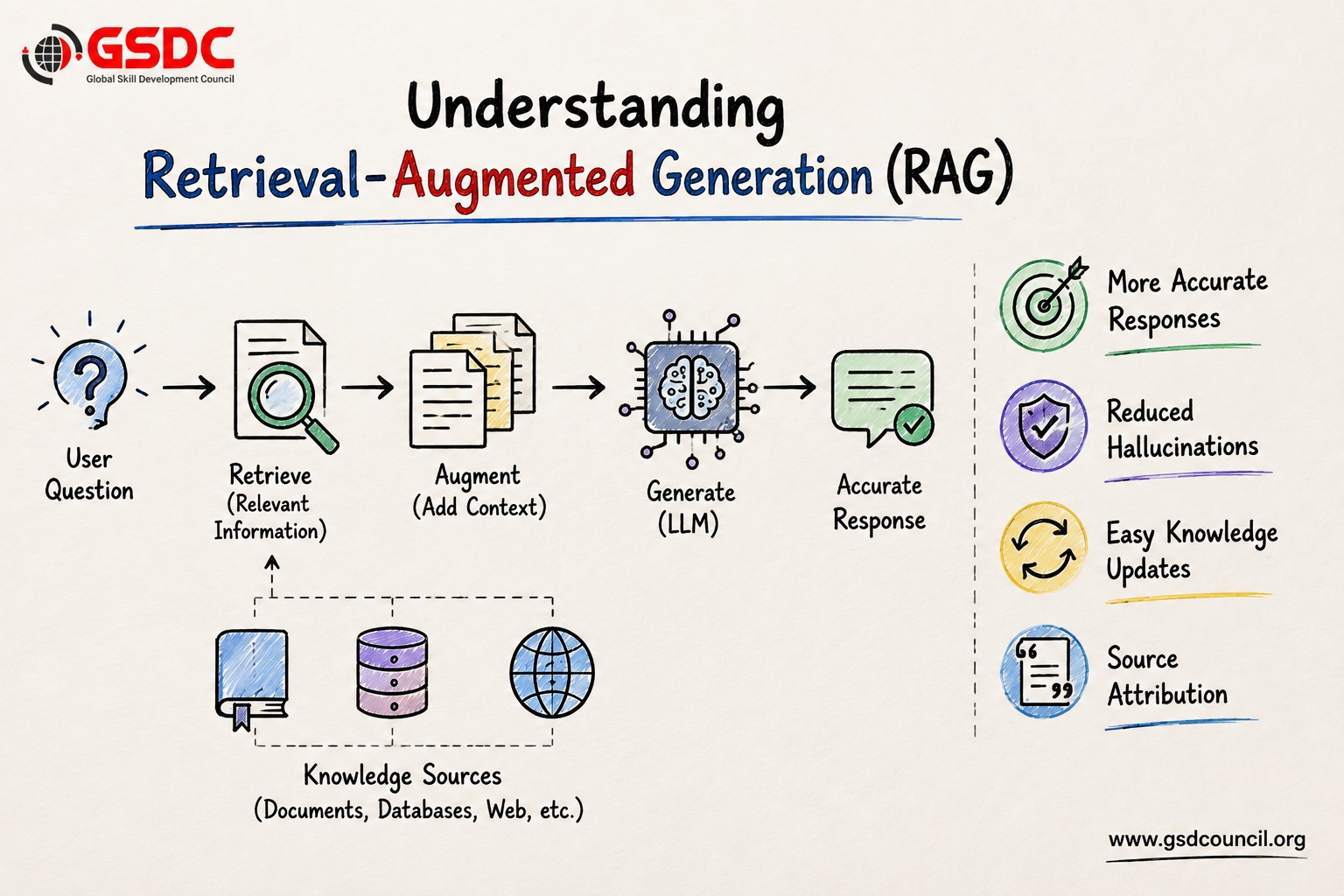
One of the biggest breakthroughs in enterprise AI development is Retrieval-Augmented Generation (RAG).
Instead of retraining large language models whenever new information becomes available, RAG allows AI systems to retrieve relevant documents during a conversation and use them to generate accurate responses.
The workflow is straightforward:
- Organizational data is uploaded into a searchable knowledge base.
- The information is converted into vector embeddings.
- When a user asks a question, the system searches for the most relevant documents.
- Those documents are sent to the language model along with the user's query.
- The model generates an answer using the retrieved information.
This process offers several significant advantages.
More Accurate Responses
Since answers are grounded in organizational knowledge rather than relying solely on the model's memory, responses become significantly more reliable.
Reduced Hallucinations
One of the biggest concerns with generative AI is hallucination when a model confidently produces incorrect information.
RAG minimizes this issue by providing factual context before generating a response.
Easy Knowledge Updates
Businesses frequently update documentation, pricing, policies, and product information.
With RAG, developers only need to update the knowledge base instead of retraining an entire model.
Source Attribution
Many applications developed through LLM application development and RAG can also display the documents or references used to generate responses, increasing user trust and transparency.
Building a Modern AI Application Architecture
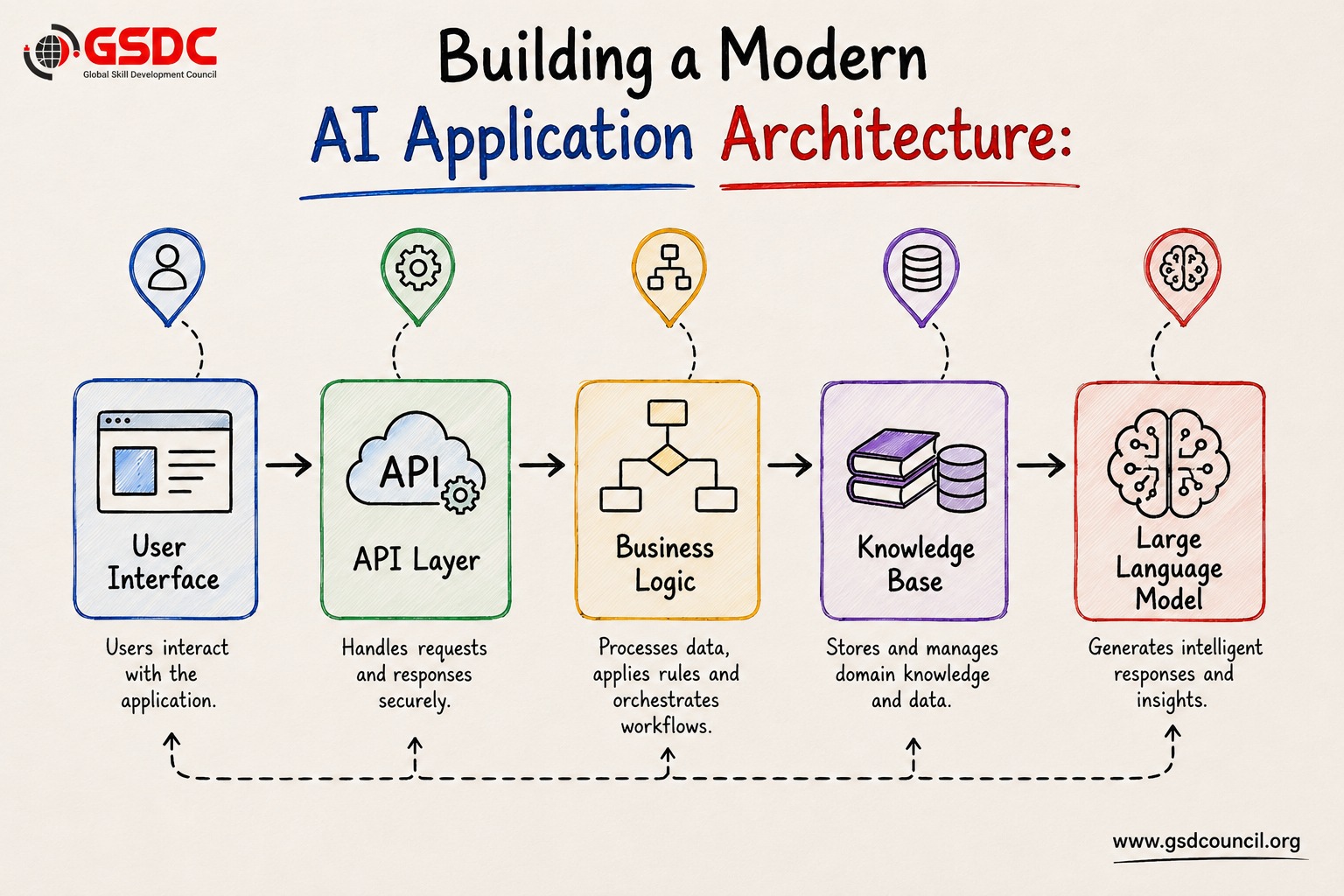
One of the reasons AI application development can now be completed so quickly is the availability of managed cloud services and modern AI development tools.
Instead of creating complex infrastructure from scratch, developers can assemble scalable AI systems using managed components.
A typical architecture consists of several layers working together.
User Interface
The front end provides users with a conversational interface where they can ask questions naturally.
Frameworks such as Streamlit have become particularly popular for AI prototypes because they allow developers to build interactive applications entirely using Python, eliminating the need for extensive frontend development.
This dramatically reduces development time while enabling rapid experimentation and rapid application development.
API Layer
The application communicates with backend services through APIs.
Rather than exposing AI models directly, API gateways manage authentication, routing, security, and communication between the user interface and backend logic.
This layer makes applications more secure and easier to scale.
Business Logic
Serverless computing platforms handle request processing without requiring developers to manage physical servers.
These services receive user queries, determine which data source should be used, invoke the appropriate AI model, and return responses to the application.
Since serverless infrastructure scales automatically, developers only pay for actual usage instead of maintaining idle resources.
Knowledge Base
The knowledge layer stores business documents, structured datasets, and other organizational information.
When users submit questions, relevant information is retrieved from this repository before being passed to the language model.
This ensures responses remain grounded in real business data.
Large Language Model
Finally, the LLM interprets user intent, combines retrieved information with natural language reasoning, and generates conversational responses.
Different models may be selected depending on performance requirements, cost, or enterprise preferences.
This architecture provides a practical foundation for building AI applications, from internal assistants to customer-facing AI-powered applications.
Why Managed Cloud Services Accelerate Development
Building AI infrastructure manually can be both expensive and time-consuming.
Developers would need to configure databases, vector stores, servers, APIs, security, storage, monitoring, scaling, and maintenance before even beginning application development.
Managed cloud platforms eliminate much of this complexity.
Services such as managed knowledge bases, serverless functions, cloud storage, and integrated AI models allow developers to focus primarily on solving business problems rather than maintaining infrastructure.
Another major advantage is cost efficiency.
Instead of paying for continuously running servers, many managed services operate on a pay-as-you-use pricing model. Organizations incur costs only when the application is actively processing requests, making experimentation significantly more affordable.
For startups and innovation teams, this creates an ideal environment for testing ideas without committing substantial infrastructure investments.
These capabilities also support modern AI deployment, allowing teams to move validated prototypes toward production more efficiently.
Rapid Prototyping Principles That Speed Up AI Development
One of the biggest reasons AI projects fail is that teams spend too much time trying to build a perfect product before validating whether users actually need it. Modern AI engineering encourages a different mindset: build quickly, test early, gather feedback, and improve continuously.
Rather than aiming for perfection, successful teams focus on delivering value as early as possible. This approach allows organizations to identify technical challenges, understand user expectations, and refine their solutions based on real-world usage.
Some proven rapid prototyping principles include:
- Start with a minimum viable solution. Build only the features that demonstrate the application's core value.
- Don't wait for perfect data. Sample datasets can be used during early experimentation before integrating production data.
- Use managed cloud services. Leveraging cloud-native AI services reduces infrastructure complexity and accelerates deployment.
- Use AI tools strategically. AI coding assistants and other AI development tools can help teams accelerate implementation and experimentation.
- Test continuously. Every prototype should be evaluated with real users, and improvements should be made through short development cycles.
- Let user feedback guide future development. Instead of assuming what users need, use the prototype to discover which features provide the greatest value.
This iterative approach not only shortens development time but also reduces the financial risks associated with building large-scale AI systems.
It also creates a foundation for AI product development, where ideas can move from experimentation to validated products through continuous feedback.
Building AI Applications That Users Trust
Creating an intelligent AI model is only one part of the development process. Equally important is designing an experience that users find intuitive, transparent, and trustworthy.
An AI assistant should feel like a helpful guide rather than a mysterious black box.
Show Users What the AI Can Do
Many users interact with an AI assistant for the first time without knowing what questions to ask.
Instead of presenting an empty chat box, developers should provide example prompts or suggested actions.
For example, an AI-powered food assistant might display prompts such as:
- Find vegetarian meals under $15
- Recommend spicy dishes near me
- Track my monthly food spending
- Help me with my recent order
These examples immediately communicate the assistant's capabilities and encourage user engagement.
Keep Users Informed During Processing
Unlike traditional software, AI systems often require a few seconds to generate responses.
Rather than leaving users staring at a blank screen, applications should provide visual feedback such as:
- Loading indicators
- Progress animations
- Streaming text
- Thinking messages
These small interface elements reassure users that the application is actively processing their request, creating a smoother overall experience.
Cite Information Sources
Trust increases significantly when users can see where information comes from.
Applications built using Retrieval-Augmented Generation (RAG) can display supporting documents, help articles, or relevant references alongside AI-generated responses.
This transparency offers several advantages:
- Users can verify the information independently.
- Businesses increase confidence in AI recommendations.
- Responses become more credible and easier to audit.
Providing source attribution is especially valuable in enterprise environments where accuracy and compliance are essential.
Handle Errors Gracefully
No AI model has every answer.
Instead of generating misleading responses when information is unavailable, applications should communicate limitations honestly.
A well-designed assistant might respond with:
"The requested information isn't available in the current knowledge base. Please try rephrasing your question or contact support for additional assistance."
Friendly error handling maintains user trust while encouraging continued interaction.
Intelligent Routing Makes AI Assistants More Powerful
Many AI assistants today perform more than one task. Rather than relying on a single knowledge source, they intelligently route user queries to different datasets based on intent.
This is also an important component of AI workflow automation, where AI systems can determine which workflow, data source, or service should handle a particular request.
For example, a food delivery assistant may process questions in three different categories:
- Food recommendations, using restaurant menus and pricing data.
- Customer support, using help articles and policy documentation.
- Personal insights, using order history and spending patterns.
When a customer asks, "Recommend a spicy meal under $20," the system retrieves menu information.
If the question changes to, "Why was I charged after my driver cancelled?", the assistant automatically switches to customer support documentation.
Similarly, a question like, "Which month did I spend the most on food?" directs the request to personal order history.
This intelligent routing creates a seamless conversational experience while ensuring responses come from the most relevant knowledge source.
Follow-Up Conversations Create a Natural User Experience
One characteristic that separates advanced AI-powered applications from basic chatbots is their ability to understand context.
Instead of treating every prompt as an independent request, conversational AI remembers previous interactions and responds naturally to follow-up questions.
For instance, after recommending several restaurants, a user might ask:
"Which one has the lowest delivery fee?"
The assistant understands that "which one" refers to the previously suggested restaurants and provides the requested comparison without asking the user to repeat the original query.
This conversational continuity makes AI interactions feel significantly more human while reducing unnecessary repetition.
It is also an important consideration when building applications powered by large language models, particularly during LLM application development.
Cost Optimization Is Easier Than Ever
A common misconception is that AI applications are prohibitively expensive to build and operate.
While training large foundation models requires substantial resources, most organizations do not train models from scratch. Instead, they use managed AI services that operate on a consumption-based pricing model.
Modern cloud platforms reduce costs by offering:
- Serverless computing that runs only when requests are received.
- Managed vector databases and knowledge bases that eliminate infrastructure management.
- Cloud storage for enterprise documents.
- Pay-per-token pricing for language model interactions.
Because infrastructure scales automatically, organizations avoid paying for idle servers, making experimentation affordable even for startups and small teams.
This cost-efficient approach enables businesses to test multiple ideas before investing in full-scale production systems.
For organizations exploring Applications of generative AI, this approach makes it easier to experiment with different use cases before committing to larger-scale AI product development and deployment.
The Role of Forward Deployed Engineering in AI
As AI moves from experimentation into real-world business environments, organizations increasingly need technical teams that can connect AI capabilities with practical customer requirements.
This is where forward deployed engineering becomes relevant. A forward deployed engineer typically works close to real users, customers, and business teams to understand practical problems and help translate those requirements into technical solutions.
For teams building AI applications, this type of engineering approach can complement traditional product and development teams by keeping implementation closely aligned with real-world needs.
People researching what is a forward deployed engineer may also encounter the role in discussions around AI engineering, enterprise software, customer-facing technical implementation, and AI product development.
Similarly, searches for forward deployed engineer salary often reflect growing interest in this emerging technical career path. However, compensation varies considerably by company, location, experience, and responsibilities.
From Prototype to Production
The transition from prototype to production requires more than simply making an AI application work.
Teams need to consider scalability, reliability, security, monitoring, data quality, user feedback, and AI deployment.
A successful development process can therefore be viewed as a continuous cycle:
- Identify a real business problem.
- Build a small proof of concept.
- Connect relevant data.
- Select appropriate AI models and AI tools.
- Test the application's core functionality.
- Gather feedback from users.
- Improve the architecture and user experience.
- Deploy the validated solution.
- Monitor performance and continue improving it.
This approach supports both rapid application development and sustainable long-term AI engineering.
Build the Skills to Lead AI Solutions from Prototype to Production
As AI-powered applications move from rapid prototypes to real-world deployment, organizations need professionals who can connect technical solutions with practical business and customer needs. The Certified Forward Deployed Engineering Certification helps you develop the skills to work at this intersection, understanding real-world requirements, building AI applications, using modern AI tools, and supporting successful AI deployment.
Whether you're exploring AI engineering, AI application development, LLM application development, or AI product development, GSDC’s certification can help you build practical capabilities for solving complex problems and delivering impactful AI-powered solutions.
Ready to turn AI ideas into real-world solutions? Explore the Forward Deployed Engineering Certification and take the next step in your AI engineering career.
Conclusion
The journey from an idea to a working AI-powered application has become remarkably shorter thanks to generative AI, cloud-native services, AI development tools, and modern development frameworks.
Rather than spending months building complex systems, teams can now validate concepts through rapid prototypes that combine quality data, Retrieval-Augmented Generation (RAG), managed infrastructure, and user-focused design.
The key to success lies not only in selecting the right AI model but also in creating trustworthy, scalable, and intuitive experiences.
Whether organizations are focused on AI application development, LLM application development, AI workflow automation, or broader Applications of generative AI, the same principle applies: start with a real problem, build a focused solution, validate it quickly, and continuously improve it.
Organizations that adopt this iterative approach can innovate faster, reduce development costs, and confidently transform promising ideas into impactful AI solutions.

Related Certifications
Frequently Asked Questions
Start with a proof of concept (POC) using frameworks like Streamlit, AI coding assistants, and managed AI services to quickly validate your idea.
RAG improves AI accuracy by retrieving relevant information from your knowledge base before generating responses.
No. Modern cloud platforms use pay-as-you-go pricing, allowing you to build AI applications without heavy infrastructure costs.
Yes. AI coding assistants and modern AI development tools can generate code from natural language prompts, making development much more accessible.
Clear responses, source citations, transparent interactions, and a user-friendly interface help build trust in AI-powered applications.
A forward deployed engineer works closely with customers and business teams to understand practical requirements and help develop technical solutions. The role can be particularly relevant to organizations implementing AI solutions in real-world environments.
AI workflow automation can help applications intelligently process requests, route tasks, retrieve relevant information, and connect different services based on user intent.
Stay up-to-date with the latest news, trends, and resources in GSDC
If you like this read then make sure to check out our previous blogs: Cracking Onboarding Challenges: Fresher Success Unveiled
Not sure which certification to pursue? Our advisors will help you decide!