What Does a Customer Experience Manager Do? Roles and Pay

Written by Matthew Hale
- Customer Experience Manager Roles and Responsibilities
- Customer Experience Manager Duties in a Typical Week
- A Real-World Example: Fixing a Confusing Checkout
- Customer Experience Metrics Every CX Manager Tracks
- Customer Effort Score: The Metric That Shows Hidden Friction
- Why it matters
- Customer Experience KPIs: Turning Data into Goals
- Skills a Strong CX Manager Needs
- Customer Experience Manager Jobs: Where They Exist and Where They Lead
- Customer Experience Manager Salary
- How to Become a Customer Experience Manager
- Final Thoughts
Think about the last time a company let you down. Maybe an order showed up late and nobody told you why. Maybe you were passed between three support agents who each asked for your account number again. Did you go back to that brand? A lot of people don't. According to PwC research, 32% of customers would stop doing business with a brand they love after just one bad experience.
That is the problem a customer experience manager is hired to solve. So, what does a customer experience manager do? In short, they look at every step a customer takes with a company, find the points where things go wrong, and fix them. They also prove, with numbers, that those fixes are working.
This blogs explains the role in plain language. You will see the day-to-day work, the customer experience manager responsibilities, the metrics and KPIs they track, how customer effort score fits in, what jobs and salaries look like, and how to get started if you want this career.
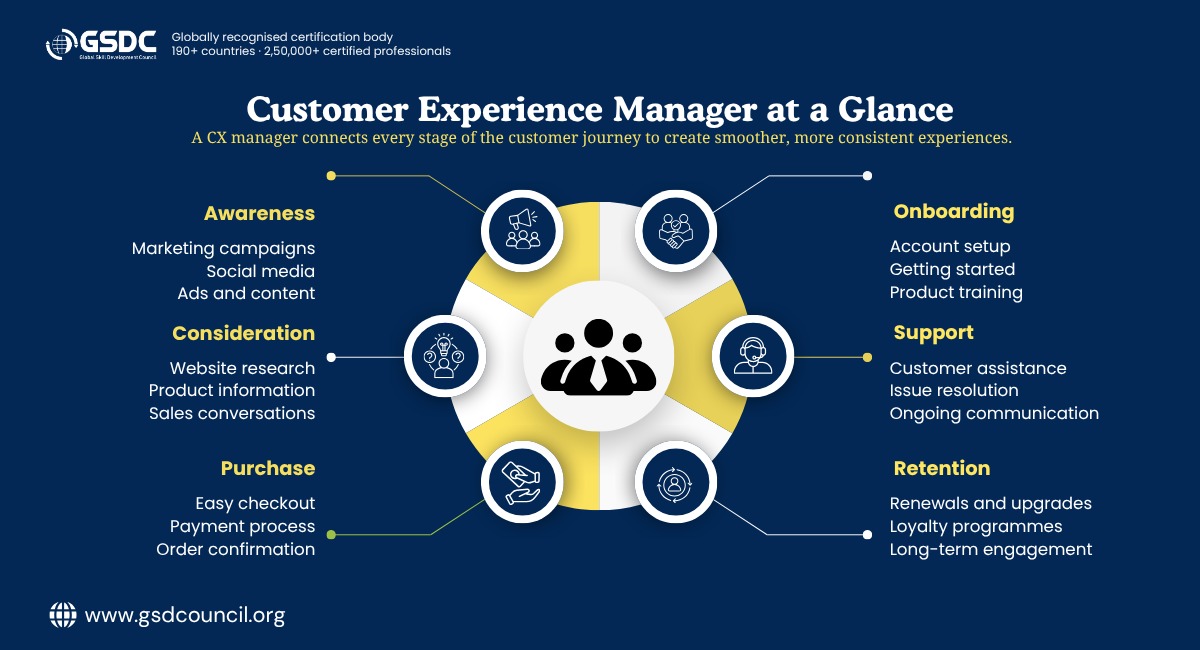
Customer Experience Manager Roles and Responsibilities
Titles and team sizes change from company to company. Still, most customer experience manager roles and responsibilities fall into six buckets.
1. Map the customer journey
They document every touchpoint, from the first ad a customer sees to the renewal email a year later. The aim is to spot where people get confused, frustrated or stuck.
2. Collect customer feedback
They set up surveys, review analysis, interviews and social listening. This is often called a voice of customer (VoC) program.
3. Measure and report
They choose the right customer experience metrics, track them over time and share results with leadership in a way that non-CX people can follow.
4. Fix the friction
They work with product, marketing, sales, support and IT to remove the pain points that the data points to. This is the part that takes the most persuasion.
5. Train and coach teams
They help frontline staff understand what good service looks like and why it matters to the business.
6. Choose and manage tools
They often own the survey platform, CRM reports and feedback dashboards, and they manage agencies or vendors where needed.
Customer Experience Manager Duties in a Typical Week
Here is what customer experience manager duties can look like in real life. This is an example, not a rule, because every company is different.
Day | Typical work |
Monday | Review last week's survey scores and flag anything that dropped |
Tuesday | Meet the support team to go through the top 10 complaint themes |
Wednesday | Workshop with product and design to fix a confusing checkout step |
Thursday | Listen to recorded customer calls and update the journey map |
Friday | Send a short report to leadership with wins, risks and next steps |
Notice how little of this is about answering customers directly. Most of it is about patterns, people and priorities.
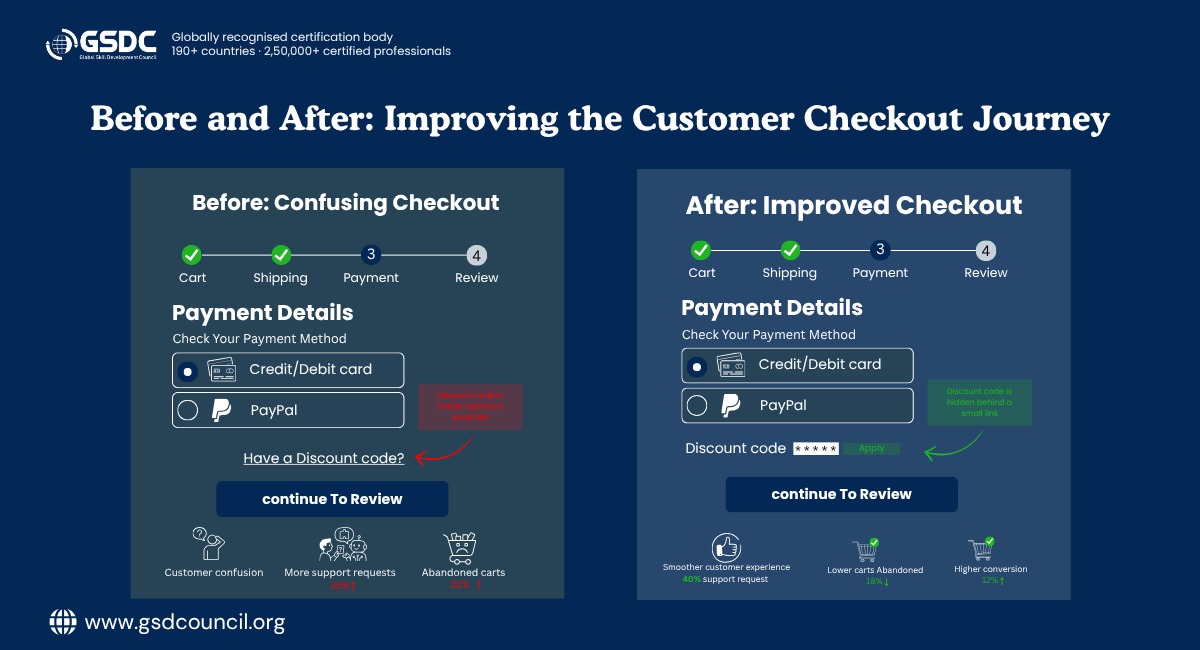
A Real-World Example: Fixing a Confusing Checkout
Here is how the six responsibilities above can come together in one project. This is an illustrative example, not a case study from a specific company.
Spot the problem.
Support keeps getting the same question: "Where do I enter my discount code?" Survey comments mention the same thing, and the checkout page has a high drop-off rate.
Map the journey.
The CX manager walks through checkout step by step and finds that the code box is hidden behind a small link on the last page.
Pick the measures.
They choose two to track: customer effort score for checkout and the cart abandonment rate.
Fix the friction.
They work with design and product to move the code box to a clear spot on the payment step, and brief support on the change.
Measure again.
A few weeks later, they compare effort scores, abandonment and the number of support contacts about discount codes with the numbers from before the change.
Share the result.
They report the before-and-after numbers to leadership in plain language and pick the next problem on the list.
That loop of finding, fixing and measuring is the heart of the job.
Customer Experience Metrics Every CX Manager Tracks
You cannot improve what you cannot see. That is why customer experience metrics sit at the center of this job. Here are the main ones.
Metric | What it tells you | Quick explanation |
Customer Satisfaction (CSAT) | How happy a customer was after a specific interaction | A short survey right after a purchase or support chat |
Net Promoter Score (NPS) | How likely a customer is to recommend you | Measures loyalty over the long term |
Customer Effort Score (CES) | How easy it was to get something done | Best for spotting friction in a process |
First Contact Resolution (FCR) | Whether the problem was solved the first time | Fewer repeat contacts means a smoother experience |
Customer Retention and Churn | How many customers stay or leave | Links CX work directly to revenue |
No single metric tells the full story. A good CX manager uses a mix of them, so one number does not hide a problem that another one would catch.
Customer Effort Score: The Metric That Shows Hidden Friction
Of all these measures, customer effort score gets a lot of attention, and for good reason. It asks one simple question after an interaction: how easy was it to get what you needed?
Many companies use a 7-point scale, where customers say how strongly they agree with a statement like "The company made it easy for me to handle my issue." On this scale, a score of 5 or above is generally seen as positive, as explained in this guide to calculating CES. Always check which scale your survey tool uses, because a "good" score depends on it.
How to calculate customer effort score
There are two common methods:
- Average score: Add up all the ratings and divide by the number of responses.
- Percentage method: Count the share of customers who picked 5, 6 or 7.
Example: Five customers rate their experience 6, 7, 5, 3 and 7. The total is 28. Divide by 5 and you get a customer effort score of 5.6. That is healthy, but the one customer who chose 3 deserves a follow-up.
Why it matters
The idea comes from a study by Matthew Dixon, Karen Freeman and Nick Toman at the Corporate Executive Board (now part of Gartner), published in Harvard Business Review. It covered more than 75,000 people who used contact centers or self-service channels. The finding was simple: how easy a company is to deal with predicts loyalty better than satisfaction scores or NPS. In other words, you do not always need to wow customers. Often, you just need to make things easy.
One thing to watch: CES works best for specific tasks, like a return, a login reset or a delivery query. It is not a replacement for NPS or CSAT. Use it together with them.
Customer Experience KPIs: Turning Data into Goals
Metrics are the raw numbers. Customer experience KPIs are the goals you set against them. For example, "improve CES for returns from 4.8 to 5.5 by the end of Q2" is a KPI.
Here are the KPIs that CX managers commonly report on.
KPI | Simple formula or idea | Why it matters |
CSAT | Satisfied responses (4 or 5) divided by total responses, times 100 | Shows short-term happiness |
NPS | % Promoters minus % Detractors | Shows loyalty and word of mouth |
CES | Total effort ratings divided by number of responses | Shows ease of doing business |
First Contact Resolution | Issues solved on first contact divided by total issues | Shows service efficiency |
Customer churn rate | Customers lost in a period divided by customers at the start | Shows the cost of poor experience |
Repeat purchase rate | Returning customers divided by total customers | Shows real loyalty |
A tip that many beginners miss: pick three to five KPIs, not fifteen. Too many goals and nobody remembers which ones matter.
Choosing and reading the right metrics takes practice, and most people build that skill step by step. Structured training can speed this up, and organisations such as the Global Skill Development Council (GSDC) offer programs that help professionals develop practical, job-ready skills for roles like this one.
Skills a Strong CX Manager Needs
You do not need to be an expert in everything. But these skills come up again and again in job listings.
- Empathy: Seeing the world from the customer's side
- Data comfort: Reading survey results and spotting trends without being a statistician
- Communication: Explaining a customer problem so that engineers and finance teams care about it
- Project management: Keeping fixes on track across several teams
- Influence: Getting things done without direct authority over every department
- Tool knowledge: CRM systems, survey platforms and dashboards
The last point about influence is worth repeating. Many CX managers do not control the teams that cause the friction. Their power comes from evidence and clear storytelling.
Customer Experience Manager Jobs: Where They Exist and Where They Lead
Customer experience manager jobs are found in almost every industry that deals with customers at scale. Common ones include:
- Banking and financial services
- E-commerce and retail
- Telecom
- Healthcare
- Travel and hospitality
- Software and SaaS
- Government and public services
A typical career path
- CX analyst or customer insights executive
- CX specialist or journey manager
- Customer experience manager
- Senior CX manager or Head of CX
- Director or VP of Customer Experience
- Chief Customer Officer or Chief Experience Officer
People arrive from different backgrounds. Some come from customer support, others from marketing, research, UX design or operations. That mix is one reason the field is open to career changers. If you are switching in from another area, a Certified Customer Experience Professional certificate can help show employers that you understand the core ideas, such as journey mapping, CX metrics and customer feedback, even if your past job titles looked different.
Customer Experience Manager Salary
Now for the question many readers have been waiting for: what is the customer experience manager salary?
Please note: the figures below are US estimates. Pay varies by country, city, industry and the scope of the role, so treat them as a reference point and not a promise.
Pay depends on country, industry, company size and how much authority the role has. The table below uses US figures from PayScale, based on 753 salary profiles and last updated in July 2026.
Measure | Figure (USD, US) |
Average base salary | About $76,000 |
Typical base salary range (10th to 90th percentile) | $49,000 to $110,000 |
Entry level (under 1 year), average total pay* | About $55,800 |
Early career (1 to 4 years), average total pay* | About $69,200 |
Total pay includes bonus, tips and overtime, not just base salary. Source: PayScale, 2026. Figures are averages and change with the exact job title, skills and city.
Two things to keep in mind. First, different salary sites define the job differently and use different samples, so you will see different averages. Always compare the job scope and not just the title. Second, outside the US, pay will look different, so check local salary data for your own market before negotiating.
What pushes pay higher?
- Proven results, such as improving retention or reducing complaints
- Owning budget or managing a team
- Experience in high-value industries like banking or technology
- Strong data and reporting skills
- A reporting line that is close to senior leadership
How to Become a Customer Experience Manager
If this role sounds like a fit, here is a practical way to get there.
- Start where customers are: Roles in support, sales, research or operations all teach you what customers struggle with.
- Learn the basics of CX measurement: Understand CSAT, NPS, CES and how to read them.
- Build proof: Run a small project, such as mapping one journey and fixing one problem. A before-and-after result is stronger than any certificate.
- 4. Get a recognised credential. Structured training shows employers that your knowledge is organised and current. The CXPA’s CCXP is one well-known example. The Global Skill Development Council (GSDC) also offers a Certified Customer Experience Professional program, which is a practical option if you want to build job-ready CX skills and show them to employers.
Practise telling the story: The best CX managers explain data in simple words and link it to money, time or risk.

Final Thoughts
So, what does a customer experience manager do? They make a company easier to deal with. They listen, measure, connect the dots between teams and push for fixes that customers actually notice. It is a role that mixes empathy with evidence, which is exactly why businesses value it.

Related Certifications
Frequently Asked Questions
They review customer feedback and survey scores, meet with teams to fix pain points, update customer journey maps and report results to leadership. Most of the day is spent analysing patterns and working with other departments.
A customer service manager leads the team that handles customer requests and complaints. A customer experience manager looks at the whole journey and works to prevent problems before they reach support.
Most employers look for a bachelor's degree in business, marketing, communications or a related field, plus several years of experience in customer-facing, research or operations roles. Certifications and a portfolio of results can set you apart.
It depends on the business, but CSAT, NPS, customer effort score, first contact resolution and churn rate are the most common. Choose a small set that links to your company's goals.
Neither is better in every case. CES is good for finding friction in a specific process, while NPS shows overall loyalty. Most teams use both.
For people who enjoy problem solving, data and working across teams, yes. Demand exists across many industries, and the career path leads to senior leadership roles.
Stay up-to-date with the latest news, trends, and resources in GSDC
If you like this read then make sure to check out our previous blogs: Cracking Onboarding Challenges: Fresher Success Unveiled
Not sure which certification to pursue? Our advisors will help you decide!